By Arun Kumar Saxena — Certified Advanced Career Coach, Founder, MINDSCAN | Published: 10 June 2026
Quick answer: Your career personality is one of six types — Builder, Thinker, Creator, Helper, Leader, or Organizer — based on the scientifically validated RIASEC framework. Take this 2-minute quiz to find yours, and discover the careers that fit how you’re naturally wired.

Key Takeaways:
- There are 6 career personality types, and knowing yours can cut through 90% of career confusion.
- This quick quiz is based on the RIASEC framework — the same model used by the U.S. Department of Labor and top career counsellors worldwide.
- 90% of Indian students pick careers without professional guidance — a personality-first approach flips that statistic.
- Your career personality rarely changes; it is wired into how you think, solve problems, and relate to people.
- Once you know your type, you can shortlist careers, pick the right stream, and stop second-guessing every decision.
Table of Contents:
- Why Most People Pick the Wrong Career
- The Career Personality Quiz: 7 Questions, 2 Minutes
- What Is a Career Personality? (Definition)
- The 6 Career Personality Types Explained
- Career Personality Types at a Glance (Table)
- What to Do After You Know Your Career Personality
- Why Career Personality Testing Works: The Science
- 3 Common Mistakes People Make
- Frequently Asked Questions
- Ready to Find the Career That Fits You?
Why Most People Pick the Wrong Career (And How a 2-Minute Quiz Fixes It)
Board exam results are out, and lakhs of Indian families are making the most expensive mistake of their lives: choosing a stream or course without knowing the student’s career personality. Here is a number that should keep every parent and student up at night: 90% of Indian students choose their careers without any professional guidance. That is not a typo. According to a UN-backed study reported by India Today, only 1 in 10 students receives career advice from a trained professional.
The result? The India Career Confusion Report 2025 found that 73% of students pick the wrong stream after Class 10, and 90% regret their choice within three years. Only 8 out of every 100 graduates end up in a job that matches their degree. These numbers are not just statistics — they represent millions of young people stuck in careers that drain them, simply because nobody asked the right question: who are you, really?

“Your career personality is not a judgment — it is a map. A map only helps if it shows where you really are.”
Your career personality — the way you naturally think, solve problems, and interact with the world — is the single biggest clue to finding work that does not feel like work. When your personality aligns with your career, you are not just more productive; you are happier, more confident, and far less likely to burn out at 30. The good news? Identifying your career personality does not require expensive assessments or weeks of soul-searching. A simple, science-backed quiz can get you started in under two minutes.
Want a professional career personality assessment? Book a 1-on-1 session with Arun on WhatsApp: wa.me/919140604743
The Career Personality Quiz: 7 Questions, 2 Minutes
This quiz is based on the RIASEC model developed by psychologist John Holland — a framework backed by decades of research and used by the U.S. Department of Labor’s O*NET system, Stanford Career Education, and thousands of career counsellors worldwide. For each question, pick the answer that feels most like you, not the one that sounds most impressive.
7 questions · about 2 minutes · no sign-up, no email
For each question, pick the answer that feels most like you, not the one that sounds most impressive. Your result appears at the end of the quiz.
0 of 7 answered
Your career personality type
Optional: help build India’s first public RIASEC study
Most Indian students end up in a stream that has nothing to do with what suits them. Nobody has published the numbers. Three optional questions, no name, no email, no phone. Skip it and nothing at all is sent.
Thank you. Your answers were added anonymously. Nothing that identifies you was sent.
Nothing leaves this page unless you press the button above. No name, email, phone or IP address is collected. This is a self-assessment, not a clinical psychometric test — use it to start the conversation, not to close it.

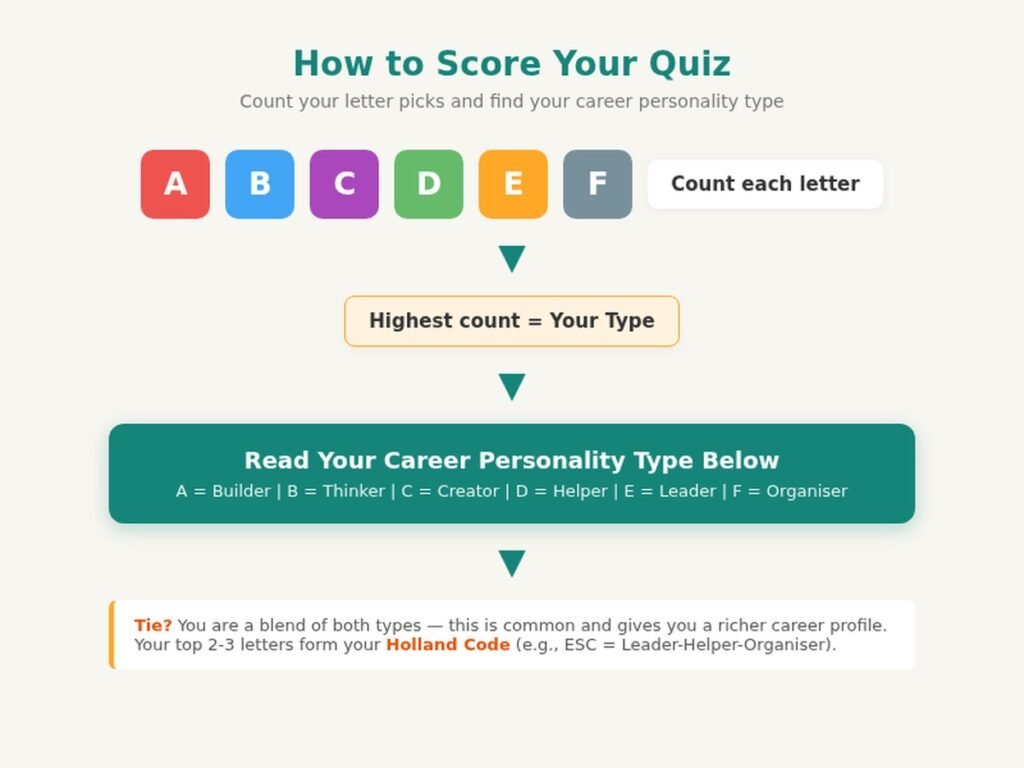
How Your Score Is Calculated
The quiz counts how many times you chose each letter, A through F. The letter you picked most often is your dominant career personality type. If two letters tie, you are a blend of both — which is very common and actually an advantage. Your result is shown to you the moment you answer the seventh question, so there is nothing to write down. Read your type below, and if you tied, read both of them.
What Is a Career Personality? (Definition)
Definition: A career personality is your natural pattern of interests, work preferences, and problem-solving style that determines which careers will keep you motivated and fulfilled. It is measured using the RIASEC model — six types (Realistic, Investigative, Artistic, Social, Enterprising, Conventional) developed by psychologist John Holland. Your career personality is stable from your late teens onward and does not change with age.
Think of it this way: your career personality is to your work life what your blood type is to medicine. It does not determine everything, but ignoring it leads to mismatched transfusions — or in this case, mismatched careers. The Holland personality types have been used by career professionals for over 60 years, and the framework is the backbone of the O*NET occupational classification system that categorises every job in the American economy.
What does RIASEC stand for? RIASEC is an acronym for the six Holland career personality types: Realistic (Builder), Investigative (Thinker), Artistic (Creator), Social (Helper), Enterprising (Leader), Conventional (Organiser). Your top two or three letters form your “Holland Code” — for example, ESC means you are primarily Enterprising-Social-Conventional.
The 6 Career Personality Types Explained
The RIASEC model, developed by psychologist John Holland in the 1950s and refined over decades, identifies six fundamental personality types that shape how we work, communicate, and find meaning. According to a study published in the National Library of Medicine, the RIASEC model remains one of the most validated frameworks for matching people to work environments. Most people are a blend of two or three types, but one usually dominates. Here is what each type looks like in the real world, especially in the Indian context.

Type 1: The Builder (Realistic) — Letter A
Builders are doers. They learn best by getting their hands dirty and figuring things out through action, not theory. They value tangible results — things they can touch, see, and point to as proof of their effort. In India, Builders often gravitate toward engineering, surgery, architecture, agriculture, and the armed forces, but they also thrive in trades like carpentry, welding, and mechanics that are massively undervalued despite offering excellent earning potential.
The biggest mistake Builders make? Choosing a desk job because it sounds more “respectable.” I have coached dozens of students who were miserable in pure software roles but came alive when they switched to robotics, hardware engineering, or sports science. If you are a Builder, you need movement, tools, and real-world problems. A career that keeps you at a screen all day will slowly drain your energy, no matter how well it pays.
Top careers in India: Mechanical Engineer, Civil Engineer, Surgeon, Pilot, Agricultural Scientist, Sports Coach, Electrician, Architect
Strengths: Practical problem-solving, physical stamina, comfort with tools and machines, ability to stay calm under pressure
Watch out for: Getting bored in purely theoretical or administrative roles; undervaluing your hands-on skills
Type 2: The Thinker (Investigative) — Letter B
Thinkers are driven by curiosity. They do not just want to know what happened — they need to understand why. They are happiest when they can dig deep into a problem, analyse data, and uncover patterns nobody else sees. In India, Thinkers often find their way into research, data science, medicine, forensic science, and academia. The explosion of data analytics and AI has opened up massive opportunities for Thinkers who might previously have been pushed into engineering by default.
The trap for Thinkers in India is the pressure to “just get a job” instead of pursuing research or specialisation. I once worked with a student whose parents insisted on an MBA, but her RIASEC profile was overwhelmingly Investigative. She switched to a master’s in bioinformatics and is now thriving at a genomics startup in Bangalore. When Thinkers are given the space to explore, they become irreplaceable.
Top careers in India: Data Scientist, Research Scientist, Doctor, Forensic Analyst, Pharmacologist, Academic Researcher, AI/ML Engineer
Strengths: Analytical thinking, attention to detail, persistence in solving complex problems, intellectual independence
Watch out for: Overthinking decisions; analysis paralysis; dismissing practical constraints as “details”
Type 3: The Creator (Artistic) — Letter C
Creators need self-expression the way most people need oxygen. They chafe under rigid rules and flourish when they can innovate, imagine, and make something that did not exist before. India’s creative economy is booming — from UX design and animation to content creation and filmmaking — yet many Creators are pushed into commerce or engineering because those paths sound “safer.” The result? A generation of frustrated accountants who should have been designers.
If you are a Creator, do not let anyone tell you that creative careers are risky. India’s digital content market is projected to cross USD 5 billion, UX design roles have grown over 300% in five years, and independent creators on YouTube and Instagram are building seven-figure businesses. The risk is not in choosing creativity — it is in suppressing it for 40 years in a job that makes you miserable.
Top careers in India: UX/UI Designer, Filmmaker, Writer/Author, Graphic Designer, Musician, Animator, Content Creator, Art Director
Strengths: Original thinking, emotional intelligence, adaptability, ability to see connections others miss
Watch out for: Dismissing structure entirely; struggling with routine tasks; undisciplined creativity that never ships
Type 4: The Helper (Social) — Letter D
Helpers are wired to make a difference in people’s lives. They are the friends everyone calls during a crisis, the colleagues who always check in, and the professionals who remember that behind every case, file, or student is a human being. In India, Helpers naturally gravitate toward teaching, counselling, nursing, social work, and human resources. These roles are often underpaid relative to their impact, but they offer something money cannot buy: the deep satisfaction of knowing your work matters to someone.
The challenge for Helpers is boundary-setting. I see many Helpers — especially women — who pour themselves into caring for others while neglecting their own career growth. If you are a Helper, remember that investing in your skills and negotiating fair compensation is not selfish; it is what allows you to help more people, more effectively, for longer. A counsellor who earns well can serve 50 clients a month instead of 10.
Top careers in India: Teacher, Career Counsellor, Nurse, Social Worker, HR Manager, Psychologist, Special Educator, Community Health Worker
Strengths: Empathy, communication, patience, ability to build trust, conflict resolution
Watch out for: Burnout from over-giving; difficulty making tough decisions that might disappoint others
Type 5: The Leader (Enterprising) — Letter E
Leaders are persuaders. They see opportunities where others see obstacles, and they have the drive and charisma to rally people around a vision. In India’s startup ecosystem — the third largest in the world — Leaders are in their element. But enterprising does not just mean entrepreneurship. It means any career where you influence, sell, negotiate, or build something from nothing: corporate law, marketing, politics, sales leadership, and venture capital are all natural fits.
The biggest pitfall for Leaders is confusing confidence with competence. Many Leaders leap before they look, take on too much risk, or ignore the details that bring down grand plans. I have seen brilliant young Leaders crash because they skipped the boring work of financial planning, market research, or legal compliance. If you are a Leader, pair your vision with a strong Thinker or Organiser co-founder, and you become nearly unstoppable.
Top careers in India: Entrepreneur, Marketing Director, Corporate Lawyer, Sales VP, Politician, Venture Capitalist, Business Consultant
Strengths: Persuasion, risk-taking, strategic thinking, energy, ability to inspire teams
Watch out for: Impatience with detail; overcommitting; dismissing cautious input as negativity
Type 6: The Organiser (Conventional) — Letter F
Organisers are the people who keep the world running. They bring order to chaos, build the systems that others rely on, and find satisfaction in precision, efficiency, and reliability. In India, Organisers are the backbone of banking, compliance, project management, and government administration. Every startup that scales from 10 people to 1,000 needs Organisers to build the processes that make growth possible.
Organisers are often the most under-appreciated personality type, especially in a culture that celebrates visible leadership and creative flair. But here is the truth: without Organisers, nothing ships on time, nothing stays legal, and nothing scales. If you are an Organiser, do not let anyone make you feel like your systematic approach is “boring.” It is the exact quality that makes companies profitable and institutions functional. Some of the highest-paid professionals in India — chartered accountants, compliance heads, and operations VPs — are Organisers.
Top careers in India: Chartered Accountant, Project Manager, Banking Professional, Compliance Officer, Operations Manager, Data Entry Supervisor, Auditor
Strengths: Organisation, reliability, attention to detail, ability to create and maintain systems, consistency
Watch out for: Rigidity when rules need bending; discomfort with ambiguity; undervaluing your contribution because it lacks “glamour”
Career Personality Types at a Glance
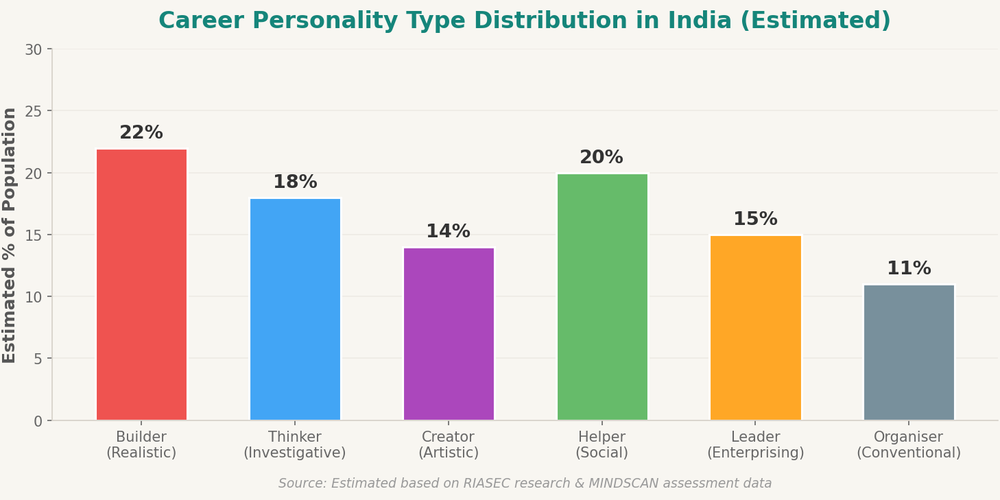
What to Do After You Know Your Career Personality
Finding your type is the starting line, not the finish line. Here is exactly what to do next, whether you are a student choosing a stream, a parent guiding your child, or a working professional thinking about a switch.

If You Are a Student (Class 10-12)
- Match your stream to your type: Builders and Thinkers often thrive in Science, Creators in Arts or Design, Organisers in Commerce, Leaders in Business Studies, and Helpers in Humanities or Psychology. But these are starting points, not rules — a Helper can be a brilliant doctor and a Builder can excel in business.
- Use your type to shortlist 5-8 specific careers instead of browsing hundreds aimlessly. If you are a Creator, research UX design, animation, and content strategy — not chartered accountancy.
- Talk to a career counsellor who uses scientific assessments (like RIASEC or psychometric tests) rather than only aptitude scores. MINDSCAN’s assessments combine personality mapping with aptitude analysis for a complete picture.
If You Are a Parent

- Before pushing your child toward engineering or medicine, find out their career personality type. An 18-year-old Builder might hate a desk job in IT but thrive in robotics or sports science.
- Resist the urge to impose your own career personality on your child. A Leader parent often cannot understand why their Organiser child prefers structure over risk — and vice versa.
- A professional assessment costs less than one semester of the wrong course. According to NCERT data, only 13.2% of Indian students receive professional career guidance — be in that 13%.
If You Are a Working Professional

- Your career personality does not change just because you took a job that does not match it. If you are a Creator stuck in accounting, or a Leader stuck in compliance, the mismatch will eventually show up as burnout, disengagement, or a string of job changes.
- You do not always need to quit. Sometimes a lateral move within your company — from operations to business development, or from coding to product management — can align your personality with your role.
- If you are considering a full career switch, validate your type with a professional psychometric assessment first. The investment of a single session with a career coach can save you years of trial and error.
“The risk isn’t in choosing creativity — it’s in suppressing who you are for 40 years in a job that makes you miserable.”
Confused about your next career move? Let’s talk. WhatsApp Arun at wa.me/919140604743 for a personalised career personality session.
Why Does Career Personality Testing Work? The Science Behind RIASEC

The RIASEC model is not a pop-psychology internet quiz. It is one of the most widely researched frameworks in vocational psychology. John Holland first proposed the theory in 1959, and it has been validated across cultures, industries, and decades of follow-up research. A 2023 peer-reviewed study in the National Library of Medicine confirmed that person-environment fit — matching personality type to work environment — significantly predicts job satisfaction, performance, and retention.
Psychometric tests built on the RIASEC framework have a reliability rate exceeding 85% in measuring personality traits and abilities. The U.S. Department of Labor uses RIASEC as the backbone of its O*NET system, which classifies every occupation in the American economy by personality type. In India, platforms like MINDSCAN integrate RIASEC-based personality mapping with aptitude analysis to give students and professionals a comprehensive career profile.
The key insight is simple: people flourish when their work environment matches their personality. When it does not, they underperform, disengage, or leave. One size does not fit all — and the RIASEC model gives you a scientifically grounded way to find your size.
3 Common Mistakes People Make with Career Personality Tests
Even the best tool is useless if you use it wrong. Here are the three mistakes I see most often in my coaching practice, and how to avoid them.
Mistake 1: Answering as the Person You Want to Be, Not the Person You Are
Many people choose answers that reflect their aspirational self — the confident leader they wish they were, or the creative genius they admire. But the quiz only works if you answer honestly about what you actually do, feel, and prefer when nobody is watching. Your career personality is not a judgment; it is a map. A map only helps if it shows where you really are.
Mistake 2: Treating Your Result as a Life Sentence
Your RIASEC type is a dominant tendency, not a cage. A Builder can learn to present in meetings. A Creator can develop organisational skills. A Thinker can lead a team. The point is not that you can only do one thing — it is that you will be happiest and most effective when your core work aligns with your natural wiring. Use your type as a compass, not a straitjacket.
Mistake 3: Skipping Professional Validation
A self-scored quiz is a starting point, not a diagnosis. If you are making a major decision — choosing a stream, switching careers, investing in a degree — validate your self-assessment with a professional psychometric test and a qualified career counsellor. The 10 minutes you spend on a free quiz can open your eyes, but the 60 minutes you spend with a professional can change your life. In my practice at MINDSCAN, I have seen students whose self-assessment changed significantly after a structured psychometric evaluation — because the professional test removes wishful thinking and social pressure from the equation.
Frequently Asked Questions About Career Personality
What is a career personality type?
A career personality type is a categorisation of your natural interests, strengths, and work preferences based on established psychological frameworks like the RIASEC model. It tells you what kind of work environment and tasks will keep you motivated and fulfilled, so you can choose a career that fits who you actually are — not who others expect you to be.
Is the RIASEC model scientifically valid?
Yes. The RIASEC model has been validated in over 60 years of research, including peer-reviewed studies published in the National Library of Medicine. It is the framework behind the U.S. Department of Labor’s O*NET system and is used by career counsellors, universities, and Fortune 500 companies worldwide. Psychometric tests based on RIASEC have reliability rates exceeding 85%.
Can my career personality change over time?
Your core career personality tends to remain stable throughout your life because it is rooted in how you naturally think and process the world. However, your skills, interests, and confidence can grow. You might discover new aspects of your personality as you gain experience, but your dominant type usually stays consistent from your late teens onward.
What if I score equally on two or three types?
That is completely normal and actually common. Most people are a blend of two or three types. Your top two or three letters form your “Holland Code” (for example, E-S-C means Enterprising-Social-Conventional). This combination gives you a richer, more specific career profile than a single type alone. A career counsellor can help you interpret your unique blend.
How is a career personality quiz different from an aptitude test?
An aptitude test measures your current abilities — numerical, verbal, logical, and so on. A career personality quiz measures your natural interests and work style preferences. Both are important. Aptitude tells you what you can do; personality tells you what you will enjoy doing. The best career decisions combine both, which is exactly what MINDSCAN’s dual-assessment approach does.
Is this quiz useful for working professionals, or only students?
Absolutely useful for professionals. Career personality does not expire at age 25. If you are considering a job change, feeling stuck, or wondering why your current role drains you, knowing your RIASEC type can explain why — and point you toward roles that fit better. I regularly coach professionals in their 30s and 40s who discover their type for the first time and finally understand years of career dissatisfaction.
Ready to Find the Career That Actually Fits You?
You just took the first step. Now take the one that matters most. Whether you are a student choosing your stream, a parent helping your child, or a professional ready for a change, a personalised career personality assessment with a qualified coach can turn your quiz result into a concrete action plan.
“I was about to enrol for engineering because everyone said so. One session with Arun showed me I’m a Creator, not a Builder. I switched to design and I’ve never looked back.” — Priya, 19, Bangalore
Book your career personality session now on WhatsApp: wa.me/919140604743
Explore MINDSCAN’s scientific career assessments: www.mindscan.in
Read more career guidance on Arun’s blog: arunkumarsaxena.com

More career guides for students, parents and professionals in the Blog.
This quiz points you in a direction in a few minutes. The full version goes considerably further: MINDSCAN’s 75-minute assessment with a counselling session is ₹2,999 and covers 14 skills, 10 interest areas and 20+ career groups.