This guide for CBSE Board Exams 2026 is designed to help students and parents follow a clear, stress-free strategy to score 95%+
Scoring 95%+ in CBSE Board Exams 2026 is not about studying endlessly, memorizing blindly, or following random advice from the internet. It is about following a clear, exam-aligned system that matches how CBSE actually sets question papers and evaluates answers today.
Every year, I work with capable students who study sincerely but still fall short of their potential. The reason is almost always the same: lack of structure, incorrect prioritisation, and poor execution, not lack of intelligence.
This pillar guide is designed to give students and parents:
- A complete preparation roadmap
- A realistic daily study timetable
- Subject-wise clarity
- Answer-writing strategies that fetch marks
- Official CBSE resources (no guesswork)
- A calm, confident approach to boards
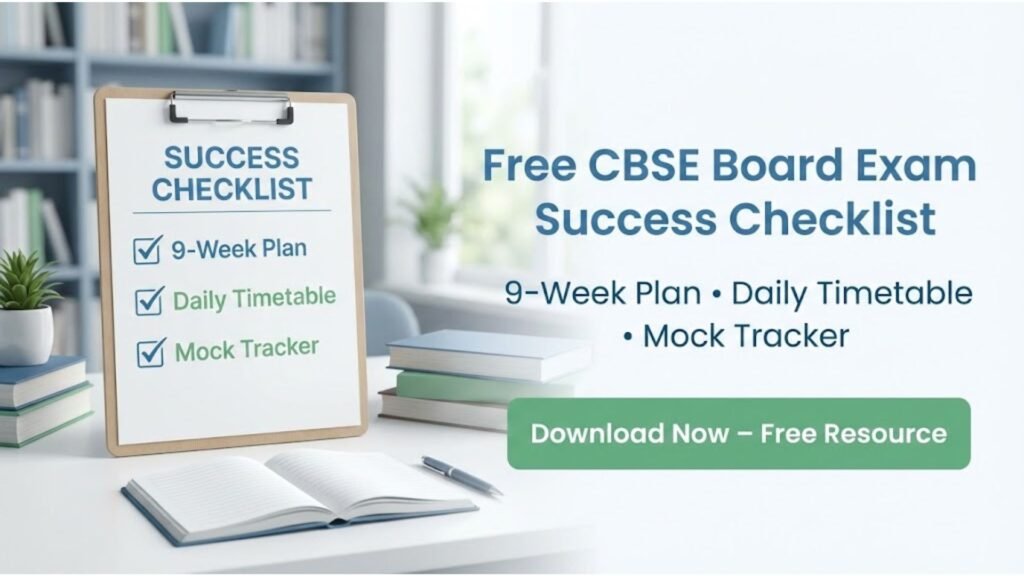
Before You Begin — Download the Free CBSE Board Exam Success Checklist
Before you go deeper into this guide, pause for a moment.
Reading strategies is useful.
Implementing them daily is what changes results.
To help students stay consistent, I have created a free, one-page CBSE Board Exam Success Checklist, which includes:
- A 9-week preparation roadmap
- A 4–6 hour daily timetable template
- A mock test & revision tracker
- A ready-to-use Error Log format
- Final exam-day dos and don’ts
👉 Download the FREE CBSE Board Exam Success Checklist here
In my coaching experience, students who track their preparation perform significantly better than those who only “study hard” without monitoring progress.
CBSE Board Exams 2026 — What Has Changed and Why Old Methods Fail
CBSE board exams today are very different from what they were a decade ago.
Through its official curriculum documents, sample question papers, and marking schemes, CBSE has clearly indicated a shift towards:
- Conceptual clarity
- Application-based thinking
- Structured answer presentation
Preparing with outdated, memory-heavy methods often leads to:
- Loss of marks despite knowing answers
- Panic during case-based questions
- Poor time management
What CBSE Rewards Today
- Clear understanding of NCERT concepts
- Ability to apply concepts to new situations
- Neat, structured answers with keywords
- Performance under exam-like conditions
The 9-Week Preparation Plan for CBSE Board Exams 2026
High scorers do not study randomly. They follow phases, each with a clear objective.
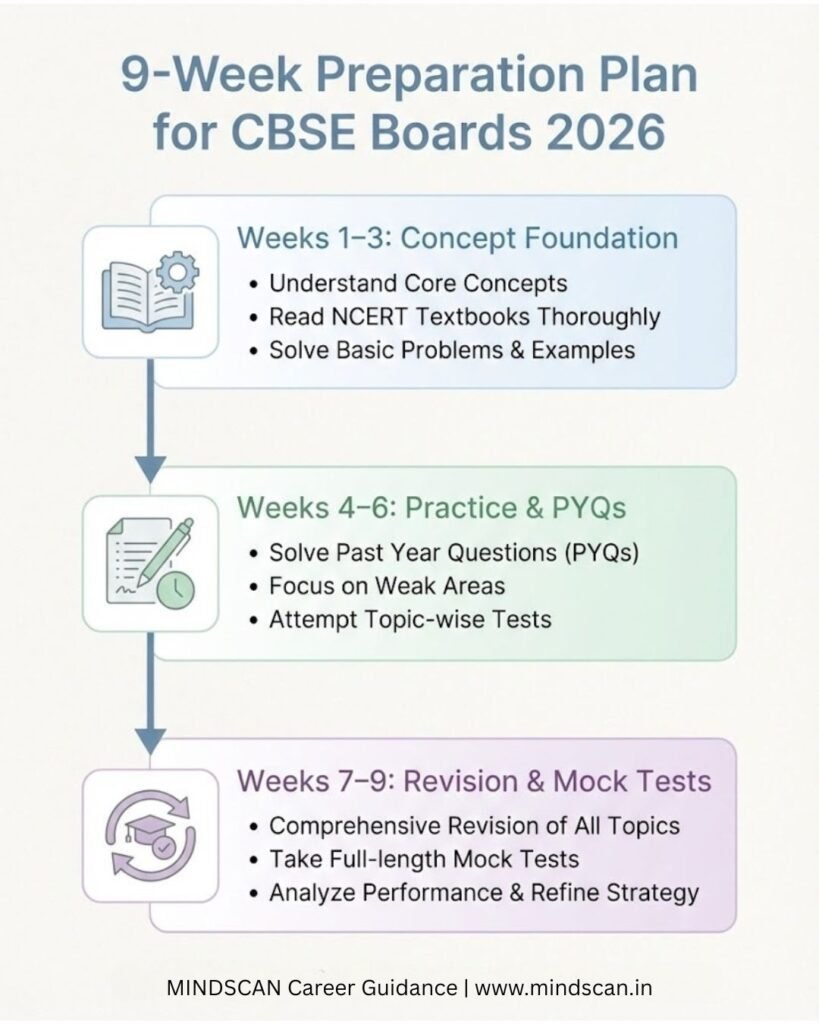
Phase 1 (Weeks 1–3): NCERT Concept Foundation
- Read NCERT line by line
- Make short notes in your own words
- Solve all in-text and exercise questions
- Identify weak chapters early
In my coaching experience, students who master NCERT concepts first reduce stress drastically during revision.
Phase 2 (Weeks 4–6): Practice + PYQs + Sample Papers
- Solve Previous Years’ Question Papers
- Practice official CBSE Sample Question Papers
- Focus on case-based and competency questions
- Begin daily answer-writing practice
- Maintain an Error Log
Phase 3 (Weeks 7–9): Revision + Mock Tests
- 2–3 full-length mock tests per week
- Revise only from notes and Error Log
- Focus on speed, accuracy, and presentation
Daily Study Timetable That Prevents Burnout (4–6 Hours)
Long study hours are unsustainable.
Structured routines deliver results.
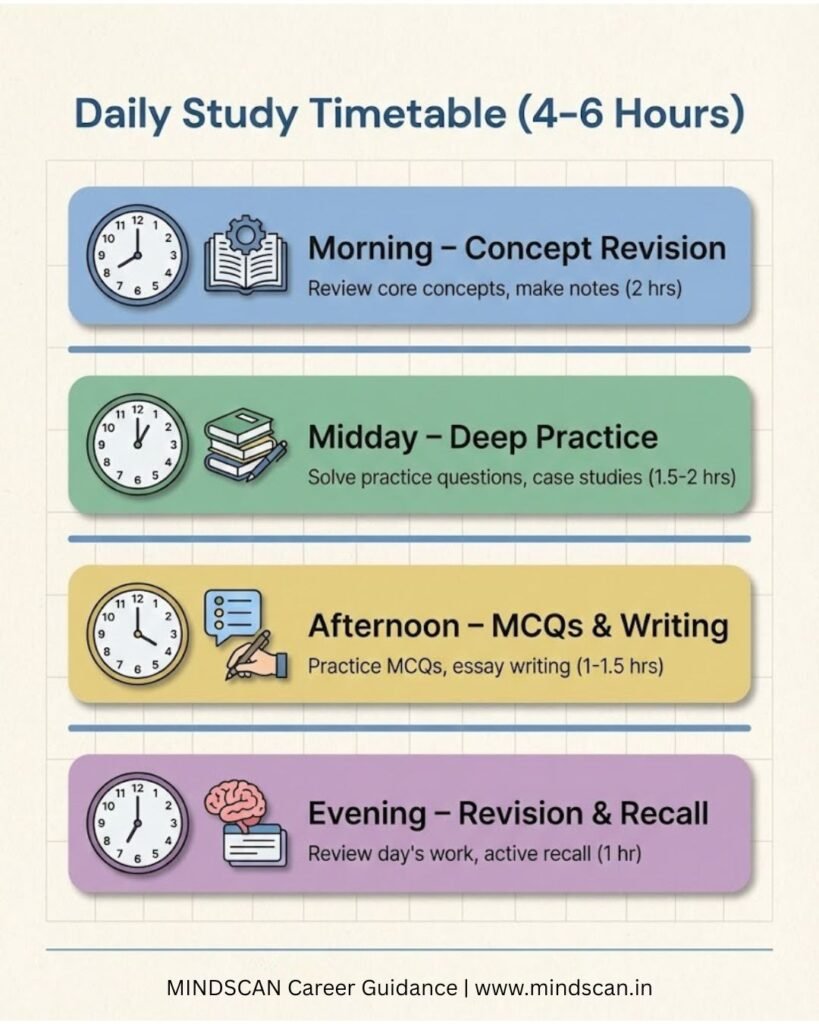
Morning (60–90 minutes): Concept Revision
- NCERT reading
- Theory-based subjects
Afternoon (60 minutes): Practice
- MCQs
- Short answers
- Assertion–reason questions
Evening (60 minutes): Recall & Memory Lock
- Mind maps
- Formula revision
- Self-testing
In my coaching experience, students following a balanced 4–6 hour plan outperform exhausted 10-hour learners.
Subject-Wise Strategy to Score High
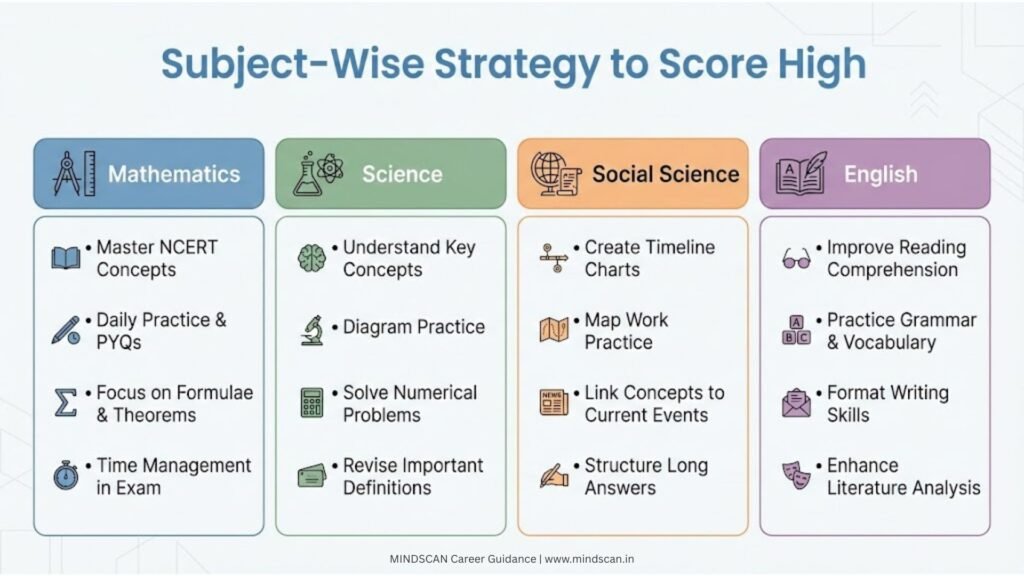
Mathematics
- Daily formula revision
- Step-wise solutions
- Time-bound practice
Science
- Diagrams with proper labels
- Numericals + reasoning
- NCERT examples are essential
Social Science
- Structured answers (Intro–Points–Conclusion)
- Maps, timelines, flowcharts
- Keywords underlined
English / Languages
- Fixed formats for writing sections
- Reading comprehension speed
- Vocabulary refinement
Answer Writing Mastery — The Silent 10% That Decides Ranks
Many students lose marks despite knowing the answer.
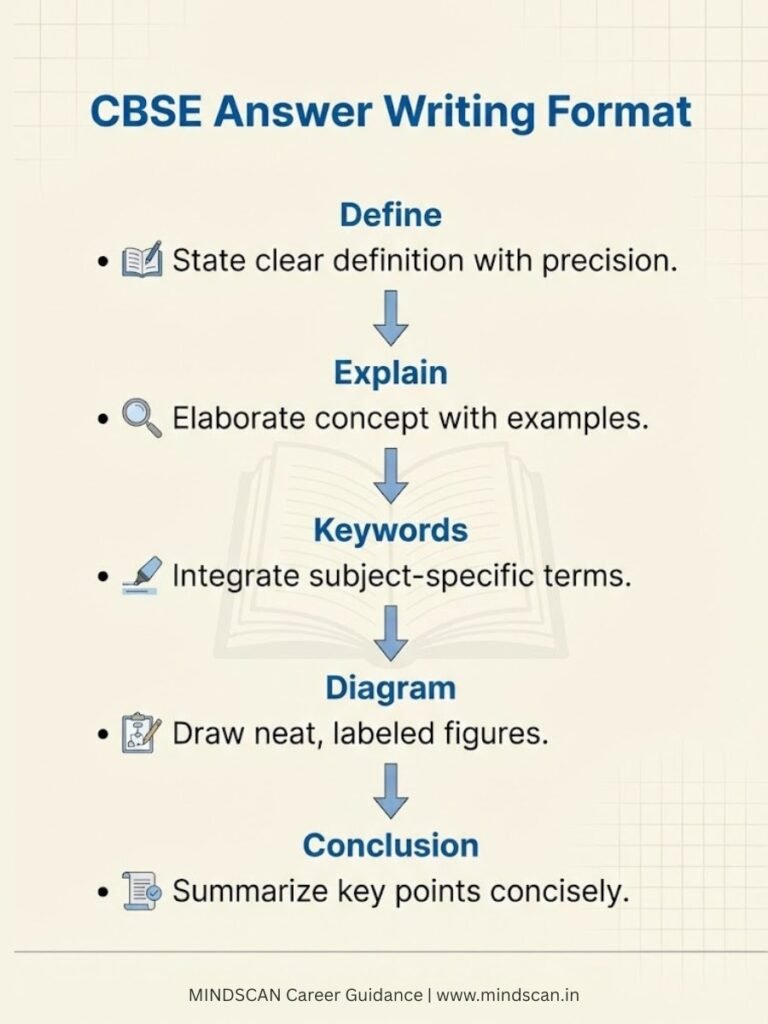
Marker-Friendly Answer Format
- Start with a direct definition
- Use headings and bullet points
- Underline keywords
- Add diagrams where relevant
- Respect word limits
The Error Log Method
Maintain a notebook with:
- Question type
- Mistake made
- Correct approach
- One reminder sentence
In my coaching experience, students who maintain an Error Log rarely repeat mistakes.
Mock Tests, Revision & Final Month Strategy
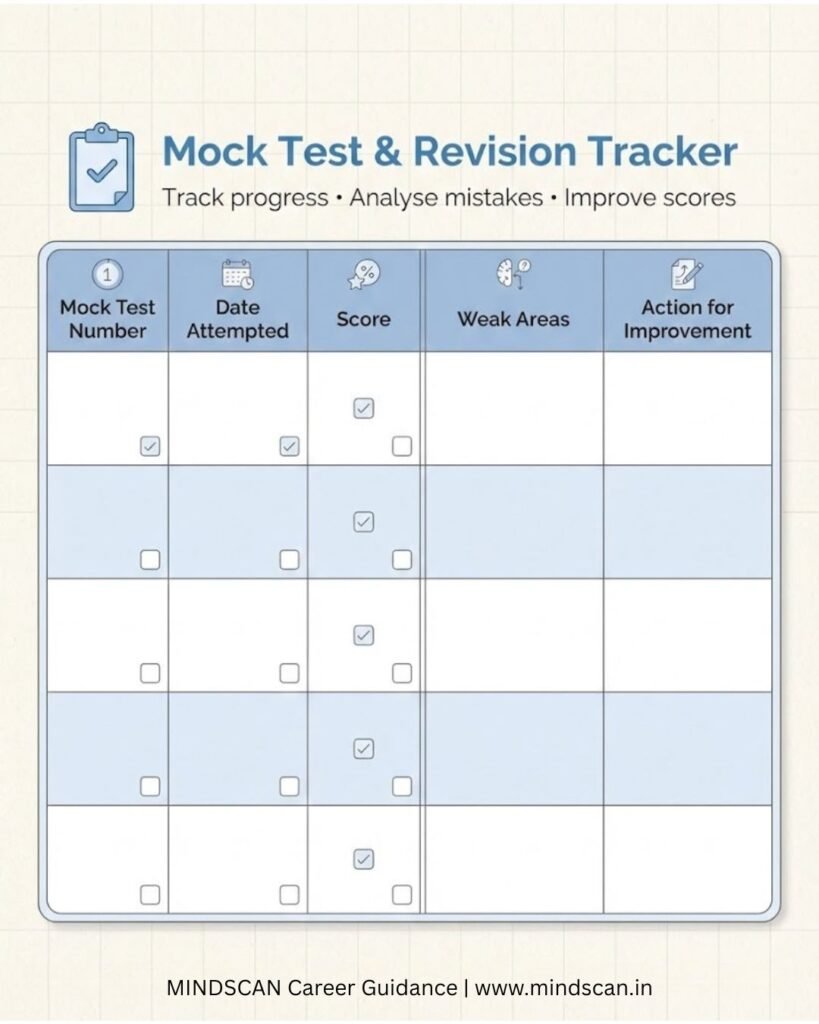
How Many Mock Tests Are Enough
- Minimum 10–12 full-length mocks
- Analyze every test thoroughly
- Improve weak areas systematically
Final 30-Day Revision Split
- 60% weak areas
- 40% strong areas
Use Official CBSE Resources Wisely (Do Not Ignore Them)
Every serious C/BSE student must rely on official CBSE resources, not random internet advice.
Official CBSE Links
- Sample Question Papers & Marking Schemes
Download - CBSE Academic Portal (Curriculum & Syllabus)
Download
Frequently Asked Questions (FAQs)
Can an average student score 95% in CBSE Boards 2026?
Yes. With structure, consistency, and exam-aligned preparation, many average students outperform high-pressure toppers.
Is NCERT enough for CBSE boards?
NCERT is the foundation. Sample papers, PYQs, and mock tests are essential for 95%+.
When should serious preparation begin?
Ideally 8–10 months before exams, but even 3–4 months with discipline can deliver strong results.
A Final Word to Students and Parents
Board exams are not just an academic test—they are a test of discipline, emotional balance, and clarity under pressure.
Marks do not come from panic or comparison.
They come from clarity, consistency, and confidence.
Follow a system, trust the process, and protect your mental well-being.
When preparation is calm and structured, results follow naturally.
Your Next Step
- Download the CBSE Board Exam Success Checklist
- Follow the weekly plan
- Maintain an Error Log
- Stay consistent
— Arun Kumar Saxena
Career Coach | Education Mentor
Founder, MINDSCAN
Web