
10th Class All Subjects: Complete List Explained
By Arun Kumar Saxena, Certified Advanced Career Coach · Updated October 2026
Quick facts: The 10th class all subjects list is the complete set of 5 compulsory CBSE Class 10 subjects, two languages, Mathematics, Science and Social Science, plus 1 optional skill subject, an optional 6th academic subject, and 3 school-graded internal subjects, with each core subject assessed on an 80 marks board exam + 20 marks internal assessment pattern.
Quick answer: The 10th class all subjects list is the complete set of compulsory, optional and internally assessed subjects a CBSE Class 10 student takes. CBSE Class 10 has 5 compulsory subjects: two languages, Mathematics, Science and Social Science. Students may add an optional skill subject and a 6th academic subject.
CBSE Class 10 subject count and pattern: 5 compulsory subjects (two languages, Mathematics, Science, Social Science) + 1 optional skill subject + 3 internal subjects (Art Education, Health and Physical Education, Work Education). Each core subject is assessed on an 80 marks board exam + 20 marks internal assessment. The best five subjects count for the percentage.
10th class all subjects at a glance (2026-27)
- 5 compulsory subjects: two languages, Mathematics, Science and Social Science
- 1 optional skill subject: Information Technology, Artificial Intelligence, Financial Literacy, Retail, Marketing and more
- 1 optional 6th academic subject, where the school offers it
- 3 internal subjects: Art Education, Health and Physical Education, Work Education (school-graded, no board exam)
- Board pattern: 80 marks board exam + 20 marks internal assessment per core subject
- Best five subjects count for the percentage
Source: CBSE Class 10 curriculum 2026-27, accessed October 2026.
Pick a subject to see its details
| Subject | What It Covers | Key Choice |
|---|---|---|
| Select a subject above to see its details. | ||
Source: CBSE Class 10 curriculum 2026-27, accessed October 2026.
Every year, I meet families who treat the 10th class all subjects list as just a set of exams to pass. They focus only on the board result and forget that these subjects are the first real data point about a student’s strengths. The 10th class all subjects list is not a random collection. It is a mirror that shows you where your child thinks clearly and where they struggle, and that mirror should guide the Class 11 stream decision.
With 22 years of experience and 20,000+ students and professionals guided, I have seen how the right subject choices in Class 10 open doors and how the wrong ones close them quietly. This page walks you through every subject in the 10th class all subjects list, the hidden choices inside each one, and the honest link between what you study now and where you can go next.
Table of Contents
How many subjects are there in 10th class?
As per the official CBSE Class 10 curriculum 2026-27 (accessed October 2026), CBSE Class 10 has 5 compulsory subjects that every student must take for the board examination. These are two languages, Mathematics, Science and Social Science. On top of these, a student may add an optional skill subject and, in some schools, a 6th academic subject. Three internal subjects are assessed by the school and do not appear in the 80-mark board pattern.
The 5 main subjects form the core of the 10th class all subjects list. The optional skill subject, if chosen wisely, can reduce exam pressure under CBSE’s best-of-five rule. The internal subjects are mandatory but graded separately. Do not ignore them entirely. A low internal grade can pull down confidence even if it does not affect the board percentage.
Many parents ask me whether taking an extra subject helps. My answer is simple. Take it only if the child has genuine interest and bandwidth. An extra subject that drags down performance in the 5 core subjects is a net loss. The 10th class all subjects list is already demanding enough for most students.
What are the main subjects in 10th class all subjects list?
The 10th class all subjects list covers English, a second language, Mathematics, Science and Social Science. English is compulsory as Language 1 in almost every CBSE school. The second language is usually Hindi, offered as Course A or Course B, though schools may also offer Sanskrit, a regional language or a foreign language. Science is taught as one combined paper covering Physics, Chemistry and Biology. Social Science is also a single paper split into History, Geography, Political Science and Economics.
English includes the First Flight textbook for prose and poetry and Footprints Without Feet as the supplementary reader. Hindi Course A uses Kshitij and Kritika, while Course B uses Sparsh and Sanchayan, plus grammar in both cases. Mathematics is offered at two levels, Standard and Basic, a choice I explain in detail below. Science and Social Science have no internal splits at the board level, but you must study all four units in each because the paper draws from all of them.
Understanding what each subject actually contains is the first step. The second step, and the one most families skip, is understanding what each subject says about the student. A child who writes clear, structured answers in Social Science but freezes in Mathematics is giving you a signal. The 10th class all subjects list is not just a timetable. It is a pattern of strengths and gaps.
What is the difference between Mathematics Standard and Basic?
Mathematics Standard is for students who want to continue Mathematics in Class 11. Mathematics Basic is for those who are certain they will drop Mathematics after Class 10. The syllabus is identical for both levels. Only the question paper differs, with Standard testing deeper application and Basic sticking to simpler, direct problems.
This choice is one of the most consequential decisions hidden inside the 10th class all subjects list. Choose Standard unless you have a clear, tested reason to drop Mathematics. Standard keeps both the Science stream and the Commerce stream open in Class 11. Basic closes the Mathematics door and, with it, many career paths. If you choose Basic and later change your mind, CBSE does offer a compartment route to switch to Standard, but it adds stress and time.
I often see families pick Basic out of fear. The child scored low in a class test, so the parent decides Maths is not for them. Fear is not data. Before you decide, look at the full year’s performance, not one bad test. Talk to the school teacher. And connect the choice to your Class 11 stream goal. The Mathematics level you pick in the 10th class all subjects list is a career decision, not just an exam decision.
How to decide Mathematics Standard vs Basic in 4 steps
- Check the full year’s Mathematics performance, not one test.
- Talk to the school Mathematics teacher about the child’s actual level.
- Decide the target Class 11 stream before locking the level.
- Choose Standard unless there is a clear, tested reason to drop Mathematics.
What is the difference between Hindi Course A and Course B?
Hindi Course A is literature-heavy, built around the Kshitij and Kritika textbooks. It suits students who enjoy reading, analysing and writing about prose and poetry. Hindi Course B is more practical, using Sparsh and Sanchayan, and places greater weight on grammar and functional language use. Both carry equal marks in the board exam.
The choice usually depends on what your school offers and your comfort with Hindi literature. If the school offers only one course, the decision is made for you. If both are available, pick based on the child’s natural bent. A student who reads Hindi stories for pleasure will find Course A engaging. A student who treats Hindi as a functional second language may find Course B lighter and more scoring.
This choice also matters for the overall 10th class all subjects list because the second language score often acts as a percentage booster under the best-of-five rule. Do not treat it as a throwaway subject. A strong score in Hindi can lift the aggregate, and a weak score can pull it down, sometimes affecting stream cut-offs in schools that use overall percentage for admission.
How is the Class 10 exam pattern structured for each subject?
Every main subject in the 10th class all subjects list is evaluated out of 100 marks. As per the CBSE curriculum document (accessed October 2026), the board examination carries 80 marks, and the school’s internal assessment carries 20 marks. This 80+20 split applies uniformly to all 5 core subjects. The internal assessment includes periodic tests, notebook submission, subject enrichment activities and, for Science, practical work.
The 20-mark internal component is not a formality. Schools assess it seriously, and CBSE moderates the marks. A student who neglects internal assessment can lose marks that are relatively easy to earn. The board paper tests knowledge under time pressure. The internal assessment tests consistency across the year. Both matter.
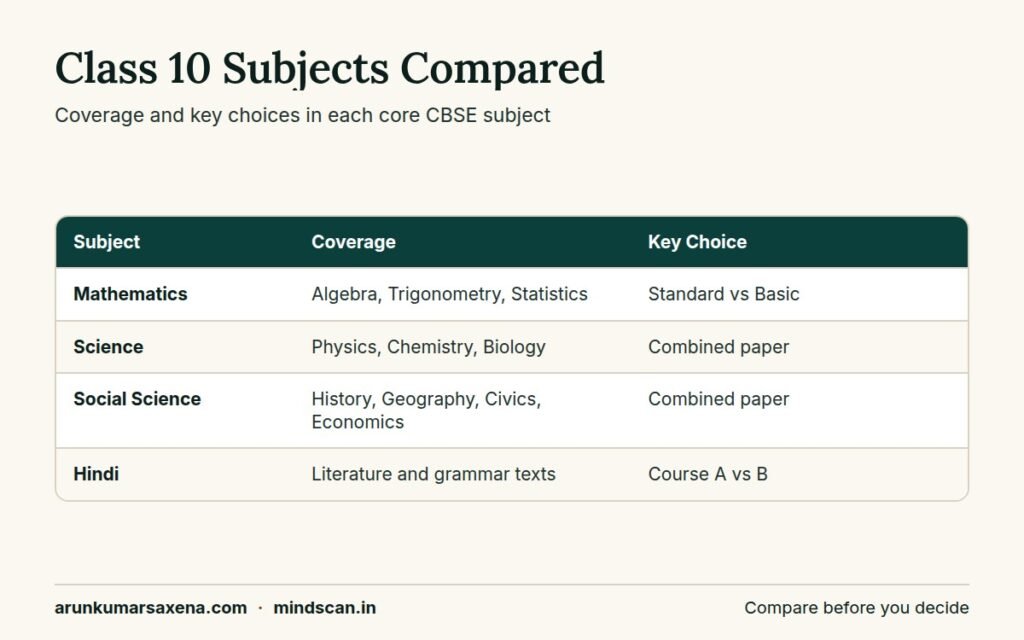
| Subject | What It Covers | Key Choice |
|---|---|---|
| Mathematics | Real Numbers, Algebra, Trigonometry, Statistics, Probability | Standard vs Basic |
| Science | Physics, Chemistry and Biology as one combined paper | No split offered |
| Social Science | History, Geography, Political Science, Economics | Single combined paper |
| English (Language 1) | First Flight prose and poetry, Footprints Without Feet | Fixed for most schools |
| Hindi or Second Language | Course A (literature-heavy) or Course B (practical) | Course A vs Course B |
Internal subjects like Art Education, Health and Physical Education and Work Education are graded separately by the school. They do not follow the 80+20 board pattern but are mandatory for promotion to Class 11. Think of them as non-negotiable co-scholastic requirements that round out the 10th class all subjects experience.
What skill subjects can you choose in Class 10?
CBSE offers skill subjects such as Information Technology, Artificial Intelligence, Financial Literacy, Retail and Marketing as optional subjects in Class 10, per the official CBSE skill education curriculum (accessed October 2026). These are credit-bearing and follow an exam-plus-internal pattern similar to the core subjects. They introduce practical, job-linked skills early and give students a low-risk way to test a possible interest before Class 11.
AI and IT are the most popular picks in the 10th class all subjects list right now. The reason is partly genuine student interest and partly peer pressure. My advice is simple. Pick a skill subject because the child wants to explore it, not because friends are taking it. Ask the child one question. If this subject had no exam and no marks, would you still want to learn it? If the answer is yes, go ahead. If the answer is no, pick something else or skip the optional subject entirely.
Under CBSE’s current rules, the best five subjects count for percentage calculation. A strong skill subject score can replace a weaker language or Social Science score. This makes the skill subject a strategic choice, not just an academic one. Use it thoughtfully within the 10th class all subjects framework.
How do Class 10 subjects affect your Class 11 stream choice?
Your 10th class all subjects list is the foundation for Class 11 streams. The Science stream needs strong Mathematics and Science scores. Commerce needs comfort with Mathematics, and the Humanities stream is open to all but benefits from good Social Science and language scores. To plan ahead, see the full commerce all subject name list for Class 11. Your performance across subjects is real data, not opinion, about where your strengths lie.
Do not pick a stream based on what the neighbour’s child took or what sounds prestigious. I have sat with too many students who took Science because their parents wanted it, only to struggle for two years and then switch fields after Class 12. The 10th class all subjects list gives you a report card of aptitude.
Read it honestly. If Mathematics and Science scores are consistently in the 90s, Science is a natural fit. If they are in the 50s, do not force it. There are many paths that do not need high Maths, and they lead to strong careers.
One tool that helps is a psychometric assessment. At MINDSCAN Career Guidance by Arun Kumar Saxena, the MINDSCAN AI Career Clarity Report maps a student to 20+ career groups and shows which Class 11 streams align with their actual aptitude and interest, not just their marks.
Is 70% bad in 10th?
No. 70% in Class 10 is a respectable score and does not close any stream. What matters more is which subjects pulled the score down and whether your aptitude matches the stream you plan. Boards matter less over a career than skill fit, and one board exam never defines a career.
A 70% with strong Mathematics and Science scores tells a different story from a 70% with weak Mathematics. Streams look at relevant subject scores, not just the total. A student with 70% overall but 85 in Mathematics and Science can still thrive in the Science stream. A student with 70% overall but 55 in Mathematics should think twice before taking Commerce with Mathematics. And if a child loves History and fieldwork, some unusual but rewarding paths exist too, see this complete guide to a Bachelor’s Degree in Archaeology for where Social Science strengths can lead.
“Analyse your child’s aptitude scientifically and check the scores critically before taking any decision.” (Arun Kumar Saxena)
I have seen too many families panic over a number. Percentage is a snapshot. Aptitude is a pattern. The 10th class all subjects list gives you both, but only if you look past the total and into the subject-wise scores.
What most guides miss: the bridge from subjects to stream
Most websites list the 10th class all subjects and stop there. They do not tell you how to read the marks pattern. A simple three-question test helps. One. which subject did the child prepare least for yet score highest in? That is natural aptitude. Two. which subject did they work hardest for yet score lowest in? That is a gap worth examining. Three. if the child had a free hour, which subject’s content would they pick up voluntarily?
That is genuine interest. The answers to these three questions, combined with the actual marks, give you a clearer stream direction than any neighbour’s advice or any coaching brochure ever will. The 10th class all subjects list is not just a syllabus. It is your child’s first career data set. Read it before you decide.
How should you prepare across all Class 10 subjects this month?
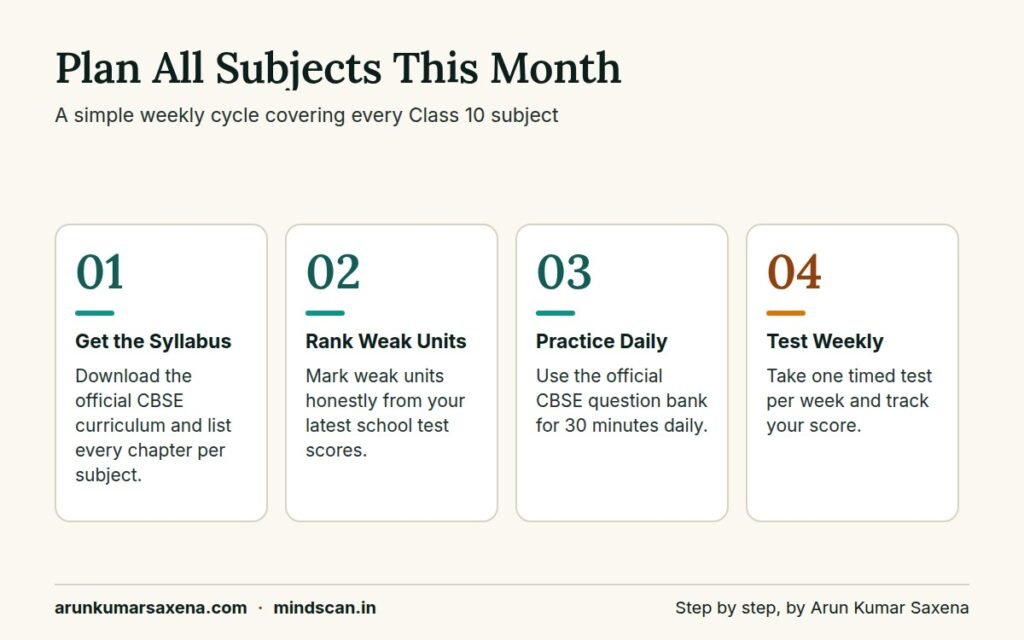
Follow a simple cycle that works for every subject in the 10th class all subjects list. Map the syllabus, prioritise high-weightage chapters, practice with the official CBSE question bank, take one timed test weekly and revise weak units. Consistency across all subjects beats cramming one favourite subject every time.
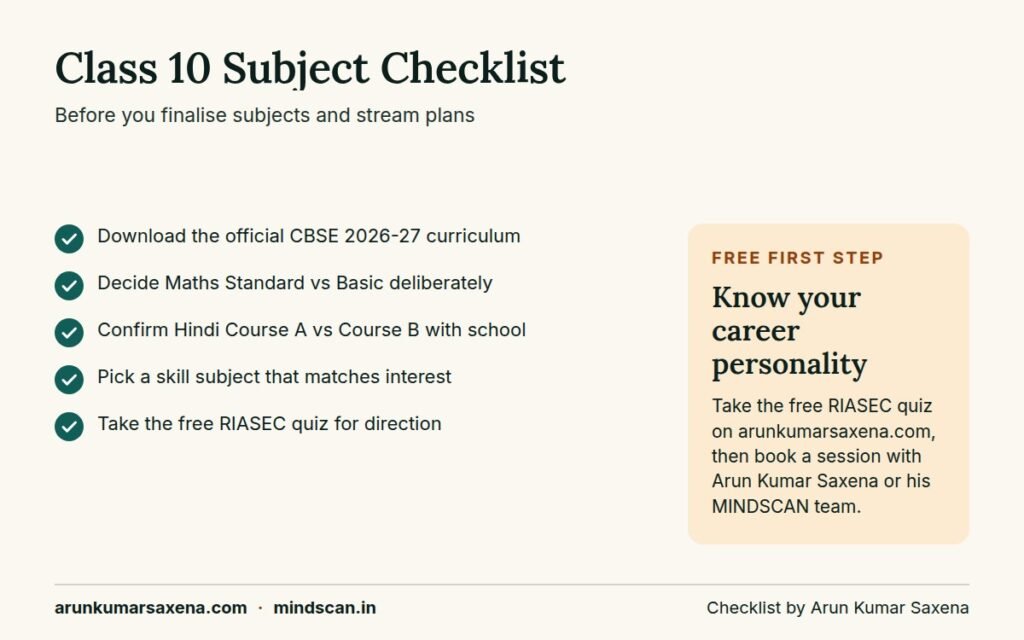
Printable 10th class all subjects checklist
- All 5 compulsory subjects listed from the official CBSE curriculum
- Mathematics level decided: Standard or Basic
- Second language course decided: Hindi Course A or Course B
- Skill subject chosen, or optional slot skipped
- Internal subjects noted: Art Education, Health and Physical Education, Work Education
- Class 11 stream goal written against subject-wise scores
Source: CBSE Class 10 curriculum 2026-27
- Download the official CBSE Class 10 curriculum 2026-27 and list every chapter per subject.
- Mark each subject’s strong and weak units honestly based on your latest school test scores.
- Pick your top 3 high-weightage chapters per subject and finish those first this month.
- Practice daily with the official CBSE Class 10 question bank, at least 30 minutes across two subjects.
- Take one full timed test per week on a rotating subject and record your score.
- Decide Mathematics Standard vs Basic and Hindi Course A vs Course B with your Class 11 stream goal in mind, not fear.
- Take the free RIASEC career personality quiz to see which subjects genuinely match your interests.
Preparation is not about studying harder. It is about studying the right things in the right order. The 10th class all subjects list is large, but the board paper is predictable. High-weightage chapters repeat. Past papers reveal the pattern. Use them. And do not wait for the date sheet to start. Every day counts.
For students who are still unsure about their Class 11 stream, preparation and exploration can run in parallel. While you revise the 10th class all subjects, spend 15 minutes a day reading about possible Class 11 streams. The 11th class humanities subjects list and the subjects for the Science stream after 10th pages on this site give you the full picture. Knowing what waits in Class 11 makes the Class 10 effort feel purposeful.
You can also explore career options on the National Career Service portal by the Government of India to understand how your subject choices connect to long-term paths.
Frequently asked questions about 10th class all subjects
Is the Class 10 syllabus for 2026-27 released?
Yes, CBSE releases the curriculum on its academic website each year. Always download the latest official curriculum from cbseacademic.nic.in rather than relying on third-party PDFs, which may be outdated. The 10th class all subjects list and chapter details are clearly laid out in the official document, and using it ensures you study exactly what the board expects.
How many marks do you need to pass Class 10 in all subjects?
You generally need 33% in each subject combining the board exam and internal assessment. This applies to every subject in the 10th class all subjects list. Confirm the exact pass rule on the official CBSE site each year, as rules can be updated. Falling short in even one subject means a compartment exam.
Can I change my skill subject in Class 10?
Skill subject changes are possible early in the academic year with school approval. Schools need the infrastructure and trained teachers for the subject, so a change is not automatic. If you want to switch, speak to the school within the first few weeks of the session, before the 10th class all subjects registration is finalised.
What are the internal subjects in Class 10?
Art Education, Health and Physical Education and Work Education are mandatory internal subjects. They are assessed by the school and do not appear in the external board exam. While they sit outside the main 10th class all subjects list, they are compulsory for promotion to Class 11.
Which subjects should I focus on if I want Science in Class 11?
Mathematics and Science matter most. Aim for Standard Maths and strong Science scores, because most schools set cut-offs based on these two subjects. English counts too, since language totals often contribute to stream admission requirements drawn from the 10th class all subjects list.
Do skill subjects count in my Class 10 percentage?
CBSE’s current rules allow the best five subjects to count for percentage, so a strong skill subject score can replace a weaker language score. This rule makes the skill subject a strategic pick within the 10th class all subjects list. Verify the latest CBSE circular each year, as the best-of-five rule can be updated.
What subjects does NIOS offer for Class 10?
NIOS offers a flexible set of secondary courses including Maths, Science, Social Science and multiple languages, useful for open schooling students. The NIOS 10th class all subjects list differs from CBSE’s and is designed for learners who need a different pace or pattern. Check nios.ac.in for the current list.
Should you take an optional subject in 10th class, or not?
Take an optional subject in 10th class only if the child has genuine interest and the bandwidth to handle it alongside the 5 compulsory subjects. An extra subject that drags down core scores is a net loss. Under the best-of-five rule, a well-chosen skill subject can reduce exam pressure, but skipping it is also perfectly safe for most students.
Which skill subjects are there in 10th class, and how do you choose one?
The skill subjects in the 10th class subjects list include Information Technology, Artificial Intelligence, Financial Literacy, Retail and Marketing. Arun Kumar Saxena advises choosing with one test: if the subject had no exam and no marks, would the child still want to learn it? If yes, choose it. If no, pick a different skill subject or skip the optional slot entirely.
What should you do after your Class 10 results: a stream checklist
Your 10th class subjects act as the first real data set for the stream decision. Science needs Standard Maths and strong Science scores, Commerce needs comfort with Mathematics, and Humanities is open to all. The subject-wise marks reveal aptitude patterns that the total percentage hides. See the subjects for the Science stream after 10th and the 11th class humanities subjects list to plan the next step. After your results, calmly write down each subject’s score, run the quick three-question aptitude check we covered above, shortlist just two streams that match your marks and interest, and then confirm subject-specific cut-offs with at least two target schools before you pay the admission fee, because cut-offs can vary sharply between schools even in the same city.
Which internal subjects are there in 10th class, and how are their marks awarded?
Art Education, Health and Physical Education and Work Education are the internal subjects in 10th class. The school assesses them through participation, projects and periodic grading rather than a board exam, so no 80+20 split applies. They are graded separately, remain compulsory for promotion to Class 11, and should never be neglected despite carrying no board marks.
Mathematics Standard or Basic: how should you decide for 10th class?
Decide by asking one question: does the child need Mathematics in Class 11? If yes, or if unsure, choose Standard, because it keeps Science and Commerce open. Choose Basic only when the child is certain of dropping Maths. Check the full year’s performance, not one bad test, and connect the choice to the stream goal instead of fear.
Can I take Sanskrit or a regional language instead of Hindi as my second language in 10th?
Yes, if your school offers it. Per the CBSE curriculum, the second language can be Hindi, Sanskrit, a regional language or, in some schools, a foreign language. Availability depends entirely on the school, so confirm with the school office before assuming a swap from Hindi is possible in the 10th subjects list.
What does each skill subject actually cover, and which one suits my interest?
The 10th subjects list confirms Information Technology, Artificial Intelligence, Financial Literacy, Retail and Marketing as options; each introduces practical, job-linked skills and follows an exam-plus-internal pattern. For the exact syllabus of any one skill subject, ask your school for its CBSE outline, then apply the interest test Arun Kumar Saxena recommends: would you still learn it without marks?
Does the optional 6th academic subject affect my best-of-five percentage?
The best five subjects count for your percentage under CBSE’s current rules, so a well-scored 6th academic subject can act as a safety net, replacing a weaker score. How a particular school treats the 6th subject can vary, so confirm the counting method with your school before relying on it in your 10th details planning.
Should I pick Mathematics Standard or Basic if I want Commerce without Maths in Class 11?
Pick Standard. Commerce without Mathematics exists in some schools, but the subject-wise pattern on this page shows Commerce still needs comfort with Mathematics, and Standard keeps that door open if plans change. Basic should be chosen only when the student is certain of dropping Mathematics after Class 10. See the full Class 11 commerce subjects list before deciding.
What should I do if my school does not offer the skill subject I want?
Ask the school whether the subject can be introduced or taken through another CBSE-approved arrangement. If not, choose the closest available skill subject, or skip the optional slot entirely, it is perfectly safe. The free RIASEC career personality quiz can help you compare your interests against what your school actually offers.
Maths Standard vs Basic and Hindi Course A vs Course B: side-by-side comparison
| Factor | Mathematics Standard | Mathematics Basic | Hindi Course A | Hindi Course B |
|---|---|---|---|---|
| Syllabus focus | Same syllabus as Basic; question paper tests deeper application | Same syllabus as Standard; question paper sticks to simpler, direct problems | Literature-heavy, focused on prose and poetry analysis | Practical, with greater weight on grammar and functional language |
| Textbooks | NCERT Mathematics textbook (same for both levels) | NCERT Mathematics textbook (same for both levels) | Kshitij and Kritika | Sparsh and Sanchayan |
| Who it suits | Students who want to continue Mathematics in Class 11 | Students certain they will drop Mathematics after Class 10 | Students who enjoy reading and writing about Hindi literature | Students who treat Hindi as a functional second language |
| Impact on Class 11 stream | Keeps Science and Commerce streams open | Closes the Mathematics door and many career paths; a compartment route exists to switch later | Equal marks as Course B; score counts under best-of-five | Equal marks as Course A; often the lighter, scoring pick |
References and sources
- CBSE Class 10 curriculum 2026-27, cbseacademic.nic.in, accessed October 2026.
- CBSE skill education curriculum, cbseacademic.nic.in, accessed October 2026.
- NIOS secondary course subject list, nios.ac.in, accessed October 2026.
Last updated: October 2026.
हिंदी में जवाब: 10वीं के सभी विषय. पूरी सूची और समझाइश
10वीं के बाद 11वीं में कौन-कौन से सब्जेक्ट होते हैं?
11वीं में तीन मुख्य स्ट्रीम होते हैं. साइंस, कॉमर्स और ह्यूमैनिटीज़. साइंस में फिज़िक्स, केमिस्ट्री, मैथ्स या बायोलॉजी जैसे सब्जेक्ट होते हैं. कॉमर्स में अकाउंटेंसी, बिज़नेस स्टडीज़ और इकोनॉमिक्स शामिल हैं. ह्यूमैनिटीज़ में इतिहास, राजनीति शास्त्र, मनोविज्ञान जैसे विषय होते हैं.
10th में 95% लाने के लिए क्या करें?
95% लाने के लिए हर सब्जेक्ट का सिलैबस पूरी तरह से खत्म करें और एनसीईआरटी की किताबों को आधार बनाएं. ज़्यादा वेटेज वाले चैप्टर पहले करें. हफ्ते में एक फुल टेस्ट ज़रूर दें. सभी सब्जेक्ट को रोज़ थोड़ा-थोड़ा समय दें, किसी एक को घंटों नहीं. कमज़ोर यूनिट को बार-बार दोहराएं. लगभग 95% लाने वाले छात्र हर विषय में बराबर मेहनत करते हैं.
10th में 80% कैसे लाएं?
80% लाने के लिए रोज़ का एक छोटा शेड्यूल बनाएं और उस पर टिके रहें. हर सब्जेक्ट के लिए 45 मिनट का एक स्लॉट रखें. एनसीईआरटी के सवाल बार-बार हल करें. पिछले साल के पेपर ज़रूर लगाएं. लगातार पढ़ाई, एक बार में घंटों पढ़ने से ज़्यादा असरदार होती है. लगभग 80% एक समझदार और नियंत्रित तैयारी से आ जाते हैं.
Your 10th class all subjects list is more than a set of exams. It is the first clear map of your child’s strengths, and it should guide the biggest academic decision they will make so far. the Class 11 stream choice. Do not leave that decision to guesswork or neighbourly advice. Book a session of online career counselling in India and let us read the data together.
The MINDSCAN AI Career Clarity Report, priced at ₹1,499, maps your child to 20+ career groups and shows which stream fits best, not which one sounds good. For ₹2,999, you get the report plus a counselling session with my MINDSCAN team. The right stream is not a guess. It is a decision backed by data.