
Commerce All Subject Name: Class 11, 12 and B.Com List
By Arun Kumar Saxena, Certified Advanced Career Coach · Updated October 2026
Quick answer: The commerce all subject name list for Class 11 and 12 has four compulsory subjects: Accountancy, Business Studies, Economics and English. Students then add one or two optional subjects such as Mathematics, Applied Mathematics, Informatics Practices, Entrepreneurship, Legal Studies or Physical Education. The exact list varies by board and school.
If you are searching for the commerce all subject name list before Class 11 admission, this page gives you the verified full list for Class 11, Class 12 and B.Com. It also tells you which subjects actually decide careers, which optional subjects close doors, and how to choose a combination that fits your tested aptitude instead of following the crowd.
With 22 years of experience and 20,000+ students and professionals guided, I have seen how a rushed subject choice in Class 11 creates regret by Class 12 and wasted years after graduation. This guide is written by me, Arun Kumar Saxena, Certified Advanced Career Coach and founder of MINDSCAN Career Guidance, for parents and students who want a clear, honest answer before they lock a stream.
Table of Contents
What are the commerce all subject names in Class 11 and 12?
The commerce all subject name list in Class 11 and 12 has four compulsory subjects: Accountancy, Business Studies, Economics and English. Students then choose one or two optional subjects from Mathematics, Applied Mathematics, Informatics Practices, Computer Science, Entrepreneurship, Legal Studies, Physical Education, Psychology or Hindi. Most schools follow a five subject plus one optional sixth subject structure.
Accountancy teaches recording financial transactions, preparing ledgers, trial balances and final statements. Business Studies covers management principles, trade, organisation and the operational framework of a business. Economics is split into microeconomics for individual markets and macroeconomics for national income, inflation, money and banking. English is the mandatory language paper that builds communication and comprehension.
The optional slot is where students differentiate. Mathematics or Applied Mathematics covers algebra, calculus, statistics and quantitative techniques. Informatics Practices or Computer Science focuses on programming, database management and computer applications. Entrepreneurship introduces business planning, market research and startup basics. Legal Studies introduces the legal system and business laws. Physical Education covers health, sports science and fitness. Some CBSE schools also offer Psychology or Hindi as optionals.
Combinations vary by board and school. CBSE, ISC and state boards each have their own rules, and a school may not offer every optional subject. Always confirm the actual commerce all subject name list with the school office before finalising. The five plus one structure means a student takes five main subjects and a sixth additional subject, which can be a skill subject or a lighter academic option.
What most guides miss: the commerce all subject name list is fixed, but the right combination is personal
Most pages dump the commerce all subject name list and stop there. They do not tell you that two students with identical marks in Class 10 can need completely different optional subjects. In my counselling sessions, I repeatedly see parents pick Mathematics because a neighbour’s son took it, or drop it because a relative said it was hard. Neither reason is based on the student’s own verified strengths.
Use this simple check before you choose. First, ask which Class 11 subjects your target career actually requires. CA and economics honours lean on Mathematics, while BBA and law do not. Second, ask whether the student’s Class 10 marks in Maths and Social Science reflect real understanding or rote effort. Third, ask what the student would study on a Sunday without being told. The answers to these three questions tell you more than any generic commerce all subject name list. The list is the same for everyone; the right combination is not.
How many subjects are there in CBSE Class 11 commerce?
When parents ask for the commerce all subject name list, they usually mean the CBSE Class 11 package. You study five compulsory papers: Accountancy, Business Studies, Economics, English and one optional. Many schools let you add a sixth subject, and that is where the commerce all subject name count can stretch to six. The core five stay the same across most CBSE schools.
CBSE commerce students typically take five subjects: English plus Accountancy, Business Studies, Economics and one optional subject. Many schools allow a sixth additional subject. Mathematics and Applied Mathematics cannot both be taken, and skill subjects can replace the standard optional in some CBSE schools.
The five subject structure keeps a student eligible for board exams with a balanced load. The sixth subject acts as a buffer or an interest area, and some students use it to protect their overall percentage. In CBSE, the sixth subject can be a language, a skill subject or an academic elective, depending on what the school offers.
CBSE skill subjects available to commerce students include Financial Markets Management, Marketing, Taxation, Banking and Insurance. These are practical, application based papers that can strengthen a commerce profile. Check the official CBSE Commerce and Finance curriculum document for the current syllabus and subject codes.
Before you rely on any list found in a random PDF, verify it against the board’s current circular. Syllabi and subject availability change, and an outdated commerce all subject name list can mislead a family at admission time.
Which optional subject is best with commerce in Class 11?
No single commerce all subject name fits every student as the best optional. Mathematics keeps CA and data careers open; Entrepreneurship suits a family business path; Informatics Practices helps with tech roles. I tell families that before you circle one name on the commerce all subject name sheet, we should verify the student’s aptitude and match it to the target career. The right optional is the one that supports a plan, not a random pick.
Mathematics is the strongest optional because it keeps CA, economics honours, actuarial science and most top commerce courses open. Informatics Practices suits data and tech inclined students. Entrepreneurship, Legal Studies and Physical Education are valid choices, but they close fewer doors. The best optional is the one matching the student’s tested aptitude.
Mathematics versus Applied Mathematics is a common confusion. Core Mathematics is the route for students aiming at economics honours, actuarial science, CA with a strong quantitative base, or any degree that lists Maths as a prerequisite. Applied Mathematics is CBSE’s practical, application oriented alternative designed for commerce and humanities students. It covers financial mathematics, statistics and commercial applications, and it suits students who want quantitative skills without the full abstract rigour of core Maths.
Informatics Practices or Computer Science beats Maths when the student is drawn to data, databases, coding or tech enabled business roles. A student who enjoys building things on a computer and dislikes theorem proving will gain more from IP than from struggling through core Maths. Entrepreneurship suits students who think in terms of products, customers and ventures. Legal Studies supports a future in law, corporate compliance or company secretaryship. Physical Education is a valid low stress sixth subject that protects board percentage, but it opens no career doors by itself.
Do not choose a subject because it sounds impressive. Choose it because it matches verified aptitude and the target degree’s requirements. A free RIASEC career personality quiz gives a first read on where the student’s interests actually sit.
Commerce vs other streams: how do the subject lists compare?
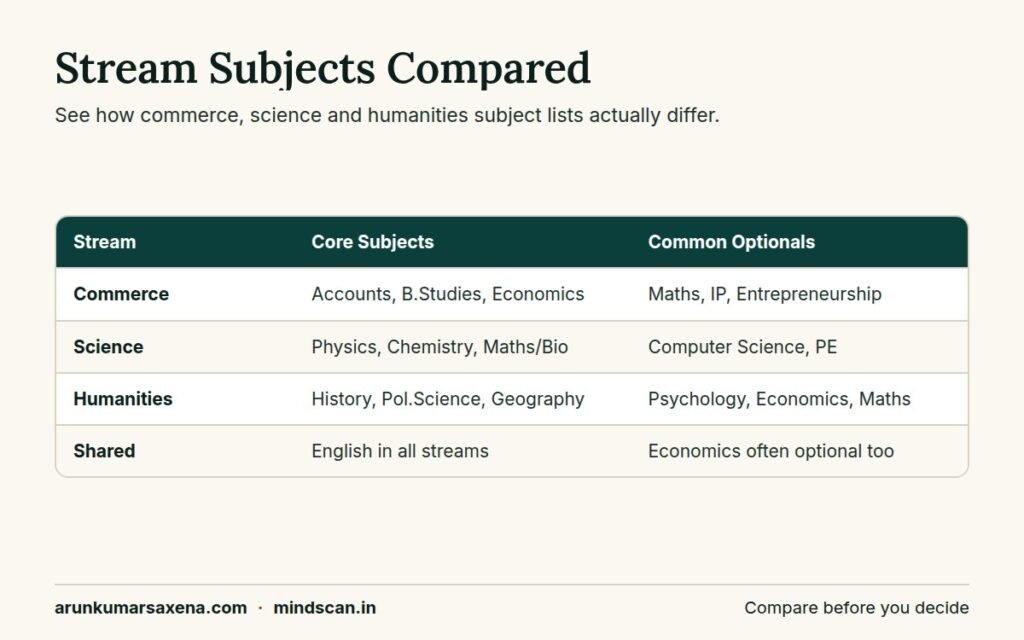
Parents often compare the commerce all subject name list with science and arts. Science adds Physics, Chemistry and Biology or Mathematics; arts brings History, Political Science and Sociology. The commerce all subject name set mixes numbers and theory with a business lens. It is not a lighter version of science, and it is not a fallback when PCM feels hard. It is a distinct stream that demands its own kind of consistent effort.
Commerce centres on Accountancy, Business Studies and Economics. Science centres on Physics, Chemistry, Maths or Biology. Humanities centres on History, Political Science, Geography, Psychology and electives. The right question is not which list looks easier but which list matches the student’s interests and verified strengths.
English is common to every stream. Economics is shared between Commerce and Humanities, and Mathematics appears in all three streams in different forms. The overlap ends there. Science builds towards engineering, medicine and research. Commerce builds towards business, finance and management. Humanities builds towards law, civil services, design, media and academia.
The myth that commerce is easy needs busting. Accountancy is cumulative and punishes skipping basics. Economics demands conceptual and graph based thinking. Business Studies is memory and application heavy. A student who finds Science hard may find Commerce equally hard, just in a different way. The stream is not a refuge from effort; it is a different kind of effort.
| Stream | Core Subjects | Common Optionals | Best Fit For |
|---|---|---|---|
| Commerce | Accountancy, Business Studies, Economics | Maths, IP, Entrepreneurship, Legal Studies, PE | Business, finance and management-minded students |
| Science | Physics, Chemistry, Maths/Biology | Computer Science, Physical Education | Engineering, medicine and research aspirants |
| Humanities | History, Political Science, Geography | Psychology, Economics, Fine Arts, Maths | Law, civil services, design and media aspirants |
When parents ask me which stream is best, I ask them to first check the Class X subject combination guide and then look at the child’s actual work patterns, not the neighbour’s opinion.
What subjects do you study in a B.Com degree?
At degree level, the commerce all subject name list grows deeper. A typical B.Com semester includes Financial Accounting, Business Law, Corporate Accounting, Cost Accounting, Income Tax and Economics. These papers build straight on the Class 11 and 12 Accountancy and Economics you already know. So the commerce all subject name you master in school becomes the base for every professional paper later.
B.Com expands beyond school subjects into Financial and Cost Accounting, Corporate and Business Law, Direct and Indirect Taxation, Auditing, Financial Management, Banking and Insurance. Economics, business mathematics and electives run across six semesters. Honours and specialisation options add depth in later semesters.
The first year of B.Com usually covers Financial Accounting, Business Organisation, Microeconomics and Business Mathematics. The second year adds Corporate Law, Cost Accounting, Income Tax and Management Principles. The final year brings Auditing, Financial Management, Indirect Taxes and specialisation electives such as Banking, Insurance, E Commerce or Investment Analysis. B.Com Honours goes deeper into accounting, finance and research methods, while BBA shifts the focus towards management and organisational behaviour.
For a full breakdown of what to do after the degree, read my detailed guide on career options after BCom. The degree is a foundation, and the subjects you pick inside it should align with the professional layer you plan to add.

Is commerce easy in Class 11? What is the honest truth?
Some students pick commerce because they have heard the commerce all subject name list looks shorter than science. That is a trap. Accountancy needs precision, Economics needs logic and Business Studies needs recall. Whether the commerce all subject name set feels easy depends entirely on the student’s aptitude. A verified assessment, not corridor talk, tells you if this stream will fit or frustrate.
Commerce is not easy. It is different. Accountancy is cumulative and punishes skipping basics. Economics needs conceptual and graph based thinking. Business Studies is memory and application heavy. Commerce suits students who like business, money systems and structured reasoning, and my data verified assessments regularly prove assumed easy streams wrong.
Accountancy is the main dropout point in Class 11. A student who misses the first few journal entry concepts spends the rest of the year chasing the class. The subject builds step by step, and there is no shortcut. Economics looks friendly at first and then introduces curves, elasticities and national income identities that demand real understanding. Business Studies feels like reading, but scoring well requires application and case study practice.
Before choosing commerce, test fit honestly. Take the free RIASEC career personality quiz as a first filter, then get a psychometric assessment for verified strengths. A student who loves numbers, follows business news and enjoys structured problem solving is a natural commerce fit. A student who hates maths and dislikes reading about markets may struggle.
My consistent advice to parents is the same one I give NEET families:
“Analyse your child’s aptitude scientifically and check the scores critically before taking any decision.” (Arun Kumar Saxena)
How do you choose the right commerce subject combination this month?
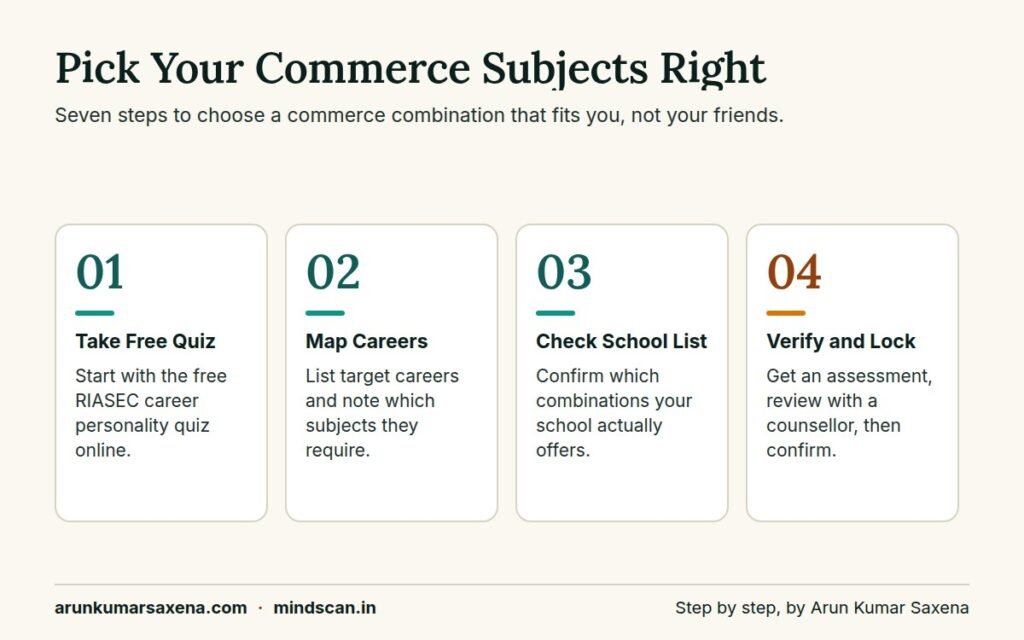
Verify your aptitude with a scientific assessment, map subjects to target careers, check your school’s actual combinations, talk to a counsellor before confirming, then lock the combination. Self-knowledge comes before any career choice, the core idea of my book 3 Steps to Knowing Yourself.
- Take the free RIASEC career personality quiz to get a first read on your fit for commerce.
- Shortlist your target careers, such as CA, BBA, economics or law, and check which Class 11 subjects they require.
- List your school’s actual commerce all subject name combinations. Availability differs school to school.
- Score yourself honestly on Class 10 Maths comfort. If weak, decide between Applied Maths and a lighter optional.
- Get a psychometric assessment done for verified strengths before finalising.
- Discuss the shortlist with a qualified career counsellor or a teacher who knows the board rules.
- Lock the combination with your school before the deadline and start Accountancy basics over the summer.
The best age to start career counselling is Class 8 onwards, so a Class 10 or 11 decision becomes a confirmation, not a guess. If you want a structured review of the shortlist before submission, book online career counselling in India with Arun Kumar Saxena.
The MINDSCAN AI Career Clarity Report costs ₹1,499, and the report with a counselling session costs ₹2,999. Both options map the student to 20+ career groups and give you a data based foundation for the commerce all subject name combination you lock.
What careers open up with each commerce subject?
Every entry on the commerce all subject name sheet is a door to a career. Accountancy leads to CA, CFA and auditing. Economics opens banking, policy and analyst roles. Business Studies points to management and entrepreneurship. When I map the commerce all subject name list to careers with a student, the subject stops being a textbook and starts looking like a launchpad. That shift matters.
Accountancy leads to CA, CMA and accounting roles. Economics leads to economics honours, UPSC and analytics. Maths keeps CA, actuarial science and quantitative finance open. Informatics Practices leads to data and tech roles. Entrepreneurship and Legal Studies support business and law paths.
Accountancy is the prerequisite for Chartered Accountancy, Cost and Management Accountancy, and most corporate accounting roles. Economics opens economics honours, civil services, RBI grade B, and analytics. Mathematics is required for actuarial science, quantitative finance, and many top economics programmes. Informatics Practices supports B.Com with computing, data analytics and fintech roles. Entrepreneurship supports BBA, family business and startup paths. Legal Studies supports law, company secretaryship and corporate compliance.
Degree choice matters more than stream alone. A commerce student with a plain B.Com and no added skills competes with lakhs of similar graduates. A commerce student with a professional layer stands out. Check the National Career Service portal by the Ministry of Labour and Employment for verified occupational information and career descriptions.
For course level guidance after Class 12, see my page on the best courses after 12th commerce.
What are 20 careers in commerce?
The twenty careers below all start with the commerce all subject name list you see in Class 11. Some need a professional course after B.Com, others open up straight after graduation. What connects them is the base the commerce all subject name subjects give you: a way of reading numbers, markets and business decisions. Pick a career first, and the subject list becomes your step-by-step route.
A commerce background opens at least 20 clear career paths, each mapping to a subject combination from the commerce all subject name list. The list includes Chartered Accountant, Cost and Management Accountant, Company Secretary, investment banker, financial analyst, economist, RBI Grade B officer, UPSC civil servant, actuary, data analyst, fintech specialist, tax consultant, auditor, banker, insurance professional, entrepreneur, corporate lawyer, business consultant, wealth manager and academic.
| Career | Required Class 11 Subjects |
|---|---|
| Chartered Accountant | Accountancy, Mathematics (recommended) |
| Cost and Management Accountant | Accountancy, Mathematics |
| Company Secretary | Accountancy, Legal Studies (recommended) |
| Investment Banker | Mathematics, Economics |
| Financial Analyst | Mathematics, Economics |
| Economist | Economics, Mathematics |
| RBI Grade B Officer | Economics, Mathematics |
| UPSC Civil Servant | Economics, any optional |
| Actuary | Mathematics, Accountancy |
| Data Analyst | Informatics Practices, Mathematics |
| Fintech Specialist | Informatics Practices, Mathematics |
| Tax Consultant | Accountancy, Legal Studies |
| Auditor | Accountancy |
| Banker | Accountancy, Economics |
| Insurance Professional | Mathematics, Business Studies |
| Entrepreneur | Entrepreneurship, Business Studies |
| Corporate Lawyer | Legal Studies, Business Studies |
| Business Consultant | Business Studies, Economics |
| Wealth Manager | Mathematics, Economics |
| Academic | Economics or Accountancy |
The right career depends on the subjects you choose in Class 11 and the professional layer you add later. Accountancy and Maths lead to CA, CMA, actuarial science and quantitative finance. Economics supports RBI Grade B, UPSC and analytics. Informatics Practices opens data and fintech roles. Legal Studies supports law and company secretaryship. Entrepreneurship and Business Studies support BBA, startups and family business. A plain B.Com alone is not enough; the professional layer decides the outcome.
What are 5 future jobs for commerce students?
Five future jobs for commerce students are fintech product analyst, data driven financial consultant, sustainability auditor, digital taxation specialist and forensic accountant. These roles combine commerce fundamentals with technology, data and regulation, and they are growing as per online sources. The commerce all subject name list gives the base, but added skills create the edge.
Fintech product analysts bridge finance and technology. Data driven financial consultants use analytics for business decisions. Sustainability auditors check environmental and social reporting. Digital taxation specialists handle GST, cross border tax and e commerce compliance. Forensic accountants investigate financial fraud. Each role needs a commerce degree plus a professional layer such as data tools, certifications or a specialised master’s programme. Before chasing a future job title, verify that your aptitude aligns with the role using the MINDSCAN psychometric assessment.
Is a commerce degree worth it? Arun Kumar Saxena’s honest 2026 view
A degree that covers the commerce all subject name set is worth it, but only when you treat it as a base, not the finish line. A B.Com alone rarely decides your career; the professional layer you add on top does. I have seen students with the same commerce all subject name foundation land in very different places. The difference was always the clarity with which they chose their next step.
A commerce degree is worth it when paired with a professional layer such as CA, CFA, data skills or a strong specialisation. A plain B.Com alone offers modest starting salaries as per online sources. The stream is a foundation; differentiation comes from verified strengths plus added skills, not from the degree label.
Plain B.Com salaries disappoint because the degree is common and the skills are general. As per online sources, fresh B.Com graduates typically earn modest starting salaries that rise sharply with CA, CFA, M.Com, MBA or data skills add ons. The degree alone is not the problem. The absence of a professional layer is.
| Qualification | Approximate Starting Salary Range (Annual) |
|---|---|
| Plain B.Com | ₹2.5 lakh to ₹4 lakh |
| B.Com + CA | ₹8 lakh to ₹12 lakh |
| B.Com + CFA | ₹6 lakh to ₹10 lakh |
| B.Com + MBA (Tier 1) | ₹10 lakh to ₹20 lakh |
Skills that multiply a commerce degree’s value include Excel and financial modelling, Tally and ERP familiarity, data tools, communication, and one specialisation such as taxation, audit or analytics. A student who builds these alongside the degree enters the job market with a different profile.
Commerce remains one of the most flexible streams in India, but flexibility without focus becomes drift. The student who knows her verified strengths and builds a professional layer on top of B.Com will do well. The student who treats the degree as a default option will struggle. For a detailed roadmap, read my guide on career options after BCom.
Frequently asked questions about commerce all subject name
These are the questions I hear most often when families first search for the commerce all subject name list. Students want to know what they will study; parents want to know if the stream is safe. Below, I answer each one honestly, without sugar-coating. If your question about the commerce all subject name is not here, you can reach me directly.
Which subjects are compulsory in commerce after Class 10?
The four compulsory subjects are Accountancy, Business Studies, Economics and English. Students then add one or two optional subjects. For example, a student aiming for CA might add Mathematics, while a student interested in law might add Legal Studies. Always confirm the exact commerce all subject name list with your school before finalising admission, as optional availability varies by board and school.
Can I take commerce without Maths in Class 11?
Yes, commerce without Maths is allowed in most boards. It closes some doors: the CA route becomes harder, and some economics honours and actuarial programmes require Maths. B.Com, BBA and law remain open. Choose based on your target career, not on fear of the subject.
What is the difference between Mathematics and Applied Mathematics in commerce?
Applied Mathematics is CBSE’s practical, application oriented alternative designed for commerce and humanities students. It covers financial mathematics, statistics and commercial applications. Core Mathematics is the route for economics honours, actuarial science and CA leaning paths that demand full quantitative rigour.
Is Informatics Practices a good optional with commerce?
Yes, for students drawn to data, databases and tech enabled business roles. It pairs well with careers in analytics, fintech and B.Com plus computing combinations. If the student enjoys working with computers more than solving abstract maths problems, IP is often the smarter optional.
Do commerce students need Physical Education or is it a waste?
Physical Education is a valid low stress sixth subject that protects board percentage, but it opens no career doors by itself. Take it for balance and as a percentage buffer, not as a career strategy. It should never replace a subject your target degree requires.
What is a B.Com salary in India?
As per online sources, fresh B.Com graduates typically earn modest starting salaries that rise sharply with CA, CFA, M.Com, MBA or data skills add ons. The degree alone is common. The professional layer you add on top determines the actual earning trajectory.
When should students start career counselling for stream selection?
The best age to start career counselling is Class 8 onwards. By Class 10 and 11, stream choice becomes a confirmation of verified strengths, not a guess. The MINDSCAN AI Career Clarity Report costs ₹1,499 and maps a student to 20+ career groups, giving a data based foundation for the decision.
हिंदी में जवाब: कॉमर्स के सभी विषयों के नाम: कक्षा 11, 12 और बी.कॉम सूची
10वीं के बाद 11वीं में कौन-कौन से सब्जेक्ट होते हैं?
10वीं के बाद कॉमर्स में चार अनिवार्य विषय होते हैं: अकाउंटेंसी, बिजनेस स्टडीज, इकोनॉमिक्स और इंग्लिश। इसके साथ एक या दो वैकल्पिक विषय चुनने होते हैं, जैसे मैथ्स, एप्लाइड मैथ्स, इंफॉर्मेटिक्स प्रैक्टिसेज, एंटरप्रेन्योरशिप, लीगल स्टडीज या फिजिकल एजुकेशन। वैकल्पिक विषय बोर्ड और स्कूल के अनुसार बदलते हैं। सही संयोजन छात्र की जांची हुई योग्यता पर आधारित होना चाहिए, दोस्तों की पसंद पर नहीं।
क्या बिना मैथ्स के कॉमर्स ले सकते हैं?
हाँ, अधिकतर बोर्डों में बिना मैथ्स के कॉमर्स लिया जा सकता है। इससे कुछ रास्ते बंद हो जाते हैं: सीए का रास्ता कठिन हो जाता है, और कुछ इकोनॉमिक्स ऑनर्स और एक्चुरियल प्रोग्राम में मैथ्स अनिवार्य होता है। बी.कॉम, बीबीए और लॉ खुले रहते हैं। अपने लक्षित करियर के आधार पर चुनाव करें, विषय के डर से नहीं।
कॉमर्स में एप्लाइड मैथ्स और कोर मैथ्स में क्या अंतर है?
एप्लाइड मैथमेटिक्स सीबीएसई का व्यावहारिक, एप्लीकेशन आधारित विकल्प है जो कॉमर्स और ह्यूमैनिटीज के छात्रों के लिए बनाया गया है। इसमें वित्तीय गणित, सांख्यिकी और व्यावसायिक अनुप्रयोग शामिल हैं। कोर मैथमेटिक्स इकोनॉमिक्स ऑनर्स, एक्चुरियल साइंस और सीए जैसे रास्तों के लिए है जिनमें पूर्ण मात्रात्मक कठोरता की आवश्यकता होती है।
The commerce all subject name list is the easy part. Choosing the right combination for your child is the decision that shapes the next five years. If you are still unsure between Mathematics and Applied Mathematics, or between Informatics Practices and a lighter optional, do not guess. A scientific assessment gives you verified strengths, and a qualified counsellor helps you map those strengths to subjects and careers.
Book online career counselling in India with Arun Kumar Saxena and get a clear, honest review of your shortlist. You can also start with the MINDSCAN AI Career Clarity Report on mindscan.in for ₹1,499, or choose the report with a counselling session for ₹2,999. The right combination is a decision you make once. Make it with data, not with doubt.