
Best Diploma Courses After 12th (Honest 2026 Guide)
By Arun Kumar Saxena, Certified Advanced Career Coach · Updated October 2026
Quick answer: The best diploma courses after 12th in 2026 depend on your stream and aptitude, not a generic list. Top options include Diploma in Engineering, D.Pharm, DMLT, Digital Marketing, Banking and Finance, and Accounting and Taxation. Match the course to verified strengths and placement evidence before enrolling.
The search for the best diploma courses after 12th is often a blind chase of listicles that push university programmes without asking one essential question: who are you? With 22 years of experience and 20,000+ students and professionals guided, I have seen too many students pick a diploma because a cousin did it, or because an ad promised a package that very few graduates ever got. This page is built for students and parents who want a stream-by-stream, evidence-first decision, not a sales pitch.
A diploma can be a faster, cheaper route to a job, a stepping stone to a degree, or a costly dead end. It all depends on how you choose. I will walk you through the best diploma courses after 12th commerce, science and arts, compare durations and costs, and show you the exact step-by-step method I use inside a MINDSCAN career counselling session. Start by learning who you are; the course comes second.
Table of Contents
Which diploma is best after 12th in 2026?
There is no single best diploma; the best one matches your stream, natural strengths and the job you want at the end. Engineering, pharmacy and lab technology diplomas suit science students, while digital marketing, banking, accounting and design diplomas work well for commerce and arts students. Verify recognition and placement records before enrolling.
I refuse to give a blanket answer to this question inside a counselling session, and I will not give one here. A Diploma in Engineering is brilliant for a PCM student who loves building things, and a disaster for a PCB student who was pushed into it. The best diploma courses after 12th are the ones that fit your RIASEC career personality. A realistic, investigative thinker will thrive in a DMLT lab. An enterprising, social student will be happier in banking and finance.
Three filters narrow the list quickly:
- Match the course to your aptitude, not to a friend’s choice.
- Check whether the course leads to a licensed or regulated profession, because pharmacy and nursing diplomas hold their value far better than unregulated certificate programmes.
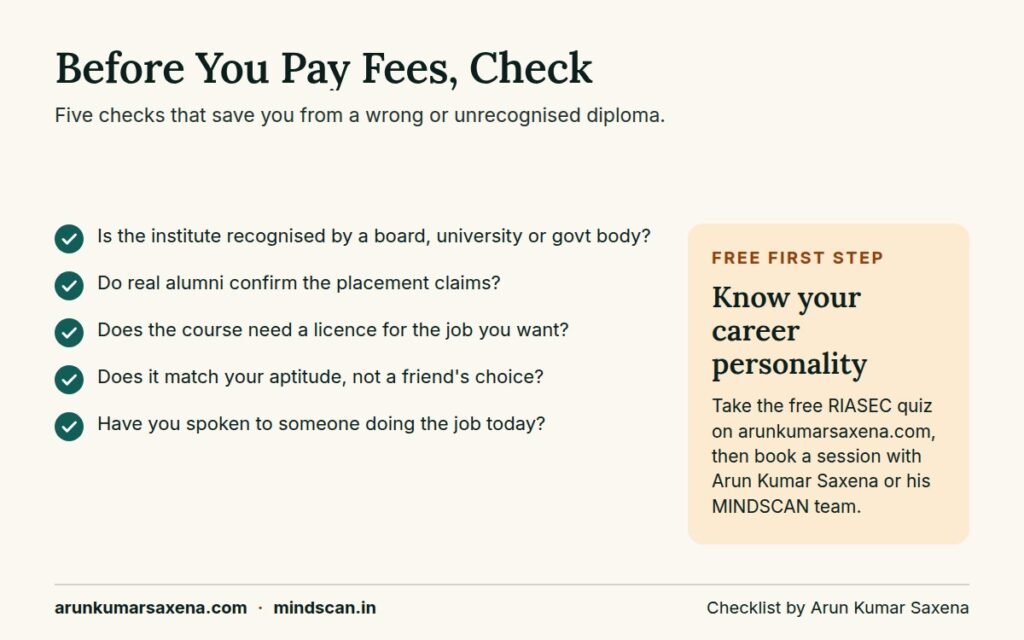
- Prefer institutes that publish real placement data over ones that publish only salary claims. A placement cell that can name five recruiters and give you alumni contact details is more trustworthy than one plastering ‘100% placement’ on every poster.
Which diploma has the best scope and job demand after 12th?
Diplomas tied to regulated or skills-short sectors hold the strongest scope: engineering diplomas with lateral entry to B.Tech, D.Pharm, DMLT and nursing in healthcare, plus digital marketing and data-adjacent computer diplomas in the private sector. Scope also depends on your city’s industry mix and your willingness to keep upskilling.
Healthcare and paramedical diplomas lead to licensed roles with steady demand. A D.Pharm holder can register with a State Pharmacy Council and work as a pharmacist; a DMLT or GNM graduate is licensed to work in diagnostic labs and hospitals. These are not gig-economy roles. They come with regulation, renewal and a career ladder. Engineering diplomas offer lateral entry directly into the 2nd year of B.Tech, a pathway that can save two years and significant fees.
In many homes, a Class 12 PCM student who missed the JEE cut-off by a whisker takes this route, completes the diploma, enters B.Tech laterally, and ends up at the same placement drive as the regular entrants, often with more hands-on lab time.
Digital marketing scope grows only if you build a portfolio, not just a certificate. A fresher with a 3-month digital marketing diploma who runs a small Instagram page for a local shop and shows real metrics can get hired. The certificate opens the door; the portfolio closes the deal. The National Career Service portal is a good place to check which diploma skills employers in your district are actually hiring for right now.
Which diploma has the highest salary after 12th?
As per online sources, engineering diploma holders commonly earn roughly ₹3 to 6 LPA in early roles, and specialised healthcare and technology diplomas can start higher in metro markets. No diploma guarantees a high salary on its own; salary follows the skill depth, portfolio and city you work in.
Treat any institute’s salary promise as marketing until you see alumni evidence. A poster that screams ‘₹8 LPA average’ usually describes approximately the top 10 to 20% of graduates, not the student who barely passed. High-salary claims in the best diploma courses after 12th listicles are often recycled from the highest offer made in a single placement season five years ago.
Entry salary matters less than whether the field offers a growth ladder. A DMLT fresher in a small-town lab may start at approximately ₹12,000 a month and reach approximately ₹40,000 with five years of experience and a specialisation. A digital marketing fresher in a metro agency may start higher but hit a ceiling fast without data analytics skills. I always ask students to check not just the first salary but the long-term salary of people who took that diploma, which is a much better indicator of scope.
Best diploma courses after 12th commerce for jobs?
For commerce students, the strongest job-oriented diplomas are Banking and Finance, Accounting and Taxation, Business Administration, Digital Marketing and Computer Applications. These map directly to entry roles in banking operations, accounts, GST filing, sales and marketing support.
Accounting and Taxation diplomas cover bookkeeping, GST and filing taxes. A commerce graduate with a 1-year diploma in this area can walk into a CA firm or a small business and handle day-to-day accounts from week one. Banking and Finance diplomas cover credit analysis, loan processing and banking operations, and many private banks hire diploma holders for relationship manager and operations roles.
Pair any commerce diploma with a computer applications skill for more interviews. A student with a B.Com and a 6-month Tally and Excel diploma can get multiple offers while batchmates with only the degree get none. The job market today does not reward the degree alone; it rewards the degree plus the skill the employer does not have to teach you. If the decision still feels tangled, book a career counselling session to map your strengths to the right diploma.
Best diploma courses after 12th science (PCB and PCM)?
PCM students should look at Diploma in Engineering in Mechanical, Civil, Electrical and Computer Science for lateral entry into B.Tech. PCB students fit D.Pharm, DMLT, GNM nursing and Radiology and Imaging Technology. Science students can also take digital marketing or data diplomas if they prefer non-technical roles.
Diploma in Engineering runs 3 years and allows direct 2nd-year B.Tech entry through lateral-entry entrance tests. It is one of the most practical best diploma courses after 12th for a PCM student who wants an engineering degree but needs a shorter, more affordable entry point. D.Pharm is 2 years and covers drug formulation, pharmaceutical chemistry and pharma laws. A registered pharmacist can work in a medical store, a hospital or a pharma company’s manufacturing and quality control wing.
DMLT trains you in pathology testing and diagnostic lab equipment; radiology covers X-ray, CT and MRI operation. Picture a PCB student in a tier-2 city who did not get a NEET seat. A DMLT diploma gets her into a diagnostic lab within two years. Three years later, she is the senior technician training new hires. She did not become a doctor, but she built a stable, respected career that fits her scientific bent. Commerce streams have their own high-demand options, and the selection logic stays the same: match aptitude first.
Which 6-month or 1-year diploma course is best after 12th?
Short diplomas work best as skill add-ons, not standalone qualifications. The best 6-month to 1-year options are digital marketing, computer applications, accounting with GST, and graphic or web design. Use them to become employable alongside a degree or to test a field before committing to a longer programme.
A 6-month diploma is valid if the issuing body is recognised, but it is not a degree, and no employer will treat it as one. An engineering firm will not hire a 6-month diploma holder for a core engineering role. A digital agency will, if the candidate can show a live campaign. Short courses need a portfolio or internship to convert into a job. The certificate alone is a receipt for time spent, not a job ticket.
Verify the certifying body on the Skill India Digital Hub before paying. India has thousands of private training centres, and some of the flashiest ones are registered nowhere. A quick check on the portal tells you whether the programme is government-recognised or just privately branded. Computer diploma courses often fall into this 6-month category and can be excellent bridges to IT and data entry roles when chosen from verified providers.
Which 3-month course is best after 12th?
A 3-month course in digital marketing, Tally with Excel, or graphic design can build a quick, employable skill when paired with a live project or portfolio. These short courses are not degrees, but they can get you an entry-level role or freelance work if you show real output. Always verify the provider on the Skill India Digital Hub before paying any fee, because the shortest courses attract the most fake-certificate scams.
Diploma vs degree after 12th: which should you choose?
Choose a diploma when you want faster, job-focused entry into a specific skill or trade; choose a degree when the careers you want require one, which applies to most corporate, government and postgraduate paths. Many students do both: a degree for the base qualification and a diploma for the employable skill.
Diplomas are shorter and cheaper but can limit eligibility for some exams and roles. A UPSC or SSC CGL notification usually demands a degree. A bank PO exam demands a degree. Degrees keep more doors open but delay earning by two to three years. A working professional who does a diploma first, starts earning at 19, funds their own degree through distance mode, and by 25 has both the qualification and four years of work experience is a path that works well. Their peers who went degree-first had the paper but were just starting out.
Check whether your target job ads ask for a degree or just demonstrable skill. Browse five live job postings for the role you want today. If four say ‘degree required’, choose the degree route or pair your diploma with a distance degree. If four say ‘proficiency in X tool’, a good diploma with a portfolio will get you the interview.
| Factor | Diploma | Degree |
|---|---|---|
| Doors kept open | Narrower; some government and PG exams require a degree | Wider; meets eligibility for most exams and PG courses |
| Time to earning | Shorter; start earning in 1 to 3 years | Longer; start earning in 3 to 4 years |
| Exam eligibility | Limited for UPSC, SSC CGL, Bank PO | Required for UPSC, SSC CGL, Bank PO and most corporate roles |
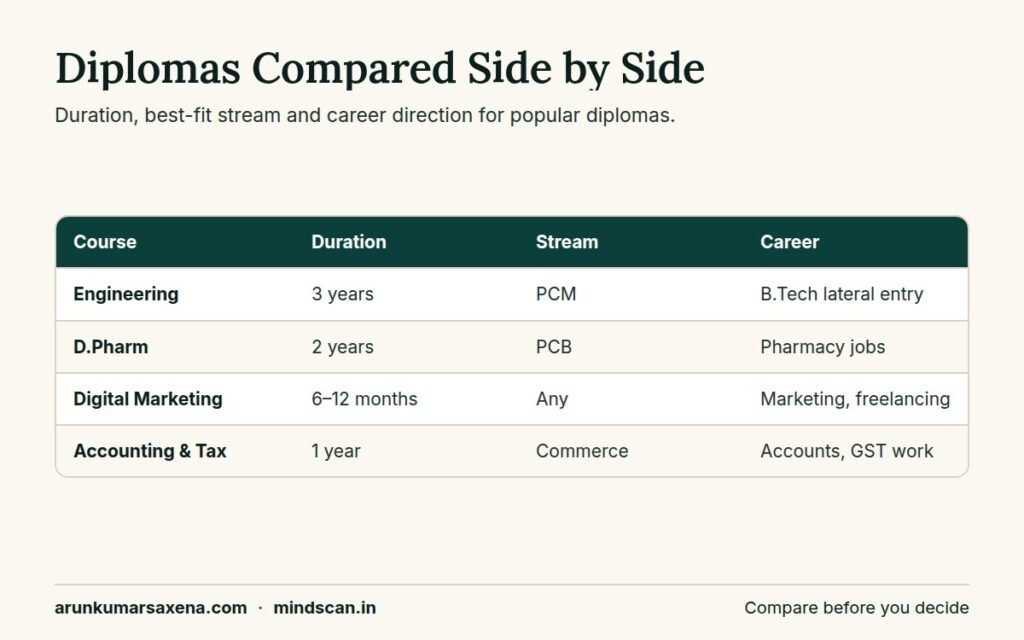
| Course | Typical duration | Best-fit stream | Career direction |
|---|---|---|---|
| Diploma in Engineering | 3 years | Science (PCM) | Lateral entry to B.Tech, core engineering jobs |
| D.Pharm | 2 years | Science (PCB) | Pharmacy, chemist, pharma industry |
| DMLT / GNM Nursing | 2 to 3 years | Science (PCB) | Labs, hospitals, patient care |
| Digital Marketing | 6 months to 1 year | Any stream | Marketing roles, freelancing, agency work |
| Accounting and Taxation | 1 year | Commerce | Accounts, GST filing, bookkeeping |
| Banking and Finance | 1 to 2 years | Commerce | Banking operations, credit and loan processing |
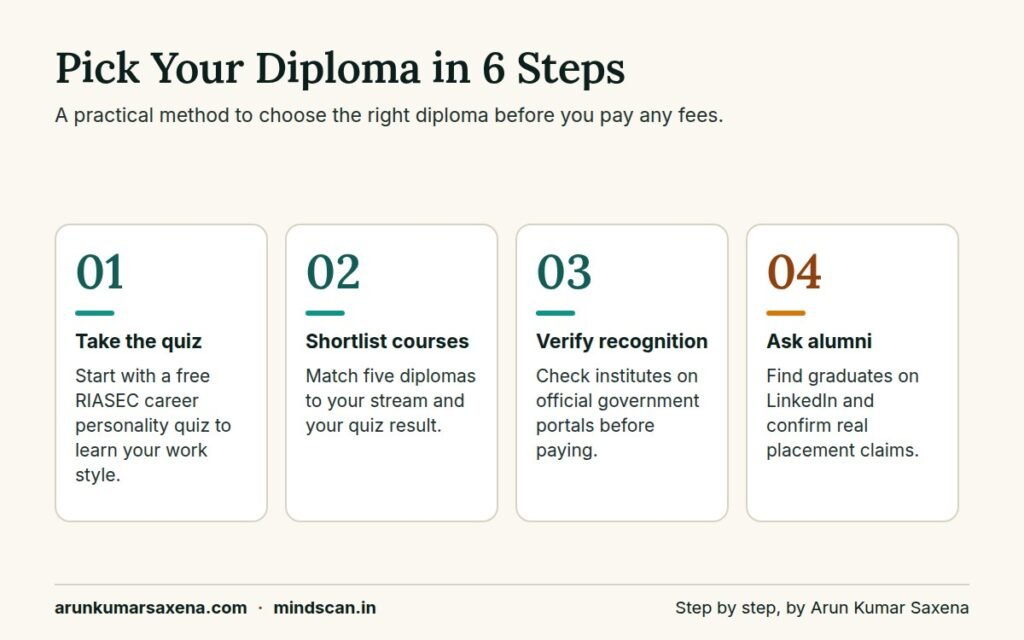
How do I choose the right diploma for me? A step-by-step method.
Start with self-knowledge, not course brochures. Verify your aptitude and interests with a scientific assessment, shortlist courses matching your stream, check recognition and placement evidence, and speak to someone working in that field before you pay fees. This is exactly the process used in professional career counselling.
“Don’t pressurise your child either to appear for NEET or to drop after the first setback. Analyse your child’s aptitude scientifically and check the scores critically before taking any decision.” (Arun Kumar Saxena)
Self-knowledge must come before any career choice, as laid out in the book ‘3 Steps to Knowing Yourself’ by Arun Kumar Saxena. A psychometric assessment maps your strengths to career groups objectively. The MINDSCAN report maps students to 20+ career groups, removing the guesswork that a typical dinner-table argument over Science versus Commerce never resolves.
- Take the free RIASEC career personality quiz to understand your natural work style.
- Shortlist five diplomas that match your stream and your quiz result.
- Check each course’s recognition on official government portals like Skill India Digital and NCS.
- Verify placement claims: find alumni on LinkedIn and ask them directly.
- Speak to a working professional in the field about real day-to-day work.
- Compare total fees, duration and whether the course leads to a licensed or regulated role.
- If still confused, get a psychometric assessment and a counselling session before paying fees.
Course choice must fit the student, not family admiration. Learning how to choose the right career after 12th with a structured method often makes the difference between a diploma that becomes a career and a diploma that becomes a story about wasted fees.
What mistakes do students make while picking a diploma after 12th?
The most common mistakes are copying friends, chasing advertised salaries, enrolling in unrecognised institutes, and choosing a field without checking aptitude. Families also often pick a course purely because a relative succeeded in it, which ignores the student’s own strengths and interests.
Copycat choices based on a relative’s career frequently lead to mid-course dropouts. A results-day scene I have seen too many times: a student opens a marksheet, the family huddles, and within hours a cousin’s diploma course is picked because that cousin got a job. Twelve months later the student has either dropped out or is attending classes with zero interest. The diploma was never the problem; the method of choosing it was.
Verify institute credentials on official portals before paying any fee, and treat any unsolicited job-plus-diploma offer as a red flag until proven otherwise.
Frequently asked questions about best diploma courses after 12th
Is a 6-month diploma valid after 12th?
Yes, a 6-month diploma is valid if the issuing body is a recognised university, board or government skilling body. It is a skill qualification, not a degree, so it cannot replace a degree where one is required. Always verify the certifying body on the Skill India Digital Hub before enrolling in any short-term diploma options after 12th.
Can I do a diploma after 12th fail?
Many certificate and short-term skill programmes accept students without a cleared 12th, and some diploma paths are open through open schooling. Clearing 12th through open boards is usually the better first step because it keeps all diploma and degree options open. A failed 12th narrows the list of diploma courses after 12th significantly.
Can I do B.Tech after a diploma after 12th?
Yes. A 3-year Diploma in Engineering allows lateral entry directly into the 2nd year of a B.Tech programme through entrance routes. This is a well-established and fully recognised path in India, and it makes the engineering diploma one of the most strategic diploma courses after 12th for PCM students.
Are online diploma courses after 12th worth it?
Online diplomas are worth it for skill fields like digital marketing, design and computer applications where a portfolio matters more than the classroom. For regulated professions like pharmacy, nursing or engineering, you need recognised in-person programmes with practical training. The best diploma courses after 12th in regulated fields will always have a mandatory practical component.
Which diploma is best for government jobs after 12th?
Diplomas that map to government-recognised roles, including engineering diplomas, D.Pharm, nursing and lab technology, open the most government doors. Check the eligibility column of specific government exam notifications, since some require a degree while others accept diplomas. The best diploma courses after 12th for a government-job aim are those with a licensing body behind them.
How much does a diploma course cost in India?
As per online sources, costs vary widely: short skill diplomas can cost a few thousand rupees, while institutional engineering or paramedical diplomas cost significantly more per year. Ask for the full fee including exam and lab charges before committing to any diploma course after 12th, because the advertised tuition fee is rarely the final number.
Which diploma has the highest salary after 12th?
Regulated healthcare diplomas like D.Pharm and DMLT, and technology diplomas like Computer Science Engineering, tend to have the highest salary potential after 12th. As per online sources, engineering diploma holders commonly earn roughly ₹3 to 6 LPA in early roles, and specialised healthcare diplomas can start higher in metro markets. No diploma guarantees a high salary on its own; salary follows the skill depth, portfolio and city you work in.
हिंदी में जवाब: हिंदी में जवाब: 12वीं के बाद डिप्लोमा कोर्स FAQ
12 वीं के बाद सबसे अच्छा कोर्स कौन सा है?
12 वीं के बाद सबसे अच्छा कोर्स वह है जो आपकी योग्यता, रुचि और करियर लक्ष्य से मेल खाता हो। साइंस के छात्रों के लिए इंजीनियरिंग डिप्लोमा, डी.फार्मा और डीएमएलटी अच्छे विकल्प हैं। कॉमर्स के लिए बैंकिंग, अकाउंटिंग और डिजिटल मार्केटिंग उपयुक्त हैं। अरुण कुमार सक्सेना सलाह देते हैं कि किसी की नकल करने से पहले अपनी योग्यता की जाँच करें।
12वीं के बाद कौन से 6 महीने के कोर्स उपलब्ध हैं?
12वीं के बाद 6 महीने के डिप्लोमा कोर्स में डिजिटल मार्केटिंग, कंप्यूटर एप्लीकेशन, जीएसटी के साथ अकाउंटिंग, ग्राफिक डिज़ाइन और वेब डिज़ाइन शामिल हैं। ये कोर्स स्किल बढ़ाने के लिए अच्छे हैं, लेकिन ये डिग्री का स्थान नहीं ले सकते। नौकरी पाने के लिए इनके साथ पोर्टफोलियो या इंटर्नशिप ज़रूरी है। फीस भरने से पहले संस्थान की मान्यता अवश्य जाँचें।
कौन सी पढ़ाई ज्यादा सैलरी देती है?
ऑनलाइन स्रोतों के अनुसार, इंजीनियरिंग डिप्लोमा धारक शुरुआती भूमिकाओं में लगभग ₹3 से 6 लाख प्रति वर्ष कमाते हैं। स्वास्थ्य सेवा और टेक्नोलॉजी के विशेष डिप्लोमा मेट्रो शहरों में अधिक सैलरी दे सकते हैं। लेकिन कोई भी कोर्स केवल सैलरी की गारंटी नहीं देता; सैलरी आपकी स्किल, पोर्टफोलियो और शहर पर निर्भर करती है। संस्थान के दावों की जाँच पूर्व छात्रों से करें।
The search for the best diploma courses after 12th ends not with a list but with a mirror. Know your aptitude, check your stream, verify the institute, and talk to someone doing the job. These steps will protect you from the most common and costly mistakes I see in my counselling sessions every admissions season. If the decision still feels tangled, do not rely on a neighbour’s suggestion or a Facebook ad.
Get a scientific psychometric assessment and a session that maps your strengths to real careers before you pay a single rupee in tuition. Book your online career counselling in India with Arun Kumar Saxena and discover the full MINDSCAN AI Career Clarity Report, available at ₹1,499, or ₹2,999 with a counselling session. It maps you to 20+ career groups and gives you a verified starting point for one of the biggest decisions you will make. Book career counselling in Hindi or English here.