
How to Become a Lawyer After 10th: Which Stream Is Best?
By Arun Kumar Saxena, Certified Advanced Career Coach and founder of MINDSCAN Career Guidance
Last updated: October 2026 · This guide on how to become a lawyer after 10th is reviewed and refreshed every admission season, so the stream comparisons, CLAT guidance and eligibility details below reflect the current admission cycle, October 2026.
Stream-fit checklist: which stream suits your law goal?
Tick the statements that sound like you, then see your instant verdict.
Your verdict: Tick at least one box to see your stream-fit result.
| Stream | Best-fit law specialisations | CLAT prep time available | Verdict |
|---|---|---|---|
| Arts / Humanities | Criminal, civil, judiciary, BA LLB | Most free time | Best fit for most students |
| Commerce | Corporate, taxation, business law | Moderate | Best for corporate law goals |
| Science (PCM/PCB) | Cyber, environmental, health, patent/IP law | Least free time | Best for tech-heavy legal fields |
Takeaway: For how to become a lawyer after 10th, Humanities/Arts gives the most CLAT prep time and fits most students, Commerce suits corporate law goals, Science fits tech-heavy legal fields, and any stream qualifies you for a 5-year integrated LLB with 45 to 50 percent in Class 12.
How to become a lawyer after 10th starts with one decision: your Class 11 stream. Quick answer: Humanities/Arts is generally the smartest stream for law after 10th, as its subjects overlap with CLAT (the Common Law Admission Test, the national entrance exam for the National Law Universities’ 5-year integrated LLB programmes) and AILET (the All India Law Entrance Test, the entrance exam for National Law University Delhi). Any stream with 45 to 50 percent in Class 12 makes you eligible. The truly best stream is the one that matches your individual aptitude and interests, verified scientifically, not picked from YouTube advice.
What is CLAT and AILET?
CLAT (Common Law Admission Test) is the national entrance exam for the 5-year integrated LLB programmes at India’s National Law Universities. AILET (All India Law Entrance Test) is the separate entrance exam for National Law University Delhi. Both test English, logical reasoning, legal aptitude, current affairs and quantitative techniques. Neither exam requires a specific stream in Class 12.
The question “which stream is best for lawyer after 10th” lands in thousands of Indian homes every year when Class 10 results come out. This page helps students and parents cut through the noise and make a data-verified choice for Class 11, a choice that shapes five years of law study and an entire career. With 22 years of experience and 20,000+ students and professionals guided, I have seen too many students pick a stream for the wrong reasons and pay for it later.
I will give you the honest answer upfront, compare Arts, Commerce and Science head to head, and share a self-fit framework you can use this week. No coaching-institute hype. No one-size-fits-all push. Just what works, backed by real counselling cases and the science of career guidance.
What is a 5-year integrated LLB? A 5-year integrated LLB (such as BA LLB, B.Com LLB, or BBA LLB) is an undergraduate professional law degree pursued immediately after Class 12, combining a bachelor’s degree in arts, commerce, or administration with comprehensive legal education, accredited by the Bar Council of India.
Table of Contents
Which stream is best for lawyer after 10th in India?
No stream is compulsory for law in India, and any stream with 45 to 50 percent in Class 12 makes you eligible for the 5-year integrated LLB. Humanities/Arts is generally the best fit because Political Science, History, Sociology and English overlap with CLAT’s legal reasoning, general knowledge and comprehension sections and leave more time for entrance prep. This is the core answer for most students.
CLAT and AILET test English, logical reasoning, legal aptitude, current affairs and quantitative techniques. They do not test stream-specific syllabus. A Science student who reads the newspaper daily can outscore a Humanities student who neglects current affairs. The stream gives you a base; your daily habits build the result. When families ask “which stream is best for lawyer after 10th”, I remind them that habits matter as much as subjects.
The Class 12 minimum mark is usually 45 to 50 percent, with relaxations for reserved categories as per online sources. If you are still weighing options, see my detailed guide on which stream is best for law after 10th, and for a creative path read for fashion designing which stream after 10th. Always verify the latest official CLAT and AILET notifications before locking your plan. For the authoritative source on legal education rules, read the Bar Council of India’s official legal education and eligibility criteria page, and check the Consortium of NLUs’ official CLAT notification page for this year’s exam dates and syllabus.
“Don’t pressurise your child either to appear for NEET or to drop after the first setback. Analyse your child’s aptitude scientifically and check the scores critically before taking any decision.” (Arun Kumar Saxena)
My honest view is simple. “Best” means best for that specific student. Aptitude verification beats popular opinion every time. The same mistake happens when a 10th grader picks a stream for law because a relative is a lawyer. Verify your own fit first before deciding “which stream is best for lawyer after 10th” for you.
Science and Commerce students become excellent lawyers too, especially in niche fields. The stream is a starting point, not a cage. The answer shifts with your long-term specialisation goal.
Why do most experts recommend Humanities for law?
Humanities is recommended because its subjects overlap heavily with the CLAT and AILET syllabus, and the lighter workload frees hours for entrance prep from Class 11 itself. Political Science gives constitutional basics, History builds the general knowledge CLAT rewards, Sociology develops social context, and English strengthens reading comprehension.
Here is what each typical Humanities subject contributes to law entrance prep.
- Political Science: Constitution, governance, rights and federal structure, core to legal reasoning.
- History: Legal history, landmark cases and the broad general knowledge CLAT tests.
- Sociology: Social issues, inequality and public policy, useful for essay and interview rounds.
- English: Reading speed, vocabulary and comprehension, a high-scoring CLAT section as per online sources.
- Economics (optional): Basic policy and regulatory awareness, a bridge to corporate law.
On Reddit and Quora, the consensus among CLAT aspirants is clear. Humanities is the most recommended stream, mainly because it leaves more daily hours for mock tests and newspaper reading. Many toppers come from this stream, but correlation is not causation. They succeed because they use the time well, not because the stream works magic. When debating “which stream is best for lawyer after 10th”, remember that free time is a strategic asset.
Choose Humanities only if you genuinely like its subjects. I have met students who picked it under peer pressure and then struggled with boredom. A bored student does not read The Hindu every morning. And without that habit, the stream’s biggest advantage is lost.
Is Commerce good for becoming a lawyer?
Yes, Commerce is good for becoming a lawyer, with a clear direction. It is ideal if the student is drawn to corporate law, taxation, business law, or a B.Com LLB or BBA LLB route. Economics and Accountancy give financial and regulatory insight that pure Arts does not. For many, the answer is Commerce when corporate law is the target.
Commerce subjects map neatly to law specialisations. Economics teaches market regulation and policy logic. Accountancy builds the numerical comfort that tax law demands. Business Studies introduces company structure and compliance, the daily bread of corporate lawyers. A Commerce student who enjoys these subjects walks into a corporate law classroom with a head start.
B.Com LLB and BBA LLB are recognised 5-year integrated programmes after Class 12 Commerce, within the legal education framework set by the Bar Council of India. Many National Law Universities and private law schools offer them. The curriculum blends legal training with business education, and graduates are sought after by law firms and corporate legal departments.
The honest trade-off is time. Commerce maths and accountancy can compete with CLAT prep hours. A student who finds Accountancy heavy may need to budget weekend hours strictly. I advise Commerce students to start CLAT prep early, in Class 11 itself, and to treat the entrance exam as a subject with a fixed weekly timetable, not an afterthought. This time management is key when Commerce is your answer to “which stream is best for lawyer after 10th”.
Can a Science student become a lawyer after 10th?
Science students become lawyers every year and have no eligibility disadvantage. They are well placed for cyber law, environmental law and patent or IP law. The honest cost is that the heavier Science workload leaves less daily time for entrance exam practice. “Which stream is best for lawyer after 10th” can be Science if your interest lies in tech-heavy legal fields.
PCM students fit naturally into cyber law, technology law and patent drafting, where understanding of software, engineering or chemistry gives an edge. PCB students can aim for environmental law, health law or biotechnology-related IP law. These are growing fields in India, and a Science background is a genuine asset, not a compromise.
Entrance prep needs roughly fixed weekly hours regardless of stream. A Science student must time-budget more carefully. One practical approach is to reserve Sunday mornings for CLAT mock tests and to read the newspaper during the school commute. Small, consistent blocks beat occasional marathon sessions.
Students can switch career direction to law from any stream before Class 12 board exams. If you chose Science in Class 11 and now feel law is the real calling, you are not stuck. Your board registration does not lock you out of CLAT.
Arts vs Commerce vs Science for law: which should you pick?
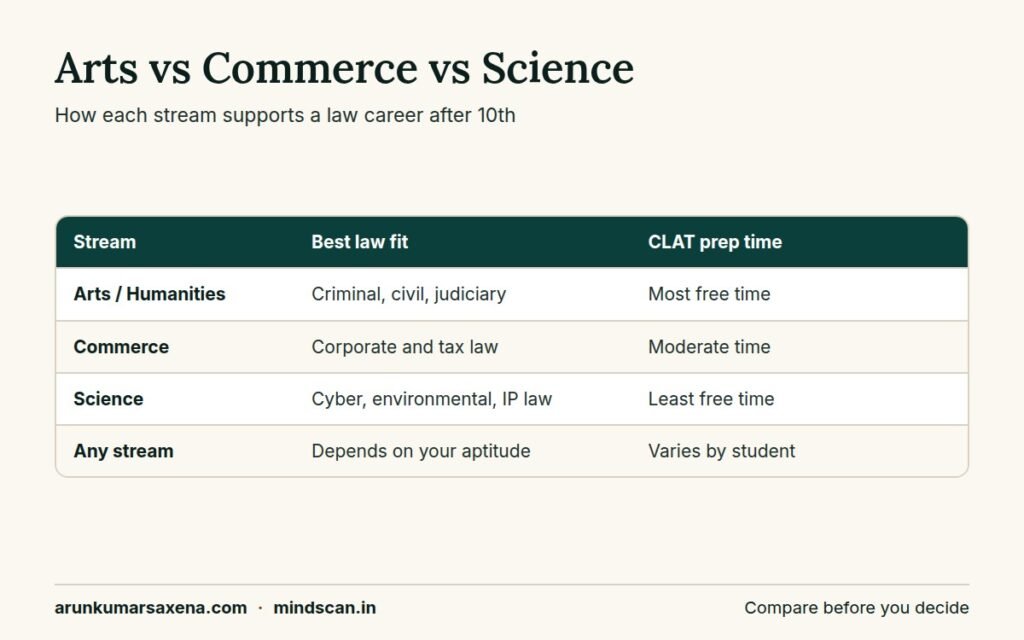
Each stream supports law, but they support it differently. Arts gives the most entrance-exam readiness and suits judiciary-style careers. Commerce fits corporate and tax law. Science opens tech and IP-heavy specialisations. The row to read is the one that matches your own strengths. The question “which stream is best for lawyer after 10th” is answered by matching your strengths to the table below.
Read the table below by matching your interest and aptitude first, then the specialisation. No row is wrong. The free RIASEC career personality quiz and a psychometric assessment are the scientific tie-breakers when you are stuck between two rows.
| Stream | Best law fit | CLAT prep time | Honest caveat |
|---|---|---|---|
| Arts / Humanities | Criminal, civil, judiciary, BA LLB | Most free time | Only if you truly like these subjects |
| Commerce | Corporate, tax, business law | Moderate | Accountancy maths can eat prep time |
| Science (PCM/PCB) | Cyber, environmental, patent/IP law | Least free time | Heavy workload vs entrance prep |
| Any stream + self-fit | Depends on aptitude and interest | Varies by student | Get aptitude verified, not YouTube-advised |
| Stream | Fit with CLAT sections | Best-suited law specialisations | 5-year integrated LLB option |
|---|---|---|---|
| Humanities / Arts | Strongest: Political Science, History and English overlap with legal reasoning, general knowledge and comprehension; most free prep hours | Criminal, civil, judiciary | BA LLB |
| Commerce | Moderate: Accountancy can compete with prep hours; Economics supports current-affairs and policy awareness | Corporate, taxation, business law | B.Com LLB, BBA LLB |
| Science (PCM/PCB) | Hardest: heavy workload leaves least free time; maths base helps quantitative techniques | Cyber, environmental, health, patent/IP law | BA LLB (or B.Sc LLB, as noted on this page) |
| Stream | Subjects offered | CLAT/AILET prep fit | Law specialisations it points toward | Best-fit student profile |
|---|---|---|---|---|
| Arts / Humanities | Political Science, History, Sociology, English, optional Economics | Strongest: subjects overlap the syllabus, most free prep hours | Criminal, civil, judiciary, BA LLB | Students who love reading, public affairs and want maximum entrance-prep time |
| Commerce | Accountancy, Business Studies, Economics, Maths | Moderate: Accountancy can compete with prep hours | Corporate, taxation, business law; B.Com LLB, BBA LLB | Students drawn to markets, finance and corporate careers |
| Science (PCM/PCB) | Physics, Chemistry, Maths/Biology | Hardest: heavy workload leaves least free time | Cyber, environmental, health, patent/IP law | Students excited by technology or science-heavy legal fields |
Once you have a tentative stream, read about career options after 12th in Arts or the best courses after 12th Commerce to see the full picture. If you are still unsure, the next section gives you a step-by-step framework to decide before your school admission deadline.
How do you know which stream suits YOU before Class 11?
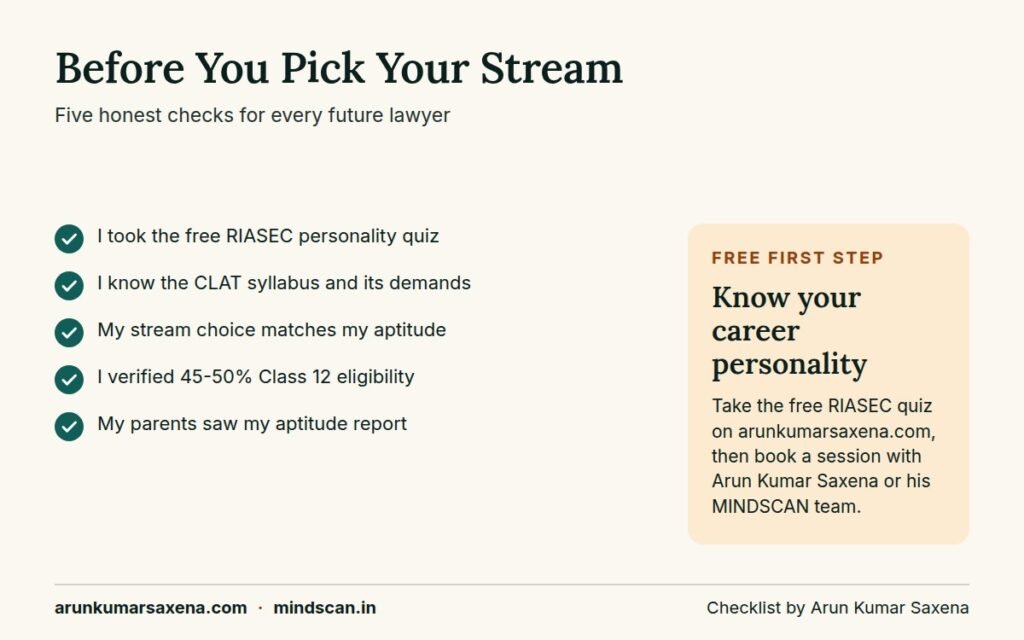
My book “3 Steps to Knowing Yourself” holds that self-knowledge must come before any career choice. Instead of copying toppers, a student should verify interests, aptitude and personality scientifically, then map them to a stream and a target law specialisation. The stream should follow the direction, not the other way round. This self-fit process is the only reliable way to answer “which stream is best for lawyer after 10th”.
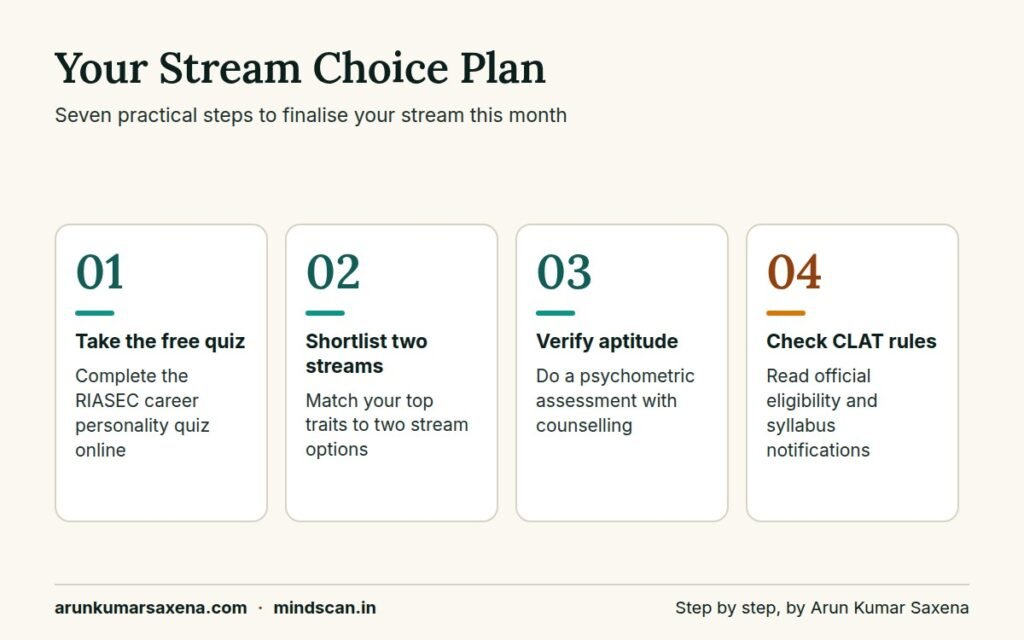
Here is the practical sequence I use in my sessions. First, self-assessment. Take the free RIASEC quiz and note your top traits. List your favourite and least favourite Class 10 subjects and be honest about why. Second, verified shortlist. A psychometric assessment maps students to 20+ career groups. This step catches mismatches early. Third, stream selection with parents. Share the verified shortlist, discuss the workload and prep-time trade-offs, and pick the stream that fits the evidence, not a relative’s opinion.
My rule of radical honesty is this. No stream choice should be made on coaching-institute hype. A stream that keeps all options open but kills your confidence closes more doors than it opens. When you ask “which stream is best for lawyer after 10th”, protect your confidence as much as your options.
The free RIASEC career personality quiz is your immediate zero-cost first step this week. It takes under ten minutes and gives you a starting vocabulary for your interests. From there, if you need deeper clarity, the MINDSCAN psychometric assessment with its AI Career Clarity Report on mindscan.in maps your aptitude and interests to 20+ career groups. Online career counselling in India with Arun Kumar Saxena then combines that report with a one-on-one session where we map it to a stream and a law specialisation.
What are the steps to become a lawyer in India after 10th? (Reviewed October 2026)
The clean path is simple. Choose your stream in Class 11, keep Class 12 marks above the 45 to 50 percent bar, prepare for CLAT or AILET alongside boards, take the entrance exam in the Class 12 year, join a 5-year integrated LLB, then register with the State Bar Council to practise. This path starts with the right answer to “which stream is best for lawyer after 10th”.
Law is never entered directly after 10th. A diploma cannot make you a lawyer. Any advertisement that claims otherwise is misleading. The minimum path is Class 12 in any stream, an entrance exam, then an LLB. The 3-year LLB route after graduation is an alternative entry point for those who decide on law later.
CLAT, AILET and state or university-level tests are the main gates. CLAT is the primary route to National Law Universities. AILET is for National Law University Delhi. Several states and private universities conduct their own tests. Prepare for CLAT as the primary option and treat others as backups.
Here is the step-by-step action plan for a Class 10 student who wants to become a lawyer.
Steps to become a lawyer in India after 10th
- Pick your stream after 10th based on aptitude and interest, not popular opinion.
- Verify your aptitude and fit scientifically before admission.
- Choose Class 11 subjects aligned to CLAT areas: English, legal aptitude, current affairs, logical reasoning and quantitative techniques.
- Complete Class 12 with the stated 45 to 50 percent minimum.
- Appear for CLAT and/or AILET in your Class 12 year.
- Join a 5-year integrated LLB: BA LLB, B.Com LLB or BBA LLB.
- Keep a specialisation direction, criminal, civil, corporate, cyber or similar, to sharpen in college.
This is the honest answer to how to become a lawyer after 10th: there is no LLB after 10th shortcut, only a well-planned Class 11 to LLB path.
- Take the free RIASEC career personality quiz this week and note your top traits.
- List your favourite and least favourite Class 10 subjects; be honest about why.
- Shortlist 2 streams that fit your traits and a tentative law specialisation for each.
- Verify aptitude scientifically with the MINDSCAN psychometric assessment on mindscan.in and a counselling session.
- Check the latest CLAT/AILET eligibility and syllabus on official notifications.
- Fix a weekly CLAT prep timetable that fits beside your Class 11 workload.
- Share the plan with your parents and school counsellor before admission season.
For a broader framework on making career decisions, read my guide on how to choose the right career after 12th. The principles apply equally to stream selection after 10th.
What is the qualification for a lawyer in India?
Pass Class 12 in any stream with the required minimum marks, usually 45 to 50 percent as per online sources, with relaxations for reserved categories. Qualify a recognised law entrance exam. Complete an LLB, either 3-year after graduation or 5-year integrated, from a recognised university. Enrol with the Bar Council to practise. The stream you pick must simply meet this eligibility bar.
Stream and board, CBSE, ICSE or State, do not restrict eligibility. A State board Humanities student and a CBSE Science student sit the same CLAT paper and compete on the same merit list. The Bar Council of India governs the final enrolment, and its norms apply uniformly.
Check the official CLAT, AILET and Bar Council of India notifications each year. Eligibility criteria can change. The National Career Service portal, Government of India also maintains official career information for lawyer qualifications and pathways.
Which law specialisation should a 10th grader aim for?
Specialisation is chosen years later, so a 10th grader should only keep a tentative direction. Corporate and tax law if Commerce feels natural. Cyber and IP law if tech excites you. Criminal, civil and judiciary if Humanities and public affairs energise you. The stream should follow the direction, not the other way round. This connects directly back to “which stream is best for lawyer after 10th” for your future focus.
Popular specialisations include corporate, criminal, civil, cyber, tax, intellectual property, environmental and legal journalism. Most law students explore these through internships and moot courts in the first three years of the 5-year programme. The real choice sharpens in college, not in Class 11.
Do not lock a specialisation now based on TV dramas or one-off advice from a relative. Keep a direction, stay curious, and let evidence from your own performance guide the final call.
The Finology Legal guide on the best stream for law after 10th offers another useful perspective on how stream and specialisation connect. Read it alongside this page to build your own informed view.
Which stream is best for lawyer after 10th if I am unsure?
If you are genuinely unsure, start with Humanities. It gives you the most free time for CLAT prep and the broadest subject overlap. You can always pivot your specialisation later. The key is to verify your aptitude now, not to wait until Class 12. A psychometric assessment removes the guesswork when you feel stuck between two options.
Frequently asked questions about which stream is best for lawyer after 10th
Can I join law without CLAT?
Yes. CLAT is not the only gate. AILET, state and university-level entrance tests and some college-level admissions exist. The 3-year LLB route after graduation has different entry rules. However, CLAT remains the main route to National Law Universities, so prepare for it as the primary option and treat others as backups.
What is the qualification for a lawyer in India after 12th?
Class 12 in any stream with usually 45 to 50 percent marks as per online sources, a qualified entrance exam score, and completion of a 5-year integrated LLB or a 3-year LLB after graduation, followed by Bar Council enrolment. Verify current-year criteria on the official CLAT and AILET notifications before applying.
What is a lawyer’s salary in India?
Starting salaries vary hugely by college, city and type of practice. A fresh litigation associate may earn a modest stipend, while a top National Law University graduate placed in a corporate firm can draw a high package. As per online sources, specialisation and reputation drive earnings over time, not the school stream.
Can a lawyer earn 1 crore in India?
Yes, but only at the top tier. Senior advocates, top corporate partners and highly specialised lawyers can reach that level after years of practice. This is a long-tail outcome, not a Class 11 planning assumption. Build your foundation on aptitude first, not on a distant salary figure.
Is Humanities ‘easy’ compared to Science for law?
Reject the ‘easy stream’ framing. Humanities is lighter in workload than Science, which helps CLAT prep, but it still demands reading, writing and current-affairs discipline. The right question is fit, not ease. A Humanities student who skips the newspaper loses the stream’s main advantage.
Can we choose a stream after 10th if we are unsure?
Yes. Stream selection happens after Class 10 results. Students unsure of their fit should complete self-assessment before school admission deadlines. Take the free RIASEC quiz now. If still unclear, a psychometric assessment with counselling gives you a verified shortlist you can discuss with your parents confidently.
How to become a lawyer after 10th directly?
You cannot become a lawyer directly after 10th. The minimum path is Class 12 in any stream, an entrance exam, then an LLB. Any course that says you can practise law without Class 12 and an LLB is misleading.
After 10th, which class should I choose to become a lawyer, 11th Arts, Commerce or Science?
For most students asking which stream is best for law, Class 11 Arts (Humanities) is the natural choice, because Political Science, History and English overlap with the CLAT syllabus and leave more prep time. Commerce suits future corporate and tax lawyers, and Science fits tech and IP fields. For studying law which stream is best still depends on your verified aptitude, not popular opinion.
Can I take Science in 11th and still do law later?
Yes. Any stream with 45 to 50 percent in Class 12 makes you eligible for the 5-year integrated LLB, so Science never blocks law. It suits cyber law, environmental law and patent or IP law best. The trade-off is time: the heavier Science workload means you must time-budget CLAT prep more strictly. You can also switch direction before Class 12 boards.
How do I prepare for CLAT alongside Class 11 studies?
Treat CLAT as a subject with a fixed weekly timetable from Class 11 itself. Read the newspaper daily, reserve a slot each week for mock tests, and cover English, logical reasoning, legal aptitude, current affairs and quantitative techniques steadily. Career coach Arun Kumar Saxena advises small, consistent blocks over occasional marathon sessions, starting from Class 11, not Class 12.
What subjects in Class 11 help with CLAT and AILET preparation?
Class 11 Political Science builds constitutional basics for legal reasoning, History strengthens the general knowledge CLAT tests, Sociology adds social context, and English sharpens reading comprehension. CLAT and AILET test no stream-specific syllabus, so for law which stream is best comes down to which subjects free your daily hours for this practice. Arts overlaps the most.
Which law specialisations suit a Commerce or Science student?
Commerce students fit corporate law, taxation, business law and a B.Com LLB or BBA LLB route, where Economics and Accountancy give real financial insight. Science students fit cyber law, environmental law, health law and patent or IP law, where their subject base is an asset. For becoming a lawyer which stream is best is the one that matches your long-term specialisation.
To go deeper on the comparison, read which stream is best for law after 10th, and if you are stuck between two options, a psychometric assessment with online career counselling in India gives you a verified shortlist.
Can I change my stream in Class 11 or 12 if I realise it does not fit my law goal?
Yes, you can switch streams after 10th if you pick the wrong one for law: you can usually switch early in Class 11, within the first few months, subject to your school and board rules. CLAT and AILET do not require a specific stream, so a change is workable. But switching mid-session is stressful. Before re-deciding, I recommend a psychometric assessment to verify that law genuinely fits your natural strengths, not just a passing interest.
Do I need maths in Class 11 or 12 to become a lawyer?
No, maths is not compulsory in Class 11 or 12 to become a lawyer. Any stream with the required Class 12 marks makes you eligible for a 5-year integrated LLB. CLAT does have a quantitative techniques section, but it tests basic school-level maths, which Commerce or standard Class 10 maths comfortably covers with practice.
Which 11th subjects within Commerce or Science help most for law?
Within Commerce, Economics and Business Studies help most, because they build the policy, regulation and company-law awareness that corporate and tax law demand, and Maths supports CLAT’s quantitative techniques. Within Science, English remains vital for reading comprehension, and Physics-Chemistry-Maths or Biology supports cyber, environmental, health and patent or IP law later. To see where each stream leads, read about the best courses after 12th Commerce.
How early should I start preparing for CLAT after 10th?
Start from Class 11 itself, not Class 12. Treat CLAT as a subject with a fixed weekly timetable: read the newspaper daily for current affairs, build vocabulary and reading speed through English, and reserve a slot each week for mock tests. Career coach Arun Kumar Saxena advises small, consistent blocks over occasional marathon sessions, so two steady years beat one rushed year.
What is the difference between BA LLB, B.Com LLB and BBA LLB after 10th?
All three are 5-year integrated LLB degrees you join after Class 12, so planning how to become a lawyer in India after 10th really means picking among them. BA LLB combines law with arts subjects and suits criminal, civil and judiciary careers. B.Com LLB blends law with commerce for corporate and tax law. BBA LLB adds business administration for corporate legal roles. Your Class 11 stream should point toward the degree that fits your direction.
Can I switch streams after 10th if I pick the wrong one for law?
Yes, but act early. You can usually switch within the first few months of Class 11, subject to your school and board rules, so verify fit before admission rather than after. CLAT and AILET accept any stream, and a switch before Class 12 boards does not block your LLB eligibility. For a wider view of paths, see career options after 12th in Arts.
Which 5-year integrated LLB degree suits each stream after 10th?
Humanities/Arts fits the BA LLB programme, which is the classic path for criminal, civil, and judiciary careers. Commerce students often choose B.Com LLB or BBA LLB for corporate, tax, and business law. Science students commonly take BA LLB or, as noted, B.Sc LLB for emerging fields like cyber and patent law. This choice decides which 5-year integrated LLB degree you pursue.
Which subjects should I actually pick within Humanities in Class 11 for law?
Pick Political Science for constitutional basics, History for the general knowledge CLAT tests, and English for reading comprehension. Add Sociology and, optionally, Economics as a bridge to corporate law. Remember, CLAT and AILET test no stream-specific syllabus. For a wider view of paths after this stream, see career options after 12th in Arts.
Which stream is best if I want to become a judge or join civil services through law later?
Humanities/Arts is the best fit. The page notes Arts suits criminal, civil, and judiciary careers, and the BA LLB degree builds exactly the foundation you need. Political Science and History develop the general knowledge that judicial services and civil services exams demand later. I, Arun Kumar Saxena, advise this stream for rule-of-law careers. A verified career path starts with online career counselling in India.
Which stream should I pick if I want corporate law after 10th?
Pick Commerce if corporate law is your target. Accountancy, Business Studies and Economics build the financial and regulatory grounding that corporate and tax law demand, and they point naturally to a B.Com LLB or BBA LLB. If you genuinely prefer Political Science and History, Humanities still works, because CLAT tests no stream-specific syllabus. For the wider business path, see the best courses after 12th Commerce.
How do CLAT and AILET syllabus match with each stream’s Class 11 subjects?
CLAT and AILET test English, logical reasoning, legal aptitude, current affairs and quantitative techniques, as listed in the official CLAT syllabus from the Consortium of NLUs. Humanities subjects overlap the most: Political Science aids legal reasoning, History and Sociology feed general knowledge, and English sharpens comprehension. Economics in Commerce supports current-affairs awareness, while any stream’s Class 10 maths base covers quantitative techniques with steady practice.
Is LLB after 10th possible, and which integrated LLB fits each stream?
You cannot start an LLB after 10th; the degree begins only after Class 12. When families search for law courses after 10th, the real planning choice is the integrated degree: Humanities leads to BA LLB, Commerce to B.Com LLB or BBA LLB, and Science usually to BA LLB or B.Sc LLB for tech-linked legal fields.
Can a Science student prepare for CLAT while handling a heavier Class 11 workload?
Yes. A Science student can prepare for CLAT by treating it as a subject with a fixed weekly timetable. Reserve Sunday mornings for mock tests, read the newspaper during the school commute, and lean on your maths base for quantitative techniques. Small, consistent blocks beat marathon sessions that a heavy Class 11 schedule cannot sustain.
How do I verify my aptitude for law before choosing a stream after 10th?
Start with the free RIASEC career personality quiz, then verify with a psychometric assessment and a counselling session before your school admission deadline. Career coach Arun Kumar Saxena has used this data-verified method across 22 years and 20,000+ students and professionals guided, because aptitude evidence beats peer pressure. Book online career counselling in India to get a verified shortlist.
How long does it take to become a lawyer after 10th, step by step?
Planning how to become a lawyer in India after 10th takes about seven years in total: two years of Class 11 and 12 with 45 to 50 percent marks, the CLAT or AILET entrance exam in the Class 12 year, and then the 5-year integrated LLB. For help planning each step, see my guide on how to choose the right career after 12th.
What exams do I have to give after 12th to get into law, and can I join law without CLAT?
After 12th, the main exams are CLAT for the National Law Universities, AILET for National Law University Delhi, and several state and private university tests. You can join many private and state law colleges without CLAT, but the degree itself must still be a recognised 5-year integrated LLB or 3-year LLB. Treat CLAT as primary and the others as backups, and verify each year’s notifications.
What subjects should I choose in Class 11 if my school does not offer Humanities with Political Science?
Take the Humanities combination your school does offer, keeping English and History if possible, because CLAT and AILET test no stream-specific syllabus. Cover Political Science basics and current affairs through daily newspaper reading and standard resources outside school. Many successful law aspirants prepare without Political Science in Class 11; your self-study habits matter more than one missing subject.
What daily habits should a Class 11 student build alongside school to prepare for CLAT?
Arun Kumar Saxena advises Class 11 students to read a newspaper daily for current affairs, solve a short logical reasoning set every day, read one opinion piece or editorial to build comprehension, and keep a weekly slot for section tests. Small, consistent blocks beside school work beat weekend marathons. To check which stream and habits fit you first, start with the free RIASEC career personality quiz.
हिंदी में जवाब: 10वीं के बाद वकील बनने के लिए कौन सी स्ट्रीम सबसे अच्छी है?
10वीं के बाद 11वीं में कौन-कौन से सब्जेक्ट होते हैं?
10वीं के बाद 11वीं में आप तीन मुख्य स्ट्रीम में से कोई भी चुन सकते हैं: आर्ट्स/ह्यूमैनिटीज़ (इतिहास, राजनीति विज्ञान, समाजशास्त्र, अंग्रेज़ी), कॉमर्स (अकाउंटेंसी, बिज़नेस स्टडीज़, अर्थशास्त्र) या साइंस (फिज़िक्स, केमिस्ट्री, मैथ्स/बायोलॉजी)। वकील बनने के लिए कोई भी स्ट्रीम मान्य है, परंतु अरुण कुमार सक्सेना के अनुसार, स्ट्रीम का चुनाव आपकी रुचि और एप्टीट्यूड के आधार पर होना चाहिए, न कि केवल लोकप्रिय राय पर।
10वीं के बाद वकील बनने के लिए कौन सी स्ट्रीम सबसे अच्छी है?
सामान्यतः ह्यूमैनिटीज़/आर्ट्स सबसे अच्छी स्ट्रीम है, क्योंकि इसके विषय CLAT और AILET की तैयारी में सीधे मदद करते हैं और पढ़ाई का बोझ कम होने से प्रवेश परीक्षा की तैयारी के लिए अधिक समय मिलता है। लेकिन अरुण कुमार सक्सेना का स्पष्ट मत है कि यदि आपकी रुचि और एप्टीट्यूड कॉर्पोरेट या टैक्स लॉ में है तो कॉमर्स, और साइबर या पेटेंट लॉ में है तो साइंस बेहतर विकल्प हो सकता है। निर्णय हमेशा वैज्ञानिक एप्टीट्यूड जाँच पर आधारित हो।
10वीं के बाद कौन सी परीक्षा देनी चाहिए?
10वीं के तुरंत बाद वकील बनने के लिए कोई प्रवेश परीक्षा नहीं होती। पहले 11वीं और 12वीं पूरी करें। 12वीं के बाद CLAT (क्लैट) मुख्य राष्ट्रीय परीक्षा है, जो नेशनल लॉ यूनिवर्सिटीज़ में दाखिले का रास्ता है। इसके अलावा AILET, राज्य स्तरीय और विश्वविद्यालय स्तरीय लॉ प्रवेश परीक्षाएँ भी होती हैं। 12वीं में ही इनकी तैयारी शुरू करें।
12 वीं के बाद सबसे अच्छा कोर्स कौन सा है?
12वीं के बाद वकील बनने के लिए 5 वर्षीय इंटीग्रेटेड LLB कोर्स सबसे सीधा रास्ता है। इसमें BA LLB, B.Com LLB और B.Sc LLB जैसे विकल्प शामिल हैं। BA LLB सबसे लोकप्रिय है और सिविल, क्रिमिनल तथा न्यायपालिका क्षेत्रों के लिए उपयुक्त है। B.Com LLB कॉर्पोरेट और टैक्स लॉ के लिए, और B.Sc LLB साइबर तथा पेटेंट लॉ के लिए अच्छा है। अपनी स्ट्रीम और रुचि के अनुसार चुनें।
Choosing which stream is best for lawyer after 10th is a decision that shapes your Class 11, your CLAT prep and your first five years of law study. Do not leave it to a YouTube video or a relative’s casual suggestion. Get your aptitude verified, match your stream to your strengths, and walk into Class 11 with a clear plan.
Book online career counselling in India with Arun Kumar Saxena for a one-on-one session where we analyse your psychometric report together. Or start with the MINDSCAN AI Career Clarity Report at ₹1,499 on mindscan.in/psychometric-assessment. Take the MINDSCAN psychometric assessment on mindscan.in for the AI Career Clarity Report, or call +91-9140604743 to book online career counselling with Arun Kumar Saxena and verify your aptitude for law scientifically.
Arun Kumar Saxena
I am Arun Kumar Saxena, Certified Advanced Career Coach and founder of MINDSCAN Career Guidance. Over 22 years, I have guided 20,000+ students and professionals. Before this, I was a corporate leader at Airtel and Reliance. I wrote the book ‘3 Steps to Knowing Yourself’, serve as a CBSE Resource Person, and am a Fellow Member of NHRD Network. This page on how to become a lawyer after 10th reflects my data-verified, radical-honesty approach to stream selection.
Unsure which stream suits you? Take the MINDSCAN psychometric assessment on mindscan.in for the AI Career Clarity Report. Or book online career counselling across India with me or my MINDSCAN team. I review every report. Call +91-9140604743.