
Commerce Mein Kaun Kaun Sa Subject Hota Hai? Full List
By Arun Kumar Saxena, Certified Advanced Career Coach and founder of MINDSCAN Career Guidance
Last updated: November 2026
Commerce is a Class 11-12 stream covering business, finance and economics. Its compulsory subjects are Accountancy, Business Studies, Economics and English, with optional subjects such as Mathematics, Informatics Practices, Entrepreneurship, Physical Education and Legal Studies.
Quick answer: Commerce mein kaun kaun sa subject hota hai? In Class 11 and 12, Commerce has four compulsory subjects: Accountancy, Business Studies, Economics, and English. Students then choose optional subjects like Mathematics or Entrepreneurship. The right combination depends on a student’s aptitude and career goals, not on trends or peer pressure.
Commerce mein kaun kaun sa subject hota hai is the first question that hits a student and their parents the moment the Class 10 board exams end. Commerce is a Class 11 to 12 stream covering business, finance and economics through Accountancy, Business Studies, Economics and English. The answer is more than a simple list.
The subjects you pick in Class 11 Commerce set the foundation for your college degree, your professional course, and your first job. A wrong optional subject can close doors to careers in finance, economics, and data science, while a well-chosen one can make the next five years smoother and more focused.
With 22 years of experience and 20,000+ students and professionals guided, I have seen too many capable students struggle simply because they picked a Commerce combination that did not match their real strengths. This page gives you the exact subject list for commerce mein kaun kaun sa subject hota hai, and more importantly, it helps you decide which combination fits you. Read it with your parents, and make a choice based on self-knowledge, not pressure. Start with a free career personality quiz to check your natural inclinations before you even look at a subject list.
Table of Contents
Commerce mein kaun kaun sa subject hota hai in Class 11 and 12?
Commerce mein kaun kaun sa subject hota hai has a straightforward answer at its core. Every Commerce student in Class 11 and 12 studies four compulsory subjects, and then adds one or two optional subjects depending on the school’s offerings and the student’s career plan. The exact list can vary slightly between boards, so always verify the CBSE Class 11 subject list or your state board’s curriculum.
The four compulsory subjects are Accountancy, Business Studies, Economics, and English. Accountancy teaches you how to record, classify, and summarise financial transactions. Business Studies introduces you to the principles of management, marketing, and how organisations function. Economics covers both micro and macro concepts along with the Indian economy. English is the mandatory language subject in almost every board and helps build communication skills that every Commerce career demands.
After these four, a student typically picks a fifth subject from a list of electives. Many schools also allow a sixth subject, which can act as a backup or an additional area of interest. When a student asks me commerce mein kaun kaun sa subject hota hai, I always add that the real question is not just what the subjects are, but which combination of core and optional subjects will keep the maximum career doors open for that particular student.

What are the compulsory and optional subjects in Commerce?
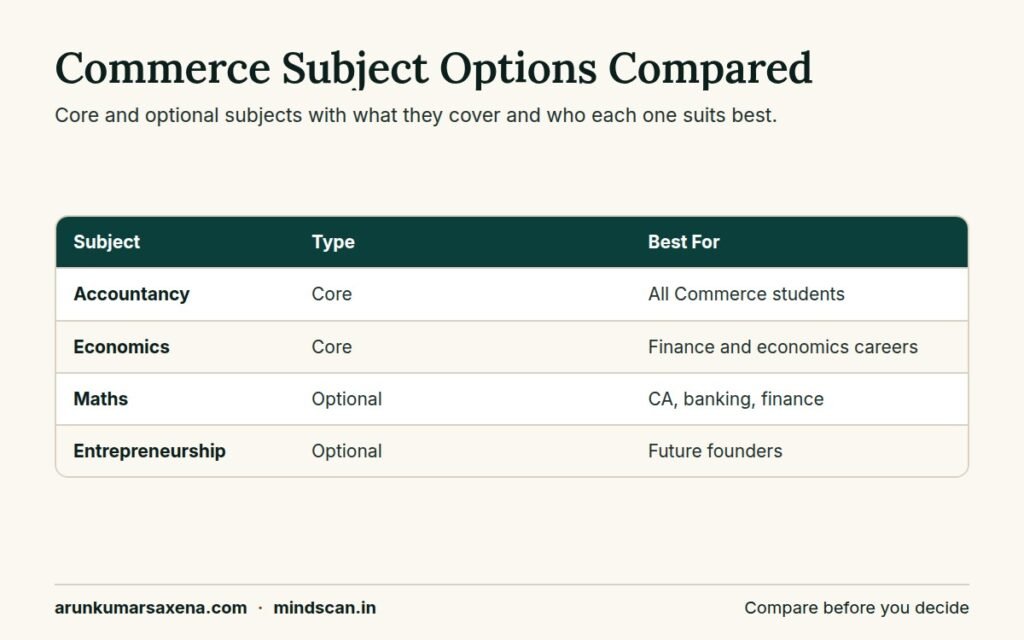
Commerce mein kaun kaun sa subject hota hai is best understood by separating the compulsory core from the electives. The four compulsory subjects are non-negotiable in almost every Indian school board. The optional subjects are where a student and their parents must apply the most thought, because this single choice can determine eligibility for top undergraduate programmes.
Picture a Class 10 student who has just received her results. She knows she wants Commerce, but the school sends a form with ten subject codes and asks her to pick a fifth and sixth option. Without a clear understanding of what each subject unlocks, the decision often comes down to a friend’s advice or a relative’s suggestion. A more reliable way is to map each subject to the career doors it keeps open.
| Subject | Type | Career Doors It Keeps Open |
|---|---|---|
| Accountancy | Compulsory | CA, CFA, Financial Analyst, Auditor, Tax Consultant |
| Business Studies | Compulsory | Management, Marketing, HR, Entrepreneurship, Family Business |
| Economics | Compulsory | Economics Honours, Actuarial Science, Policy Research, RBI Grade B |
| English | Compulsory | All careers requiring communication, Law, Mass Communication |
| Mathematics | Optional | Economics Honours, B.Com (Hons), BBA, Data Science, Actuarial Science, Banking |
| Informatics Practices | Optional | B.Com (Computer Applications), BCA, Data Analytics, IT roles |
| Entrepreneurship | Optional | BBA, BMS, Family Business, Startup ecosystem, Franchise management |
| Physical Education | Optional | Sports Management, Physiotherapy (with Science in some cases), Fitness industry |
| Legal Studies | Optional | 5-year Integrated Law (B.A. LL.B., B.Com LL.B.), Company Secretary, Legal Analyst |
Is Maths compulsory in Commerce?
Maths is not compulsory in Commerce for most Indian school boards. A student can complete Class 11 and 12 Commerce without Mathematics and still pursue many respected careers. The decision to drop Maths should be made only after checking the eligibility criteria of the specific college and course the student is targeting.
Many parents worry that dropping Maths will limit their child’s future. The truth is that it limits some paths and leaves others wide open. A student who drops Maths can still aim for B.Com, BBA, Law, Hotel Management, Mass Communication, and even the UPSC civil services exam. A student who keeps Maths adds Economics Honours, Actuarial Science, Data Analytics, and several top-tier B.Com (Hons) programmes to their options.
The choice is not about smart or less smart; it is about fit. I have seen students with average mathematical ability thrive in marketing and law, and I have seen students who forced themselves to take Maths struggle through two years and lose confidence. Check the Ministry of Education, Government of India guidelines and your target university’s CUET subject requirements before you decide.
What is the difference between Commerce with Maths and without Maths?
The core four subjects stay the same in both combinations. The only difference is the fifth subject. Commerce with Maths replaces the optional subject slot with Mathematics, while Commerce without Maths fills it with Informatics Practices, Entrepreneurship, Physical Education, Legal Studies, or another elective offered by the school.
This single difference changes the college application picture significantly. A student with Maths can apply for B.Com (Hons) at top Delhi University colleges, for Economics Honours, and for BBA programmes that value quantitative aptitude. A student without Maths focuses on programmes where communication, management principles, and legal reasoning carry more weight. Neither path is superior; they lead to different destinations.
The mistake happens when a student takes Maths without the aptitude for it and then scores poorly, hurting both their Class 12 percentage and their confidence. The safer route is to assess aptitude first and then decide. The National Career Service portal by the Government of India offers additional career exploration resources that can help with this decision.
How to choose the right optional subject in Commerce?
Choosing the right optional subject for commerce mein kaun kaun sa subject hota hai requires a three-step check that goes beyond school handouts. First, identify three career paths that genuinely interest the student. Second, check the Class 12 subject requirements for the top five colleges offering those paths. Third, pick the optional subject that satisfies the maximum requirements while matching the student’s natural strengths.
In many homes, a dinner-table argument breaks out the week after results. The father insists on Maths because a neighbour’s son became an investment banker. The mother suggests Physical Education because it will boost the percentage. The student stays quiet, unsure of what she actually wants. This is where a structured approach helps. Instead of arguing about subjects, the family should first agree on the career direction. Once the destination is clear, the subject choice becomes a logical step rather than an emotional debate.
What most guides miss: the self-knowledge gap before subject selection
Most YouTube videos and school handouts stop at listing the subjects. In my counselling sessions, I notice a pattern that almost no list addresses. A student often picks an optional subject based on three things: what their best friend is taking, what their parents have heard is good, or what feels easy. None of these involve a single minute of looking at the student’s own aptitude or interest profile.
This is why I insist on a self-knowledge first approach. Before you even look at a subject combination sheet, you need a clear picture of where your natural strengths lie. Are you comfortable with numbers and abstract logic, or do you thrive when you are analysing human behaviour and markets? The answer to this question should drive your choice of optional subject. My book ‘3 Steps to Knowing Yourself’ is built entirely on this principle: self-knowledge must come before any stream or career choice. A student who skips this step is essentially building a house without checking the soil.
“Analyse your child’s aptitude scientifically and check the scores critically before taking any decision.” (Arun Kumar Saxena)
A psychometric assessment can add objectivity to this process. The MINDSCAN psychometric assessment report maps the student to 20+ career groups, helping students see which Commerce combination aligns with real career paths. When you know your career group, the subject choice becomes a logical conclusion rather than a guess. Here is a simple step-by-step process I recommend to every family facing the commerce mein kaun kaun sa subject hota hai decision:
- Take a free RIASEC career personality quiz to understand your interest profile.
- List three careers that match your top interest areas and seem genuinely exciting.
- Research the Class 12 subject requirements for the top five colleges offering those careers.
- Identify the one optional subject that keeps the maximum doors open for your chosen paths.
- Discuss the choice with a career coach or a teacher who knows your academic history well.
- Make the final decision based on aptitude evidence, not on peer pressure or hearsay.

Is Commerce harder than Science or Arts?
No stream is objectively harder than another. Commerce suits students who are interested in business, finance, and economic systems. Science demands comfort with laboratory work and mathematical intensity. Arts suits those drawn to humanities, languages, and social sciences. The difficulty a student experiences depends almost entirely on how well the stream matches their natural aptitude.
A student who scored 95 percent in Class 10 Science may struggle in Class 11 Physics if the subject never truly interested them. A student who was average in Class 10 may flourish in Commerce because the subjects connect with how their mind naturally works. The question is not which stream is easier; it is which stream aligns with the student’s thinking style.
A student who enjoys understanding how businesses make money, how markets move, and how financial decisions are made will find Commerce engaging. A student who prefers abstract theories and laboratory experiments will find Science more natural. Fit matters far more than any perceived difficulty level.
Can Commerce students become IAS or get government jobs?
Commerce students are fully eligible for the UPSC Civil Services Examination and most other government job exams after graduation. Several government exams are also open to students immediately after Class 12, including positions in banking, railways, and defence services. The Commerce stream does not block any government career path.
In fact, the Commerce syllabus provides a strong foundation for the Economics and Indian Economy sections of the UPSC prelims and mains. Accountancy and Business Studies build analytical thinking that helps in the decision-making and management aspects of administrative roles. Many successful IAS officers, banking probationary officers, and SSC officers come from a Commerce background.
The key is to plan the undergraduate degree carefully, because the graduation subject can influence which optional paper a candidate chooses for the UPSC mains. Commerce students who keep their options broad and focus on building strong analytical and communication skills are well-positioned for government careers.
What jobs can Commerce students get immediately after Class 12?
Commerce students can apply for several government job exams right after Class 12. Banking sector openings include clerical cadre positions in public sector banks through the IBPS Clerk exam. Railway Recruitment Board exams offer positions like Ticket Collector and Commercial Clerk. Staff Selection Commission exams such as SSC CHSL recruit for Lower Division Clerk and Data Entry Operator roles. Private sector opportunities include entry-level accounting, data entry, and customer service positions. These jobs provide a steady income while a student pursues higher education or professional qualifications like CA or CS.
Which is the easiest job to get after 12th Commerce?
Government clerical posts through SSC CHSL and IBPS Clerk exams are among the most accessible structured jobs for Commerce students after Class 12. The syllabus overlaps significantly with the Commerce curriculum, especially the reasoning and quantitative aptitude sections. Private sector data entry and back-office roles also have a lower entry barrier and can be found through job portals. The term easiest is misleading because every job requires preparation. A student who prepares seriously for the SSC CHSL exam during Class12 can appear for it immediately after results and has a realistic chance of securing a position.
When should I start thinking about my Commerce subjects?
The ideal time to start thinking about commerce mein kaun kaun sa subject hota hai is in Class9 or10. This gives the student and the family enough time to check aptitude, explore careers, and verify college eligibility requirements before the admission window opens after Class10 results. Starting early removes the panic that forces rushed, uninformed decisions.
Most families begin this conversation the day the Class10 results are declared. By then, schools have already started their admission process, and the pressure to fill the form within two days leads to choices based on hearsay. A family that starts in Class9 can spend a year observing the student’s natural interests.
Does the child enjoy tracking stock market news? Does she instinctively calculate discounts and profit margins? Does he read business magazines or follow economic policy debates? These observations, combined with a structured aptitude assessment, make the Class11 subject choice a confident decision rather than a stressful gamble.
Does the subject combination affect CUET and college admission?
Yes, the Class12 subject combination directly affects CUET domain subject eligibility and college admission requirements. Several university programmes, especially in economics and finance, require Mathematics as a Class12 subject. Students who do not check these requirements early can face a rude shock when they discover their dream college is not accepting applications from non-Maths Commerce students.
The Common University Entrance Test has made subject mapping more transparent, but it also means that a Class11 decision locks in or locks out certain CUET domain subjects. A student who wants to apply for B.Com (Hons) at a top central university must typically appear for Accountancy, Business Studies, and one other domain subject in CUET. If the programme requires Mathematics and the student did not take it in Class12, that door closes.
The same applies to Economics Honours programmes, which often mandate Mathematics. Before finalising the Class11 subject combination, download the CUET information bulletin from the official NTA CUET page for the current year and check the subject requirements for at least ten target colleges. This one hour of research can prevent two years of regret.
What are the Class 12 Commerce subjects for B.Com eligibility?
For B.Com eligibility, the Class 12 Commerce subjects are Accountancy, Business Studies, Economics and English as compulsory papers, plus one optional subject. Most B.Com programmes accept any optional, but B.Com (Hons) and economics-focused courses often require Mathematics. Always check your target university’s criteria before choosing, because commerce mein kaun kaun sa subject hota hai is only the starting point.
Frequently asked questions about commerce mein kaun kaun sa subject hota hai
Which is the easiest subject in Commerce?
Difficulty is personal. Many students find Physical Education or Entrepreneurship lighter in terms of theory, but an easy subject should never replace a subject that is necessary for your target career. Choose for your future, not for a slightly lighter study load.
Which subjects should Commerce with Maths students choose for CUET?
Commerce with Maths students should typically choose Accountancy, Business Studies, and Mathematics as their CUET domain subjects. This combination keeps B.Com (Hons), Economics Honours, and BBA programmes open. Always verify the specific programme requirements on the official NTA CUET website before finalising.
Can Commerce students do CA without Maths?
Yes, Maths is not required for CA Foundation or Intermediate. However, the CA course includes logical reasoning and statistics, so comfort with numbers helps. Many successful CAs did not take Maths in Class12.
Is Commerce a good stream for entrepreneurship?
Commerce is an excellent stream for future entrepreneurs. Business Studies and Accountancy teach the fundamentals of running a business, managing finances, and understanding markets. Many successful Indian entrepreneurs started with a Commerce education.
What are the career options after Commerce without Maths?
Career options include B.Com, BBA, Law, Hotel Management, Mass Communication, Company Secretary, Cost Accounting, Fashion Design, and government exams like UPSC and banking. Many creative and management careers do not require Class12 Maths.
How many subjects are there in Commerce Class11?
A Commerce student typically studies five subjects: four compulsory (Accountancy, Business Studies, Economics, English) and one optional. Some schools allow a sixth additional subject, which can serve as a backup or an extra area of interest. For the full degree-level view, see how many subjects are there in commerce across Class 11, 12 and B.Com.
How do CUET subject requirements affect Commerce students?
CUET domain subject choices are locked in by your Class12 subjects. A Commerce student without Maths cannot select Mathematics as a CUET domain subject, which blocks entry to several economics and finance programmes. Check the official NTA CUET bulletin before Class11 admission.
हिंदी में जवाब: कॉमर्स मे कौन-कौन से विषय होते हैं?
कॉमर्स मे कौन-कौन से विषय होते हैं?
कक्षा 11 और 12 मे कॉमर्स के चार अनिवार्य विषय होते हैं: लेखाशास्त्र (Accountancy), व्यवसाय अध्ययन (Business Studies), अर्थशास्त्र (Economics), और अंग्रेजी (English)। इसके बाद छात्र एक या दो वैकल्पिक विषय चुनते हैं, जैसे गिणत, उद्यिमता, सूचना प्रौद्योिगकी, शारीिरक िशक्षा, या वििधक अध्ययन। सही संयोजन छात्र की रुिच और भिवष्य के किरयर लक्षयों पर िनभर् करता है।
क्या कॉमर्स मे गिणत अनिवार्य है?
नही, अिधकांश बोडर्ों मे गिणत वैकल्पिक है। यह सीए, िवत्त, अर्थशास्त्र ऑनसर्स और बैंिकंग किरयर के िलए अनुशंिसत है, लेिकन प्रबंधन, िविध और िवपणन जैसे क्षेत्रों मे इसकी आवश्यकता नही होती। िनणर्य लेने से पहले अपने लक्षित कॉलेज की पात्रता जांच ले।
कॉमर्स के बाद किरयर िवकल्प क्या हैं?
कॉमर्स के बाद सीए, सीएस, बी.कॉम, बीबीए, अर्थशास्त्र ऑनर्स, िविध, पत्रकारिता, होटल प्रबंधन, और सरकारी नौकिरयों जैसे यूपीएससी और बैंिकंग मे किरयर बनाया जा सकता है। अरुण कुमार सक्सेना के अनुसार, सही किरयर चुनने के िलए पहले अपनी योग्यता और रुिच को वैज्ञािनक रूप से जांचना आवश्यक है।
Commerce mein kaun kaun sa subject hota hai is a question that deserves more than a quick list. It deserves a decision that puts your aptitude and your future at the centre. If you are still unsure which optional subject to pick, or if a parent and child disagree on the right combination, one structured online career counselling in India with Arun Kumar Saxena session can bring clarity that lasts for years.
You can also start with the MINDSCAN AI Career Clarity Report, which maps your strengths to career groups and helps you see which subjects may align with your natural abilities.