
Diploma in Nursing After 10th and 12th: The Complete 2026 Guide
By Arun Kumar Saxena, Certified Advanced Career Coach · Updated October 2026
Quick answer: A diploma in nursing is a hospital-based healthcare qualification in India, primarily the GNM course of 3 to 3.5 years including internship. It is usually pursued after 12th, with Science preferred, though many institutions accept other streams. After 10th, the ANM route is possible, but GNM requires 10+2. Verify your genuine fit for patient care before committing.
Definition: A diploma in nursing is a hospital-based qualification in India that trains students for entry-level registered nursing practice, primarily through the GNM course of approximately 3 to 3.5 years including internship. It is taken after 12th, while after 10th the ANM diploma is the realistic entry route.
If you are searching for a diploma in nursing, you are likely a student who has just finished 10th or 12th, or a parent trying to map out a secure, respectable career path. This page cuts through the college directories and gives you one direct decision guide. It covers every practical question: eligibility after 10th and 12th, the real difference between GNM and B.Sc Nursing, admission steps for 2026, salary realities, and whether nursing is the right fit for you at all.
With 22 years of experience and 20,000+ students and professionals guided, I have seen too many students pick nursing for the wrong reasons. A diploma in nursing is a demanding, hands-on healthcare career. It rewards empathy and stamina far more than board-exam marks. This guide will help you decide with your eyes open.
Last updated: October 2026
Table of Contents
What is a diploma in nursing and who is it really for?
A diploma in nursing is a hospital-based nursing qualification in India, primarily the GNM course of approximately 3 to 3.5 years including internship. It prepares you for entry-level registered nursing roles. It suits students who are compassionate, emotionally steady and comfortable with hands-on patient care, hospital shifts and physically demanding work.
GNM is hospital and institution based. It is more clinical and practical than classroom-heavy degree programmes. This makes it a good choice for students who want to start earning earlier than the four-year B.Sc route. The course is not suited to students who only want a ‘safe course’ without a genuine interest in caregiving. In my sessions, I often ask a simple question: can you picture yourself calming a distressed patient in the middle of the night? If the answer is a clear no, this path will exhaust you.
“Analyse your child’s aptitude scientifically and check the scores critically before taking any decision.” (Arun Kumar Saxena)
Can I do a diploma in nursing after 10th?
After 10th, the direct route to a diploma in nursing is not open because GNM requires 10+2. The realistic option is the ANM course, a shorter entry-level nursing and midwifery diploma, or first completing 12th and then entering a GNM diploma in nursing. If you want a wider view of diploma routes after 10th, this guide on what is polytechnic course options is a useful reference. Choose Science with Biology in 11th and 12th to keep every door open.
Quick figures: the ANM course duration is approximately 2 years as per online sources, while the GNM diploma in nursing takes approximately 3 to 3.5 years including internship. Both durations can vary slightly by state council and institution, so verify before applying.
ANM eligibility rules vary by state and institution, so you must verify the current state nursing council norms before applying. The clearest path is to choose Science with Biology in 11th and 12th. This keeps every option open for a diploma in nursing and beyond. Do not close off options at the 10th standard itself.
Diploma in nursing after 12th: what are the eligibility rules in 2026?
For a diploma in nursing after 12th, you need to have passed 10+2 from a recognised board. Science with Physics, Chemistry and Biology (PCB) and English is the preferred combination and is accepted everywhere. Many institutions also accept Arts and Commerce students, but you must check the specific rules of your state nursing council.
Minimum aggregate marks vary by institution and category. Age criteria commonly apply, with a minimum of 17 years at the time of admission. Admission is usually entrance-based or through merit counselling. The revised GNM regulations on the Indian Nursing Council nursing programmes page are the authoritative reference for these age and marks criteria. Always verify the current year’s notification from the Indian Nursing Council and your State Nursing Council website before you shortlist any college.
Quick comparison: which nursing path fits you?
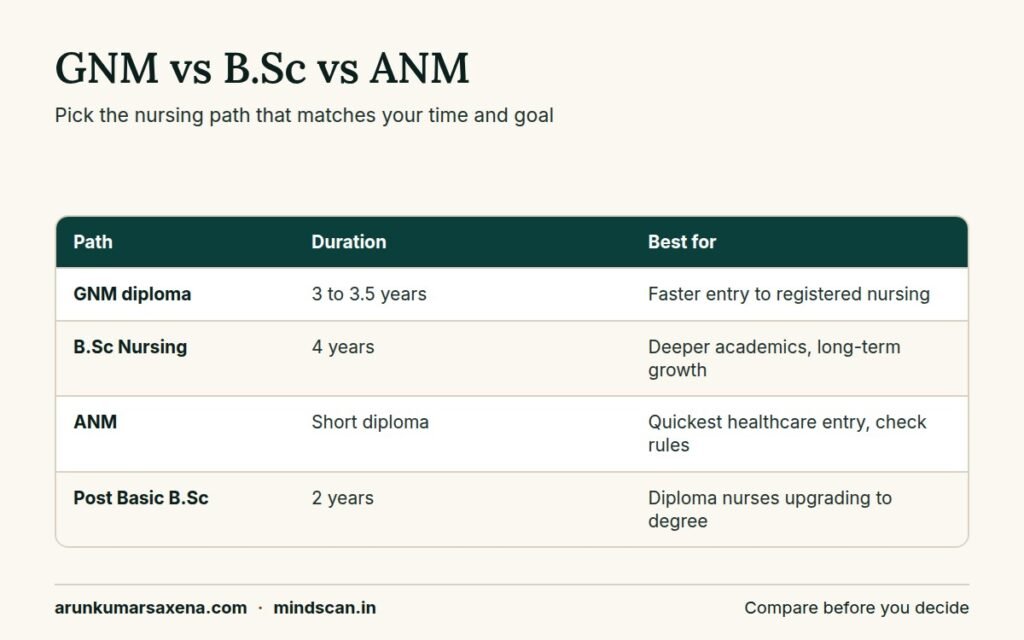
| Path | Duration (approx.) | Entry level | Best suited for |
|---|---|---|---|
| GNM diploma | 3 to 3.5 years including internship | After 12th | Students wanting faster entry into registered nursing practice |
| B.Sc Nursing | 4 years | After 12th (Science preferred) | Students wanting deeper academics and stronger long-term growth |
| ANM | Shorter diploma (as per council norms) | Entry-level nursing/midwifery route | Those seeking the quickest healthcare entry; check state rules |
| Post Basic B.Sc | 2 years (as per institution norms) | After GNM | Diploma nurses upgrading to a degree for career growth |
Duration: approximately 3 to 3.5 years including internship
Entry: after 12th
Focus: hands-on hospital and midwifery training
Best for: faster, more affordable entry into registered nursing practice
Duration: 4 years
Entry: after 12th (Science preferred)
Focus: deeper academic and clinical study
Best for: stronger long-term growth into senior and specialised roles
GNM diploma vs B.Sc Nursing: which should you choose?
GNM is a roughly 3 to 3.5-year diploma focused on practical nursing and midwifery. B.Sc Nursing is a 4-year degree with broader academic depth and often faster progression to senior and specialised roles. Diploma holders can later do a Post Basic B.Sc to upgrade their qualification.
Choose a diploma in nursing if you want a faster, more affordable entry into registered nursing practice. Choose B.Sc if you can invest four years and want a stronger long-term growth ceiling. The standard bridge from a diploma in nursing to a degree is the Post Basic B.Sc Nursing course. Your choice should match your immediate financial needs and your long-term ambition.
Visual walkthrough: GNM vs B.Sc in six steps
- Check your entry level: After 10th, the ANM route is the realistic option; GNM requires 10+2.
- Compare duration: GNM takes approximately 3 to 3.5 years including internship; B.Sc Nursing takes 4 years (as per council norms).
- Verify eligibility: 10+2 pass, minimum age 17 at admission, marks and stream rules per the Indian Nursing Council and your state council.
- Confirm recognition: Shortlist only institutions recognised by the State Nursing Council and the Indian Nursing Council.
- Apply through counselling: Track entrance tests or merit-based counselling dates and confirm your seat before the deadline.
- Verify your fit: Complete a scientific aptitude check before paying any fee.
How do you get admission into a diploma in nursing this year?
Admission into a diploma in nursing typically involves checking state nursing council notifications, shortlisting recognised institutions, meeting the eligibility criteria, and appearing for entrance tests or merit-based counselling. You must verify the institution’s recognition and confirm your seat before the deadline.
Before anything else, verify the institution’s recognition with your State Nursing Council and the Indian Nursing Council. Keep your 10th and 12th marksheets, ID, and category documents ready before counselling begins. Be wary of agents promising ‘direct admission’ to unrecognised colleges. A fake admission wastes a year and your money.
How do you verify recognised government nursing colleges?
Government GNM and ANM colleges in every state are listed by the respective State Nursing Council and the Indian Nursing Council. Official college lists are published on these council websites, and recognition should be re-checked for each admission year. Admission runs through state counselling, so check your state’s current notification before applying.
What most guides miss: the fit-first check before any nursing admission
Most admission guides jump straight to forms and deadlines. They skip the one step that determines whether you will finish the course or drop out after a year. In my practice, I see a pattern: students who choose nursing because an admired relative is a nurse, or because parents see it as a stable government-job feeder, often struggle the most. The day-to-day reality of a diploma in nursing is shift work, body fluids, distressed families and emotional labour. If your personality does not align with that, even a top college will not make you happy.
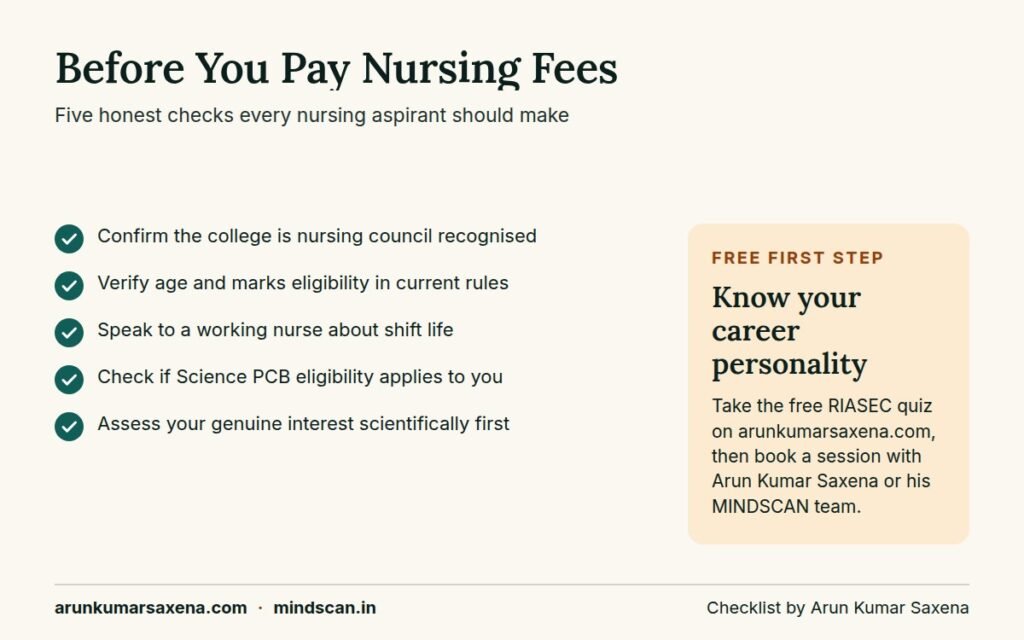
The same trap catches nursing applicants. Before you pay a single fee, take the free RIASEC career personality quiz.
It takes minutes and tells you whether a ‘Social’ and ‘Realistic’ caregiving profile actually matches your wiring. For a deeper, data-verified read, the MINDSCAN psychometric assessment on mindscan.in maps each student to 20+ career groups, including healthcare careers, so a nursing decision is checked against data, not coaching-institute hype. If the fit is wrong, no amount of hard work will fix it.
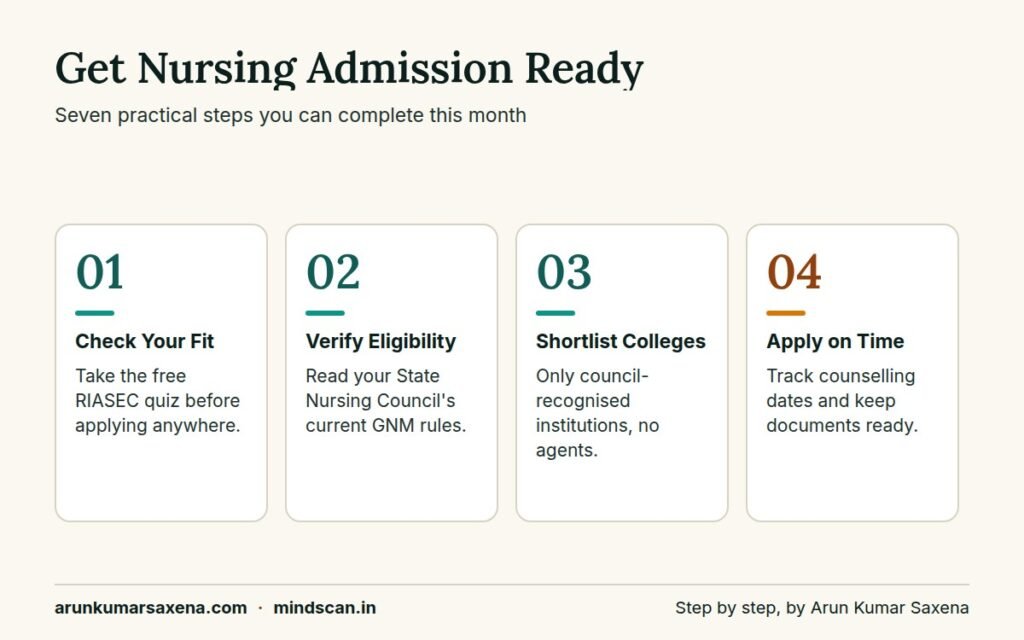
- Confirm your genuine interest in patient care using the free RIASEC career personality quiz on arunkumarsaxena.com.
- Check the current eligibility rules for GNM/ANM on your State Nursing Council website for 2026.
- Shortlist only institutions recognised by the State Nursing Council and Indian Nursing Council.
- Prepare documents: 10th and 12th marksheets, ID, category certificate and photographs.
- Track entrance exam or merit-based counselling dates and apply before deadlines.
- Talk to a working nurse for one honest hour about shift life before you pay fees.
- If unsure, book an online career counselling in India session to verify fit before committing years.
Can I study nursing at age 35 or 40 in India?
Yes, nursing is one of the few healthcare fields where mature students do enter. Most GNM programmes have a minimum age of 17, and some have upper age limits set by councils or institutions. A 12th-pass adult of 35 should verify the current state norms and honestly consider whether shift-based hospital life fits their circumstances.
There is no blanket national ban on studying for a diploma in nursing in your 30s or 40s. Upper age limits, where they exist, come from specific councils or institutions. I have seen mature entrants succeed precisely because of their discipline and life experience. If you are considering a career change at 40 in India, nursing is one path, but check the physical demands first. You can also book an online career counselling session to discuss your specific situation.
What do you learn in a diploma in nursing and how hard is it?
A diploma in nursing combines subjects like anatomy, physiology, fundamentals of nursing, midwifery, community health and medical-surgical nursing with supervised clinical postings in real hospitals. It is demanding, with long hours, heavy memorisation and emotionally charged situations. Students with a genuine interest manage it well, starting from zero assumed knowledge.
The course includes classroom theory plus mandatory clinical rotations. Exams are state council or examination board based. The hardest parts for most students are not the theory. They are the night duties, the emotional resilience required daily, and the sheer consistency needed over three years. If you are looking for an easy course, a diploma in nursing is the wrong choice.
What is the salary and career growth after a diploma in nursing?
As per online sources, a fresh diploma in nursing holder in India earns approximately ₹15,000 to ₹25,000 per month in private hospitals, with government posts often paying more. Growth comes through experience, specialisation, the Post Basic B.Sc bridge and government nursing exams. Actual salaries vary widely by city, sector and experience.
Approximate GNM diploma duration including internship, as per council norms
Approximate starting salary in private hospitals, as per online sources
Commonly applied minimum age at admission, as per GNM regulations
Typical roles after a diploma in nursing include staff nurse, community health nurse, home care nurse and, later, nursing tutor. Government nursing posts are recruited through state and central exams. The long-term path includes postgraduate diplomas in critical care or emergency nursing, and M.Sc Nursing after the degree. There is a clear upgrade ladder, but it requires continuous study and upskilling.
Is a diploma in nursing the right fit for you? Arun Kumar Saxena’s honest view
Most students pick a diploma in nursing because of family pressure, an admired relative or perceived job security. This is the same trap I see in NEET aspirants. You must check your genuine interest with a scientific assessment before committing three to four years of your life.
Nursing rewards empathy and stamina more than board-exam marks. A wrong-fit healthcare student wastes years and fees. A right-fit one thrives even with average marks. In my book “3 Steps to Knowing Yourself”, the core idea is that self-knowledge must come before any career choice. A nursing decision should start with knowing your own interests and temperament, not with college brochures. Explore best diploma courses after 12th and career options after 12th Science PCB to compare your choices. Your career clarity is worth more than a rushed admission.
6-step checklist before applying for a diploma in nursing in 2026
Before you fill any form for a diploma in nursing in 2026, work through this checklist in order. Each step uses facts already covered on this page, and skipping one is the most common reason students waste a year or land in an unrecognised college.
- Confirm your entry level: after 10th the realistic route is ANM, while the GNM diploma in nursing course requires 10+2.
- Check your State Nursing Council rules for the current 2026 notification on eligibility, age and counselling.
- Verify that the college is recognised by the State Nursing Council and the Indian Nursing Council before shortlisting it.
- Confirm age and stream eligibility: minimum 17 years at admission is commonly applied, and Science with PCB is preferred.
- Choose your path consciously: GNM vs ANM vs B.Sc Nursing, based on your entry level, finances and long-term goals.
- Do a fit-first self-check of your genuine interest in patient care before paying any fee; a career counselling session can verify it with data.
If you are still comparing diploma paths beyond nursing, this guide to the best diploma courses after 12th will help you weigh your options side by side.
Frequently asked questions about diploma in nursing
Which diploma is best for nursing in India?
The GNM is the main and most recognised diploma in nursing in India. It is the standard entry route for registered nursing practice. Post-basic and specialised diplomas in critical care or nursing administration come later, for nurses who are already registered. The ‘best’ diploma in nursing depends entirely on your current entry level and your long-term goal.
Is a diploma in nursing equal to B.Sc Nursing?
No, a diploma in nursing is not equal to a B.Sc Nursing degree. The scope, hierarchy and pay progression differ. A B.Sc degree offers broader academic depth and faster access to senior roles. However, a diploma in nursing holder can bridge the gap through a Post Basic B.Sc Nursing course and then progress to M.Sc Nursing.
Can I do a diploma in nursing online or through IGNOU?
Nursing is a hands-on clinical course, so a full entry-level diploma in nursing cannot be done purely online. Distance or post-basic options exist only for already-registered nurses. For example, in-service GNM holders can explore options on the IGNOU official admission portal for nursing programmes. Always verify on official portals.
Is nursing harder than MBBS?
They are hard in different ways. MBBS is longer and more academically intense. A diploma in nursing is physically and emotionally demanding, with relentless clinical shifts and direct patient care. One is not simply easier than the other. Your natural temperament usually determines which one you find harder.
Can I become a nurse if I am only 12th pass and 35 years old?
Possibly, yes. Eligibility for a diploma in nursing depends on state council and institution age rules. There is no blanket national ban. You must check the current norms for the specific GNM programme you are targeting and honestly consider whether the physically demanding, shift-based hospital life fits your current life stage and health.
Do I need NEET for a diploma in nursing?
No, NEET is not required for a diploma in nursing like GNM or ANM. Admission is through state-level or institution-specific entrance tests, or through merit-based counselling. Always verify the current year’s admission notification from the state nursing council. You can also check the National Career Service portal, Government of India for career information.
What can I study after a diploma in nursing?
After a diploma in nursing, your clear upgrade ladder starts with Post Basic B.Sc Nursing. Following that, you can pursue postgraduate diplomas in specialisations like critical care, emergency nursing or nursing administration. After the degree, an M.Sc in Nursing is the natural next step for senior clinical, educational or administrative roles.
What is the difference between GNM and ANM, and which one should I pick?
GNM is a nursing diploma of approximately 3 to 3.5 years including internship, taken after 12th, and leads to registered nursing practice. ANM is a shorter entry-level nursing and midwifery diploma possible after 10th. If you have completed 12th, pick GNM; if you have only passed 10th and want the quickest healthcare entry, ANM is the realistic starting point, subject to state council rules.
What subjects and stream should I choose in 11th and 12th for a nursing diploma?
Choose Science with Physics, Chemistry and Biology (PCB) plus English in 11th and 12th. This combination is preferred and accepted everywhere for a diploma in nursing course after 12th. Many institutions also accept Arts and Commerce students, but Science with Biology keeps every nursing path open, including GNM and later B.Sc Nursing, so do not close doors early.
What documents and steps should I verify before shortlisting a nursing college for 2026?
Before shortlisting any college for 2026 admission, verify its recognition with your State Nursing Council and the Indian Nursing Council, and re-check the current year’s notification. Keep your 10th and 12th marksheets, ID, category certificate and photographs ready. Be wary of agents promising direct admission to unrecognised colleges. Arun Kumar Saxena advises students to confirm recognition in writing before paying any fee.
Can male students apply for a nursing diploma in India?
Yes, male students can apply for a nursing diploma in India. GNM and other nursing diploma courses accept male candidates, and men work as staff nurses, community health nurses and nursing tutors across India and abroad. Eligibility rules on age, stream and marks are the same as for any applicant, so check your state nursing council’s current notification before applying.
What is the day-to-day work of a diploma in nursing holder after finishing the course?
A diploma nursing holder typically works as a staff nurse: monitoring patients, giving medicines, assisting in procedures, maintaining records and supporting distressed families, often in rotating shifts including nights. Community health and home care roles involve field visits and patient education. The work is hands-on and physically demanding, which is why checking your genuine fit before the course matters so much.
A diploma in nursing is a career of service, stamina and skill. It is not a default option you drift into because a neighbour did it. The MINDSCAN AI Career Clarity Report, available on mindscan.in, maps your personality to 20+ career groups and gives you a data-verified answer before you invest years of your life. The report costs ₹1,499, and a session with the report costs ₹2,999.
If you are still unsure, let us talk. Book your online career counselling in India session. We will look at your assessment results together, and I will give you my honest, experience-backed view on whether a diploma in nursing is your right next step. Your clarity is worth one honest conversation.
Sources
The eligibility, duration and recognition details on this page are based on the following primary sources:
- Indian Nursing Council – Revised GNM Nursing Programme regulations (age, marks and duration criteria)
- Indian Nursing Council official website (recognition of nursing programmes)
- National Career Service portal, Government of India (career information)
Always re-verify the current year’s notification with your State Nursing Council before applying, as rules can change.
About Arun Kumar Saxena
Arun Kumar Saxena is a Certified Advanced Career Coach and founder of MINDSCAN Career Guidance, with 22 years of experience and 20,000+ students and professionals guided. A former corporate leader at Airtel and Reliance, he is also a CBSE Resource Person, a Fellow Member of NHRD Network, and the author of ‘3 Steps to Knowing Yourself’. He and his MINDSCAN team offer online career counselling across India, and he personally reviews every MINDSCAN report.
You can explore his career counselling services and blog on arunkumarsaxena.com, and the MINDSCAN psychometric assessment and AI Career Clarity Report on mindscan.in.
Last updated: October 2026