
Career Options After BA: Your Honest 2026 Guide
By Arun Kumar Saxena, Certified Advanced Career Coach · Updated October 2026
Quick answer: The main career options after BA are government exams, private-sector jobs, higher studies, and skill-first careers. The right choice depends on your personality and strengths, not a generic salary list. Before committing to any path, understand your fit first; self-knowledge saves years of wrong turns.
What are the real career options after BA in 2026, and how do you pick one that will not waste the next three years of your life? This page is for the BA graduate or final-year student who is tired of seeing the same 20-item list on every website and still does not know which door to knock on. It gives you a fit-first decision framework, an honest comparison of the four main paths, and a copyable month-one action plan you can start this week.
With 22 years of experience and 20,000+ students and professionals guided, I have seen too many bright arts graduates drift into a course because a cousin did it, or prepare indefinitely for one exam with no fallback. My MINDSCAN team and I built this guide to give you the clarity that a list alone cannot. By the end, you will know which bucket fits you, what each path honestly demands, and the exact first step to take right now.
Table of Contents
What are the best career options after BA in 2026?
BA graduates have four strong career buckets in 2026: government exams, private-sector jobs, higher studies and skill-first careers. The honest answer is that “best” means best-fit, the path that matches your interests, strengths and risk appetite, not the one with the highest salary figure on a random blog.
Most lists throw 20 options at you and leave you more confused than before. A fit-first approach sorts career options after BA into these four honest buckets so you stop drowning in choices and start evaluating what actually suits you.
- Government exams: UPSC Civil Services, state PSC, SSC CGL, banking and railway exams. A BA degree meets the graduation eligibility bar for almost all of them.
- Private-sector jobs: Content writing, digital marketing, HR, sales, business development and social media roles. These care more about demonstrable skills and a portfolio than about your degree stream.
- Higher studies: MA, MBA, LLB and B.Ed. Each makes sense only when the target job demands that specific qualification, choose the job first, then the degree.
- Skill-first careers: Data analysis, design, translation and tool-based roles where a 3-6 month certification and a portfolio can open doors faster than another full-time degree.
Salary lists without fit analysis mislead BA graduates every year. The wrong “high-paying” path wastes 2-3 years and a lot of money. A BA is accepted for almost all government exams and most MBA programmes, so the degree itself is not a limitation, the real risk is choosing without self-knowledge. My book “3 Steps to Knowing Yourself” argues that self-knowledge must come before any career choice.
Which government exams can I attempt after a BA degree?
A BA degree makes you eligible for UPSC Civil Services, SSC CGL and CHSL, IBPS PO and SBI PO, RRB NTPC and state PSC exams. Graduation in any stream is the common eligibility bar, so your arts background does not close any of these doors.
Here are the main exam families you should know about when exploring career options after BA in the government sector.
- UPSC Civil Services Examination: IAS, IPS, IFS and allied services. The syllabus is vast and preparation typically demands 1-2 years of full-time effort.
- SSC CGL and CHSL: Entry into central government ministries and departments. CGL leads to officer-level posts like Income Tax Inspector; CHSL is for lower-division clerk and data entry roles.
- Banking exams: IBPS PO, SBI PO and clerical cadre exams. These test reasoning, quantitative aptitude, English and general awareness.
- RRB NTPC: Non-technical popular category posts in Indian Railways. The exam pattern is similar to SSC but with railway-specific general awareness.
- State PSC exams: Each state’s public service commission conducts its own administrative and subordinate service exams.
Competitive exams are a multi-year commitment. Check the National Career Service portal (Government of India) for official exam notifications rather than trusting blog summaries that may be outdated.
Pair your exam preparation with one marketable skill, content writing, data entry tools or digital marketing, so the gap years stay productive and you have an income track running alongside.
“I always recommend students to have a plan B to be on the safer side while maintaining their focus on the goal that they have set.” (Arun Kumar Saxena)
What private-sector jobs can I get after BA without another degree?
BA graduates are hired directly for content writing, digital marketing, HR executive, sales and business development, customer success, journalism and social media roles without needing another degree. Employers in these fields care more about demonstrable skills and a portfolio than about your degree stream.
Here are the entry roles that recruit BA graduates right now, without asking for an additional degree.
- Content writer: Blogs, website copy, social media captions and email newsletters for companies and agencies. Writing samples matter more than any certificate.
- Digital marketing executive: SEO, paid ads, social media management and email marketing. A 3-6 month certification plus one small real campaign can get you hired.
- HR executive: Recruitment coordination, employee onboarding and HR operations. Psychology and sociology graduates often find this a natural fit.
- Business development executive: Lead generation, client calls and sales coordination. Communication skills and persistence count more than your BA specialisation.
- Journalist: Reporting, editing and content production for digital and print media. A portfolio of published pieces, even on a personal blog, opens doors.
- Social media executive: Managing brand accounts, creating posts and analysing engagement. Platform fluency and creative thinking are the real qualifications.
Portfolio beats pedigree in these roles. One writing sample, one small campaign you ran for a local business, or one internship speaks louder than a generic certificate course with no practical output. Before you reflexively enrol in another full-time degree, consider a 3-6 month skill certification instead. The entry-level job market values what you can do, not just what you studied. For more on how fresher hiring actually works, read about online career counselling in India with Arun Kumar Saxena and how we help graduates bridge the skill gap.
Is an MBA, LLB, MA or B.Ed the right higher study after BA?
Each of these four paths makes sense only when the target job demands that specific qualification. An MBA opens corporate and management careers and accepts BA graduates. An LLB leads to litigation or corporate law via the 3-year degree. An MA is necessary for academia, research and subject-specialist roles. A B.Ed is the gateway to school teaching.
| Path | What it needs | Best suited for |
|---|---|---|
| Government exams | Sustained 1-2 year preparation; all BA streams eligible | Those seeking job security and public service |
| MBA | Entrance exam prep and tuition investment; any graduation accepted | Corporate-ambitious graduates with strong communication |
| LLB | 3 years of study plus legal aptitude and reading stamina | Argument-driven, reading-heavy minds aiming for law |
| Digital marketing and content | 3-6 month certification and a portfolio of real work | Creative, self-driven learners who want quick entry |
| MA and academics | Deep subject interest and a long time horizon | Research-inclined readers aiming for teaching or PhD |
| B.Ed and teaching | B.Ed degree plus TET or CTET qualification | Patient, explanation-loving communicators |
An MBA is the most common switch route after BA. Most programmes accept any graduation stream, and BA students often add distinct value in marketing, HR and people-facing roles because they bring strong verbal and reasoning skills to the cohort. The real gate is the entrance exam, CAT, XAT or CMAT, not your undergraduate background. Explore MBA courses after graduation for a detailed breakdown of specialisations that suit arts graduates.
The 3-year LLB is a structured law route after any graduation. It suits students who enjoy dense reading, argumentation and structured reasoning. Do not enter it just because you did not know what else to pick. An MA should be chosen for genuine subject interest, not as a delay tactic while you figure things out. It is essential for teaching at higher levels and for research roles. A B.Ed is the gateway to school teaching; combine it with your subject interest and plan for the TET or CTET exam from the start.
Career options after BA in English, Political Science, Psychology or Economics: does your specialisation matter?
Your BA specialisation shapes the natural first doors. English leads to writing, media and communications. Political Science points to civil services, law and policy. Psychology opens HR, counselling and organisational roles. Economics feeds into analytics, banking and finance. But in most private-sector careers, skills can override the stream.
Here is how each major specialisation maps to its most natural career options after BA degree completion.
- BA in English: Content writing and strategy, journalism and mass communication, publishing and editing, corporate communications, PR, teaching (with B.Ed or MA) and civil services. English honours graduates have an edge in any communication-heavy role.
- BA in Political Science: Civil services and state PSC, law (3-year LLB), policy research, journalism with a political beat, public affairs and NGO programme roles. The subject builds exactly the analytical and argumentation skills these careers demand.
- BA in Psychology: HR and talent acquisition, organisational development, counselling (with further certification), market research, social work and user research. People-centric roles are the natural fit.
- BA in Economics: Banking and finance, data analysis, policy research, actuarial science (with additional exams), MBA in finance and development sector roles. The quantitative grounding gives economics graduates a head start in analytical career options after BA.
What happens when your specialisation no longer interests you? This is common and it is not a failure. The skill-bridge route works: identify your current genuine interests using a validated assessment, then pick a 3-6 month certification or an entry role in that new direction. Your BA still satisfies degree eligibility for almost all exams and jobs.
Honours versus programme BA matters mainly for academic routes like MA admissions and research; most private-sector employers do not distinguish between them. A psychometric assessment can confirm whether your real interest lies outside your stream, the MINDSCAN report maps students to 20+ career groups and often reveals directions a graduate had never considered.
How do I choose the right career after BA when nothing feels clear?
Use a fit-first process. Start with a self-assessment of your interests and strengths using a validated test, not guesswork. Shortlist 2-3 directions, talk to people working in them, run a low-cost experiment like an internship or a short course, then commit. This is exactly how I structure counselling sessions at MINDSCAN.
Here is a four-step decision method to move from confusion to a clear direction.
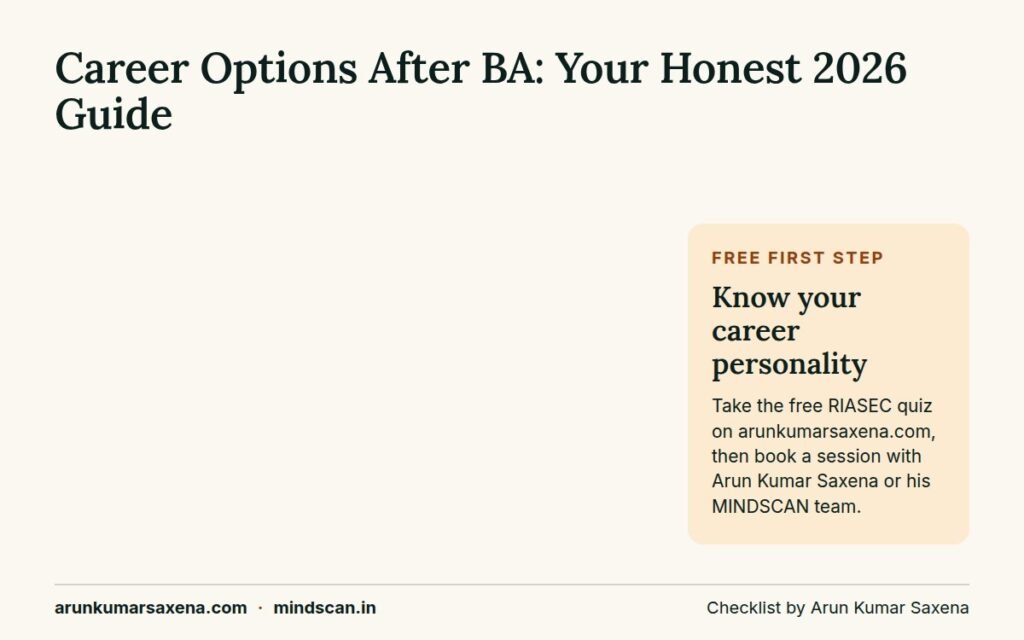
- Assess: Take the free RIASEC career personality quiz this week. It measures your interests across six dimensions and maps them to career families. No cost, just an honest starting point.
- Shortlist: Write down your top three interest areas from the quiz and match them against the four career buckets on this page. Circle the 2-3 options that appear in both lists.
- Test: Talk to two people who actually work in your shortlisted fields this month. Then start one 4-6 week online skill course in your top direction. A small real project tells you more than six months of overthinking.
- Commit: Set a decision deadline. Pick your primary path and one plan B by the end of the month. Update your resume and start applying or preparing with full focus.
Two traps catch BA graduates every year. The first is enrolling in a course because peers did, an MBA or MA that nobody genuinely wanted, just because everyone else seemed to be doing it. The second is preparing indefinitely for one exam with no plan B, no skill track and no checkpoint. My book “3 Steps to Knowing Yourself” rests on the core idea that self-knowledge precedes career choice. Without it, even the best career options after BA become a shot in the dark.
Can I prepare for government exams alongside a private job after BA?
Yes, many BA graduates combine a low-hours private job or freelancing with exam preparation. This is often the smarter route because it protects your income and employability if the exam does not work out. The key is a realistic weekly structure and honest checkpoint criteria.
The plan-B principle is not about hedging out of fear. It is about building a safety net while you chase a competitive goal. A backup does not distract you, it gives you and your family the confidence to pursue the main goal without panic.
A realistic weekly structure for working and preparing looks like this: four to five hours of focused work or freelancing each weekday morning, three hours of fixed study in the evening, one full-length mock test on Saturday and a complete revision day on Sunday. The total weekly study hours stay in the 25-30 range, which is enough for steady progress on most government exam syllabi.
Full-time preparation genuinely makes sense only when two conditions are met. First, your mock-test scores show consistent upward momentum and you are clearing preliminary cutoffs comfortably. Second, your family’s financial situation can absorb another year without strain. If either condition is shaky, keep a part-time income track running. Even during preparation years, build one marketable skill, spreadsheet proficiency, content writing or digital marketing basics, so your resume never has a blank gap to explain.
What skills should I learn after BA to stay employable in the AI era?
The highest-use skills after a BA are written and spoken communication, digital marketing, data literacy (spreadsheets and basic analytics) and domain-specific tools for your chosen field. AI is reshaping entry-level content and admin work, so BA graduates should pair their human strengths with tool fluency rather than compete with AI on volume tasks.
Four skill families will keep you relevant across most career options after BA in the coming years.
- Communication: Clear writing, structured thinking and confident spoken English. AI can generate text, but it cannot replace human judgement, tone and context. Writing that persuades, explains complex ideas simply or builds trust will stay valuable.
- Digital marketing: SEO, social media strategy, email marketing and basic analytics. Businesses need people who can run campaigns and interpret results, not just tools that can post.
- Data literacy: Spreadsheets, basic data cleaning and chart creation. You do not need to code, but you should be able to look at a dataset and draw a conclusion. This skill alone opens analyst-adjacent roles in every industry.
- Domain tools: Design software if you are in a creative path, legal research databases if you are in law, Tally or Zoho Books if you are in commerce-adjacent roles. Tool fluency plus BA thinking is a combination AI cannot easily replicate.
Judgement, people skills and creative synthesis hold up far better than routine content generation or data entry. Start skill-building before or immediately after graduation, not after a failed exam attempt when the gap on your resume has already widened. The Skill India Digital Hub (Government of India) offers free and low-cost courses that you can start today.
The BA graduates who thrive in the AI era will be those who treat their degree as a thinking foundation and layer practical skills on top of it, not those who hope the degree alone will carry them.
Frequently asked questions about career options after ba
Can I do an MBA after BA without a business background?
Yes. Most MBA programmes in India accept graduates from any stream, including BA. The real gate is the entrance exam, CAT, XAT or CMAT, not your undergraduate background. BA students often perform well in the verbal ability and logical reasoning sections. Marketing, HR and communication-heavy MBA specialisations suit arts graduates naturally.
Is a BA degree enough to get a job, or do I need another course?
For many private-sector entry roles, a BA plus demonstrable skills and a portfolio is enough. Another degree is not automatically needed. But for structured careers, teaching, law, academia and some corporate tracks, a specific further qualification is mandatory. The decision rule: the target job dictates the qualification, not the other way around.
Which course after BA gives a job quickly?
Short skill certifications in digital marketing, data analytics tools or content strategy can get you job-ready in roughly 3-6 months of focused effort. The honest qualifier is that speed depends on portfolio quality and local market demand, not the certificate alone. Employers hire what you can show, not what you studied.
What can I do after BA English honours specifically?
The natural doors are content writing and strategy, journalism and mass communication, publishing and editing, corporate communications, PR, teaching (with B.Ed or MA), and civil services. English honours graduates have an edge in any communication-heavy role. AI has changed writing careers but has not removed them, human judgement and voice still matter.
I have a BA but no interest in my subjects anymore. What now?
This is common and not a failure. Use the skill-bridge route: take the free RIASEC quiz to identify your genuine current interests, then pick a 3-6 month certification or entry role in that new direction. Your BA still satisfies degree eligibility for most paths and exams. The degree is your foundation; your skills are your direction.
How many years should I give to UPSC preparation after BA before switching?
As a rule of thumb, commit to approximately two serious attempts within a fixed window before reassessing. Set clear checkpoint criteria like mock scores and preliminary clearance. Always maintain a plan B skill or job track running alongside. A deadline protects you from indefinite preparation without progress.
Is career counselling worth it after graduation?
Yes, when you are stuck between 2-3 directions or have already spent time on a wrong path. A structured session with a validated psychometric assessment saves years, which costs far more than the session fee. With 22 years of experience and 20,000+ students and professionals guided, my MINDSCAN team and I run sessions online across India for graduates who need clarity, not just a list of options.
Your BA degree is not a limitation. The real risk is choosing a career based on a random list instead of your own personality and strengths. Graduates who invest one hour in honest self-assessment save years of wrong turns. The MINDSCAN AI Career Clarity Report (₹1,499) maps you to 20+ career groups and gives you a data-verified starting point, not a guess. For a complete session, choose the report with a counselling session (₹2,999).
If you are stuck between two or three directions, or if you have already spent time on a path that does not feel right, book an online career counselling session. We will work through your assessment results together, shortlist the options that actually fit, and build a month-one action plan you can start immediately. Clarity is closer than it feels.