
Audiology Courses After 12th in India: Eligibility, Fees and Career Scope
By Arun Kumar Saxena, Certified Advanced Career Coach and founder of MINDSCAN Career Guidance
Last updated: November 2026
Quick answer: Audiology courses after 12th train you to test, diagnose and manage hearing and balance disorders. In India the main entry route is BASLP, a 4-year degree after Class 12 with a science background. Arun Kumar Saxena advises confirming your scientific and people-oriented fit through a psychometric assessment before committing to this specialised healthcare path.
An audiology course in India is a four-year BASLP degree requiring Class 12 Science with Biology, with government institutes sometimes under one lakh for the entire programme and private colleges charging several lakhs, as per online sources.
Arun Kumar Saxena, career coach
An audiology course is a specialised healthcare programme that prepares you to assess and rehabilitate individuals with hearing and balance disorders. This page is for Class 12 students, graduates and parents who want a clear, honest map of the BASLP degree, the master’s options, the real costs and the career scope, without the usual coaching-institute hype.
With 22 years of experience and 20,000+ students and professionals guided, I have seen too many families pick a degree first and check career fit later. An audiology course demands a rare mix of scientific precision and patient empathy. My team and I help you test that fit scientifically before you invest four years and significant fees. Let me walk you through every detail you need.
Table of Contents
What is an audiology course and who should choose it?
An audiology course is a specialised healthcare programme that prepares you to assess and rehabilitate individuals with hearing and balance disorders. It suits students who like biology and physics, enjoy working with people and want a healthcare career with less competition intensity than MBBS or NEET.
The work sits at the intersection of medicine, technology and human connection. You study ear anatomy, the auditory nerve and the vestibular system in depth. Then you learn to combine diagnostics with rehabilitation and patient counselling. A typical day might involve testing a newborn’s hearing, tuning a hearing aid for an elderly patient, or mapping a cochlear implant for a child. It is precise, protocol-driven work that also demands patience and clear communication.
Picture a Class 12 student who loves the science lab but also volunteers at school health camps. That student is often a stronger fit for audiology than for a pure research degree. Detail-oriented students who are comfortable in clinical settings tend to thrive here.
Before you commit, verify your fit. Take a psychometric assessment that maps your interests and aptitudes to real career groups. The MINDSCAN AI Career Clarity Report does exactly that, mapping you to 20+ career groups so you can see whether audiology sits in your high-fit zone. If you are still exploring, book an online career counselling with Arun Kumar Saxena session first.
What most guides miss: the personality profile that struggles in audiology
Most course listings describe who succeeds. In my sessions I also look at who struggles, and one pattern stands out. Students who score very high on investigative interests but very low on social interests often find clinical audiology draining. They love the diagnostic technology but dislike the daily patient interaction that fills most of an audiologist’s calendar. A BASLP degree places you in front of newborns, anxious parents, elderly patients and individuals with communication difficulties, every single day.
If you prefer machines to people, audiology will exhaust you. If you like both, it can be deeply satisfying. This is exactly the kind of fit question a good psychometric assessment answers before you enrol. No course brochure will tell you this, but your own interest profile will.
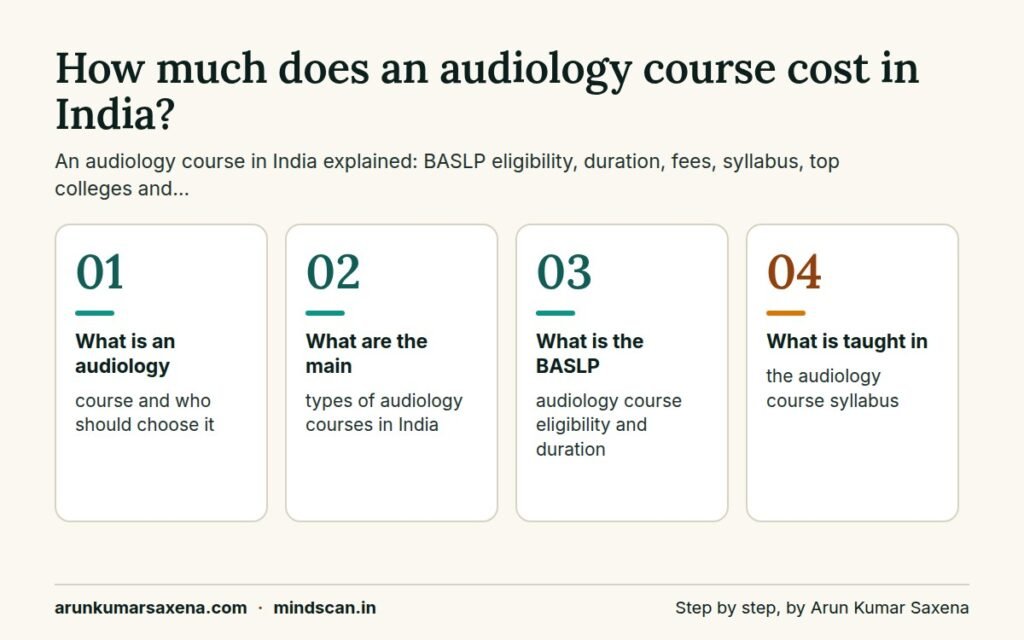
What are the main types of audiology courses in India?
India offers three levels of audiology training: the full clinical degree, the advanced master’s and shorter diploma programmes that lead to technician roles. Each level has a different duration, eligibility and career scope, so the level you pick shapes the work you do.
- BASLP (Bachelor in Audiology and Speech-Language Pathology): The standard four-year clinical degree for practising as an audiologist.
- M.Sc. Audiology or MASLP: Advanced master’s programmes for research, teaching and senior clinical roles.
- Diploma programmes: One-year courses like Diploma in Hearing Aid and Earmould Technology or Audiometry Technician, leading to technician-level positions.
BASLP, the Bachelor in Audiology and Speech-Language Pathology, is the standard entry qualification for clinical practice, and many students research the broader scope of psychology in India alongside allied health degrees before deciding. It runs four years: six academic semesters plus two internship semesters. Most hospitals, clinics and rehabilitation centres hire BASLP graduates as audiologists. M.Sc. Audiology or MASLP builds on this with advanced clinical training and opens research, teaching and senior clinical roles. Diplomas, such as the Diploma in Hearing Aid and Earmould Technology or Audiometry Technician courses, run about one year and qualify you for technician-level positions. Some institutes also offer postgraduate diplomas and certificates that add a specialisation to an existing degree.
If you are clear that clinical audiology is your goal, BASLP is the safest and most recognised route. A diploma can be a quick entry point, but your scope of practice stays narrower. A diploma holder can upgrade later by completing BASLP, and BASLP then opens the route to M.Sc. Audiology or MASLP.
One caution I give every family: a short audiology course is not a shortcut to the audiologist’s chair. A diploma holder assists, tests under supervision and handles hearing-aid fitting support. The independent diagnosis and rehabilitation decisions stay with the registered degree holder. Choose the level that matches the work you actually want to do, not the one that gets you a certificate fastest.
What is the BASLP audiology course eligibility and duration?
BASLP requires Class 12 with Physics, Chemistry and Biology. Some institutes accept PCM with English. The typical minimum mark is around 50 percent, as per online sources, though cut-offs vary by institute and category. The duration is four years, including a compulsory internship.
Admission is through institute-level merit lists or entrance tests. There is no single national entrance exam for BASLP, so you must check each institute’s specific eligibility cut-off and entrance process individually. The duration is four years: six academic semesters of coursework and clinical exposure, followed by two internship semesters that give supervised, hands-on practice in real clinical settings. The final-year internship is where most students truly discover whether clinical audiology suits them.
If you are still in Class 10, plan your stream early. Choosing the science stream with Biology keeps the BASLP door open.
BASLP meaning explained
BASLP stands for Bachelor in Audiology and Speech-Language Pathology. It is a four-year undergraduate degree that qualifies you to practise as an audiologist and speech-language pathologist in India. The programme includes six academic semesters and two internship semesters of supervised clinical training.
| Parameter | Details |
|---|---|
| Full name | Bachelor in Audiology and Speech-Language Pathology |
| Duration | 4 years (6 academic semesters + 2 internship semesters) |
| Eligibility | Class 12 with Physics, Chemistry and Biology (PCM with English accepted at some institutes) |
| Minimum marks | Around 50 percent in Class 12 (varies by institute and category) |
| Admission | Institute-level merit or entrance test |
| Qualification | Full clinical qualification to practise as an audiologist |
| Higher study | M.Sc. Audiology, MASLP |
What is taught in the audiology course syllabus?
The audiology course syllabus combines medical science with hands-on clinical training from the first year itself. You study ear anatomy, acoustic physics, diagnostic testing and rehabilitation techniques, alongside speech-language pathology, across the four years.
Year one covers anatomy and physiology of the ear, acoustic physics and an introduction to speech-language pathology. Year two moves into pure-tone and speech audiometry, tympanometry and basic hearing aid technology. Year three adds OAE and ABR testing, cochlear implants, auditory training and advanced speech-language pathology. The final phase includes a research project or dissertation alongside intensive clinical postings. Clinical exposure begins early in most institutes, often by the second semester, so you are never stuck in theory alone for long.
Speech-language pathology is a core parallel component throughout the programme. This dual focus is what makes BASLP graduates employable in both audiology and speech-therapy settings. Before you compare syllabi, read the career counselling services and pricing page to see how a structured session can help you weigh two similar-looking programmes.
How much does an audiology course cost in India?
Fees vary widely by institute type. Government and national institutes are far cheaper, while private colleges commonly charge in lakhs across the full BASLP programme, as per online sources. Always compare the total programme cost, not just the yearly tuition, before applying.
Government institutes typically cost a fraction of private fees, sometimes under a lakh for the entire programme. Private colleges can charge several lakhs, and hostel and clinical-kit costs add to the total. Some state quotas and scholarships reduce the burden significantly. Always compare the total programme cost, not just the per-year tuition, and check the current official fee schedule of each institute before applying. A diploma costs less and runs shorter, making it a lower-risk entry point if you are unsure about the field.
If the fees feel daunting, remember that audiology salaries, while not as high as some medical specialities, start reliably and grow with experience and setting. The return on investment is steady rather than spectacular, and government and national-institute graduates often have the best ratio of cost to career outcome. If the budget is the deciding factor, a session on online career counselling in India can help you compare a low-fee government seat against a high-fee private one with the same clinical outcome.
What is the comparison of BASLP, B.Sc. and diploma routes?
BASLP is the full clinical qualification and the safest route to practise as an audiologist. A B.Sc. in Audiology is similar in focus but availability and recognition vary across India. Diplomas qualify you as an audiometry or hearing-aid technician, a quicker but narrower path.
BASLP takes four years and gives you complete clinical scope. You can diagnose, rehabilitate and run independent practice after registration. B.Sc. Audiology programmes are comparable in curriculum, but you must verify recognition by the Rehabilitation Council of India before joining, because not all are approved for clinical practice. A diploma runs about one year and leads to technician roles under the supervision of a qualified audiologist. It can be an easy exit point if you want to work quickly, or an entry point if you plan to upgrade later with a degree.
I recommend BASLP for students committed to clinical audiology. If you are still exploring, take the free RIASEC career personality quiz first. It gives you an honest starting point before you choose a path.
| Parameter | BASLP | M.Sc. Audiology / MASLP | Diploma |
|---|---|---|---|
| Duration | 4 years (6 academic + 2 internship semesters) | Advanced master’s programme after graduation | About 1 year |
| Eligibility | Class 12 with PCB (PCM with English accepted at some institutes), around 50 percent | BASLP or equivalent degree | Varies by programme and institute |
| Level of practice | Full clinical qualification to practise as an audiologist after registration | Senior clinical roles, research and teaching | Technician-level work under the supervision of a qualified audiologist |
| Career scope | Audiologist in hospitals, clinics and rehabilitation centres; independent practice; higher study via M.Sc. Audiology or MASLP | Research, teaching and senior clinical positions | Audiometry or hearing-aid technician roles; upgrade later by completing BASLP |
How to start an audiology course in India: step-by-step
Starting an audiology course needs careful planning, from stream selection to institute verification. Work through these steps in order so you avoid the common mistakes that cost students a year or a wrong degree.
- Confirm your interest in biology, physics and working closely with people.
- Take a psychometric assessment to check your fit for healthcare and clinical roles.
- Research BASLP institutes and their eligibility criteria, entrance tests and recognition status.
- Compare total fees, including hostel and clinical-kit costs, across government and private institutes.
- Apply to multiple institutes before their deadlines and keep your documents ready.
- Prepare for institute-level entrance tests or merit-based admission processes.
- Once admitted, focus on building strong clinical skills during your internship semesters.
Many students rush into the first institute that offers admission. A better approach is to shortlist at least five institutes, verify their recognition and compare their clinical exposure. The National Career Service portal (Ministry of Labour and Employment, Government of India) can help you understand the demand and career pathways for audiologists.
The most common mistake I see is choosing an institute by its advertisement rather than its clinical postings. Ask one plain question at every campus: how many patients does a student actually see during internship? A college with a busy attached hospital gives you real hands, and a college without one leaves you reading about audiology instead of doing it. Ask it before you pay the admission fee, not after.
Frequently asked questions about audiology course
What does BASLP stand for?
BASLP stands for Bachelor in Audiology and Speech-Language Pathology. It is a four-year undergraduate degree that qualifies you to practise as an audiologist and speech-language pathologist in India. The programme includes six academic semesters and two internship semesters of supervised clinical training.
Is it hard to become an audiologist?
The coursework is demanding because it combines medical science, acoustic physics and clinical skill development. The real challenge is the dual demand of technical precision and patient empathy. Students who enjoy both science and people work tend to find the programme intense but manageable. A psychometric assessment can reveal whether your natural interests align with these demands before you enrol.
How much do audiologists earn in India?
Entry-level audiologists in hospitals and clinics typically start at approximately ₹25,000 to ₹40,000 per month, as estimated. With experience, senior audiologists and those in private practice earn significantly more. Cochlear implant specialists and those working with high-end hearing-aid brands command higher packages. Government salaries follow the standard pay scales for allied health professionals.
Is AI going to replace audiologists?
AI is already assisting with hearing-aid tuning and some diagnostic screening, but it will not replace the audiologist. Hearing loss is deeply personal. Patients need a professional who interprets test results in the context of their daily life, counsels families and adjusts rehabilitation plans over time. AI handles data; the audiologist handles the human being.
Is there a future in audiology?
Yes, and the need is growing. India has a large and ageing population, rising noise-induced hearing loss among young people and expanding newborn hearing screening programmes. All of these create demand for qualified audiologists. The supply of trained professionals is still modest, which means steady employment for BASLP graduates who build real clinical competence.
Is audiology in demand?
Audiology is in consistent demand across hospitals, rehabilitation centres, special schools and hearing-aid companies. The National Career Service portal lists audiology and speech-language pathology among the allied health professions with growing vacancies. As awareness of hearing health increases, the demand for clinical audiologists and hearing-aid specialists continues to rise.
Is audiology a good career choice after Class 12 science?
Yes, if you enjoy biology and physics and want a healthcare career with less entrance pressure than MBBS. An audiologist course after Class 12 science leads to steady demand in hospitals, rehabilitation centres and hearing-aid companies. If you are unsure, start with the free RIASEC career personality quiz to check your fit before committing.
BASLP or diploma in audiology: which route should you choose?
Choose BASLP if you want to practise independently as an audiologist; choose a diploma only for technician-level work. A diploma runs about a year and the audiologist course fees are usually lower, so it is a quicker, lower-risk entry point. A diploma holder can upgrade later by completing BASLP, and BASLP then opens the route to M.Sc. Audiology or MASLP.
Can you become an audiologist without biology in Class 12?
Usually no, but there is limited room. Most BASLP programmes require Physics, Chemistry and Biology in Class 12, though some institutes accept Physics, Chemistry and Mathematics with English. Since the standard audiologist qualification in India is the BASLP degree, students without Biology should verify each institute’s eligibility criteria before applying rather than assuming they qualify.
What can you do after a BASLP audiology course: career options explained?
After a BASLP audiology course, you can work as a clinical audiologist in hospitals and clinics, join hearing-aid and cochlear implant companies, work in special schools and newborn screening programmes, or take up research and teaching after a master’s. Many graduates also build independent practice after registration, fitting hearing aids and running rehabilitation plans for patients of all ages.
Can you do an audiology course after 12th without NEET?
Yes. Audiology courses after 12th, mainly BASLP, do not require NEET. Admission happens through institute-level merit lists or each institute’s own entrance test, and there is no single national entrance exam. Focus instead on your Class 12 science marks and on confirming your career fit before you shortlist colleges.
Which subjects in Class 12 are required for audiology courses after 12th?
Physics, Chemistry and Biology are required by most BASLP programmes, though some institutes accept Physics, Chemistry and Mathematics with English. A minimum of around 50 percent in Class 12 is commonly expected, as per online sources. Because eligibility varies by institute and category, verify each institute’s specific criteria before applying.
Is audiology a good course after 12th for science students who don’t want MBBS?
Yes, for students who like biology and physics and want a healthcare career without NEET pressure. Audiology and speech therapy course details show steady demand in hospitals, rehabilitation centres and hearing-aid companies, with independent practice possible after registration. Arun Kumar Saxena recommends checking your interest profile with a free RIASEC career personality quiz before committing to four years of study.
BASLP vs diploma in audiology after 12th: which should a fresher choose?
A fresher who wants to practise as an audiologist should choose BASLP, the four-year clinical degree. A diploma costs less and audiologist course fees for diploma programmes are usually lower, but it leads only to technician-level work under supervision. A diploma holder can upgrade to BASLP later and then progress to M.Sc. Audiology or MASLP.
What is the step-by-step admission process for an audiology course after 12th?
First, complete Class 12 with Physics, Chemistry and Biology. Next, shortlist BASLP institutes and verify their recognition and eligibility cut-offs. Then apply before deadlines, appear for institute-level entrance tests or merit-based selection, and compare total fees including hostel and kit costs. An online career counselling in India session can help you shortlist wisely, and the internship semesters build your clinical skills.
Do you need NEET for an audiology course in India?
No, NEET is not required for BASLP. Admission is through institute-level merit lists or the institute’s own entrance test, and there is no single national entrance exam. That is exactly why Arun Kumar Saxena recommends a structured online career counselling session before you shortlist institutes, so the absence of NEET does not become a reason to skip checking career fit.
What subjects are needed for an audiology course after Class 12?
You need Physics, Chemistry and Biology in Class 12 for most BASLP programmes. Some institutes accept Physics, Chemistry and Mathematics with English. A minimum of around 50 percent in Class 12 is commonly required, though cut-offs vary by institute and category. Always check the specific eligibility criteria of each institute before applying.
An audiology course is a serious commitment of four years and significant fees. Before you take that step, know your fit scientifically. Book an online career counselling with Arun Kumar Saxena session or start with the MINDSCAN AI Career Clarity Report. The report maps you to 20+ career groups and gives you a data-verified answer, not a guess. Your career deserves that clarity.