
Which Stream is Best for Law After 10th? An Honest Guide
By Arun Kumar Saxena, Certified Advanced Career Coach and founder of MINDSCAN Career Guidance (mindscan.in)
Last updated: October 2026
Quick answer: Arts/Humanities is generally the best answer to which stream is best for law after 10th because its subjects overlap with CLAT. Commerce suits corporate law, and Science works for niche fields if you can manage the workload. Choose based on your aptitude, not hearsay, and protect your CLAT preparation time.
Definition: Law after 10th means choosing a Class 11 stream and then a 5-year integrated LLB such as BA LLB, BBA LLB, or B.Com LLB through national entrance tests like CLAT.
Which stream is best for law after 10th is a question that lands on thousands of Indian dinner tables every year, usually right after the board results. This page is for the Class 10 student who has a clear law dream, the parent who wants a safe backup, and the family that is split between Arts, Commerce and Science. It gives you an honest, decision-based comparison tied to your own aptitude and the CLAT timeline, not a generic ‘any stream works’ shrug.
With 22 years of experience and 20,000+ students and professionals guided, I have seen too many law aspirants pick a stream because a cousin did or because the school’s Science section looked prestigious, only to realise in Class 12 that their entrance prep time had vanished. The right stream is the one that protects your CLAT preparation hours while matching how your brain actually works. Let us examine each option without coaching-institute hype.
Table of Contents
Which stream is best for law after 10th in India: Arts, Commerce or Science?
Arts/Humanities is the most recommended stream for law after 10th because its subjects directly overlap with the CLAT syllabus. Commerce is a strong second for corporate law, while Science works for niche fields but leaves less time for entrance preparation. The right choice depends on your aptitude and how much time you can protect for CLAT study.
Law entrance exams like CLAT and AILET test aptitude and reasoning, not any specific school subject, so all three streams are officially permitted after Class 12. The real difference is how much time and mental energy each stream leaves for two years of consistent CLAT preparation alongside board studies. Arts students typically get more free hours. Commerce with Economics helps if you already lean towards corporate or tax law. Science is viable but demanding. Pick it only if you genuinely enjoy it or want a niche like cyber law.
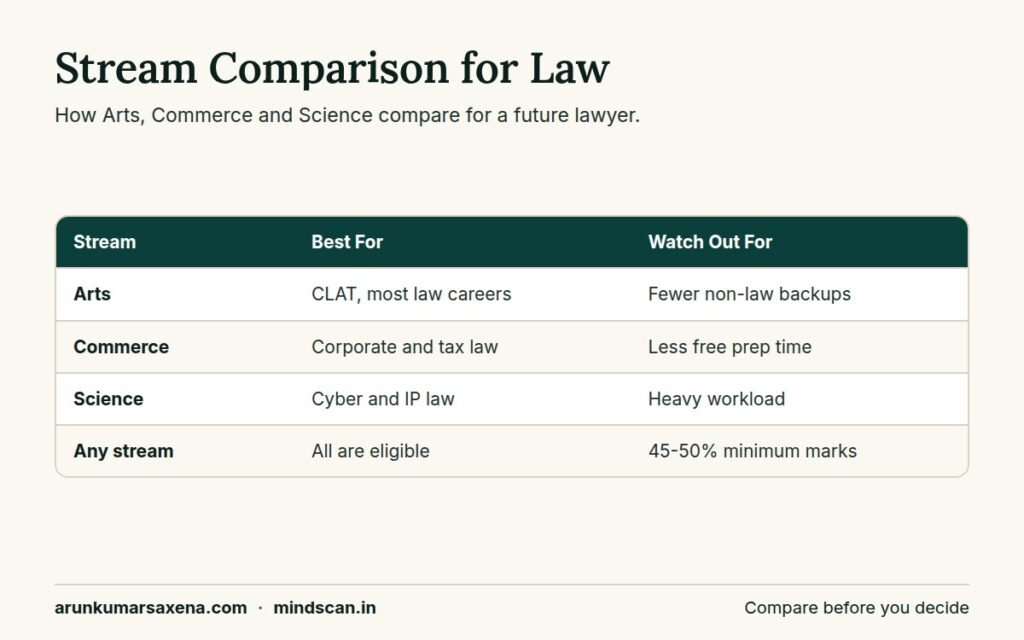
The table below lays out the honest trade-offs so you can compare them in one place.
| Stream | Best For | Subjects That Help | Watch Out For |
|---|---|---|---|
| Arts / Humanities | CLAT, judiciary, most law careers | Political Science, History, Sociology, English | Fewer non-law backup options |
| Commerce | Corporate, tax, business law | Economics, Accountancy, English | Balance entrance prep with practical subjects |
| Science | Cyber, environmental, patent/IP law | Physics-Chem-Bio/Maths plus strong English | Heavy workload reduces CLAT prep time |
| Any stream (eligible) | Law has no stream restriction | English is the common essential | Eligibility minimum marks (around 45-50%) still apply |
Quick decision checklist: which stream fits you?
Tick what applies to you and read your result below.
Result: Tick the statements that apply to you to see which stream fits your law goal best.
Why is Arts considered the best stream for law after 10th?
Arts is considered the best stream for law after 10th because its subjects mirror what law entrance exams and law school demand. Political Science, History, Sociology and English build the reading, reasoning and general knowledge base that CLAT rewards, and the manageable workload protects daily preparation time.
CLAT’s legal reasoning and GK sections reward Humanities background knowledge in a way that no crash course can fully replicate. Some CBSE schools offer Legal Studies as an optional subject in Class 11, which gives an early advantage. The more predictable workload of Arts also makes balancing CLAT coaching and boards realistic. Picture a Class 11 Humanities student who spends the morning on school subjects and still has a clear hour each evening for newspaper reading and mock practice. That rhythm, sustained over two years, builds the kind of reading stamina that CLAT rewards.
Can you become a lawyer after taking Commerce or Science in Class 11?
Yes. Law in India has no stream restriction, so Commerce and Science students can sit for CLAT, AILET or other law entrance exams and join a 5-year integrated LLB programme. They need extra time for general knowledge and reasoning practice, but the path is open and many succeed every year.
Commerce students often choose BBA LLB or B.Com LLB integrated programmes because the business-law overlap feels natural. Science students can target cyber law, environmental law or patent/IP law niches where a technical background is a genuine asset. What matters in the end is entrance exam performance, not the board stream printed on your mark sheet. The filter is CLAT, not your Class 12 subject combination. This is a key point many families miss when they ask which stream is best for law after 10th. If you are also weighing design careers, read which stream is required for architecture after 10th.
A common mistake is assuming Science is the ‘safe’ choice for law. It is safe only if you genuinely enjoy the subjects and can protect your CLAT study hours. Otherwise, a Science student with mediocre board scores and no entrance prep time is worse off than an Arts student who read The Hindu daily.
What subjects should you pick in Class 11 for a law career?
Pick English, Political Science, and Legal Studies where offered, plus Economics, History or Psychology based on your stream. This subject set maps closest to CLAT and law school demands. Choose subjects you can score well in, because Class 12 percentage still matters for some colleges’ eligibility cut-offs.
English is essential for comprehension-heavy exams like CLAT. Legal Studies, offered by CBSE and some state boards, gives an early advantage by introducing concepts like contracts and torts at school level. Do not choose Maths under pressure unless you may keep commerce or finance options open. A subject you dislike will drain time you could have spent on CLAT reading. For a wider view of where Arts can lead, explore career options after 12th in Arts before locking your subject form.
What is the step-by-step path to law school after Class 10?
Choose your Class 11 stream after an honest aptitude assessment, prioritizing Humanities or Commerce if you want direct subject synergy. Build daily reading habits across Class 11 and 12 to master comprehension and legal reasoning. Appear for CLAT or AILET in Class 12, and secure admission into a recognized 5-year integrated LLB programme.
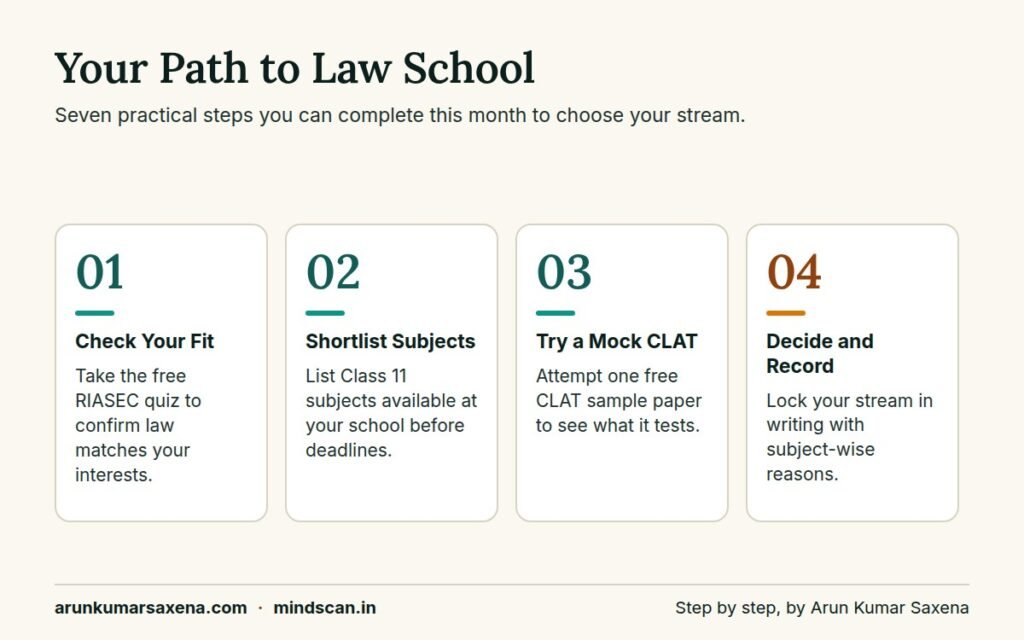
Here is a clear sequence you can follow starting this week.
- Class 11 stream selection: Confirm your genuine interest in law by taking the free RIASEC career personality quiz this week. Lock your stream choice in writing with subject-wise reasons so you can revisit it without emotion. List your likely Class 11 subjects and check your school’s stream options before admission deadlines.
- Class 11 foundation: If law is your primary goal, prioritise Humanities with English and Political Science (or Legal Studies where offered). Start a daily 30 to 45 minute habit of newspaper reading and current affairs notes from now.
- Class 12 preparation: Take one free CLAT sample paper online to understand what the exam actually tests. Discuss your shortlist with parents. If the family is split, book an online career counselling session with Arun Kumar Saxena for a data-verified opinion.
- CLAT/AILET exam year: Appear for CLAT in Class 12 itself; early planning is allowed and recommended.
- 5-year LLB admission: Track eligibility minimums (generally 45 to 50% in Class 12; category relaxations apply) and apply to your chosen integrated programme once results are out.
Start newspaper reading and basic legal GK from Class 11 itself. Official statutory standards and advocate enrollment rules are set by the Bar Council of India. Official eligibility details are also available on the Ministry of Education, Government of India website and the National Career Service portal by the Government of India for official career and course information. Exam pattern, syllabus and eligibility specifics are published by the Consortium of National Law Universities, which conducts CLAT.
| Point | CLAT | AILET |
|---|---|---|
| Exam body | Consortium of National Law Universities | National Law University, Delhi |
| Timing | Held in the year you finish Class 12; Class 11 is the right time to start preparing | Held in the same exam season as CLAT in your Class 12 year |
| Focus | Reading comprehension, logical reasoning, legal aptitude and current affairs | Similar aptitude-based sections with its own pattern set by NLU Delhi |

Is LLB easy or hard after choosing the wrong stream?
LLB is demanding for everyone. It involves heavy reading, case analysis and writing, and stream choice does not make it easy or hard. What stream choice affects is your entrance exam readiness and comfort in the first year. Students who enjoyed reading and argumentation in Class 11 to 12 adjust faster regardless of stream.
CLAT is the real filter, not LLB itself. Arts students often report a smoother first-year transition because they have already handled volumes of text. A wrong stream can be compensated with structured entrance preparation, but the cost is wasted study hours and avoidable stress. That is why I tell families to decide with data, not dinner-table opinions. For a related perspective, read our companion guide on the best stream for a lawyer after 10th.
Can you do CLAT preparation along with Class 11 and 12?
Yes, and you should start in Class 11 rather than waiting for boards to end. CLAT rewards consistent reading, vocabulary, current affairs and logical reasoning practice over two years far more than last-minute cramming. That is exactly why a lighter workload stream like Humanities helps many aspirants who wonder which stream is best for law after 10th.
One hour of daily newspaper and reasoning practice beats weekend marathons every time. Mock tests become meaningful from Class 12 onward, once you have built a base. Stream choice should factor in the study hours you can realistically give to CLAT. If your school subjects consume five hours of homework each evening, entrance prep will suffer no matter how motivated you are. Many families wait for an exam date to be announced before they start, and that is a mistake. When you know you want law, every day from Class 11 counts.
Yes, you can and should start CLAT preparation after 10th. The exam tests reading comprehension, logical reasoning, legal aptitude and current affairs, skills that build over time. Beginning in Class 11 gives you two full years to develop the reading stamina and general knowledge that CLAT rewards, without the pressure of last-minute cramming.
To check whether law truly fits your strengths before you commit two years to this timeline, a psychometric assessment with the MINDSCAN AI Career Clarity Report maps your aptitude and interests to 20+ career groups, so your stream choice rests on data rather than dinner-table opinions.
How do you decide your stream if you are still unsure about law?
If law is one of several options, choose a stream that keeps multiple doors open and matches your natural interests, then verify with a scientific self-assessment. I recommend testing your aptitude and interests before Class 11 admission rather than following relatives’ advice or a friend’s stream choice.
Take the free RIASEC career personality quiz to check whether your interests fit law-adjacent traits like investigative and enterprising types. The best stream is the one that fits you, as long as entrance prep time is protected. Career counselling from Class 8 onwards helps avoid stream regret. My book ‘3 Steps to Knowing Yourself’ argues that self-knowledge must come before any stream or career decision. When you know what kind of work energises you, the stream question answers itself.
“Analyse your child’s aptitude scientifically and check the scores critically before taking any decision.” (Arun Kumar Saxena)
Arun Kumar Saxena has 22 years of experience and has guided 20,000+ students and professionals. The MINDSCAN report maps each student to 20+ career groups, reducing guesswork from the stream decision. You can browse the career counselling FAQ or learn more about Arun Kumar Saxena before booking.
Why trust this guide on which stream is best for law after 10th
This guide is written by Arun Kumar Saxena, a Certified Advanced Career Coach with 22 years of experience and 20,000+ students and professionals guided. Arun Kumar Saxena has been featured in the HT brand story (2023), Hindustan Metro and The Entrepreneur Bytes. The stream comparison is built on observed student outcomes and CLAT preparation patterns across two decades of career counselling, not coaching-institute marketing. Read Arun Kumar Saxena’s full profile.
Which stream is best for law after 10th: a final word on aptitude
When families ask which stream is best for law after 10th, the honest answer begins with aptitude, not a stream name. A student who loves reading, argument and current affairs will thrive in Arts. One who enjoys numbers and business logic may prefer Commerce. The stream is a tool, not a destiny. Use it to buy CLAT preparation time. If you are also weighing a creative field, see for fashion designing which stream after 10th is the better question to ask.
Arts/Humanities with English and Political Science gives the strongest base for CLAT and most law careers. Commerce with Economics suits corporate or tax law paths. Science works for niche fields like cyber or IP law only if you protect enough weekly hours for CLAT preparation. Aptitude and consistent entrance-prep time matter more than the stream name.
Frequently asked questions about which stream is best for law after 10th
Can I do LLB with 45% marks in Class 12?
Yes. The general eligibility minimum for the 5-year integrated LLB is around 45% for the general category, with relaxations for reserved categories as per the rules of the exam body and university. Verify the exact requirement of each exam and college you target before applying.
Can I join LLB without clearing CLAT?
Yes. CLAT is for National Law Universities, but many state and private law colleges accept other entrance exams such as AILET, state-level tests, or institute-specific exams, and some accept merit-based admission. Check each institution’s accepted exam before Class 12.
Is law harder than MBBS?
No, law is not harder than MBBS in a universal sense. They are hard in different ways. MBBS demands years of intense science memorisation and practicals. Law demands sustained reading, comprehension, writing and argumentation. The honest answer is that the right question is which workload matches your aptitude, not which is universally harder.
Can I study LLB at home or through distance education?
The Bar Council of India does not permit a standard LLB through pure distance mode. The 3-year LLB is typically a regular programme. You can prepare for law entrance exams at home, and some universities offer flexible learning options for allied legal studies. Confirm current BCI norms before enrolling anywhere.
What if I choose the wrong stream after Class 10?
A wrong stream does not end a law dream. Law entrance exams are stream-agnostic, so you can compensate with structured CLAT preparation. Some boards allow limited subject changes early in Class 11. The bigger cost is wasted study hours, which is why deciding with an aptitude assessment first matters.
What if I fail in LLB?
Failing a paper in an LLB programme is not the end. Most universities offer supplementary or back-paper exams within a set timeframe, allowing you to clear the subject and continue. Check your university’s specific rules on attempts and timelines. Use the setback to identify weak areas and seek academic support early.
Which stream is best if I want to become a judge?
Judiciary aspirants follow the same path: any stream, an LLB degree, then judicial services exams. Humanities with Political Science and English again gives the smoothest base because judicial services exams test law, GK and language. Those are the same skills CLAT rewards.
The question of which stream is best for law after 10th has a clear answer when you look at the data: Humanities gives you the strongest head start for CLAT, Commerce builds a bridge to corporate law, and Science opens niche doors if you can handle the load. What matters more than the stream name on your admission form is whether you chose it with honest self-knowledge or with borrowed opinions. If your family is still divided, book an online career counselling session with MINDSCAN Career Guidance and let a data-verified assessment settle the debate.
Start with the MINDSCAN AI Career Clarity Report at ₹1,499, or get the report with a counselling session at ₹2,999. Both are available at MINDSCAN Career Guidance. A wrong stream costs two years of energy and entrance prep time. A right one costs one honest conversation with yourself.