
How Many Subjects Are There in Commerce? Complete List
By Arun Kumar Saxena, Certified Advanced Career Coach · Updated November 2026
Quick answer: How many subjects are there in commerce? In Class 11 and 12 commerce, students study 5 main subjects under CBSE: 4 compulsory ones (Accountancy, Business Studies, Economics and English) plus 1 elective such as Mathematics, Applied Maths, Informatics Practices, Entrepreneurship or Physical Education. The right elective depends on your strengths, so verify with a career assessment before choosing.
How many subjects are there in commerce? The answer is simpler than most search results suggest, but the choice behind it is far more important than a number. This page gives parents and students the exact CBSE structure, a clear with-maths versus without-maths comparison, and a data-verified stream-selection framework that no generic list of subjects can offer.
With 22 years of experience and 20,000+ students and professionals guided, I have seen too many bright students struggle simply because they picked an elective that looked popular instead of one that matched their aptitude. If you are filling a Class 11 admission form right now or helping your child decide, read this before you tick a box.
Table of Contents
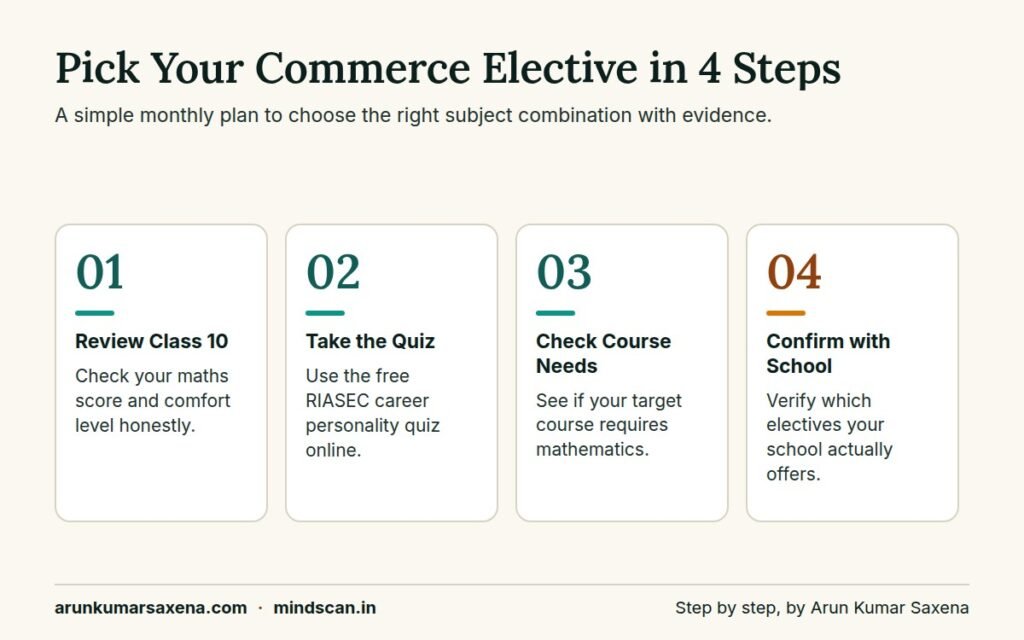
How many subjects are there in commerce in Class 11?
Class 11 commerce under CBSE has 5 subjects: 4 compulsory (Accountancy, Business Studies, Economics and English) and 1 elective chosen from Mathematics, Applied Mathematics, Informatics Practices, Entrepreneurship, Physical Education or another approved option. Some schools allow a 6th subject.
Before you finalise any combination, confirm the exact list your school offers. A school may list Informatics Practices on its website but not run the class if too few students opt for it. State boards can differ slightly. Maharashtra, for example, includes a compulsory environmental education component that CBSE does not. A 6th subject can act as a backup if you underperform in one main paper, but it adds real workload. Take it only if you are sure you can manage the extra preparation honestly.
How many subjects are there in commerce in Class 12?
Class 12 commerce keeps the same 5-subject structure as Class 11: Accountancy, Business Studies, Economics, English plus one elective. The best 5 subjects count for your board percentage, so a 6th subject is usually a safety net, not a scorer.
The combination you pick in Class 11 normally continues unchanged through Class 12. Check the CBSE Senior School Curriculum for the latest subject codes and marking schemes before the academic year begins. Board percentage is calculated from your main subjects, and a low score in a 6th subject does not drag it down, which is why families treat it as insurance.
What are the 4 compulsory subjects in commerce?
The 4 compulsory commerce subjects are Accountancy (financial records and statements), Business Studies (management and trade), Economics (micro, macro and statistics) and English (communication). These form the core of every commerce combination in Class 11 and 12.
Accountancy carries the highest weight for CA and B.Com paths, and it is the subject most students underestimate because the initial chapters feel easy. Business Studies is theory-heavy and scoring with the right method, but it punishes rote learning the moment case-based questions appear. Economics suits students comfortable with graphs and data; the statistics portion catches many off guard in the first term. English is a compulsory subject in commerce class 12 as well, and strong communication skills pay off in every interview and presentation later.
Commerce with maths or without maths: which combination is better?
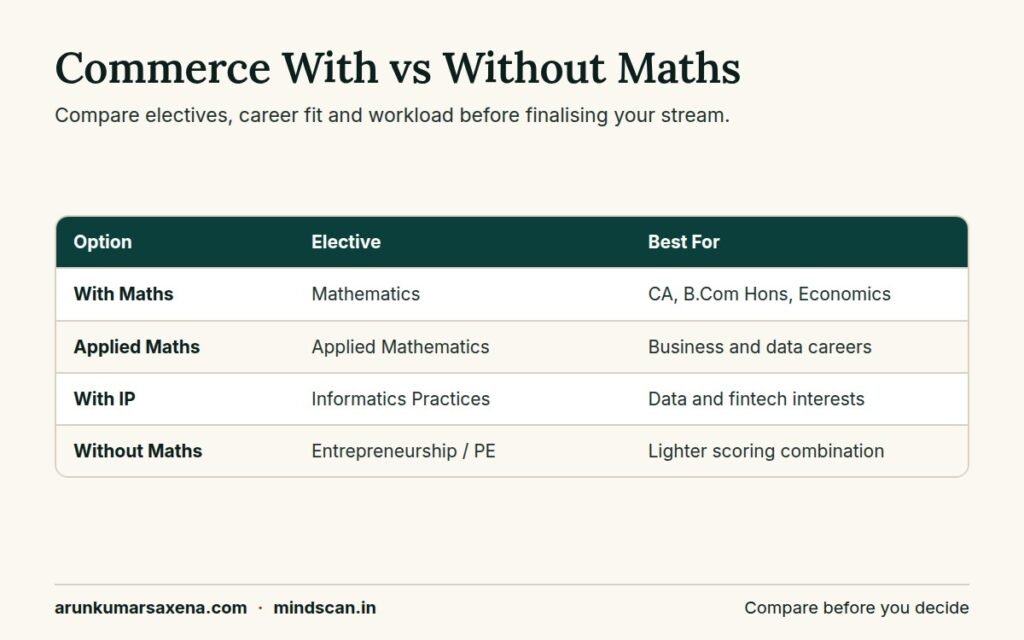
Commerce with maths keeps doors open for courses like B.Com (Hons), Economics honours, CA and data-driven finance careers; commerce without maths suits students weak in maths who can still pursue B.Com, BBA and management paths. Choose based on your Class 10 maths comfort, not peer pressure.
Picture a Class 10 student who scored 55 in maths after two years of tuition. Her relatives urged her to take commerce with maths because “it keeps options open.” She struggled through Class 11, lost confidence, and her Accountancy scores dropped too. A student with 75 or above and a genuine liking for problem-solving, on the other hand, often finds Applied Maths a natural fit. The decision is personal, and it must be made on evidence.
| Option | Elective Subject | Best Suited For | Points to Know |
|---|---|---|---|
| Commerce with Maths | Mathematics | CA, B.Com (Hons), Economics, finance careers | Strong Class 10 maths is a big advantage. Harder to switch from non-maths to maths later. |
| Commerce with Applied Maths | Applied Mathematics | Business, finance and data-oriented roles | More practical than core Maths. Accepted for many commerce courses. |
| Commerce with Informatics Practices | Informatics Practices | Data, tech and fintech interests | Combines commerce with computing skills. Check college-level prerequisites. |
| Commerce with Entrepreneurship / PE | Entrepreneurship or Physical Education | Business interest or a lighter scoring subject | Workload is comparatively manageable. Availability varies by school. |
Which elective should you choose in commerce?
Choose your elective by matching it to your strengths and target career: Mathematics for finance and CA, Informatics Practices for data and tech, Entrepreneurship for business, Physical Education for a lighter scoring subject. A psychometric assessment removes guesswork from this decision.
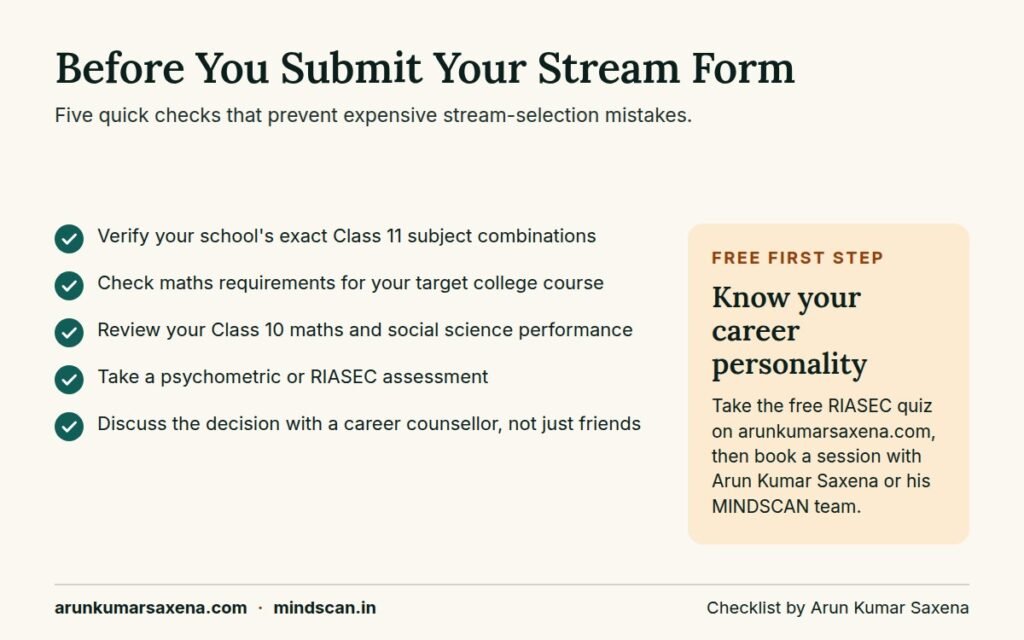
Your interest and aptitude matter more than what friends pick. I have seen entire friend groups choose the same elective in July and regret it by September because their abilities were different. Check college prerequisites for your target course. Some Delhi University B.Com (Hons) programmes, for instance, require Mathematics or Applied Mathematics. Ask your school which electives are actually available before you build a plan around a subject they do not offer. Take the free RIASEC career personality quiz to see your work-style pattern before you decide.
- List your Class 10 maths score and how comfortable you felt with it.
- Note the careers that genuinely interest you right now.
- Shortlist your target course after 12th (CA, B.Com, BBA, economics, etc.) and check if it needs maths.
- Match that requirement to an elective: Mathematics, Applied Maths, IP, Entrepreneurship or PE.
- Ask your school which electives and combinations they actually offer for Class 11.
- If still unsure, book one career counselling session before submitting your stream form.
What most guides miss: the hidden cost of a wrong elective
Most websites list how many subjects are there in commerce and stop there. They do not tell you what I observe in counselling sessions every year: a wrong elective choice in Class 11 is a common reason commerce students lose a full academic year to confusion. The student who picks Mathematics under parental pressure but scores 40 in the first term often stops studying Accountancy well too, because the daily frustration spills over.
The student who picks Physical Education as a “light” option and later decides to pursue Economics honours discovers she is locked out of colleges that demand maths. When I sit with a family, I ask these questions: What does your Class 10 marksheet actually say about your aptitude? Which college course do you see yourself in after school? And are you choosing this subject, or is someone else choosing it for you?
Answer those honestly, and the elective decision becomes much clearer.
“Analyse your child’s aptitude scientifically and check the scores critically before taking any decision.” (Arun Kumar Saxena)
My book 3 Steps to Knowing Yourself is built on this principle: self-knowledge must come before any stream or career choice. The MINDSCAN report maps a student to 20+ career groups, so the elective decision sits inside a larger, evidence-backed plan rather than a guess.
Is commerce easier than science (PCM)?
Neither stream is objectively easier. Commerce rewards conceptual clarity and writing skill, science rewards problem-solving and maths. Students strong in arithmetic and language often find commerce natural; those who love physics and calculus thrive in PCM. Fit decides difficulty, not the stream label.
Commerce theory needs consistent revision, not memorisation alone. The student who rewrites Business Studies notes three times without practising case-study application will still lose marks. Compare the streams against your own Class 10 performance. If you enjoyed Social Science and scored well in it, commerce is likely a stronger fit than PCM, regardless of what the neighbour’s son chose.
Is 12th CBSE commerce hard to score in?
Class 12 CBSE commerce is scoring if you master Accountancy formats, practise Business Studies case-based questions and revise Economics diagrams regularly. As per online sources, students who start revision from the first term routinely cross 90%, while last-minute crammers struggle with Accountancy.
Presentation and step marking matter in Accountancy. A correct answer without the working notes can lose marks that make the difference between 89 and 95. Case-study questions in Business Studies need application practice; reading the textbook is not enough. Use the CBSE Board Exam Strategy to Score 95%+ for a structured plan that covers all three core subjects.
How do you decide if commerce is right for you?
Decide with evidence, not pressure: review your Class 10 maths and social science performance, take a career personality quiz, and map your results to careers that commerce leads to. Career counselling from Class 8 onwards helps students choose streams scientifically instead of by family tradition.
In many homes, the dinner-table argument is Science versus Commerce, with relatives weighing in at weddings. The student who scored 65 in Science and 88 in Social Science is often pushed into PCM because “Commerce has no scope.” That is outdated thinking. Compare commerce careers against science and humanities options with actual data from the National Career Service portal by the Government of India and the Ministry of Education, Government of India.
A short counselling session can save two years of misalignment, and the best age to start is Class 8 onwards, well before the stream-selection form lands on your table.
What careers does commerce lead to after Class 12?
Commerce opens paths to CA, CS, B.Com, BBA, economics, banking, finance, management and entrepreneurship, with and without maths. The elective you pick in Class 11 shapes eligibility, so match it to your target course early.
CA and CS can be pursued from any commerce combination. Maths is required for some economics and finance honours courses, so check the specific college website before you drop it. Explore the full best courses after 12th commerce list to see how many options a commerce background actually opens. For a complete subject-wise breakdown across classes, see Commerce All Subject Name: Class 11, 12 and B.Com List.
Frequently asked questions about how many subjects are there in commerce
Can I change my elective subject in Class 12?
Most boards allow elective changes only in rare cases early in Class 12, with school approval. Accountancy, Business Studies and Economics rarely change. Decide carefully at the end of Class 10 because switching later costs revision time and can affect your board percentage.
Is Mathematics compulsory in commerce?
No. Mathematics is optional in CBSE commerce; Applied Mathematics is a common alternative, and students can also pick Informatics Practices, Entrepreneurship or Physical Education. However, some college courses do require maths, so check prerequisites before you finalise your Class 11 subject combination.
How many subjects are there in commerce in college (B.Com)?
B.Com first year typically includes around 5 to 6 papers per semester covering financial accounting, business law, economics and related papers, varying by university. As per online sources, the total across three years is approximately 18 to 20 papers. Always confirm with your university’s syllabus. If you are comparing postgraduate options next, see mca course is of how many years before you plan beyond B.Com.
Can a commerce student without maths do CA?
Yes. CA eligibility does not require Class 12 mathematics. Commerce students with or without maths can register for the CA Foundation. Strong accountancy basics matter more than the maths elective, so do not let the absence of maths stop you from pursuing the CA path.
Is a 6th subject in commerce useful?
A 6th subject acts as a backup: if you fail or underperform in one main subject, the 6th can protect your overall result. It adds workload, so take it only if you can manage the extra preparation honestly. Many students drop the 6th subject by Class 12 to focus on the core five.
Which is better for banking careers: commerce with or without maths?
Both work, because banking exams test aptitude, not your Class 12 elective. Commerce with maths makes exam preparation for quantitative sections slightly easier, but students without maths clear banking exams every year with focused practice. The subject combination matters less than consistent exam preparation.
When should students start career counselling for stream selection?
The best age to start career counselling is Class 8 onwards, well before stream selection in Class 10. Early counselling builds self-awareness so the Class 11 subject combination is a confident, data-backed choice rather than a rushed one made in the week after board results.
हिंदी में जवाब: कॉमर्स में कितने विषय होते हैं? पूरी सूची
10वीं के बाद 11वीं में कौन-कौन से सब्जेक्ट होते हैं?
10वीं के बाद कॉमर्स में CBSE के अनुसार लगभग 5 मुख्य विषय होते हैं: 4 अनिवार्य (अकाउंटेंसी, बिज़नेस स्टडीज़, अर्थशास्त्र और अंग्रेज़ी) और 1 वैकल्पिक विषय जैसे गणित, एप्लाइड मैथ्स, इंफॉर्मेटिक्स प्रैक्टिसेज़, उद्यमिता या शारीरिक शिक्षा। कुछ स्कूल छठा विषय भी देते हैं।
क्या कॉमर्स में गणित अनिवार्य है?
नहीं, CBSE कॉमर्स में गणित अनिवार्य नहीं है। एप्लाइड मैथ्स एक आम विकल्प है, और छात्र इंफॉर्मेटिक्स प्रैक्टिसेज़, उद्यमिता या शारीरिक शिक्षा भी चुन सकते हैं। कोई भी वैकल्पिक विषय चुनने से पहले कॉलेज की ज़रूरतें ज़रूर जाँच लें, क्योंकि कुछ कोर्स में गणित अनिवार्य होता है।
How many subjects are there in commerce is a five-second answer. Which combination will work for your child is a decision that shapes the next five years. Do not leave it to a neighbour’s suggestion or a YouTube comment. Book a session of online career counselling in India with me or my MINDSCAN team, and get the MINDSCAN AI Career Clarity Report.
The report costs ₹1,499. A report with a counselling session costs ₹2,999. Both are far cheaper than a wasted year in the wrong stream. Learn more about my approach on my profile page.