
ITI Courses Name List After 10th and 12th (2026 Guide)
By Arun Kumar Saxena, Certified Advanced Career Coach · Updated November 2026
Quick answer: The most popular ITI courses name include Electrician, Fitter, Welder, Turner, Draughtsman, Mechanic (Diesel/Motor Vehicle), Plumber, Computer Operator and Programming Assistant (COPA), Stenographer and Health Sanitary Inspector, split into engineering and non-engineering trades. The right ITI course is not the popular one but the one matching a student’s aptitude, verified by a scientific career assessment before admission.
An ITI courses name list is the first thing most students and parents search for after Class 10 or 12 board results. This page gives you the full classified list, but it does something more important: it shows you how to match each trade to a student’s real interests and aptitude so the decision is not just popular, it is right. With 22 years of experience and 20,000+ students and professionals guided, I have seen too many young people pick a trade because a friend picked it, only to drop out or switch later.
ITI (Industrial Training Institute) is a government-recognised training centre offering short-duration technical and non-technical trades under the NCVT framework. This guide covers the official ITI courses name after 10th and 12th, engineering and non-engineering trades, eligibility, duration, government job routes, and a step-by-step method to choose. If you are a parent wondering whether ITI is better than continuing school, or a student confused by a long list of trades, start here.
Table of Contents
What is the full ITI courses name list for engineering trades?
Engineering trades form the backbone of the ITI system and are the most searched ITI courses name by students with a science background. These trades focus on hands-on technical skills in manufacturing, construction and maintenance. Most require a Class 10 pass with Mathematics and Science, and durations typically range from one to two years.
The core engineering trades include Electrician, a two-year trade covering electrical wiring, motor winding and circuit repair. Fitter, another two-year programme, teaches assembling, fitting and maintaining machinery parts. Welder trains students in gas and electric welding techniques. Turner and Machinist focus on operating lathes and machine tools to shape metal components. Draughtsman (Mechanical) and Draughtsman (Civil) teach technical drawing and CAD software.
Mechanic (Diesel) and Mechanic (Motor Vehicle) cover engine repair and vehicle maintenance. Refrigeration and Air Conditioning Mechanic is a growing trade as cooling systems spread across homes and industries. Each of these trades leads to jobs in factories, workshops, construction sites and government departments like railways and defence.
Picture a Class 10 student in a small town who enjoys dismantling and fixing household gadgets. He picks Electrician over the more popular COPA because wiring and circuits match his natural curiosity. Three years later he is working with a state electricity board, earning steadily while his schoolmates are still searching for desk jobs. That is the power of matching a trade to aptitude, not popularity.
What most guides miss: the hidden demand for multi-skilled engineering trades
Most trade lists treat each option as a separate box. In my counselling sessions I see a different reality. Employers today, especially in manufacturing and infrastructure, look for multi-skilled workers. A factory manager does not want to hire one Fitter and one Welder separately if one person can do both. Students who combine two related trades, perhaps Fitter followed by a short Welder module, get hired faster and at higher starting pay.
This is not about doing two full two-year courses. It is about building a primary skill and adding one complementary skill that makes you useful on a real shop floor. When you look at a trade list, look for pairs that work together: Electrician plus Refrigeration, Fitter plus Welding, Mechanic plus Auto Electricals. That combination thinking is what separates a job seeker from a sought-after technician.
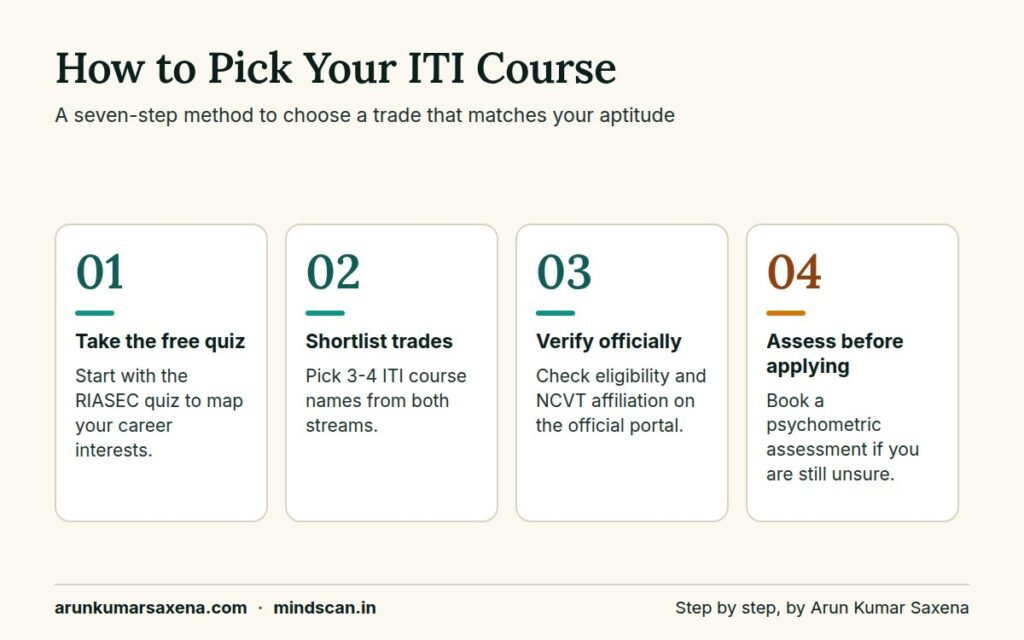
What is the full ITI courses name list for non-engineering trades?
Non-engineering trades cover a wide range of service-sector and desk-based skills. These options are popular among students from Arts and Commerce streams, and many are open to those who passed Class 10 without Mathematics. Durations typically vary from six months to two years.
Computer Operator and Programming Assistant (COPA) is the most searched non-engineering trade. It is a one-year course teaching computer operation, office software, internet use and basic programming support. Stenographer and Secretarial Assistant (English/Hindi) trains students in shorthand, typing and office administration. Dressmaking and Fashion Design Technology teach garment construction and design. Health Sanitary Inspector prepares students for public health and sanitation roles in municipal bodies and hospitals.
Plumber, though technically a construction trade, is often grouped here and has high demand. Other non-engineering options include Hair and Skin Care, Food Production, and Front Office Assistant. These trades lead to jobs in offices, salons, hotels, hospitals and self-employment.
In many homes, a Class 12 Arts student is told ITI is only for technical boys. She discovers COPA or Stenographer, completes the course in a year, and lands a desk job at a local firm while her degree classmates are still searching. The right non-engineering trade can give a faster, cleaner start than a general degree.
ITI courses name list: engineering and non-engineering trades comparison
This table compares the main trade options by type, duration and typical eligibility. Use it to shortlist trades that match your qualification and interest area before checking the official NCVT portal for state-specific details.
| Trade Name | Type | Duration | Eligibility |
|---|---|---|---|
| Electrician | Engineering | 2 years | Class 10 with Maths and Science |
| Fitter | Engineering | 2 years | Class 10 with Maths and Science |
| Welder | Engineering | 1 year | Class 8 or 10 |
| Turner | Engineering | 2 years | Class 10 with Maths and Science |
| Draughtsman (Mechanical) | Engineering | 2 years | Class 10 with Maths and Science |
| Draughtsman (Civil) | Engineering | 2 years | Class 10 with Maths and Science |
| Mechanic (Diesel) | Engineering | 1 year | Class 10 with Maths and Science |
| Mechanic (Motor Vehicle) | Engineering | 2 years | Class 10 with Maths and Science |
| Refrigeration and AC Mechanic | Engineering | 2 years | Class 10 with Maths and Science |
| COPA | Non-Engineering | 1 year | Class 10 |
| Stenographer (English) | Non-Engineering | 1 year | Class 10 |
| Dressmaking | Non-Engineering | 1 year | Class 8 or 10 |
| Health Sanitary Inspector | Non-Engineering | 1 year | Class 10 |
| Plumber | Non-Engineering | 1 year | Class 8 or 10 |
| Hair and Skin Care | Non-Engineering | 1 year | Class 10 |
Always verify the exact eligibility and duration for your chosen trade on the official Directorate General of Training (DGT) portal, as these can vary by state and institute.
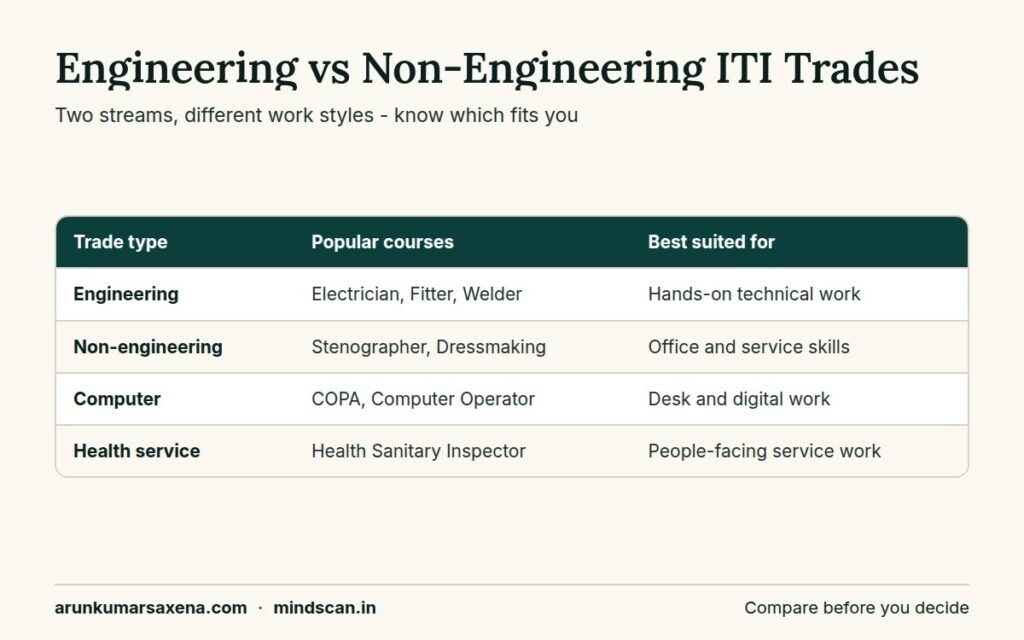
How to choose the right ITI course in 4 steps
Picking a trade from a long list without a method is like choosing a train without knowing the destination. Follow these four steps to narrow the list and arrive at a trade that fits your aptitude and career goal.
- Take a free career personality quiz. Start with the free RIASEC career personality quiz to see whether you lean toward hands-on engineering trades or desk-based non-engineering ones. It takes a few minutes and gives you a direction before you even look at a trade list.
- Shortlist three to five trades. From the table above, pick trades that match your RIASEC result and your education level. A Realistic type fits Electrician or Welder. A Conventional type fits COPA or Stenographer. An Artistic type fits Dressmaking or Hair and Skin Care. Write down three to five options that feel right.
- Verify on the official NCVT portal. Check each shortlisted trade on the DGT/NCVT official website for the latest eligibility, duration and affiliated ITIs in your district. This step saves you from outdated information and unrecognised institutes.
- Get a scientific career assessment. For a complete, data-verified decision, the MINDSCAN AI Career Clarity Report maps you to 20+ career groups and confirms whether your shortlisted trades actually fit your aptitude. Combine it with an online career counselling session and you walk away with a final shortlist, not a guess.
Which ITI courses have the best government job scope?
Many families search for trades with a clear path to a government job. The good news is that several options feed directly into public-sector recruitment. Electrician, Fitter, Welder and Mechanic (Diesel) are regularly recruited by Indian Railways, defence establishments, state electricity boards and public works departments. COPA and Stenographer open doors to clerical and office assistant posts in government offices. Health Sanitary Inspector leads to municipal corporation roles.
The route is usually through apprenticeship or direct recruitment against trade-specific vacancies. ITI pass-outs also get age relaxation and reservation benefits in many government job categories. However, no single trade guarantees a government job. The competition is real, and a certificate alone is not enough. A student who completes Electrician and then clears the wireman licence exam stands a far better chance than one who simply holds the certificate. Use the Skill India Digital Hub (Government of India skilling portal) to track apprenticeship openings and skill certification programmes that boost employability.

What mistakes do students make when picking an ITI trade?
The most common mistake I see is picking a trade because a cousin or neighbour did it. A boy joins Electrician because his uncle is an electrician, without checking if he has the patience for circuit work. A girl joins COPA because her friend joined, only to discover she hates sitting at a desk all day.
The second mistake is ignoring eligibility. A student who barely passed Class 10 Mathematics struggles through Draughtsman and drops out after six months. The third mistake is chasing a trade that is trending online without verifying local demand. A course may be popular on YouTube but have no apprenticeship openings in your district.
Another pattern I observe in counselling sessions is the rush to decide immediately after results day. A family sees the trade list for the first time on admission day and picks whatever seat is available. That is like buying the first pair of shoes you see without checking the size. A good decision takes a few days of research, a career quiz and ideally a scientific assessment. The MINDSCAN AI Career Clarity Report, available on mindscan.in/psychometric-assessment, removes the guesswork by mapping a student’s aptitude to 20+ career groups before any trade is discussed.
How can Arun Kumar Saxena help you pick the right ITI trade?
I am Arun Kumar Saxena, Certified Advanced Career Coach and founder of MINDSCAN Career Guidance. With 22 years of experience and 20,000+ students and professionals guided, I offer online career counselling in India with Arun Kumar Saxena that helps students pick an ITI trade matching their interests and aptitude, not just the popular name on a list.
Start with the free RIASEC career personality quiz. It takes a few minutes and shows whether you lean toward engineering trades or non-engineering ones. For a full, data-verified decision, the MINDSCAN AI Career Clarity Report maps you to 20+ career groups and, combined with a counselling session, gives you a shortlist of trades that actually fit. No guesswork, no neighbour’s advice, just scientific clarity.
What are the eligibility and duration rules for ITI courses?
Eligibility for these trades varies. Engineering trades like Electrician, Fitter, Turner and Draughtsman generally require Class 10 with Mathematics and Science. Non-engineering trades like COPA, Stenographer and Health Sanitary Inspector usually need Class 10 in any stream. A few trades, including Welder, Plumber and Dressmaking, accept Class 8 pass candidates. Durations typically range from six months for short certificate courses to two years for full trade programmes. One-year trades are the most common.
Always check the specific trade on the official DGT/NCVT portal before applying. State rules, institute type and seat availability can change the eligibility criteria. A trade listed as one year on a general website may run for two years in your state ITI. The official portal is the only source you should trust for admission decisions.
Is ITI better than continuing school after Class 10?
This question comes up in nearly every counselling session with Class 10 families. The answer is not a simple yes or no. An ITI trade is better than continuing school if the student has clear hands-on interests, struggles with academic theory and wants to start earning in one to two years. Continuing school is better if the student wants a degree, needs more time to explore interests or is aiming for a career that requires higher education.
The middle path works for many. A student can complete an ITI trade after Class 10, start working or doing an apprenticeship, and simultaneously enrol in open schooling for Class 12. Later, lateral entry into a polytechnic diploma becomes possible. This way, the student earns, learns a skill and keeps the degree door open. The key is to pick a trade that genuinely interests the student, not one that feels like a compromise after a poor board result.
What is the difference between NCVT and SCVT ITI courses?
NCVT stands for National Council for Vocational Training, and SCVT stands for State Council for Vocational Training. Both offer trade programmes, but an NCVT certificate is recognised nationally and preferred for central government jobs and apprenticeships. An SCVT certificate is valid within the issuing state and may not carry the same weight outside it. Most popular trades are available under both frameworks, but the syllabus, exam pattern and certificate value differ.
When shortlisting a trade, check whether the institute is NCVT-affiliated. An NCVT certificate gives you wider mobility and better apprenticeship chances. If you plan to work in your home state only, an SCVT trade from a good institute can still be a solid choice. The important thing is to know the difference before you enrol, not after you finish.
Frequently asked questions about iti courses name
What is the full form of ITI?
ITI stands for Industrial Training Institute, a government-recognised training centre offering short-duration technical and non-technical trades under the NCVT framework. These institutes are spread across India and provide skill-based education to students after Class 8, 10 or 12. The right ITI trade can lead to jobs, apprenticeships or self-employment.
Can I do ITI after 8th pass?
Yes, some ITI trades admit students who have passed Class 8. Trades like Welder, Plumber and certain fabrication courses often have this lower entry bar. Eligibility varies by trade and state, so verify the exact requirement for the specific option on the official NCVT portal before applying. A free RIASEC career personality quiz can help identify which trade type suits you.
Which ITI course is shortest in duration?
Several certificate-level ITI trades run for approximately 6 months. These are typically short-term skill programmes rather than full two-year trades. Durations vary by trade, so confirm the exact duration for the specific option in the official list before enrolling. Short courses can be a quick way to test interest in a trade before committing to a longer programme.
Is an ITI certificate equal to a diploma?
No. An ITI certificate is a trade-level qualification focused on practical skills, while a polytechnic diploma is a higher-level technical qualification with deeper theory. The two differ in depth, duration and career routes, though ITI pass-outs can sometimes enter diploma programmes laterally under current rules. Choose a trade based on whether you want hands-on skill training or a theory-heavy technical education.
Can girls join ITI courses?
Absolutely. Trades like COPA, Stenographer, Dressmaking, Health Sanitary Inspector and even engineering trades such as Electrician are open to girls. Many ITIs actively encourage women enrolment, and the government runs dedicated schemes to support female trainees in skill development. The right trade depends on interest and aptitude, not gender.
What is COPA in ITI?
COPA stands for Computer Operator and Programming Assistant. It is a popular non-engineering 1-year trade that teaches computer operation, office software, internet skills and basic programming support. It is one of the most searched options for students seeking desk-based jobs. For a complete career decision, consider an online career counselling session to confirm if COPA matches your aptitude.
Do ITI students get apprenticeship stipends?
ITI pass-outs can apply for apprenticeships under government schemes, and many receive a monthly stipend during training. Stipend amounts vary by scheme and employer, so treat any specific figure online as approximate and verify current apprenticeship notifications on official portals. Trades like Electrician, Fitter and Welder often have high demand for apprenticeships.
हिंदी में जवाब: 10वीं और 12वीं के बाद आईटीआई कोर्स: पूरी जानकारी
10वीं के बाद आईटीआई में प्रवेश कैसे मिलता है?
10वीं के बाद आईटीआई में प्रवेश के लिए आमतौर पर कोई राष्ट्रीय प्रवेश परीक्षा नहीं होती। अधिकांश राज्यों में सीधे या काउंसलिंग के माध्यम से दाखिला मिलता है। अरुण कुमार सक्सेना सलाह देते हैं कि कोई भी कोर्स चुनने से पहले छात्र की रुचि और योग्यता की वैज्ञानिक जांच कराएं, ताकि गलत ट्रेड में समय बर्बाद न हो।
12 वीं के बाद सबसे अच्छा कोर्स कौन सा है?
12वीं के बाद सबसे अच्छा आईटीआई कोर्स वही है जो छात्र की स्ट्रीम और व्यक्तित्व से मेल खाता हो। साइंस के छात्रों के लिए इलेक्ट्रीशियन, फिटर, ड्राफ्ट्समैन जैसे इंजीनियरिंग ट्रेड उपयुक्त हो सकते हैं, जबकि कॉमर्स और आर्ट्स के छात्रों के लिए COPA, स्टेनोग्राफर और हेल्थ सैनिटरी इंस्पेक्टर जैसे नॉन-इंजीनियरिंग ट्रेड बेहतर विकल्प हैं। लोकप्रियता के आधार पर नहीं, योग्यता के आधार पर चुनाव करें।
कौन सी पढ़ाई ज्यादा सैलरी देती है?
आईटीआई के बाद सैलरी ट्रेड, शहर और नियोक्ता पर निर्भर करती है। इलेक्ट्रीशियन, वेल्डर और फिटर जैसे हाथों के कौशल वाले ट्रेड में लगातार मांग बनी रहती है और अनुभव के साथ आय बढ़ती है। अरुण कुमार सक्सेना बताते हैं कि ऑनलाइन दिखने वाले सैलरी के आंकड़े लगभग अनुमान हैं, इसलिए किसी एक आंकड़े पर भरोसा करने से पहले स्थानीय मांग और अप्रेंटिसशिप के अवसरों की जांच जरूर करें।
An ITI courses name list is easy to find. A decision that fits your child’s aptitude and leads to a steady career takes more than a list. The students who succeed are not the ones who picked the most popular trade. They are the ones who picked the right trade for them.
Start with the free RIASEC career personality quiz. When you are ready for a complete, data-verified decision, the MINDSCAN AI Career Clarity Report, available on mindscan.in/psychometric-assessment, maps you to 20+ career groups. Combine it with an online career counselling session and you walk away with a shortlist of trades that actually fit, not a list of trades your neighbour recommends. Book your session and let us find the right ITI course for you, together.