
Science Stream Subjects for Class 11 and 12: Full List and How to Choose
By Arun Kumar Saxena, Certified Advanced Career Coach · Updated October 2026
Quick answer: The science stream subjects for class 11 and 12 are a fixed core of English, Physics and Chemistry plus Mathematics (PCM), Biology (PCB) or both (PCMB), completed by one optional subject. Choose the combination from your verified aptitude and career goal, not peer pressure or coaching-institute hype.
Key definition, the 4+1 subject structure: Science stream subjects for class 11 and 12 follow a 4+1 structure: four core subjects (English, Physics, Chemistry, plus Mathematics or Biology) and one optional fifth subject. MINDSCAN Career Guidance recommends confirming this structure in writing with your school before finalising any combination.
Subject for science stream choice after Class 10 is the first career fork that shapes engineering, medical and research paths. This page gives parents and students a full, board-by-board subject list and a step-by-step method to pick the combination that fits the student’s verified aptitude, not the topper’s timetable.
With 22 years of experience and 20,000+ students and professionals guided, I see the same costly mistake every March: families choose PCM or PCB on a neighbour’s advice, only to discover the mismatch in Class 12 when switching is hardest. This guide replaces guesswork with a data-verified selection process you can use at your own dining table.
Table of Contents
What subject for science stream is compulsory in Class 11?
English, Physics and Chemistry form the compulsory spine of every science combination, while the fourth core subject is either Mathematics or Biology and a fifth optional subject completes the standard five-subject load. Board circulars may label the papers differently, but this four-plus-one structure holds across the country.
- English (language paper, mandatory in every combination)
- Physics (cannot be dropped in any science stream variant)
- Chemistry (cannot be dropped in any science stream variant)
- Mathematics or Biology (the real decision point)
- One optional subject (varies sharply from one institution to the next)
Most schools expect students to pick one optional subject to reach five, and a few add a sixth internal or skill subject. Confirm your school’s exact list before you fill the form, because optional availability is not uniform and seats in popular optionals fill fast. The subject for science stream is built on this structure, so know the frame before you discuss the paint.
For official reference on senior secondary subject rules, check the CBSE Academic official website, which publishes the curriculum documents and circulars that define Class 11 and 12 subject combinations, and the official CBSE portal for board-level updates.
12th science subject list: what continues from Class 11
The 12th science subject list is the same science stream subjects for class 11 and 12 combination you chose in Class 11: English, Physics, Chemistry, Mathematics or Biology, and your optional subject continue into Class 12 with minimal change. Your board registers the subjects in Class 11, so the list carries forward; only the syllabus depth increases. Confirm any board-level tweak with your school before Class 12 registration.
How many subjects are there in college science stream?
In college, a science stream programme such as a B.Sc. usually combines one main discipline with a few allied papers and practicals per semester, so the count differs from school. Unlike the fixed five-subject school structure, college science typically means one honours subject plus electives, as per each university’s own rules.
What is PCM, PCB and PCMB?
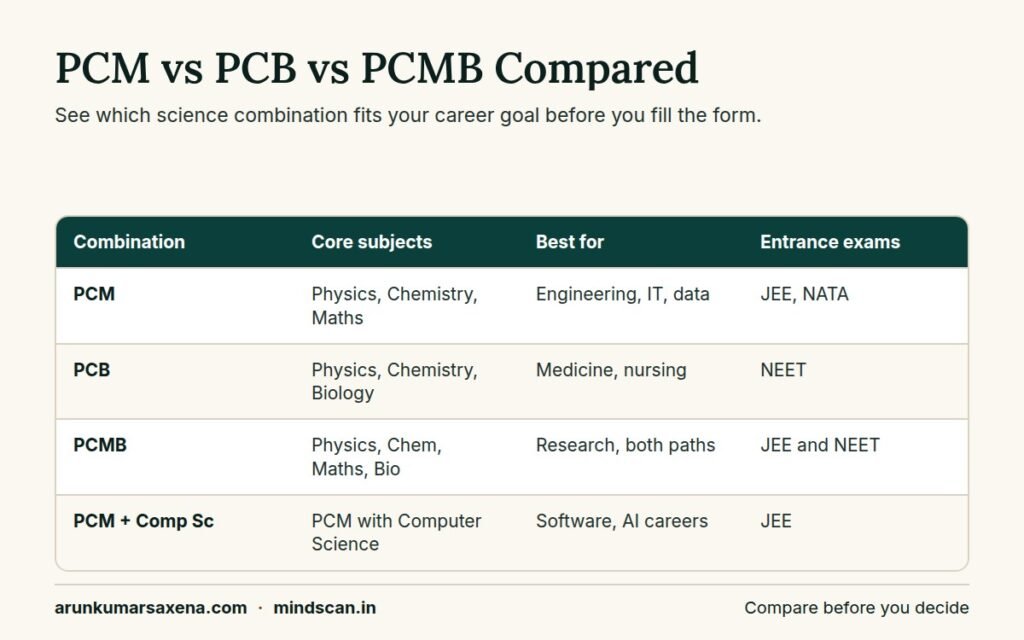
PCM is the science combination of Physics, Chemistry and Mathematics, the non-medical route to engineering, architecture, data science, AI and defence services. PCB is the combination of Physics, Chemistry and Biology, the medical route required for NEET, nursing, pharmacy and biotechnology. PCMB is the combination that takes both Mathematics and Biology, keeping both doors open at the cost of a heavier daily workload.
PCM is the base for B.Tech and B.E. programmes via JEE, B.Arch via NATA, and careers in the Merchant Navy. PCB is the only path to MBBS and BDS via NEET, and it also serves forensic science and allied health fields. PCMB suits research-minded students who genuinely enjoy both numerical problem-solving and heavy theory volume.
Take PCMB only with verified aptitude, not fear of missing out, because it roughly doubles the academic load and can hurt performance in both sets of subjects. The right subject for science stream is the one you can sustain for two years, not the one that sounds most ambitious. If you are still unsure whether science is the right fit at all, my detailed guide to 11th class humanities subjects shows what the alternative stream actually looks like.
Which subject is best in science stream for jobs and money?
No single subject guarantees high income; the combination does. PCM with Computer Science leads to the widest set of high-paying roles in engineering and IT, while PCB leads to medicine and allied health where earnings grow with specialisation and experience. Income follows fit and skill depth, not the subject label on your Class 11 form.
PCM plus Computer Science is the common path into software, data and AI careers. PCB is the only route to NEET-based medical careers where long-term earnings can be strong but come after years of study and residency. Optional subjects like Economics can keep commerce-adjacent careers open later, and Psychology helps future doctors and counsellors. Verify aptitude before chasing salary headlines, because a high-paying field that mismatches your natural strengths will exhaust you before the pay-off arrives. Treat the subject for science stream as a foundation, not a final destination.
How do I choose between PCM and PCB honestly?
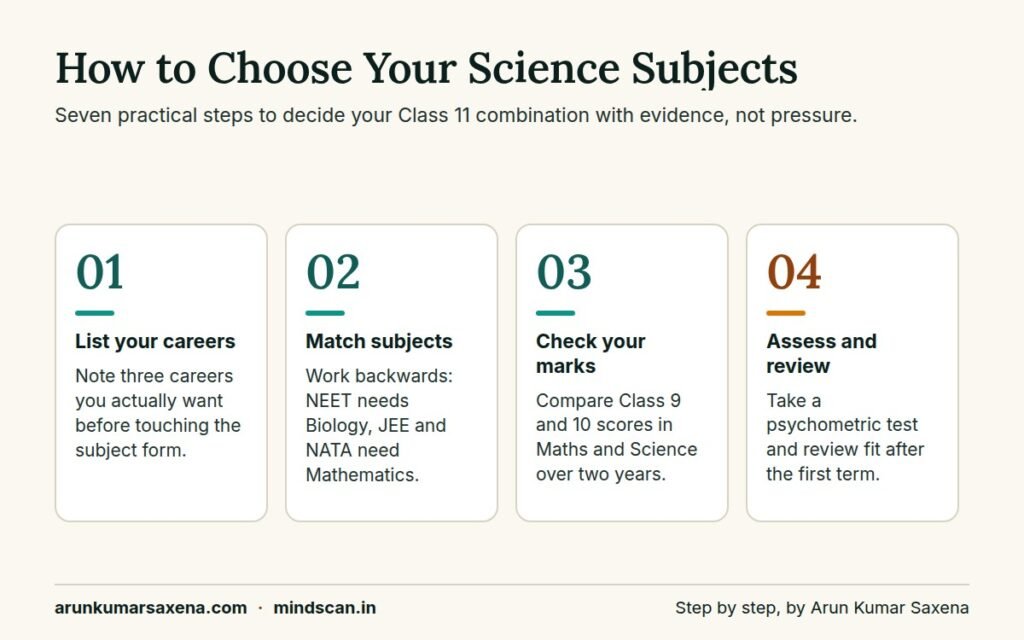
Start from the career you actually want, then test it against evidence: your Class 9 and 10 marks in Maths and Science, your genuine daily interest, and a psychometric assessment. If your goal needs NEET, Biology is non-negotiable; if it needs JEE or NATA, Mathematics is. When the gap between interest and aptitude is large, get a professional assessment before you sign the subject form.
List the three careers you genuinely want, then work backwards to the required subjects. Compare your Maths and Biology performance over two years, not one final exam. Use a validated psychometric test rather than relatives’ opinions, because a cousin’s success in engineering says nothing about your child’s aptitude. Ask one honest question: would I study this subject for science stream for years to come by choice? If the answer is no, the combination is wrong.
“Don’t pressurise your child either to appear for NEET or to drop after the first setback. Analyse your child’s aptitude scientifically and check the scores critically before taking any decision.” (Arun Kumar Saxena)
Which stream is best for computer science after 10th?
PCM, ideally with Computer Science or Informatics Practices as the optional subject, is the best stream for computer science after 10th. Mathematics is required for most B.Tech computer science programmes, so the Maths side of science is the right base. Coding skills, however, can and should start alongside school, not after it.
Mathematics is the non-negotiable for engineering computer science degrees across India. Computer Science or Informatics Practices as the optional gives a genuine head start in programming logic and syllabus familiarity. Some B.Sc. computer science routes are flexible on the fourth subject, but the safest path is PCM with Computer Science. Start programming practice in Class 11 itself, because the degree alone is not enough to land a strong first job. Pick the subject for science stream that keeps your computer science goal open without closing other doors prematurely.
Which subject is toughest and which is easy in the science stream after 10th?
Tough is personal, not absolute. Science is widely considered the most demanding stream because of daily Maths or Biology plus Physics numericals, but a student strong in these subjects may find it easier than Commerce or Arts students find their own subjects. Difficulty depends on your aptitude, not the stream’s reputation.
PCM is demanding on speed and problem-solving; PCB is demanding on memory and consistent reading volume. Students weak in Maths often suffer more in PCM than in any other stream, and students who dislike long theory hours struggle in PCB. Ease without interest leads to boredom and poor scores in any stream. Assessment beats guesswork when judging difficulty for a specific child. Test before you label a subject for science stream as hard or easy, because a label that sticks in Class 11 can shape a student’s confidence for years.
What optional subjects can science students take in Class 11?
Common optional subjects are Computer Science, Informatics Practices, Physical Education, Economics, Psychology, Environmental Science and Engineering Drawing or Graphics. Availability depends entirely on your school, so confirm the list with your school before deciding. Choose the optional that supports your career direction or plays to a verified strength. If you are still weighing science against other options, my guide to the class 11 humanities subject list compares that stream honestly before you commit.
Computer Science supports engineering and IT goals directly. Physical Education is a scoring option with a lighter daily load that can balance a heavy PCM or PCB schedule. Economics keeps commerce-linked careers open and adds quantitative reasoning. Psychology helps future doctors, counsellors and HR professionals build people skills early. Confirm seat availability in writing, because popular optionals fill fast in many schools. The optional subject for science stream can shape your Class 12 workload and your beyond-school options, so treat it as a strategic choice, not an afterthought. And if you are still weighing science against commerce, my guide to which subjects are in the commerce stream lists that stream’s full subject set.
| Combination | Core subjects | Best suited for | Key entrance exams |
|---|---|---|---|
| PCM (Non-Medical) | Physics, Chemistry, Mathematics, English | Engineering, architecture, data science, defence | JEE Main, JEE Advanced, NATA |
| PCB (Medical) | Physics, Chemistry, Biology, English | Medicine, nursing, pharmacy, forensic science | NEET |
| PCMB (Both) | Physics, Chemistry, Mathematics, Biology, English | Research, pure sciences, dual-option students | JEE, NEET, IISER |
| PCM + Computer Science | Physics, Chemistry, Mathematics, English, Computer Science | Software engineering, AI, data science, IT | JEE Main, JEE Advanced |
| Factor | PCM | PCB | PCMB |
|---|---|---|---|
| Main subjects beyond English, Physics, Chemistry | Mathematics | Biology | Mathematics and Biology |
| Career routes | Engineering, architecture, data science, AI, defence, Merchant Navy | MBBS, BDS, nursing, pharmacy, biotechnology, forensic science | Research and pure sciences, both medical and engineering routes kept open |
| Entrance exams | JEE Main, JEE Advanced, NATA | NEET | JEE, NEET, IISER |
| Daily workload | Heavy on problem-solving practice and numericals | Heavy on memory and reading volume | Roughly double load; needs verified aptitude in both directions |
| Who should avoid | Students weak in Maths speed or unwilling to practise numericals daily | Students who struggle with memory-heavy theory and long reading hours | Students without verified aptitude and genuine interest in both Maths and Biology |
| Who it suits (verified aptitude) | Students strong in problem-solving speed who want engineering, architecture, data science or defence | Students strong in memory and reading volume who want medical and allied health careers | Students with verified aptitude and genuine interest in both Maths and Biology, typically research-minded |
What should I do after 10th science courses are chosen: a 2026 action plan?
Direct answer: After 10th science courses are chosen, confirm your school’s subject list and deadlines in writing, map each career goal to its required subjects, audit two years of marks, validate the fit with a psychometric assessment if signals conflict, start one skill alongside school, and review the combination after the first term while switching is still possible.
Once a subject for science stream is fixed, the work shifts to execution: confirm board deadlines, build a study rhythm, start skill practice early, and revisit the plan every six months with data. Students who treat Class 11 subject choice as a one-time decision usually discover misfits only in Class 12, when switching is costliest.
Quick self-check before you submit the subject form
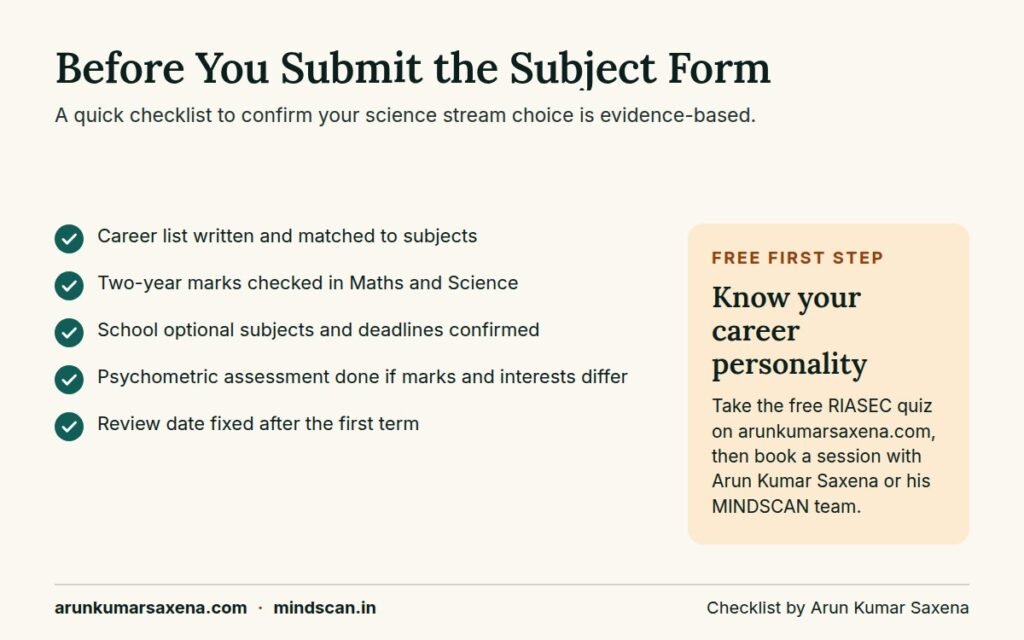
Tick every box you can honestly answer yes to. If fewer than four are ticked, get a professional assessment before you finalise.
Need help reading the evidence? Book an online career counselling session.
- List your genuine career goals: Identify the three careers you genuinely want, using the free RIASEC career personality quiz as a starting filter.
- Work backwards to subjects: Map each career to the subjects it demands: NEET needs Biology, JEE needs Mathematics.
- Audit your marks: Check your Class 9 and 10 marks in Maths and Science over two years, not one exam.
- Confirm school options: Confirm your school’s exact optional subject list and seat deadlines in writing.
- Validate with an assessment: Take a psychometric assessment if your marks and interests point in different directions.
- Discuss with evidence: Discuss the choice with parents using your evidence sheet, not opinions.
- Schedule a review: Fix a review date after the first term to confirm the combination still fits.
Track monthly test scores against your target entrance exam from the first month of Class 11. Start one skill alongside school: coding, NEET-style biology practice or communication. Reassess fit after each term; switching streams in Class 11 is still possible in most boards. Involve parents with evidence, not arguments, and keep the National Career Service portal by the Government of India bookmarked for updated career pathways.
The Ministry of Education, Government of India also publishes education policy updates that clarify subject rules each academic year. The subject for science stream you choose now is the foundation of this action plan, not an end point.
When should students take career counselling for stream selection?
Start career counselling from Class 8 onwards so that stream selection after 10th is a confirmation, not a panic decision. A structured assessment from MINDSCAN Career Guidance maps interests and aptitude to 20+ career groups, and a coach interprets it against the student’s real academic record. This is the process I follow in my online sessions across India.
For official reference, students and parents can check the National Career Service portal by the Government of India for verified career pathways, and the Ministry of Education, Government of India for policy updates on subject rules each academic year.
Early counselling avoids last-minute pressure choices in March when schools demand the subject form within days. Psychometric evidence beats guesswork and relatives’ advice every time. A student in a small town gets the same rigour as one in a metro, and sessions work entirely online. The MINDSCAN report maps the student to 20+ career groups, and every report is reviewed before the family discussion.
Waiting until Class 10 results are out is the most common mistake I see. By then, school deadlines are looming and the decision gets rushed. Book a session early, and the subject for science stream becomes a confirmation of known facts, not a gamble on unknown ones.
What most guides miss: the self-knowledge step before the subject list
Most subject-selection pages jump straight to the list of subjects for science stream and the colleges they lead to. That order is backwards. My book 3 Steps to Knowing Yourself argues that self-knowledge must come before any subject or career choice. In practice, this means a student should spend at least two weeks mapping their own interests, study stamina and daily energy patterns before even looking at a PCM or PCB comparison table.
Families who skip this step usually circle back to me in Class 12, asking for a stream change that board rules make nearly impossible. Start with the student, not the syllabus. The subject for science stream that fits a self-aware student will outlast any shortcut choice made by a neighbour.
For a wider comparison of post-10th options, read my guide on which stream is best for CEO after 10th. If your child is in Class 10 now, the CBSE Class 10 board exam planning guide helps you time the subject decision correctly. And when the PCM-versus-PCB debate gets stuck, my article on subject for science stream breaks the deadlock with evidence.
Frequently asked questions about subject for science stream
How many subjects are compulsory in Class 11 science?
Typically five: English, Physics, Chemistry, Mathematics or Biology, plus one optional. Some schools add a sixth internal or skill subject. Boards differ slightly, so verify with your specific school and board circular before you finalise the subject for science stream.
Can I switch from PCB to PCM after Class 11?
Switching is possible in most schools early in Class 11 but becomes very hard in Class 12 because of board registration and syllabus gaps. Review your fit after the first term and decide within Class 11, not later, while the subject for science stream is still adjustable.
Is Biology harder than Mathematics in Class 11?
Neither is objectively harder: Mathematics demands problem-solving speed and practice, Biology demands memory and consistent reading volume. The harder one for you is the one that mismatches your aptitude, which a psychometric assessment from MINDSCAN can reveal before you lock the subject for science stream.
Do I need Computer Science as a subject to study computer science later?
No. Most B.Tech computer science programmes require Mathematics, not school-level Computer Science. However, taking it as an optional gives a genuine head start, and self-study coding works just as well alongside any subject for science stream.
Is PCMB a good choice or an unnecessary burden?
PCMB keeps both medical and engineering doors open, but it roughly doubles the daily academic load. Choose it only if your assessment shows strong aptitude and genuine interest in both Maths and Biology, not because of fear of closing doors on a subject for science stream.
What percentage is needed in Class 10 to take science?
Schools set their own cut-offs, commonly based on Science and Maths marks. There is no single national percentage requirement. If your marks are borderline, get an aptitude assessment before negotiating with the school for the subject for science stream. For a full timeline, see my CBSE Class 10 board exam planning guide.
Should parents or the student make the final subject decision?
The student should own the decision, informed by parents, teachers and a professional assessment. Parents bring experience and finances; the student brings the daily effort. Decisions imposed by parents, as I repeatedly see, fail under Class 12 pressure when the subject for science stream feels like a burden rather than a choice.
What are the types of science streams?
The main types of science streams in India are PCM (Physics, Chemistry, Mathematics), PCB (Physics, Chemistry, Biology), PCMB (both Mathematics and Biology), and PCM with Computer Science as an optional. PCM serves engineering and defence careers, PCB serves medical careers, and PCMB keeps both routes open for research-minded students. If science does not feel like the right fit, my guide to 11th class humanities subjects compares the alternative stream honestly.
What are the 5 main subjects in science stream?
The 5 main subjects in the science stream are English, Physics, Chemistry, Mathematics or Biology, and one optional subject such as Computer Science, Physical Education, Economics or Psychology. Some schools add a sixth internal or skill subject, so always confirm the exact list with your school before filling the form.
What are 10 common topics in science?
Common topics in science include mechanics, thermodynamics and electromagnetism in Physics; organic, inorganic and physical chemistry; genetics, human physiology and ecology in Biology; and algebra, calculus and statistics in Mathematics, as per standard board syllabi. The exact topic list varies by board and by whether you choose PCM or PCB.
Can I take PCM with Biology as an optional subject instead of full PCMB?
Yes, in many schools PCM with Biology as the optional fifth subject is possible, and it is lighter than a full PCMB subject load because Biology is treated as an additional paper rather than a core one. Availability varies by school, so confirm the optional list in writing before you fill the form.
Which subjects are needed for NEET and which for JEE?
NEET requires Physics, Chemistry and Biology, so the PCB combination of science stream subjects is the qualifying base; always confirm the latest rules on the official NTA website. JEE requires Physics, Chemistry and Mathematics, so PCM is the base for engineering. English is needed for board eligibility in both cases, and PCMB keeps both entrance routes open simultaneously.
Science or Commerce: how do I compare the subject lists and decide?
Write both subject lists side by side, then mark which subjects match your Class 9 and 10 performance and your target careers. Science keeps engineering and medical doors open; Commerce keeps finance, business and CA routes open. Compare each science side subject against the commerce stream list, then verify the fit with an assessment rather than a friend’s timetable.
What optional subject should I pick with PCM or PCB?
Pick the optional that supports your career direction: Computer Science for engineering and IT goals, Psychology for medicine and counselling, Economics for commerce-linked careers, and Physical Education for a scoring subject with a lighter daily load. Confirm your school offers it, because optional availability and seats differ from one institution to the next.
What happens if I choose the wrong subject combination in Class 11?
You face falling scores, lost confidence and pressure to switch, which board registration rules make very hard in Class 12. In my 22 years of experience and 20,000+ students and professionals guided, Arun Kumar Saxena has seen most switches fail because families skip a validated psychometric assessment before signing the subject form.
Science stream subjects: full list and how to choose, in brief
Which subjects are there in Class 11 science after 10th?
Class 11 science usually has five subjects: English, Physics, Chemistry, Mathematics or Biology, and one optional subject; some schools add a sixth internal subject. Check your school and board circular for the exact list. Arun Kumar Saxena advises taking this decision only after a scientific assessment of interest and aptitude.
Which science job is the best?
No single subject guarantees a good job; the combination decides. PCM with Computer Science opens the highest-paying engineering and IT roles, while PCB leads to medicine and healthcare. Arun Kumar Saxena’s honest view: income depends on your aptitude and depth of skill, not just the subject name on the Class 11 form.
Choosing the right subject for science stream is too important to leave to a fifteen-minute conversation with a neighbour. Book a session of online career counselling in India with Arun Kumar Saxena and get a data-verified combination that fits your child’s actual aptitude. You can also start with the MINDSCAN AI Career Clarity Report at ₹1,499, or take the report with a personal counselling session at ₹2,999. The subject form comes once; the evidence should come first.
About the author: Arun Kumar Saxena is a Certified Advanced Career Coach and the founder of MINDSCAN Career Guidance, with 22 years of experience and 20,000+ students and professionals guided. A former corporate leader at Airtel and Reliance, a CBSE Resource Person and the author of 3 Steps to Knowing Yourself, he and his MINDSCAN team counsel students, parents and professionals online across India. Call +91-9140604743 or visit mindscan.in.