
11th Class Humanities Subjects: Full List and Smart Combinations
By Arun Kumar Saxena, Certified Advanced Career Coach and founder of MINDSCAN Career Guidance
Last updated: October 2026
Humanities is the stream of social sciences and languages that studies how people live, think, govern and create. The 11th class humanities subjects are the subjects a student selects in the humanities stream in Class 11, typically one language plus electives such as History, Political Science, Geography, Economics, Psychology and Sociology.
Quick answer: 11th class humanities subjects typically include one compulsory language plus four electives from History, Political Science, Geography, Economics, Psychology, Sociology, Legal Studies, Fine Arts, and Physical Education. The best combination is the one matched to your target career and verified aptitude, checked with a psychometric assessment like MINDSCAN’s before you lock it.
How many subjects? Class 11 humanities typically has 5 subjects: one compulsory language, usually English, plus four electives chosen from History, Political Science, Geography, Economics, Psychology, Sociology, Legal Studies, Fine Arts or Physical Education. Many schools allow a 6th optional subject, so always confirm with your school’s combination chart.
Picking your 11th class humanities subjects is not about finding the lightest workload. It is about building a base for the career you want after Class 12. This page gives you the full CBSE and ICSE subject list, practical combinations and a clear method to choose without regret.
With 22 years of experience and 20,000+ students and professionals guided, I see the same mistake every admission season: students lock a combination because a friend took it, then discover the mismatch after two terms. The fix is simple. Decide with data, not guesswork. This guide helps you do exactly that.
Table of Contents
How many subjects are there in 11th humanities?
Most boards require 5 subjects in Class 11 humanities, one language (usually English) plus four electives, and many schools allow a 6th optional subject such as Physical Education, Fine Arts or a second language. Exact numbers vary by school, so confirm with your school’s combination chart before finalising.
Humanities in Class 11 is a stream of social sciences and language subjects that builds a base for careers in law, civil services, psychology, media, design and academia. It rewards reading, writing and analysis over formula-based problem-solving. CBSE typically sets the minimum at 5 subjects, with a 6th as an optional add-on. ICSE and state boards may structure the total differently, and some electives depend on teacher availability.
Always ask for the official combination sheet from your school before you shortlist your 11th class humanities subjects. A student who assumes a subject is available and discovers later it is not offered loses precious time.
What are the subjects in humanities in class 11th?
The full pool of 11th class humanities subjects starts with English (or another language) as the compulsory core and expands into social sciences, creative fields and even technical electives. The official CBSE Arts/Humanities curriculum document, titled Arts, Humanities and Social Sciences on cbse.gov.in, lists every approved option, and your school’s combination chart shows which of them are actually offered.
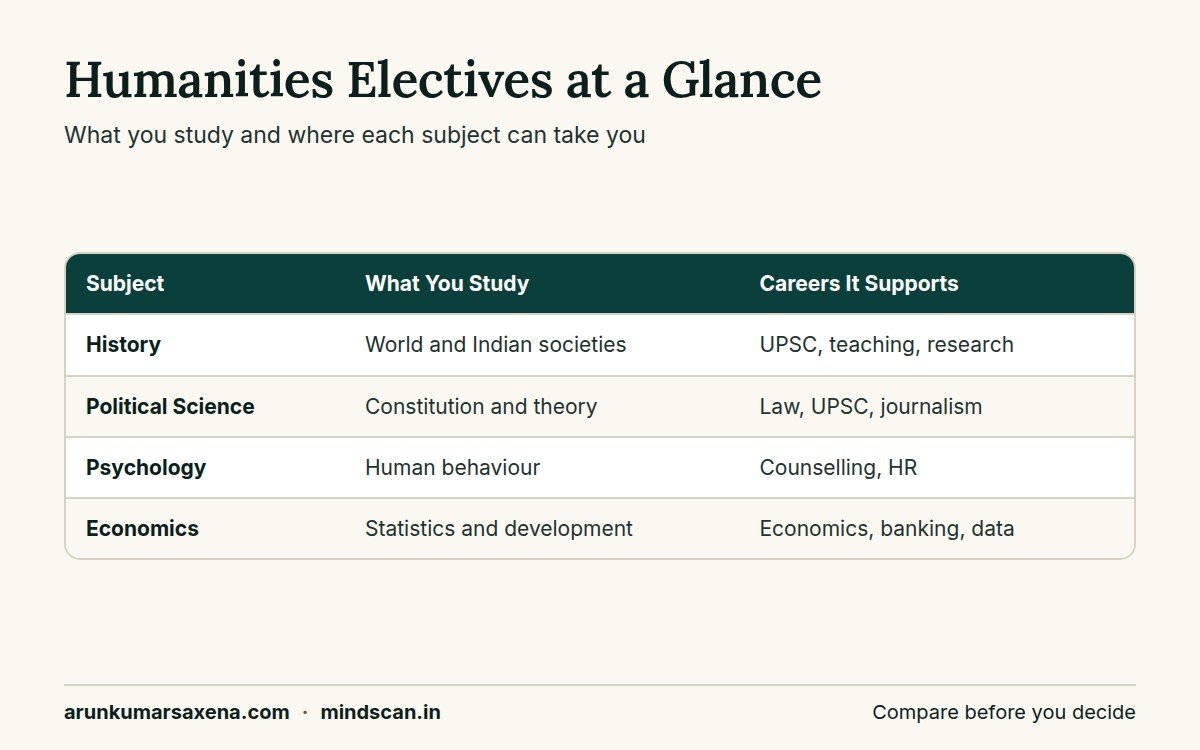
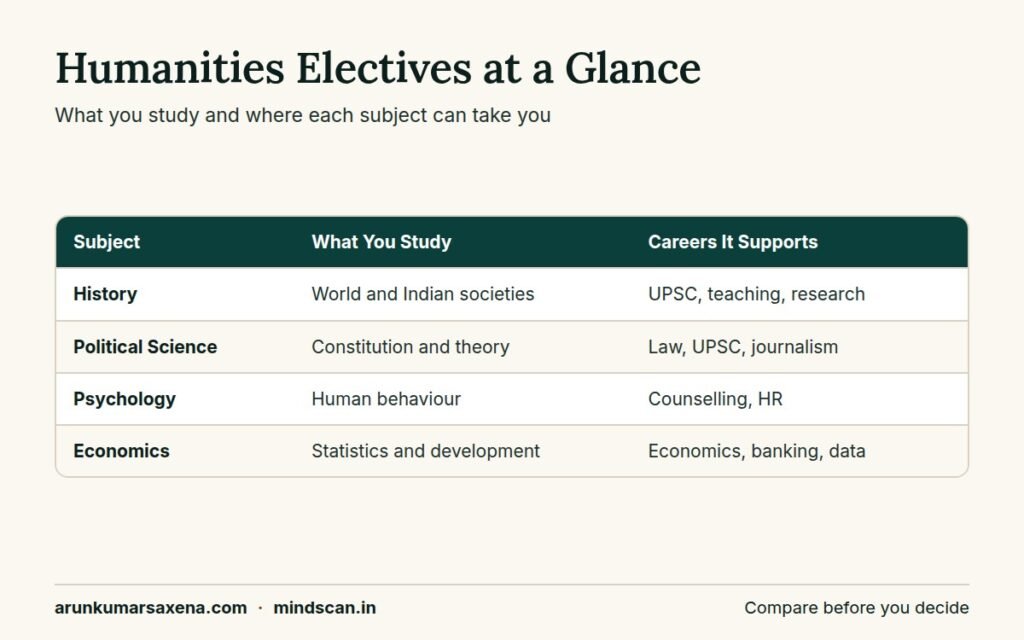
Core humanities electives include History, Political Science, Geography, Economics, Psychology and Sociology. Skill and creative options cover Legal Studies, Fine Arts, Physical Education and Home Science. Mathematics and Informatics Practices are open to humanities students in many schools and add a strong quantitative edge. For a full comparison of what each stream offers at this stage, see our guide to the class x subject combination. If you are still building your base, revisit our guide to 10th class all subjects to see how your current subjects connect. The table below maps the most common electives to the careers they support.
| Subject | What You Study | Careers It Supports | Best Paired With |
|---|---|---|---|
| History | Ancient to modern societies and world history | Civil services, teaching, research | Political Science, Economics |
| Political Science | Indian Constitution and political theory | Law, UPSC, journalism | History, Economics, Legal Studies |
| Psychology | Human behaviour and mental processes | Counselling, HR, clinical psychology | Sociology, Biology interest, English |
| Economics | Statistics and Indian economic development | B.A. Economics, banking, data careers | Maths, Political Science |
| Legal Studies | Basics of law and justice | Law and CLAT | Political Science, English |
| Fine Arts | Creative and performance practice | Design, media, arts careers | Any academic elective |
| Physical Education | Practical fitness and sports theory | Sports science and general balance | Any combination |
Is class 11 humanities easy?
Humanities is not easy, it is different. It rewards reading, writing and analysis over formula-based problem-solving. Students who assume no memorising or no effort is needed often slip in the first term. The right question is whether your aptitude and interests match the 11th class humanities subjects, not which stream looks lightest.
History and Political Science demand sustained writing practice and the ability to build arguments. Psychology and Economics involve statistics, research methods and applied concepts that surprise students expecting only theory. Ease depends on the individual student’s aptitude, never on the stream label. I have seen toppers stumble and average students soar, purely because of subject fit. Picture a Class 11 student who chose humanities because relatives said it was the easy route.
By mid-term, the essay assignments and source analysis in History felt heavier than any formula. The workload did not change. The expectation did. That gap is what makes a stream feel hard. Your 11th class humanities subjects will feel manageable only when they match how your mind works.
Which subject is best in 11th class humanities?
There is no single best subject, the answer depends entirely on your career target. Political Science and Economics suit civil services and law paths. Psychology suits counselling and HR. Mathematics strengthens economics, data careers and UPSC readiness. Match your 11th class humanities subjects to a career goal and verify your interest with an assessment before choosing.
For a law track, pair Political Science, Legal Studies and Economics. For psychology and counselling, combine Psychology with Sociology and a genuine interest in biology-adjacent topics. For civil services, History, Political Science, Economics and optional Maths form a proven base. The subject that is best is the one that pulls you closer to your target, not the one your cousin picked. In many homes, the dinner-table debate pits History against Economics as if one holds more prestige. The truth is simpler. A subject is best when it aligns with what you can study for two hours without being told.
How do I choose the right humanities subject combination for my career?
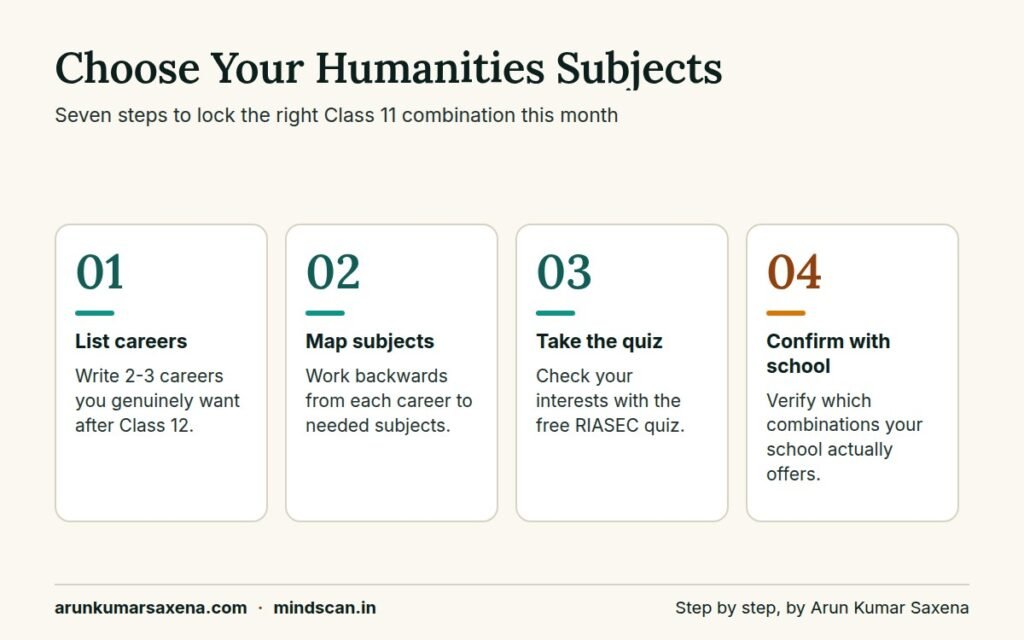
Start from the career, work backwards to subjects. Self-knowledge comes before any subject choice, a principle from my book ‘3 Steps to Knowing Yourself‘. Verify with a scientific aptitude and interest assessment rather than copying friends or following parental pressure. The MINDSCAN AI Career Clarity Report maps a student to 20+ career groups and shows which stream fits the data. The steps below give you a repeatable process.
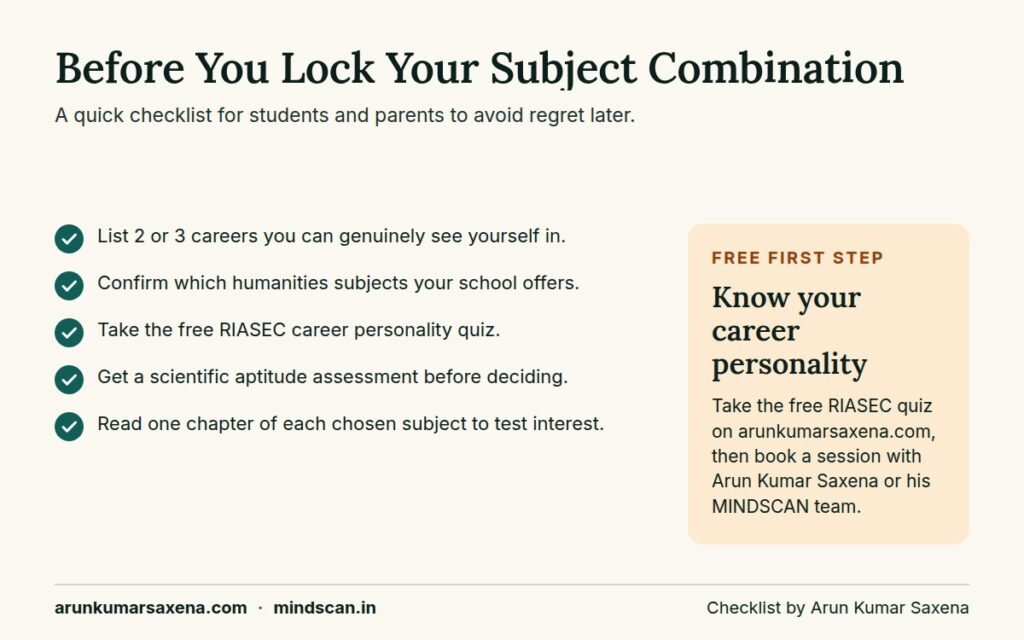
- List 2-3 careers you can genuinely see yourself in after Class 12.
- Work backwards: note which 11th class humanities subjects each career needs.
- Take the free RIASEC career personality quiz to check your interests honestly.
- Discuss the shortlist with your school and confirm which combinations are actually offered.
- Get a scientific aptitude assessment like the MINDSCAN psychometric assessment instead of copying your friends’ choices.
- Finalise 5 (or 6) subjects with one language plus matched electives.
- Within a month, read one chapter of each chosen subject to test real interest before the session locks.
What most guides miss: the self-knowledge check before the subject list
Most pages hand you a list of 11th class humanities subjects and stop there. In my sessions, the students who struggle are rarely those who picked a wrong subject on paper. They are the ones who never paused to ask: what do I actually enjoy doing for two hours without being told? Before you even look at a combination chart, do this short exercise.
- Take a blank page and write down three activities that absorb you completely, the ones where you lose track of time.
- Write down three topics you avoid even when marks depend on them.
- Compare the two lists. The first list points to subjects you will sustain effort in. The second list warns you away from subjects that will drain you.
That short exercise tells you more than any generic best subjects list ever will. Pair that honest self-check with a validated psychometric assessment, and your subject shortlist becomes yours, not a copy of someone else’s choice. A student who loves debating current affairs but dreads map work already knows Geography is a risk, no test needed. The blank-page exercise makes that obvious before the school form is filled.
Can I take maths with humanities in class 11?
Yes, in many CBSE and ICSE schools mathematics is offered as an elective to humanities students, and it is highly useful for Economics (Hons), data-oriented careers, CA-adjacent paths and UPSC. Availability depends on the school, so check the combination chart. Schools may also set a minimum Class 10 maths mark to allow it.
Maths plus Economics is a powerful combination for B.A. Economics and data careers. Informatics Practices or Computer Applications also add a technical edge for students who want a digital skill without the full maths syllabus. If your school does not offer Maths, check whether Informatics Practices is available as a bridge subject. A humanities student with Maths stands out in university applications where quantitative skills are valued, and the 11th class humanities subjects list becomes far more flexible with that one addition.
What is the difference between humanities subjects and science subjects in class 11?
| Point | Humanities (Class 11) | Science (Class 11) |
|---|---|---|
| Core subjects | One language plus social sciences such as History, Political Science, Psychology | Physics and Chemistry, plus Biology or Mathematics |
| Thinking style | Reading, writing and building arguments | Formulas, problem sets and one-right-answer tasks |
| Main careers | Law, UPSC, psychology, media, design, teaching | Engineering, medicine, research, technology |
| Shared electives | Maths, Economics, Psychology and Physical Education appear in both streams | |
Science (medical and non-medical) takes Physics and Chemistry with Biology or Mathematics, while humanities takes social sciences and languages. Some subjects like Maths, Psychology, Economics and Physical Education appear in both streams. Choose by aptitude, not by social pressure.
Non-medical science includes Physics, Chemistry, Mathematics plus English. Medical science includes Physics, Chemistry, Biology plus English. The shared electives, Maths, Economics, Psychology, Physical Education, mean a humanities student can build a combination that overlaps with science interests without taking the full science load. A student curious about human behaviour but not keen on Physics can take Psychology inside humanities and still keep career paths in counselling or HR open.
The 11th class humanities subjects are not a closed box. They are a different route to many of the same destinations. For a closer look at the non-medical stream, you can explore the subjects offered in the science stream on our website.
What most guides miss: the three-question stream test
Before you commit to humanities or science, answer three questions honestly. One: when you read something difficult, do you prefer arguing about its meaning or solving the problem it presents? Two: do you enjoy building a long essay from scratch or working through a set of steps to one correct answer? Three: which Class 10 subject did you study without anyone reminding you? If your answers lean toward argument, essays and self-driven reading in social studies or English, your 11th class humanities subjects are likely a strong fit.
If you lean toward problem sets, formulas and one-right-answer tasks, science or commerce may suit you better. This is not a final verdict. It is a starting point for a conversation with a qualified career counsellor who can add data to your instinct.
What careers open up after class 12 humanities?
Main paths include law (CLAT), civil services (UPSC), psychology and counselling, journalism and mass communication, design and fine arts, teaching and academia, hotel management, social work, foreign languages and government jobs. For the full breakdown, you can read about career options after 12th in Arts on our website.
Law, UPSC and psychology are the most-asked humanities paths in my practice. Creative tracks, design, fine arts, media, content, are growing fast and reward portfolio-building from Class 11 onward. The National Career Service portal (Government of India) is a good official starting point for exploring government job pathways.
For law and civil services, also check the official CLAT Consortium and UPSC websites. A student who picks 11th class humanities subjects with a clear career map in Class 11 has a two-year head start over peers who figure it out after board results.
When should I consult a career counsellor about my stream choice?
The right time is before the school asks you to lock subjects, ideally Class 9 or 10, and Class 8 onward is the recommended start for career counselling. A data-verified assessment maps the student to 20+ career groups, removing guesswork from the stream decision. I review every report to ensure the recommendation fits the student.
Decide with data: a psychometric assessment plus counselling, not guesswork. Early counselling avoids costly stream switches in Class 11 or 12.
“Analyse your child’s aptitude scientifically and check the scores critically before taking any decision.” (Arun Kumar Saxena)
Plus one humanities subjects: the direct answer
Plus one means Class 11, a term used mainly in Kerala and other state boards. In Kerala’s plus one humanities (Humanities I and II under DHSE Kerala), students typically take one language plus History, Political Science, Geography, Economics, Sociology or Psychology. CBSE and ICSE schools in Kerala follow their own combination charts, so confirm the official school list before admission.
11th humanities subjects CBSE: the direct answer
In CBSE, 11th humanities subjects are one compulsory language, usually English, plus four electives from History, Political Science, Geography, Economics, Psychology, Sociology, Legal Studies, Fine Arts, Home Science or Physical Education. Mathematics and Informatics Practices are open to humanities students in many schools. A 6th subject is optional, and the official CBSE Arts/Humanities curriculum document on cbse.gov.in lists every approved option.
Frequently asked questions about 11th class humanities subjects
Is maths compulsory in humanities class 11 CBSE?
No, maths is optional in humanities. Only one language is typically compulsory. But taking maths strengthens economics, data and UPSC paths. Check your school’s specific policy because availability varies, and some schools require a minimum Class 10 maths score to offer it as an elective.
Can I change subjects in class 11 after admission?
Many schools allow a change within a short window early in Class 11 if seats exist in the new combination. After that window closes, switching becomes very difficult. That is exactly why I recommend deciding with a data-verified assessment before admission instead of discovering the mismatch after two terms.
Which board is best for humanities, CBSE, ICSE or state board?
There is no single best board. CBSE offers wide subject availability and strong alignment with competitive exams like UPSC and CLAT. ICSE offers breadth in arts and languages. State boards vary widely. Compare the 11th class humanities subjects your local schools actually offer rather than chasing a board label. For a deeper look at where these subjects lead, see our guide on career options after 12th in Arts.
Is psychology a good subject in class 11 humanities?
Psychology is an excellent choice for students interested in human behaviour, counselling, HR or clinical psychology. It pairs well with Sociology and biology-adjacent interest. Be aware that it involves applied concepts and some research methods, not just reading, students expecting only theory often find the statistics component surprising.
Do humanities students get government jobs?
Yes, 11th class humanities subjects map directly to UPSC, SSC, banking, law and state services careers. History, Political Science and Economics form the core of many competitive exam syllabi. The National Career Service portal is a good official starting point for exploring government job pathways.
What if I choose the wrong stream in class 11?
It is recoverable but costly. Switches are easiest in the first weeks of Class 11. After that, you may lose a year or carry a subject that drags down your Class 12 board percentage. A data-verified assessment before admission is the simplest way to avoid this situation entirely.
How do I know my aptitude before choosing humanities?
Take a validated psychometric assessment that measures aptitude and interests, review it with a qualified counsellor, and cross-check it against your Class 10 academic performance. That triangulation, test data plus expert interpretation plus your own track record, is far more reliable than marks alone or a casual chat with relatives.
Humanities subjects in 11th CBSE
CBSE humanities in Class 11 usually has one compulsory language, usually English, plus four electives chosen from History, Political Science, Geography, Economics, Psychology, Sociology, Legal Studies, Fine Arts or Physical Education. Exact availability depends on the school’s combination chart, so check the official list before finalising.
Plus one humanities subjects
‘Plus one’ refers to Class 11, and the humanities subjects at this level are typically one language plus four electives such as History, Political Science, Geography, Economics, Psychology, Sociology or Fine Arts. The mix varies by board and school, so confirm the official combination list before admission.
Choosing your 11th class humanities subjects is a career decision, not just a school formality. The combination you lock today shapes the degrees and jobs open to you three years from now. Do not leave it to a last-minute guess or a friend’s recommendation.
Get the MINDSCAN AI Career Clarity Report for ₹1,499, or with a counselling session for ₹2,999. Book a session of online career counselling across India or start with the report alone on MINDSCAN’s psychometric assessment page. The right combination is waiting. Let us find it together.