
Teacher Profession in India: Meaning, Path and Honest Reality
By Arun Kumar Saxena, Certified Advanced Career Coach and founder of MINDSCAN Career Guidance
Last updated: October 2026
Quick answer: The teacher profession is a field of guiding knowledge, character and skills, requiring formal training and certification, not just subject knowledge. It is called a noble profession yet deserves an honest look at pay and workload. Before choosing the teacher profession, verify your fit with a psychometric assessment instead of copying an admired teacher.
The teacher profession in India requires a D.El.Ed or a B.Ed from an NCTE-recognised college, plus clearing CTET for central government schools or a state TET for state schools. Private schools often accept a B.Ed without a TET. The profession meets all four classic tests of a profession: specialised knowledge, formal qualification, code of ethics and a regulatory body.
Prefer reading in Hindi? Jump to the Hindi answers section for step-by-step guidance after Class 10 and Class 12.
The teacher profession is a career of shaping minds, not just delivering a syllabus. If you are a student considering this path or a parent helping your child decide, this page gives you the full qualification-to-classroom road map, an honest pros-and-cons table, and a self-knowledge-first view that most guides miss.
With 22 years of experience and 20,000+ students and professionals guided, I have seen too many young people choose the teacher profession because they admired one teacher. Admiration is a fine starting point, but it is not a career plan. This page helps you test whether teaching fits you before you invest years in a B.Ed or D.El.Ed.
Table of Contents
What is the teacher profession and is teaching really a profession?
Teaching is a profession built on specialised knowledge, formal training and certification, ethical standards and continuous professional development. It meets the classic tests of a profession, though its prestige and autonomy in India are debated. The teacher profession is guided by UNESCO’s definition of the teaching profession framework and India’s own NCTE-recognised teacher education programmes.
Four tests define whether an occupation is a profession. First, it requires a body of specialised knowledge that takes years to acquire. Second, entry is gated by a formal qualification. Third, practitioners follow a code of ethics. Fourth, professional bodies regulate standards and development. The teacher profession clears all four, yet in India the ground reality varies sharply between a well-funded international school and a single-teacher rural school.
In India, the National Council for Teacher Education (NCTE) sets the standards. A B.Ed or D.El.Ed from an NCTE-recognised college is the baseline. State recruitment boards and central agencies like KVS and NVS then apply their own filters, usually through the CTET or state TET. So while teaching is a profession on paper, the lived experience of autonomy, pay and workload depends heavily on the type of school and management.
I tell every aspirant: respect for teachers is high in Indian society, but respect does not pay the bills. Check the salary structure of the school type you are targeting before you enrol in a training programme. A government school teacher’s pay and a private school teacher’s pay can differ by approximately two to three times at the same experience level.
Why is teaching called a noble profession?
Teaching is called a noble profession because teachers shape character, not just careers. A teacher’s influence outlasts any syllabus, exam or academic year. The label “why teacher is a noble profession” appears in essays and speeches across India, and the core reason is that a teacher acts as mentor, role model and external parent to hundreds of children over a career.
Long-term impact is the real measure. A good teacher helps a child learn; a great teacher helps a child want to learn. That multiplier effect, repeated across decades, is why society places the teacher profession on a moral pedestal. Teachers build the citizens who build the nation, and no other profession can claim that chain of influence so directly.
But here is my honest note. Nobility is a reason to respect the work, not a reason to ignore salary, workload and fit. I have met young people who chose the teacher profession solely because one teacher changed their life. That is a beautiful tribute, but it is a weak career decision.
“Analyse your child’s aptitude scientifically and check the scores critically before taking any decision” (Arun Kumar Saxena)
The same rule applies to you. Admiration is not aptitude. Verify your fit before you commit.
What types of teachers are there in India?
India’s teacher profession spans pre-primary educators, primary teachers, upper-primary teachers, secondary teachers, senior secondary teachers, special educators and college professors. Each type works at a different educational stage, and qualification requirements differ at every level. Government and private schools both hire across these categories, though pay scales and entry rules vary.
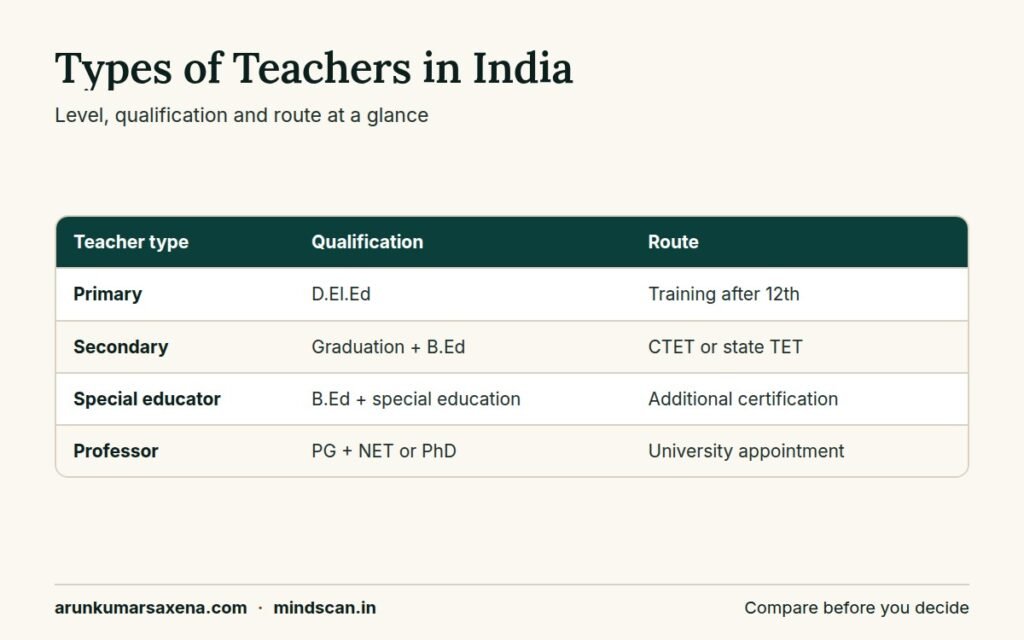
| Teacher type | Typical qualification | Main route |
|---|---|---|
| Pre-primary & primary | D.El.Ed (or equivalent) | Teacher training after 12th; CTET/TET for eligible levels |
| Secondary & senior secondary | Graduation + B.Ed | Subject graduation, B.Ed, CTET/TET, school or state recruitment |
| Special educator | B.Ed/degree + special-education certification | Additional special-education qualification alongside regular training |
| Professor | Postgraduation + UGC NET or PhD | Master’s degree, NET/PhD, university appointment per UGC rules for college and university teaching careers |
Pre-primary and primary teachers typically work in nursery schools, government primary schools and private K-12 schools. Secondary and senior secondary teachers handle subject-specific classrooms from Class 6 to Class 12. Special educators work across levels, supporting children with learning disabilities, physical challenges or developmental needs. A full professor is the highest academic rank in a college or university, earned after years of teaching, research and publication, distinct from an assistant professor or associate professor.
How to become a teacher in India step by step?
The path to the teacher profession in India runs through choosing a stream after Class 10, completing Class 12, graduating in your teaching subject, adding a B.Ed or D.El.Ed, clearing CTET or a state TET, and applying through school and government recruitment channels. Private schools often accept B.Ed without TET, but clearing the TET widens your options considerably.
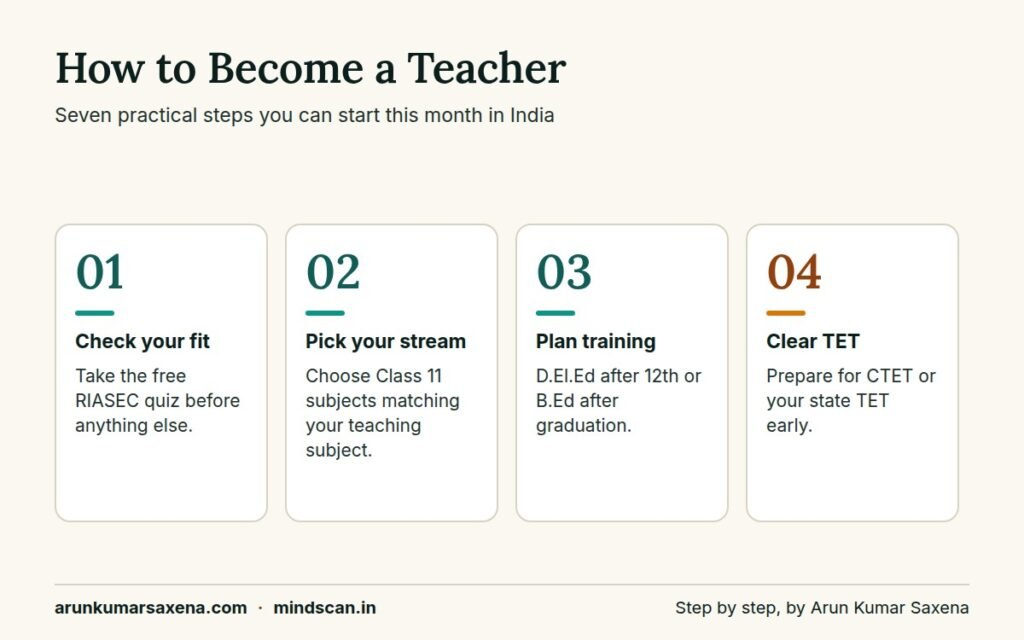
- Check your fit first: take the free RIASEC career personality quiz on arunkumarsaxena.com this week.
- Choose your Class 11 stream based on the subject you want to teach, using the stream guides on the site.
- Shortlist graduation programmes in your teaching subject before Class 12 results.
- Plan the teacher training route: D.El.Ed after 12th or B.Ed after graduation; verify NCTE recognition of the college.
- Prepare for CTET or your state TET alongside the final year of training; attempt it as soon as eligible.
- Gather classroom exposure: tutoring, internships or volunteer teaching to test the day-to-day reality.
- If still unsure, book a psychometric assessment and counselling session so the B.Ed decision is data-verified, not guesswork.
CTET is the central eligibility test for Kendriya Vidyalayas, Navodaya Vidyalayas and other central government schools. Each state runs its own TET for state government schools. Continuous professional development is now an expectation under the NEP 2020 policy direction from the Ministry of Education, so a teacher’s learning never really stops after the B.Ed. For a broader view of subjects and streams, check the complete list of Class 10 subjects to plan early.
Which subjects and stream should you pick in Class 11 to become a teacher?
Any stream can lead to the teacher profession. What matters is choosing the subject you want to teach and scoring well enough in it at graduation level. Match your Class 11 stream to your intended teaching subject, and use the stream guides on this site to weigh the options. My angle: pick the stream from your own verified fit, not from what a favourite teacher taught.
If you want to teach primary classes, the stream matters less than your aptitude for the D.El.Ed route. Primary teachers need broad foundational skills, not deep subject specialisation. For secondary and senior secondary teaching, the stream must contain the subject you plan to teach. A future Physics teacher takes Science with Physics, Chemistry and Mathematics. A future History teacher takes Humanities. The Class 11 humanities subject list and combinations page lays out the options clearly.
Humanities is a common and fully valid route for teaching careers. Many of India’s finest teachers come from an Arts background. Do not let anyone tell you that Science is the only respectable stream for a teacher. The subject you love and can teach well is the one that matters. For students exploring Arts further, the career options after 12th in Arts page opens up the full picture.
What skills does a good teacher need beyond subject knowledge?
A good teacher fills five key roles: instructor, mentor, counsellor, role model and facilitator. The skills behind these roles are communication, patience, classroom management, assessment design and digital teaching skills. Post-2020 classrooms demand comfort with digital tools, and hiring panels now weigh communication and classroom management ahead of pure content knowledge.
Communication is the skill that turns subject knowledge into student learning. A teacher who knows the topic cold but cannot explain it simply will lose the class. Classroom management is the quiet skill that keeps 40 or 50 students engaged, orderly and safe. Assessment and feedback skills let a teacher spot gaps and correct them before the exam does.
Digital and blended teaching skills are no longer optional. Even government schools now use smartboards, DIKSHA digital learning content and online assessment tools. The NCERT’s pedagogy and teacher development resources set the baseline for these classroom skills. Emotional connection rounds out the skill set: care, respect, trust and integrity, the four values UNESCO frames as the ethical core of the teacher profession. A teacher who builds trust gets more learning done than one who only builds lesson plans.
What are the pros and cons of the teacher profession in India?
The teacher profession offers job security, scheduled vacations, deep respect in society, the satisfaction of shaping lives and steady demand across India. On the minus side, starting salaries are moderate in many private schools, correction and administrative workload extends well beyond class hours, and early-career growth can be slow. No invented salary figures are given here; pay varies sharply by school type, state and management.
Pros include security, especially in government teaching jobs, where a permanent position is among the most stable careers in India. Vacations align with your children’s holidays, a practical perk few other professions offer. The impact is real: every year, a teacher sees students grow and move on, carrying something the teacher gave them. Demand for qualified teachers stays steady because India’s school-age population is enormous.
Cons start with pay variance. A government school teacher in a metro may earn a comfortable salary; a private school teacher in a small town may earn half that for the same work. Workload beyond class hours is the hidden cost: correction, report cards, parent meetings, cultural programme rehearsals and administrative paperwork eat into evenings and weekends.
| Factor | Government school teacher | Private school teacher |
|---|---|---|
| Entry test | CTET or state TET usually mandatory | B.Ed often accepted without TET |
| Pay scale | Fixed pay commission scales, higher at entry | Varies widely by school and city |
| Job security | Permanent posts are highly stable | Contract roles common in early years |
| Growth route | Departmental seniority and promotions | Faster role switches, coordinator and edtech options |
How much does a teacher earn in India?
A teacher’s salary in India varies sharply by school type and location. As per online sources, an entry-level private school teacher may earn approximately ₹15,000 to ₹25,000 per month, while a government teacher under pay commission scales can earn roughly two to three times that amount at the same experience level. No single official figure exists; pay depends on state, management, and role.
Pros and cons of the teacher profession at a glance
Pros of the teacher profession:
- Job security, especially in permanent government teaching positions.
- Scheduled vacations that align with your children’s holidays.
- Deep respect in society for shaping young lives.
- Steady demand for qualified teachers across India.
- Growth paths into coordinator, vice-principal, principal, edtech or counselling roles.
Cons of the teacher profession:
- Moderate starting salaries in many private schools.
- Sharp pay variance between government and private schools.
- Correction, reports and paperwork extending beyond class hours.
- Slow early-career growth, often taking years.
Growth paths exist (senior teacher, coordinator, vice-principal, principal, or pivots into edtech and counselling) but they take years. My honesty rule: check your fit before you check the salary. If teaching fits your aptitude and interests, the pros outweigh the cons. If it does not, no salary will make it feel right.
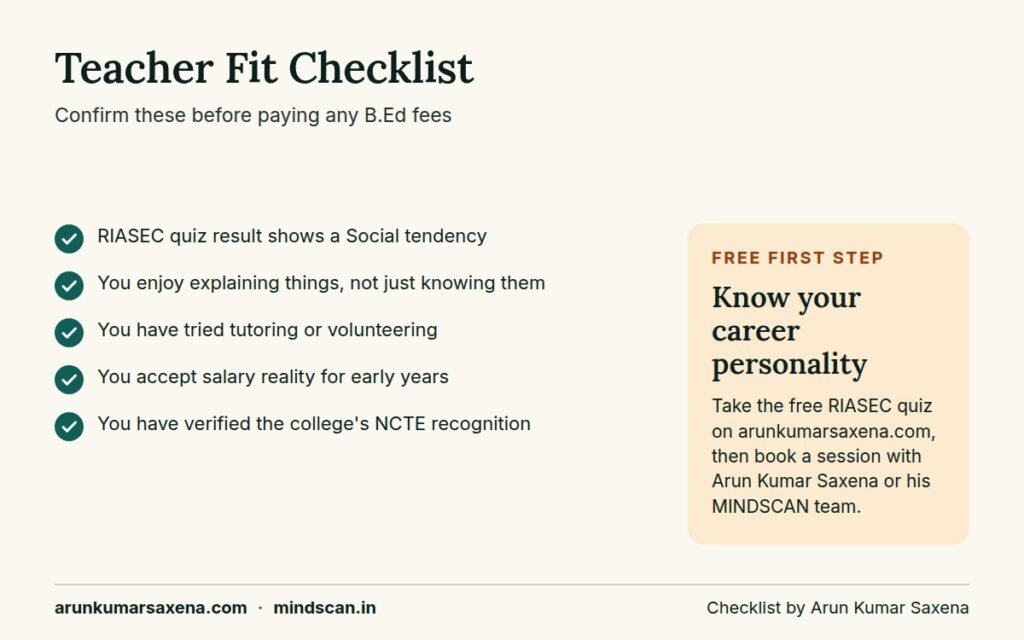
Teaching-fit checklist: tick these before you enrol in a B.Ed
- I can explain a difficult topic in simple words to a mixed-ability class.
- I stay patient with slow learners, not only with bright students.
- I can hold the attention of 40 to 50 students for a full period.
- I accept correction, report cards and paperwork beyond class hours.
- I enjoy assessing and giving feedback, not just lecturing.
- My chosen stream contains the subject I want to teach.
- I have tested my fit with a psychometric assessment, not just admiration.
Ticked fewer than five? Verify your fit with a psychometric assessment before you commit years and fees to a teaching qualification.
How do you know if the teacher profession fits you?
Fit comes from verified aptitude and interests, not admiration. The RIASEC model, widely used in career psychology, shows that teaching typically suits strong Social-type profiles: people who enjoy helping, explaining, guiding and working closely with others. The free RIASEC career personality quiz on this site gives you a first check, and a full psychometric assessment with a career counsellor gives you a verified verdict.
My book 3 Steps to Knowing Yourself rests on one principle: self-knowledge comes before any career choice. You cannot choose the teacher profession wisely if you do not know your own aptitude, interests and work-style preferences. I recommend career counselling from Class 8 onwards, and a psychometric assessment before committing to B.Ed fees. The MINDSCAN report maps students to 20+ career groups so you see exactly where you stand.
What most guides miss: admiration is not aptitude
Most career pages list qualifications and salary ranges. They skip the single biggest reason young Indians choose the teacher profession for the wrong reason: they admired one teacher and copied the choice without testing themselves. I see this pattern in my sessions. A student loved her History teacher, so she decides to become a History teacher. She never checks whether she has the patience for a classroom of 50, the communication skill to hold attention, or the interest in continuous assessment and paperwork. Two years into a B.Ed, she realises the daily reality does not match the image.
The same dynamic plays out in the teacher profession. Admiration for one teacher is a feeling. Aptitude for teaching is a measurable fact. Do not confuse the two. Before you spend three to four years and significant fees on a teaching qualification, take a psychometric assessment. Let the data speak first.
With 22 years of experience and 20,000+ students and professionals guided, I have seen the pattern is consistent: those who test their fit before choosing a career reach clarity faster and regret less. The teacher profession deserves people who are truly suited to it. Be one of them by verifying your fit first.
Frequently asked questions about teacher profession
What does ‘teacher by profession’ mean?
The phrase ‘teacher by profession’ means a person whose trained, certified occupation is teaching. It is used in bios, application forms and introductions to state that teaching is the person’s primary career, not a side activity. It distinguishes a trained schoolteacher from someone who teaches occasionally but is a professional in another field, such as an engineer who takes weekend tuition classes.
Is teacher a profession or an occupation?
Teaching is a profession, not merely an occupation. It meets the professional criteria: specialised training through B.Ed or D.El.Ed programmes, certification through CTET or TET, a code of ethics, and continuous professional development requirements. Debates about pay and autonomy in India do not change its professional status, though they do affect how the teacher profession is experienced day to day.
What is the difference between a teacher and a professor?
A teacher works in schools with school-level qualifications such as D.El.Ed or B.Ed and typically clears CTET or TET. A professor teaches in colleges and universities and needs postgraduation plus UGC NET or a PhD. Within the professor track, ranks progress from assistant professor to associate professor to full professor, the highest academic rank, which requires significant teaching experience and published research.
Do I need B.Ed to become a teacher in India?
For most school teaching roles, yes. D.El.Ed is the standard for primary levels, and B.Ed is required for secondary and senior secondary teaching. Many private schools also expect a B.Ed even when it is not legally mandated. Always verify that the college is NCTE-recognised before enrolling, because a degree from a non-recognised college will not qualify you for government teaching posts or TET eligibility.
Is teaching a good career for the future?
Demand for good teachers stays steady in India, and digital and special-education roles are growing. However, pay growth is slow in the early years, especially in private schools. Suitability matters more than market demand alone. A psychometric assessment verifies whether the teacher profession fits your aptitude and interests, so you do not invest years in a career that looks good on paper but drains you in practice.
When should a student start planning for the teacher profession?
Career counselling is ideal from Class 8 onwards. Concrete planning for the teacher profession should begin before Class 11 stream selection, because the stream determines which teaching subject you can pursue at graduation. Early verification of fit avoids wasted years in a stream or degree that does not lead where you want to go.
How do I choose between teaching and other careers I like?
Compare verified aptitude, interests and work-reality exposure across your options. Do not decide on prestige or one admired role model. A professional psychometric assessment plus a counselling session gives you data to settle the question. I have seen too many students choose the teacher profession for emotional reasons and later switch fields.
What is the definition of a professor?
A professor is a teacher at the college or university level, and full professor is the highest academic rank in higher education. The rank is earned after years of teaching, research and publication, as per UGC rules. It sits above assistant professor and associate professor, and requires postgraduation plus UGC NET or a PhD to enter the track.
What is a nickname for a professor?
Informal nicknames for a professor include ‘prof’ and ‘doc’, used by students as friendly shorthand. These nicknames are not official titles. They are distinct from the formal academic ranks of assistant professor, associate professor and full professor, which are earned positions defined by teaching experience, research output and publication under UGC rules in India.
हिंदी में जवाब: भारत में शिक्षक पेशा: अर्थ, मार्ग और ईमानदार वास्तविकता
12 वीं के बाद सबसे अच्छा कोर्स कौन सा है?
12वीं के बाद सबसे अच्छा कोर्स वह है जो आपकी योग्यता, रुचि और करियर लक्ष्य से मेल खाता हो। यदि आप शिक्षक पेशा चुनना चाहते हैं, तो स्नातक के बाद बी.एड करें। प्राथमिक शिक्षक बनने के लिए 12वीं के बाद सीधे डी.एल.एड भी कर सकते हैं। अरुण कुमार सक्सेना सलाह देते हैं कि कोई भी कोर्स चुनने से पहले साइकोमेट्रिक असेसमेंट से अपनी फिट जाँच लें।
10वीं के बाद 11वीं में कौन-कौन से सब्जेक्ट होते हैं?
10वीं के बाद 11वीं में मुख्य तीन स्ट्रीम होती हैं: विज्ञान, वाणिज्य और मानविकी। विज्ञान में भौतिकी, रसायन, जीवविज्ञान और गणित जैसे विषय होते हैं। मानविकी में इतिहास, भूगोल, राजनीति विज्ञान, समाजशास्त्र और मनोविज्ञान जैसे लगभग 15 से अधिक विषयों के विकल्प मिलते हैं। शिक्षक पेशा चुनने वाले छात्रों को वह स्ट्रीम लेनी चाहिए जिसमें उनका पढ़ाने का विषय शामिल हो।
10वीं के बाद कौन सी परीक्षा देनी चाहिए?
10वीं के बाद सीधे शिक्षक पेशा से जुड़ी कोई परीक्षा नहीं होती। पहले 11वीं और 12वीं पूरी करें, फिर स्नातक करें। स्नातक के अंतिम वर्ष में या उसके बाद सीटीईटी या राज्य टीईटी की तैयारी करें। यदि प्राथमिक शिक्षक बनना चाहते हैं, तो 12वीं के बाद डी.एल.एड में प्रवेश के लिए राज्य स्तरीय प्रवेश परीक्षा दे सकते हैं। अरुण कुमार सक्सेना के अनुसार, पहले अपनी रुचि और योग्यता की जाँच कराएँ।
The teacher profession needs people who are truly suited to it, not those who drift in because they liked one teacher or could not think of anything else. If you are serious about teaching, do not guess. Take the MINDSCAN AI Career Clarity Report at ₹1,499, or ₹2,999 with a counselling session, and get a data-verified answer on whether teaching fits you. Then book online career counselling in India with Arun Kumar Saxena and build your path with clarity, not hope.