
Career Options After BSc: The Complete 2026 Guide
By Arun Kumar Saxena, Certified Advanced Career Coach and founder of MINDSCAN Career Guidance
Last updated: October 2026
Quick answer: Career options after BSc fall into four main paths: higher study, direct jobs, government exams, and skill-based roles. The right choice depends on your specialisation, personality, and goal, not on salary lists. Career coach Arun Kumar Saxena recommends a psychometric assessment before choosing, so you pick a path that fits you and not the crowd.
Career options after BSc are wider than most graduates realise, but wider does not mean easier. A BSc degree opens doors to master’s programmes, private-sector jobs, government exams and skill-based careers. The real question is not which list is longest, it is which path fits you. With 22 years of experience and 20,000+ students and professionals guided, I have seen too many science graduates pick a course because a friend picked it, or because a blog promised a high package, and regret it.
Career options after BSc include MSc (via IIT JAM or CUET PG), MBA (via CAT or XAT), MCA (via NIMCET), B.Ed, direct private jobs, certification routes, and government exams such as UPSC Civil Services, SSC CGL, banking and state PCS.
This page is for every BSc student or parent who wants a clear, honest, data-verified guide to career options after BSc in 2026. It covers higher study, direct jobs, government routes and the self-assessment step most guides skip. By the end, you will know which buckets fit your specialisation, what each path actually demands, and how to decide with confidence rather than guesswork.
Table of Contents
What are the best career options after BSc in 2026?
Career options after BSc are the higher-study, job and exam paths open to Bachelor of Science graduates. The strongest ones fall into four buckets: master’s degrees, high-demand private jobs, government and PSU exams, and skill-based roles. Your specialisation narrows the list; your aptitude should decide it.
Most university pages and coaching blogs give you a flat list of courses. They rarely tell you how to pick between an MSc, an MBA, a government exam and a direct job when all four are technically open to you. Here is the honest breakdown.
Master’s degrees remain the most common next step. An MSc deepens your subject expertise and leads to research, teaching or specialised industry roles. Entrance exams include IIT JAM and CUET PG. An MBA pivots you into management, business analysis or marketing and requires CAT, XAT or similar exams. An MCA builds a software-development career and typically needs NIMCET. A B.Ed opens school teaching if you prefer stability and structure.
Private-sector jobs after BSc are growing in data science, IT services, clinical research and lab technology. Companies hire BSc graduates as data analysts, software developers, lab technicians, clinical research associates and biotechnologists. The catch: a degree alone rarely lands the job. Certifications, projects and off-campus job-hunting skills matter more, and campus placements are weak in most non-tier-1 colleges. Read my guide on off-campus placement strategies that actually work before you start applying.
Government and PSU exams give BSc graduates access to scientific and administrative roles. The main exams include:
- UPSC Civil Services
- SSC CGL
- IBPS and SBI banking exams
- State PCS exams
- ISRO and DRDO scientific posts
Some scientific posts prefer or require an MSc, so always check the latest notification on the National Career Service portal.
The gap most guides miss: none of them tell you how to choose between these buckets. That choice starts with self-knowledge, not with a course catalogue.
“Analyse your child’s aptitude scientifically and check the scores critically before taking any decision.” (Arun Kumar Saxena)
Which course is best after BSc for a high salary?
For salary upside among career options after BSc, the most reliable routes are an MSc in a specialisation with research demand, an MBA into management roles, or MCA into software, plus certifications in data science and AI. Salaries vary widely by city, company and skill, so treat any single salary figure as an estimate, not a promise.
An MSc in a high-demand field like data science, biotechnology or chemistry can lead to research roles in pharma, agritech and government labs. An MBA from a decent B-school opens business analyst, product manager and marketing roles that pay well but demand long hours and people skills. An MCA plus a strong coding portfolio lands software developer and data engineer jobs where demonstrated projects outweigh degree grades.
Choosing a course purely because a blog lists a high LPA is a mistake I see every admission season. A high-salary field that does not match your aptitude will exhaust you within two years. Data and AI roles, in particular, demand demonstrated projects and continuous upskilling, a degree certificate alone will not get you hired. Before you chase a salary figure, check whether the daily work of that role fits your personality. Also look at AI-proof careers for 2030 to see which roles will stay relevant.
Which BSc specialisation has the highest scope?
Computer science, data science, biotechnology, nursing and agriculture BSc degrees currently show the widest scope, as per online sources. But scope changes with market cycles; the safer question is which field matches your strengths, because skills and fit outlast trends.
Here is a realistic view by specialisation. BSc Computer Science and IT lead to software, data and cybersecurity roles. BSc Biotechnology opens pharma, clinical research and agritech paths. BSc Zoology and Microbiology feed into lab technology, wildlife conservation and food safety. BSc Physics and Chemistry graduates move into research, quality control and teaching. BSc Agriculture connects to agribusiness, government extension roles and food processing. BSc Nursing remains one of the most employable degrees in India and abroad, as per online sources, with hospital and community-health demand staying strong.
Each specialisation has two or three realistic next steps. A BSc Zoology graduate can aim for an MSc in wildlife science, a lab-technician certification or a government forest-service exam. A BSc Physics graduate can target IIT JAM for an MSc, a data-analytics certification or ISRO scientific posts. The honest truth: high-scope fields are also the most crowded. A BSc Computer Science degree alone puts you in a pool of lakhs of graduates. Differentiation, through projects, internships and a clear specialisation, matters more than the degree name.
Which degree has future scope after BSc?
A BSc degree combined with the right skills or specialisation builds strong future scope. Degrees in computer science, data science, biotechnology and nursing continue to show growing demand, as per online sources. The real future-proofing comes from evaluating proven career options after BSc and adding a master’s, certification or project portfolio that matches your aptitude to a specific, in-demand role rather than chasing the broadest degree name.
Can I get a job directly after BSc without a master’s degree?
Yes, but be realistic. Direct jobs represent one of the viable career options after BSc, existing in IT support and development, lab technician roles, banking exams, sales and data entry-adjacent analytics. Competition is heavy, so certifications, projects and a strong resume matter more than the degree alone.
Realistic direct-job roles include:
- IT support executive
- Junior software developer
- Lab technician
- Clinical research coordinator
- Medical representative
- Bank probationary officer (via IBPS/SBI exams)
- Data entry analyst
Each role requires something beyond the BSc certificate: a coding portfolio for IT roles, a lab-technician certification for hospital jobs, or a cleared banking exam for public-sector banks.
The certification route works as a bridge. A BSc graduate with a Google Data Analytics certificate, an AWS cloud certification or a clinical research diploma becomes employable faster than one waiting for a master’s degree. Use the Skill India Digital Hub for structured, low-cost courses recognised by employers.
Off-campus job hunting is the reality for most BSc graduates. Campus placements are concentrated in tier-1 colleges; everyone else must build a LinkedIn profile, apply on job portals and network. My off-campus placement strategies that actually work page gives a step-by-step plan for this.
MSc, MBA or MCA after BSc: which should I choose?
Choose MSc if you love your subject and want research, teaching or deep technical work. Choose MBA if you want management, business analysis or marketing careers. Choose MCA if you want software development and have the aptitude for it. The decision starts with knowing your interests and aptitude, not with entrance-exam trends.
An MSc suits students who enjoy lab work, theory and academic depth. Typical roles after an MSc include research scientist, lecturer, quality control officer and biotechnologist. Entrance is through IIT JAM or CUET PG. An MBA fits those who like leading teams, solving business problems and working across functions. Roles include business analyst, product manager and marketing lead, entered via CAT or XAT. An MCA is for graduates who want to build software; NIMCET is the common entrance, and roles include software developer, systems analyst and database administrator.
Doing an MBA by default is a trap. I meet BSc graduates every year who enrol in an MBA programme because their family pushed it or because they think it guarantees a high salary. Two years and significant fees later, many realise they dislike corporate roles and wish they had stayed in science. Before you pick a degree, take the free RIASEC career personality quiz to see which work style fits you. Then read about MBA courses after graduation to understand what the degree actually demands.
What are the government job options after BSc?
BSc graduates are eligible for UPSC Civil Services, SSC CGL, IBPS and SBI banking exams, state PCS exams, and scientific or technical roles advertised by ISRO, DRDO and other PSUs. Some scientific roles prefer or require an MSc, so check each notification carefully.
Government exams rank among the most sought-after career options after BSc and fall into two groups. Generalist exams, UPSC Civil Services, SSC CGL, state PCS and banking exams, test reasoning, general awareness and quantitative aptitude. Specialist exams, ISRO scientist, DRDO technical officer and PSU scientific posts, test your BSc subject knowledge and often require an MSc. Preparation styles differ: generalist exams demand months of static GK and current-affairs study, while specialist exams demand deep subject revision.
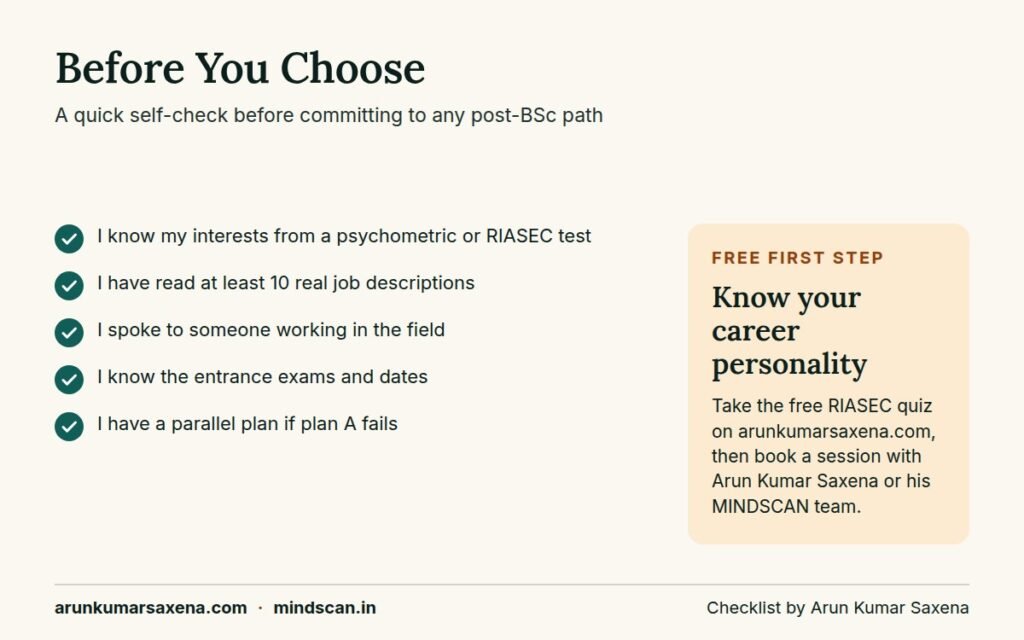
The honest note: competition ratios for popular government exams are brutal. UPSC Civil Services sees lakhs of applicants for roughly a thousand posts. Banking exams are slightly more accessible but still attract massive numbers. Always keep a parallel plan. While you prepare for government exams, build a certification or a skill that keeps a private-sector door open. Check verified government-linked openings on the National Career Service portal alongside your exam preparation. If you feel undecided between civil services, banking or corporate opportunities, choosing online career counselling in India can help evaluate your readiness and aptitude.
How do I decide the right career option after my BSc?
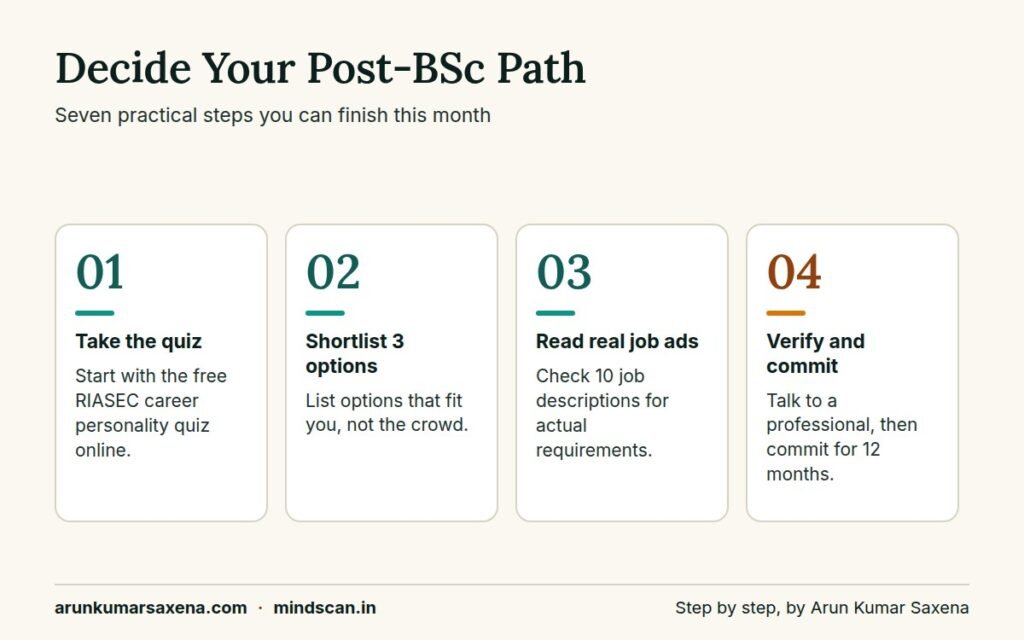
Follow a simple sequence this month: take a career personality test, list your shortlisted options, verify each against real job descriptions, talk to someone working in that field, then commit to one path for the next 12 months. Data-verified guidance beats guesswork and peer pressure.
This process comes from watching thousands of graduates make career decisions, and watching many reverse them within a year because they skipped the self-assessment step. Arun Kumar Saxena’s book “3 Steps to Knowing Yourself” argues that self-knowledge must come before any career choice. Apply that principle here before you compare course lists.
- Take the free RIASEC career personality quiz online to map your interests.
- List your top three post-BSc options honestly, not your parents’ or friends’ top three.
- Open 10 real job descriptions in your shortlisted field and note the actual requirements.
- Talk to at least one person working in that field for 15 minutes.
- If choosing a master’s, shortlist entrance exams and check registration dates now.
- If choosing a job, complete one relevant certification or project this month.
- If still stuck, book a psychometric assessment and a counselling session for data-verified clarity. The MINDSCAN assessment maps you to 20+ career groups, and every report is reviewed to ensure the recommendation fits.
This sequence works because it replaces opinion with data. A career personality test shows your interests. Real job descriptions show the market reality. A conversation with a professional shows the daily truth. Together, they give you a decision you can trust.
Career options after BSc compared: which path fits you?
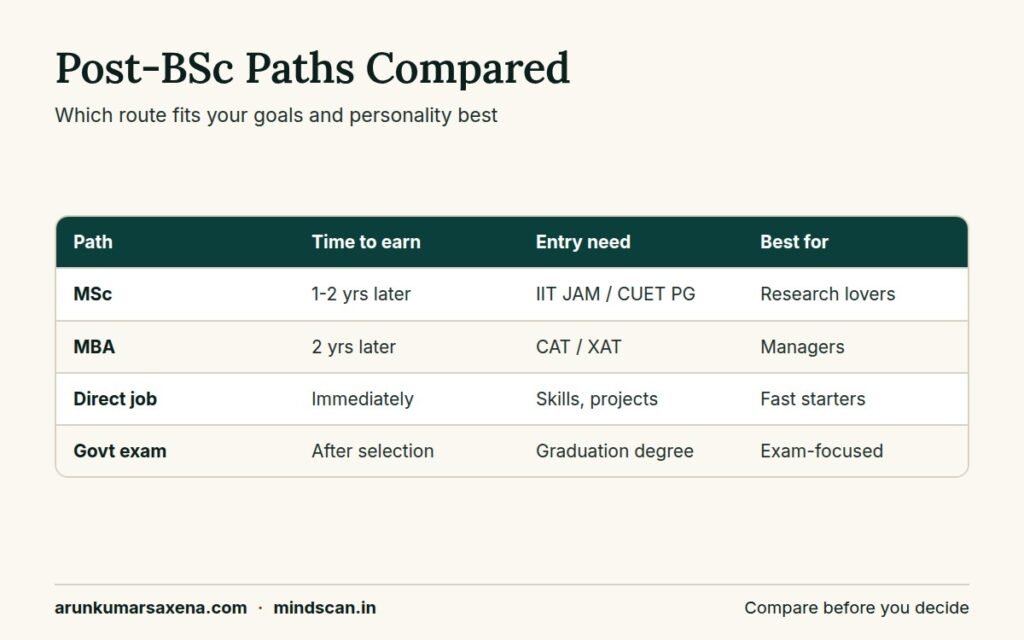
A side-by-side comparison of the main post-BSc paths, higher study, direct jobs, government exams and skill-based careers, across time to start, entry requirements and best-fit personality makes the choice clearer than any ranked list. Use this table to shortlist your career options after BSc.
| Path | Time to start earning | Entry requirement | Best suited for |
|---|---|---|---|
| MSc (subject specialisation) | 2 years of study, then job or PhD | BSc with required minimum marks; IIT JAM or CUET PG | Those who enjoy deep subject study, lab work and research |
| MBA | 2 years of study, then corporate placement | Any bachelor’s degree; CAT, XAT or similar exam | Those drawn to management, strategy and people-heavy roles |
| MCA / IT courses | 2 to 3 years of study, then tech placement | BSc with maths background typically; NIMCET or equivalent | Those with logical aptitude and interest in building software |
| Direct private jobs | Quick entry but crowded field | Graduation plus certification or portfolio | Those who want immediate income and can self-learn skills |
| Government exams | approximately 6 months to 2 years of preparation | Graduation; exam clearance with high competition | Those seeking stability, public service and structured careers |
| Skill + certification route | approximately 3 to 6 months to job readiness | Graduation plus a recognised certification | Those targeting specific roles like data analyst or lab technician |
The personality column is the one most students skip, and the one that causes the most regret later. Take the free RIASEC career personality quiz to fill that column with your own data before you decide.
Sources
This page on career options after BSc was last updated in October 2026. Figures marked as estimates are indicative and not official data.
The information on this page draws from the following primary sources, which are also linked inline where relevant:
- National Career Service portal, verified government job listings and career information
- Skill India Digital Hub, structured, low-cost certification courses
- IIT JAM, CUET PG and NIMCET official exam pages, entrance-exam eligibility and structure
- Arun Kumar Saxena’s 22 years of career-coaching experience
Frequently asked questions about career options after bsc
Is BSc a good degree for the future?
Yes, a BSc builds analytical and scientific thinking that transfers across fields. Its value depends on what you add on top: skills, certifications, a master’s degree or exam preparation. It is a foundation, not a finish line. Treat your BSc as the base layer and build a specialisation or skill stack on it.
Can I do an MBA after BSc?
Yes, any graduate including BSc holders can appear for CAT, XAT or other MBA entrance exams. Science graduates often do well in analytics-driven management roles, but only choose an MBA if you genuinely want business careers. An MBA by default leads to expensive regret. Check MBA courses after graduation for the full picture.
Which government exams can I write after BSc?
When reviewing government career options after BSc, you can apply for UPSC Civil Services, SSC CGL, IBPS and SBI banking exams, state PCS exams and eligible scientific roles in ISRO, DRDO and PSUs. Always check the latest notification for specialisation-specific eligibility. Some scientific posts require an MSc, so read the fine print before you commit to preparation.
Should I take a drop year to prepare for exams after BSc?
When weighing career options after BSc, a drop year works only with a gap analysis. If your scores are improving and the gap to the cutoff is narrowing, one more attempt is reasonable. If the gap is big and not shrinking, switch to a parallel path instead of waiting. A year of skill-building often pays better than a year of repeated exam attempts.
Is MCA better than MSc Computer Science after BSc?
Both lead to IT careers. MCA suits BSc Computer Science or IT graduates targeting software development and is entered via NIMCET; MSc suits those wanting deeper theory, research or academia. Choose by role preference and aptitude, not by course popularity. Both paths need strong project portfolios to land good jobs.
How much does career counselling cost after graduation?
The MINDSCAN AI Career Clarity Report costs ₹1,499, and ₹2,999 with a counselling session. It maps you to 20+ career groups so your post-BSc decision is data-verified rather than guesswork. You can book online career counselling in India with Arun Kumar Saxena for a personalised session.
What skills should I learn alongside my BSc for better jobs?
Data analysis, coding basics, communication and domain-relevant tools, lab techniques, clinical research basics, agricultural technology, make you employable before graduation. Use the Skill India Digital Hub for structured, low-cost courses. One certification completed before your final semester can change your placement outcome.
हिंदी में जवाब: BSc के बाद करियर विकल्प: पूरी गाइड
जल्दी जॉब पाने के लिए कौन सा कोर्स करें?
अगर आपको जल्दी नौकरी चाहिए तो डेटा एनालिटिक्स, क्लिनिकल रिसर्च या आईटी सपोर्ट का सर्टिफिकेशन कोर्स करें। BSc के बाद सीधे नौकरी पाना संभव है लेकिन इसके लिए डिग्री के साथ एक प्रैक्टिकल स्किल या प्रोजेक्ट पोर्टफोलियो जरूरी है। स्किल इंडिया डिजिटल हब पर कम खर्च में अच्छे कोर्स उपलब्ध हैं।
BSc के बाद सरकारी नौकरी के लिए कौन से एग्ज़ाम दे सकते हैं?
BSc ग्रेजुएट्स UPSC Civil Services, SSC CGL, बैंक PO/क्लर्क (IBPS/SBI) और राज्य PCS एग्ज़ाम दे सकते हैं। ISRO और DRDO जैसी संस्थाओं में तकनीकी और वैज्ञानिक पदों के लिए भी अवसर होते हैं, हालांकि कई वैज्ञानिक पदों के लिए MSc की आवश्यकता हो सकती है।
करियर की शुरुआत कैसे करें?
करियर की शुरुआत सही आत्म-मूल्यांकन से करें। सबसे पहले एक करियर पर्सनालिटी टेस्ट लें, अपने तीन सबसे उपयुक्त विकल्प चुनें, असली जॉब डिस्क्रिप्शन पढ़ें और उस फील्ड में काम कर रहे किसी व्यक्ति से बात करें। इसके बाद एक साल के लिए एक रास्ते पर पूरी मेहनत से चलें।
Exploring career options after BSc is not about picking from a generic list; it is about assessing proven career options after BSc against your personality, aptitude and real-world requirements. The graduates who build satisfying careers are rarely the ones who followed the most popular course. They are the ones who assessed themselves honestly and chose a path that fit.
If you are stuck between options, or if your family’s expectation does not match your own instinct, get data-verified clarity. The MINDSCAN AI Career Clarity Report maps you to 20+ career groups and costs ₹1,499; with a counselling session it is ₹2,999. Book online career counselling in India with Arun Kumar Saxena or start with the MINDSCAN psychometric assessment to turn guesswork into a decision you can trust.