
Bachelor’s Degree in Archaeology: The Complete Guide
Quick answer: A bachelor’s degree in archaeology is a 3-year Indian undergraduate programme open after Class 12 in any stream, leading to roles like field archaeologist and museum assistant with fresher pay around 3-4 LPA. Arun Kumar Saxena advises checking your aptitude and keeping a Plan B before committing.
By Arun Kumar Saxena, Certified Advanced Career Coach and founder of MINDSCAN Career Guidance · Updated October 2026
A bachelor’s degree in archaeology draws students who love history, fieldwork and uncovering the past, but it is a niche degree with a specific job market. This page gives you an India-specific, honest look at the degree, its colleges and real career outcomes. If you are a Class 12 student or a parent weighing this choice, you will find clear answers here.
With 22 years of experience and 20,000+ students and professionals guided, I see many families choose courses based on prestige or a single dream job. A bachelor’s degree in archaeology demands that you match your genuine interest and aptitude to the degree before you enrol, not after. This guide helps you make that call with data, not guesswork.
Table of Contents
What is a bachelor’s degree in archaeology and what will you study?
A bachelor’s degree in archaeology is a 3-year undergraduate degree (BA or BSc, 4 years under NEP 2020 at some universities) that studies the human past through material remains. Core subjects include field excavation methods, stratigraphy, artifact cataloging, prehistory, ancient history and heritage management, plus technical skills like GIS, remote sensing and report writing.
A BA in archaeology leans toward ancient history and culture, while a BSc leans toward scientific and laboratory analysis. Whichever track you pick, practical fieldwork and excavation training are central to the degree. You graduate with skills in mapping, lab analysis, cataloging and research report writing that apply directly to heritage and museum roles. Picture a student on a dig site in Haryana, carefully brushing soil off a potsherd while documenting its exact location. That hands-on patience is what the degree builds, and it is not for everyone.
Can I study archaeology after 12th and am I eligible?
Yes, you can apply for a bachelor’s degree in archaeology after Class 12 in any stream. Many universities ask for around 50% aggregate marks, and admissions commonly run through CUET UG or university-specific entrance tests. Some universities admit directly on Class 12 marks, so check each one before applying.
Any stream is generally accepted, though humanities students often find the transition easiest. If you are still in Class 11, planning your Class 11 humanities subjects and combinations early makes the path smoother. Always confirm the minimum percentage and entrance exam on the official university website before you lock your choice. A common mistake is assuming all colleges have the same rules.
A university in the north might accept science students without history, while a southern university may ask for history as a subject in Class 12. Check, do not assume. For the official CUET UG eligibility and subject list, visit the CUET UG portal by NTA.
Which degree is best for archaeology: BA, BSc or BA Honours?
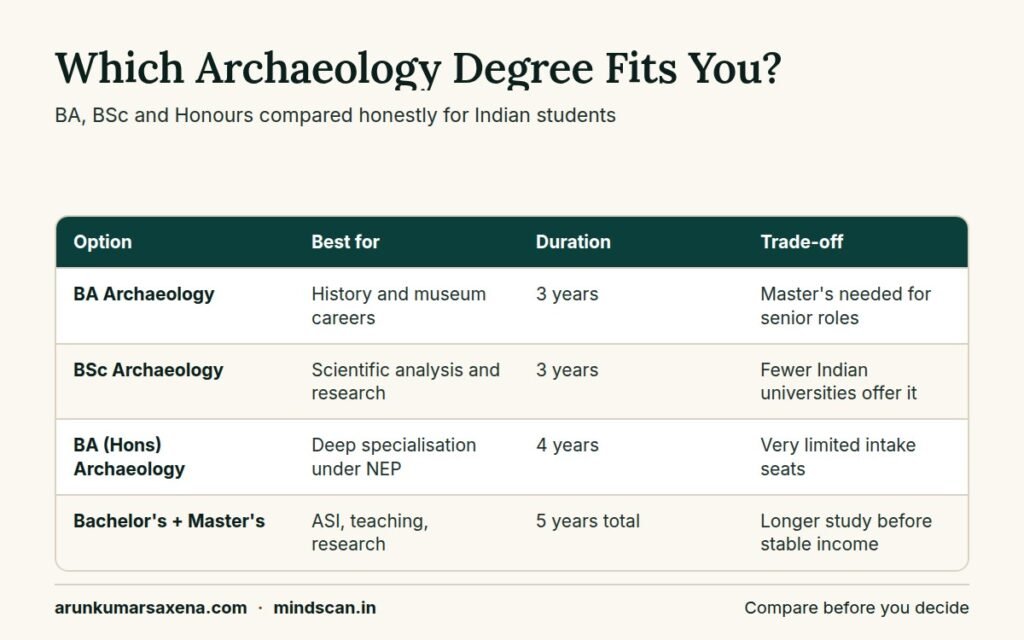
There is no single best degree. A BA in archaeology suits heritage, history and museum careers. A BSc suits scientific analysis and research. An Honours programme such as MSU Baroda’s 4-year BA (Hons) in Archaeology and Ancient History offers deeper specialisation under NEP 2020 and prepares you better for research and higher study.
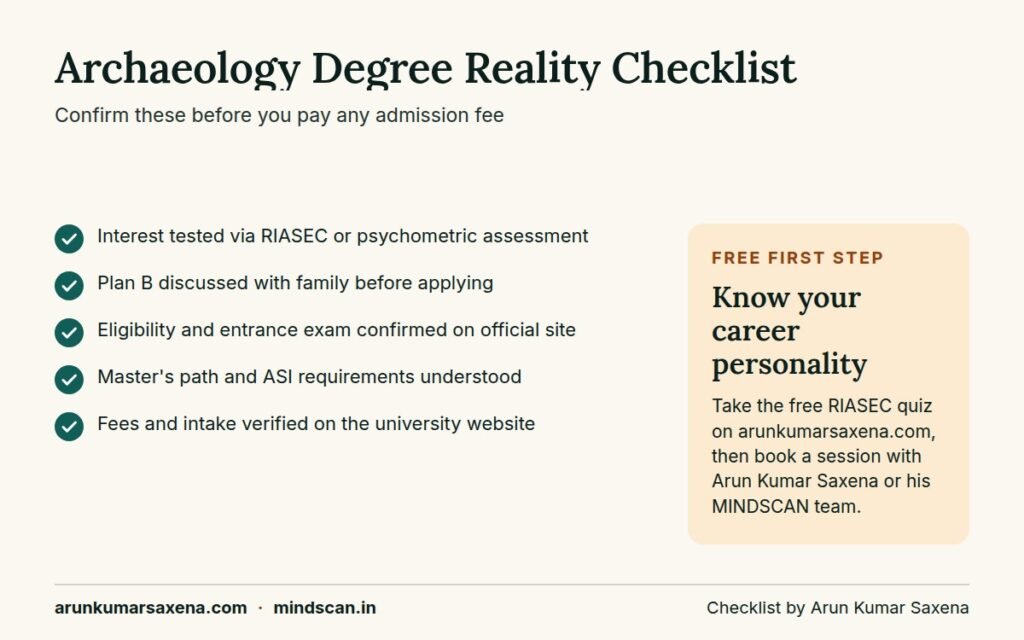
Choose based on your interest in humanities versus scientific methods. Match the degree to your personality first. Take the free RIASEC career personality quiz to check whether your interest profile fits an archaeology career before you pay any fees.
| Option | Best suited for | Typical duration | Honest trade-off |
|---|---|---|---|
| BA Archaeology | History, museums, heritage careers | 3 years | Needs a master’s for senior roles |
| BSc Archaeology | Scientific analysis, research methods | 3 years | Fewer universities offer it in India |
| BA (Hons) Archaeology and Ancient History | Deep specialisation, research readiness | 4 years under NEP | Limited seats and intake |
| Bachelor’s + Master’s path | ASI, teaching, senior research roles | 3 + 2 years | Longer study commitment before stable income |
Which are the best colleges in India for a bachelor’s degree in archaeology?
As per online sources, widely cited Indian institutions include Maharaja Sayajirao University of Baroda, University of Calcutta, University of Madras, Panjab University, Cotton University and CSJMU, which offers BA Archaeology and Museology. Fees range broadly, from very low at public universities to higher at private institutions, approximately ₹1,200 to ₹1.5 lakh total, as per online sources, varying by institution.
Public universities are usually far cheaper than private options. Verify current intake, duration and admission mode on each official university website. For example, check MSU Baroda’s BA (Hons) in Archaeology and Ancient History page directly. Do not rely on aggregator sites for deadlines or fees. The Archaeological Survey of India (ASI) website is also worth visiting to understand the field’s professional standards and current excavation projects, which can help you shortlist colleges with active fieldwork ties.
Is archaeology a high-paying job in India?
Honestly, no, not at the start. Freshers with this undergraduate programme typically earn around 3-4 LPA, with a median around 6 LPA overall as estimated from online sources. Pay improves with a master’s degree, research credentials, ASI roles or private cultural resource management work. Entry roles include field archaeologist, assistant researcher, museum assistant and junior heritage manager.
Recruiters include the Archaeological Survey of India, the Indian Council of Historical Research (ICHR), state heritage departments, UNESCO-linked projects and private CRM firms. Treat this as a passion-plus-patience career, not a quick-money one. The National Career Service portal of the Government of India lists current openings and salary bands that give you a realistic picture. Many families picture a government salary with full benefits from day one. The reality is that initial contracts are often project-based, and permanent ASI posts come through a separate, competitive examination cycle that takes time and preparation.
Can you become an archaeologist with just a bachelor’s degree?
You can enter field and assistant-level roles with a bachelor’s degree, but most professional and academic positions such as ASI officer posts, university teaching and senior research require a master’s degree or NET qualification. Plan the bachelor’s degree as step one of a longer academic path.
A bachelor’s degree qualifies you for entry-level fieldwork and museum roles. A master’s and NET open government and teaching positions. Some ASI roles accept varied degrees, but archaeology or history helps most. If you aim for a government career, prepare for that path alongside your degree. Budget that time and cost from the start.
Are archaeologists still in demand in India?
Yes, demand is steady though limited, driven by ASI excavations, state heritage departments, museum modernisation, cultural resource management and heritage tourism. It is a niche field with fewer openings than mainstream careers, so competition is real and specialisation matters.
Heritage tourism and conservation projects are creating newer roles. Government hiring cycles are slow, while private CRM is growing as per online sources. Skills like GIS and remote sensing improve your employability and set you apart from other archaeology graduates. If you want to understand the broader picture of humanities careers and where archaeology fits, read my guide on career options after 12th in arts to compare demand across fields.
How do you start a bachelor’s degree in archaeology this admission season?
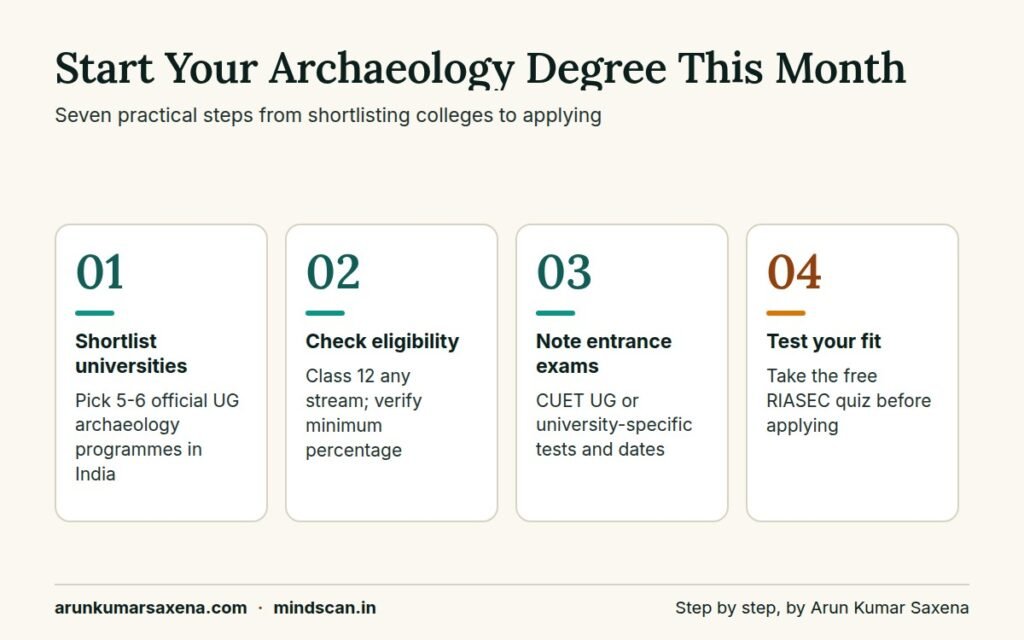
Shortlist universities offering archaeology at UG level, confirm eligibility and entrance exams (CUET UG or university tests), prepare your documents, apply before deadlines, and in parallel assess your fit for the field through aptitude testing and a conversation with a career coach.
- Shortlist 5-6 Indian universities offering archaeology at UG level from official websites.
- Confirm eligibility: Class 12 in any stream and the minimum percentage each asks for.
- Note the entrance route: CUET UG or university-specific tests, and their dates.
- Take the free RIASEC career personality quiz to check your genuine interest fit.
- Book a career counselling session or psychometric assessment to validate the choice with data.
- Discuss a Plan B (history, heritage management, civil services) with your family before applying.
- Apply before deadlines and prepare for any entrance test with past papers.
Is a bachelor’s degree in archaeology right for you? Arun Kumar Saxena’s honest view
Pick archaeology only if you genuinely love history, fieldwork and patient research, and always keep a Plan B. Self-knowledge before course choice is the core message of my book ‘3 Steps to Knowing Yourself’. A psychometric assessment maps you to 20+ career groups so the choice is data-verified, not guesswork.
“When parents use adjectives like ‘power’, ‘prestige’, ‘respect in society’ or ‘security’ but never use words like ‘aptitude’, ‘interest’, ‘growth’, or ‘skills’, I immediately understand that they are heading in the wrong direction.” (Arun Kumar Saxena)
Before you commit to the degree, explore career options after BA and career options after 12th in arts so you see the full map. Learn more about my approach on my profile page.
What most guides miss: the Plan B test before you enrol
Most career pages list colleges and salaries but skip the one conversation that saves years of regret. In my sessions, I ask many students and parents a few questions before they lock this undergraduate programme. First, if the ASI or a museum job does not come through in two years after your master’s, what will you do? Second, does your family understand and accept that this is a slow-build career with a modest starting salary?
Third, have you checked your aptitude for patient, detail-oriented fieldwork through an objective tool, or are you choosing based on a romantic idea of excavation? If you cannot answer all three clearly, do not pay the admission fee yet. Book one session of online career counselling in India with Arun Kumar Saxena or take the psychometric assessment on mindscan.in first. A data-verified choice now saves a career switch at 25.
What exams do I need to crack for a bachelor’s degree in archaeology admission?
The common route is CUET UG for central universities, plus university-specific entrance tests at institutions like MSU Baroda. Some state universities admit on Class 12 merit. Confirm the current exam pattern on official university websites each admission season.
Common mistakes families make before choosing an archaeology bachelor degree
One mistake I see often is families treating archaeology as a safe government-job ticket without checking the actual vacancy cycle. Another is students enrolling because they love history books, only to discover that excavation means months of physical labour in remote locations. A third is parents pushing the degree for its perceived prestige while ignoring the child’s aptitude for scientific analysis or outdoor work.
Before you commit, ask yourself honestly: would you still choose this degree if the ASI job never came? If the answer is no, you need a wider set of options. Use the free RIASEC career personality quiz to check your fit, and talk to a career coach who can show you data, not opinions.
How a bachelor’s degree in archaeology fits into a longer career plan
An archaeology bachelor degree works best when you see it as the foundation, not the finish line. Map out the full path: bachelor’s, then a master’s, then NET or a specialised diploma in heritage management or museology. Along the way, build skills in GIS, remote sensing and technical writing. These skills make you employable even outside pure archaeology, in environmental consulting or urban planning firms.
The degree teaches you how to gather evidence, analyse it patiently and write clear reports. Those abilities transfer to many fields if you plan your electives and internships wisely. Do not wait until final year to think about what comes next. Start in second year.
Frequently asked questions about bachelor’s degree in archaeology
Is there a bachelor’s degree in archaeology online in India?
Online archaeology degrees are rare in India because the degree requires fieldwork, excavation and lab training. Some universities and platforms offer heritage, history or museum-studies certificates online, which can supplement but not replace a field-based bachelor’s degree in archaeology.
Can I do archaeology after 12th commerce or science?
Yes. Most Indian universities accept Class 12 in any stream for a bachelor’s degree in archaeology, though some may prefer or require specific subjects. Always check the individual university’s eligibility page on its official website before applying.
How long does it take to become an archaeologist in India?
A bachelor’s degree in archaeology takes three years, and a master’s adds two more. With NET preparation and project experience, plan for roughly six to eight years from Class12 to a stable professional role. The timeline stretches if government hiring cycles are slow, so patience is essential.
What can I do after a bachelor’s degree in archaeology besides a master’s?
Options include museum assistant roles, heritage tourism, cultural resource management firms, state heritage departments, archaeology journalism and content work, or preparing for competitive exams while specialising. A clear career options after BA plan helps map these choices honestly.
How do I know if archaeology suits my personality?
Archaeology rewards patience, curiosity, physical fieldwork and detailed documentation. A RIASEC-based career personality test or a psychometric assessment that maps you to20+ career groups gives you objective evidence instead of relying on romantic ideas of the profession.
Is archaeology a government job only?
No. While ASI and state heritage departments are major employers, private cultural resource management firms, museums, universities, NGOs and heritage tourism companies also hire archaeology graduates. Government hiring is slower; private and academic routes offer alternatives.
What is the difference between archaeology and history as a degree?
History studies the past through written records; archaeology studies it through material remains such as artifacts, excavations and sites. Many Indian programmes combine archaeology with ancient history, so you study both sources of evidence in one degree.
हिंदी में जवाब: पुरातत्व में स्नातक डिग्री: पूरी गाइड
क्या12वीं के बाद पुरातत्व की पढ़ाई कर सकते हैं?
हां,12वीं किसी भी संकाय से पास करने के बाद आप पुरातत्व में स्नातक डिग्री के लिए आवेदन कर सकते हैं। अधिकांश वि्श्वविद्यालय लगभग50% अंक मांगते हैं और प्रवेश CUET UG या वि्श्वविद्यालय की अपनी परीक्षा से होता है। अरुण कुमार सक्सेना सलाह देते हैं कि आवेदन से पहले हर वि्श्वविद्यालय की आधिकारिक वेबसाइट पर पात्रता जरूर जांच लें।
पुरातत्व में स्नातक डिग्री के बाद क्या नौकरी मिलती है?
पुरातत्व में स्नातक डिग्री के बाद फील्ड आर््कियोलॉजिस्ट, म्यूजियम असिस्टेंट और जूनियर हेरिटेज मैनेजर जैसे पदों पर काम मिल सकता है। शुरुआती वेतन लगभग3-4 लाख सालाना होता है। वरिष्ठ पदों के लिए मास्टर डिग्री और नेट योग्यता आवश्यक है। अरुण कुमार सक्सेना कहते हैं कि इसे एक धैर्य वाला करियर मानकर चलें, जल्दी ऊंची कमाई की उम्मीद न करें।
पुरातत्व की पढ़ाई के लिए कौन सा विषय जरूरी है?
पुरातत्व में स्नातक डिग्री के लिए कोई एक अनिवार्य विषय नहीं है।12वीं में इतिहास, भूगोल या समाजशास्त्र लेने वाले छात्रों को थोड़ा आसान लगता है, लेकिन विज्ञान या वाणिज्य वर्ग के छात्र भी आवेदन कर सकते हैं। हर विश्वविद्यालय की अपनी शर्तें होती हैं, इसलिए आधिकारिक वेबसाइट से जांच करना सबसे सही तरीका है। ऑनलाइन करियर काउंसलिंग बुक करें – अरुण कुमार सक्सेना (MINDSCAN करियर गाइडेंस)।
ऑनलाइन करियर काउंसलिंग बुक करें – अरुण कुमार सक्सेना (MINDSCAN करियर गाइडेंस)
A bachelor’s degree in archaeology is a serious commitment to a niche, patience-driven field. Before you fill an admission form, know your aptitude, check the real salary numbers and build a Plan B that keeps your family confident and your future secure. The MINDSCAN AI Career Clarity Report at ₹1,499 maps you to 20+ career groups and gives you data-verified evidence of where you fit. Add a counselling session for ₹2,999 and we will walk you through every doubt on the call.
Book your online career counselling in India with Arun Kumar Saxena or start with the psychometric assessment at mindscan.in. One honest conversation now can save you years of second-guessing later.