
After BTech Career Options: Your Complete 2026 Guide
By Arun Kumar Saxena, Certified Advanced Career Coach · Updated October 2026
Quick answer: After BTech career options are the six families of paths: IT jobs, core engineering, higher studies, government exams, startups, and non-technical roles. The right one depends on your verified interests and constraints, not on salary headlines. Career coach Arun Kumar Saxena advises testing fit with a psychometric assessment before committing to any path.
After BTech career options are far wider than the ten or twelve paths most placement cells and listicles repeat. As the founder of MINDSCAN Career Guidance, I have seen how the real challenge is not discovering what exists, it is deciding which of these after BTech career options actually fits your strengths, your financial reality and your long-term interests. You can build software, specialise in AI, move into core engineering, sit for government exams, pursue an MBA or M.Tech, or walk into a non-coding role in product management, business analysis or digital marketing.
With 22 years of experience and 20,000+ students and professionals guided, I have seen talented graduates waste years on a path chosen only because a batchmate took it or because a social media post made the salary sound easy. This page gives you an honest decision framework for after BTech career options, realistic salary benchmarks, the non-technical routes most engineering blogs skip, and a step-by-step method to test a path before you invest a degree or two years of your life in it.
Table of Contents
What are the main after BTech career options in 2026?
After BTech career options are the six families of paths graduates realistically choose among: IT and software jobs, core engineering roles, higher studies, government and PSU jobs, startups and freelancing, and non-technical roles such as business analysis, sales, digital marketing and product management.
Most students can pursue more than one path in parallel in the first year after graduation. A CSE graduate might apply for off-campus software roles while simultaneously preparing for CAT. A civil engineering graduate might work at a construction firm and register for the SSC-JE exam. The important thing is knowing which combination is realistic for your energy and your constraints.
- IT and software roles: developer, tester, data analyst, cloud engineer and cybersecurity specialist. These after BTech career options are the most visible because campus placement headlines are built on them.
- Core engineering roles: manufacturing, automotive, civil infrastructure, power and electronics. Less glamorous on social media but more stable for branch loyalists.
- Higher studies: M.Tech via GATE, MBA via CAT, MS abroad. Each delays earnings and each rewards genuine interest more than a backup motive.
- Government and PSU jobs: PSU recruitment through GATE, UPSC Engineering Services and civil services, SSC Junior Engineer and RRB Junior Engineer. Tough competition but clear entry routes.
- Non-technical and startup roles: product management, business analysis, technical sales, UI/UX design and entrepreneurship. These career options after BTech value communication and domain thinking over programming depth.
If you want a diagnostic tool before studying any list, take the free RIASEC career personality quiz to shortlist paths that suit your interest type.
Which job is best after BTech?
The right job after BTech matches your aptitude, interests and practical constraints, not a universal ranking. A software development role at a product company fits a CSE graduate who likes building things, but that same role can feel like a trap to a mechanical engineer who prefers field work.
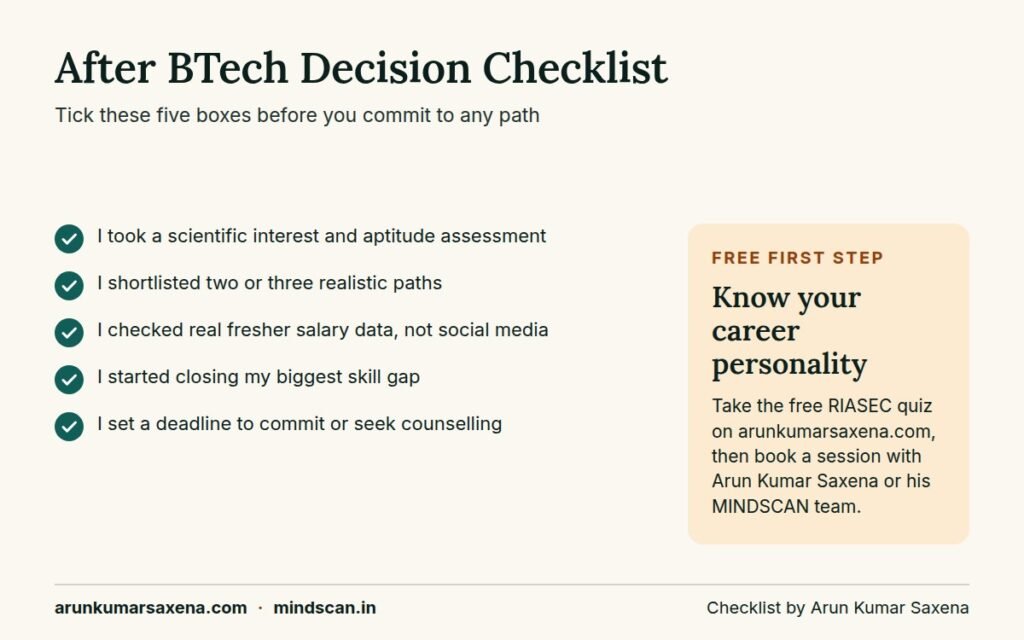
Three questions cut through the noise when you are weighing after BTech career options. First, can you sustain interest in the day-to-day work for at least three years? Second, does the path respect your financial and family constraints now? Third, have you verified your fit with a scientific tool, or are you guessing? Guessing leads to expensive mid-career pivots. A psychometric assessment that maps you to 20+ career groups can surface options you had not considered and rule out paths that look good only on paper.
For stability seekers, government and PSU roles through GATE or SSC-JE are worth the preparation time. For high-risk, high-reward minds, a startup job or an off-campus placement route into a product company can accelerate growth. Neither is best for everyone. The best career options after BTech are the ones that match your verified self-knowledge, not your batchmate’s LinkedIn update. Take the free RIASEC career personality quiz to start narrowing your fit.
Which BTech branch has the highest salary and demand?
BTech CSE with specialisations in AI, data science and cybersecurity currently commands the highest fresher salaries, followed by ECE where VLSI and semiconductor roles are rising, and then IT. However, salary figures are misleading without context because the same CSE graduate fetches approximately ₹4 LPA from a mass recruiter and approximately ₹30 LPA from a top product company, as per online placement trends and data from the National Career Service portal by the Ministry of Labour and Employment.
Tier-1 college plus strong projects plus relevant internships beats branch choice almost every time. A civil engineering graduate from an IIT who built data analytics projects and cracked a product management internship can out-earn a CSE graduate from a Tier-3 college with no portfolio. Branch decides the ceiling of your core domain; skills and college brand decide the floor of your offer.
Core branches like mechanical, civil and electrical pay less initially but face less competition at entry level and build domain expertise that becomes valuable with experience. The India semiconductor push is creating demand for ECE graduates who invest in VLSI design skills. No branch is a golden ticket, and none is a dead end. When you evaluate after BTech career options, ask what skills you can add to your branch, not only what your branch can give you.
Can I get 1 lakh salary after BTech?
One lakh per month, roughly 12 LPA in cost-to-company terms, is possible after BTech but is not a typical fresher outcome. It usually requires a placement from a Tier-1 college, high-demand skills like AI/ML development or full-stack engineering, or an off-campus offer from a product company or well-funded startup.
Treat the one-lakh-per-month number as a two-to-four-year goal built on skills, not a first-offer expectation. Graduates who reach it early do three things right: they build a strong GitHub or project portfolio during college, they complete at least one substantial internship, and they target product companies or high-growth startups rather than mass recruiters. The salary reels on Instagram describe outliers. A realistic plan for after BTech career options weighs median offers, not headline offers.
If you are starting below that mark, the gap closes faster through high-income skills to build before you graduate and through switching companies strategically after gaining approximately 18 to 24 months of solid experience. The first offer is not your permanent salary, it is your launchpad.
What can I do after BTech CSE without coding?
After BTech CSE without coding, strong after BTech career options include data analysis with low-code and no-code tools, business analysis, product management, technical sales and pre-sales, digital marketing, QA and automation-adjacent roles, and UI/UX design. Many non-coding tech roles pay well and reward communication, logic and domain thinking more than programming depth.
Picture a CSE graduate who realises in the third year that coding feels draining. Instead of forcing a developer path and burning out, she explores business analyst roles. She learns SQL basics, Excel modelling and requirement documentation through a short course, builds a small portfolio with a case study, and lands an analyst role at an IT services firm. Within two years she moves into product management. That path is real and increasingly common.
An MBA after BTech opens consulting, marketing and finance tracks where coding is not required at all; the value depends heavily on institute tier, so read the MBA courses after graduation page to understand what makes the degree worth the investment. Government exams like UPSC civil services and SSC remain fully non-coding routes, demanding only a degree and disciplined preparation. Non-coding career options after BTech are not second-class, they are simply different tracks that suit a different kind of mind.
Should I do M.Tech, MBA or a job after BTech?
Choose a job if you have a decent offer and want to learn while earning, choose M.Tech if you genuinely love your technical field and want research or specialisation, and choose an MBA if you want management or leadership tracks and can gain admission to a good institute.
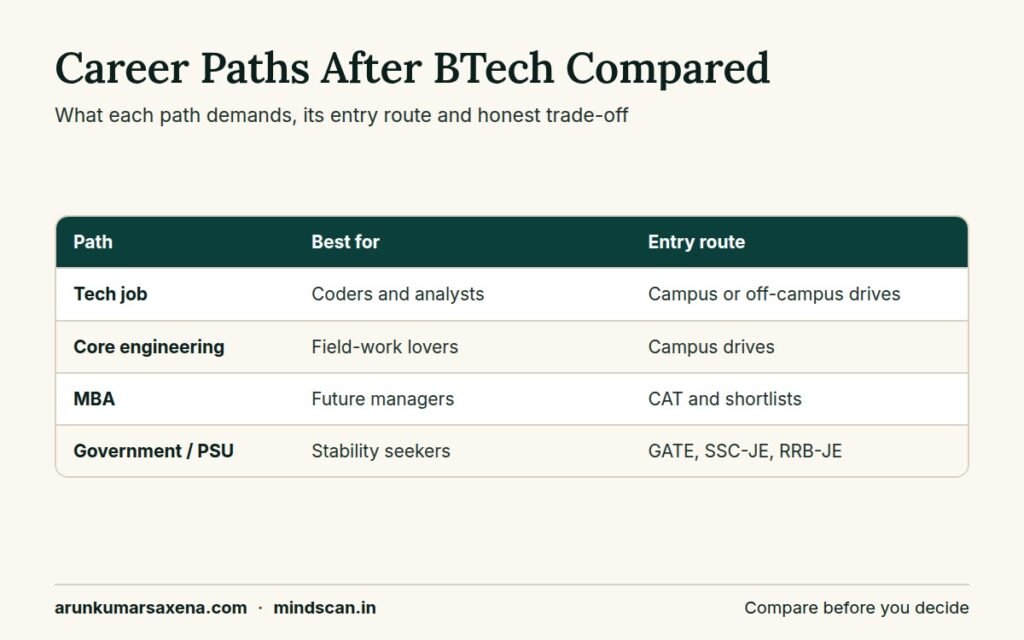
| Path | Best suited for | Entry route | Honest trade-off |
|---|---|---|---|
| Corporate tech job | Hands-on coders and analysts | Campus or off-campus drives | Salary depends heavily on college tier and skills |
| Core engineering | Branch enthusiasts who like field work | Campus drives, off-campus applications | Slower early salary growth than IT |
| M.Tech / MS | Research and specialisation minded | GATE or GRE/IELTS | Delays earnings; needs genuine interest |
| MBA | Future managers and consultants | CAT and institute shortlists | Value depends almost entirely on institute tier |
| Government / PSU | Stability seekers | GATE, UPSC ESE, SSC-JE, RRB-JE | Tough competition and long preparation cycles |
| Non-tech / startup roles | Communicators and generalists | Direct applications, internships | Less structured career ladders |
Work experience before an MBA often helps both admissions and outcomes, because you bring real problems and context into the classroom. M.Tech through GATE also serves as a route into PSU jobs, so the same exam can open two different after BTech career options. The decision framework is: ask what you are genuinely curious about, check the realistic entry requirements, and do not let fear of the job market push you into a degree you will resent.
How do I get a government job after BTech?
The main government after BTech career options are PSU recruitment through a valid GATE score, UPSC Engineering Services Examination and civil services, SSC Junior Engineer and RRB Junior Engineer for civil, mechanical and electrical branches, plus state engineering services and banking exams.
Visit the National Career Service portal by the Ministry of Labour and Employment for job listings and career information, and check the Skill India Digital Hub for government-backed skilling courses to add certifications that strengthen your profile for government and PSU applications.
GATE is the single most versatile government-job lever for BTech graduates. A strong GATE score qualifies you for PSU interviews at organisations like BHEL, ONGC, IOCL and NTPC, and simultaneously keeps the M.Tech route open. UPSC Engineering Services suits those who want a design-and-execution engineering career within government departments. SSC-JE and RRB-JE target junior engineer posts and are more accessible for graduates from Tier-2 and Tier-3 colleges.
Preparation cycles are long, often approximately 12 to 18 months, so it is realistic to hold a less demanding job or do contract work while studying.
How do I choose the right path after BTech? A step-by-step plan
Choose your after-BTech path by first mapping your interests and strengths through a scientific assessment, then shortlisting two or three realistic options, checking honest salary and demand data, filling your biggest skill gap this month, and testing each shortlisted path with a low-cost trial before fully committing.
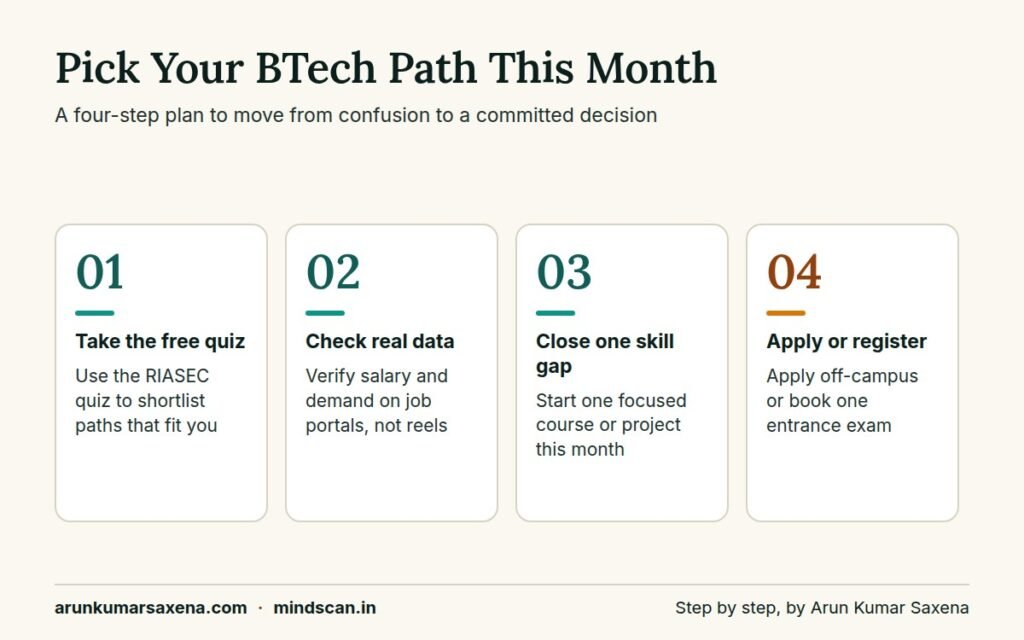
- Take the free RIASEC career personality quiz to shortlist compatible after BTech career options. A 10-minute quiz can surface paths you had dismissed or never considered.
- Write down your honest constraints: finances, family expectations, location preference and risk appetite. A path that works for a debt-free graduate in Bengaluru may not work for someone who needs to support parents within six months.
- Shortlist two or three paths from the comparison table above. Two is enough; five means you have not narrowed anything.
- Search real fresher salary and demand data for each shortlisted path on job portals, not on social media reels. Median figures, not outlier stories.
- Fill your single biggest skill gap this month with one course or one project. If you need SQL for analyst roles, learn SQL. If you need a portfolio for UI/UX, build one case study.
- Apply to at least 20 relevant off-campus openings or register for one entrance exam. Action creates data. Rejection from 15 applications tells you where you need to improve.
- If you are still confused after these steps, get a psychometric assessment and a counselling session before spending money on any degree. The MINDSCAN AI Career Clarity Report maps you to 20+ career groups and a session with the MINDSCAN team turns that map into a concrete plan. Book online career counselling in India with Arun Kumar Saxena to get started.
What do BTech graduates get wrong when picking a career?
The most common mistakes are choosing a path because classmates did, trusting salary claims from coaching-style content without checking the source, doing an MBA purely as a backup when no other path seems easy, ignoring non-technical after BTech career options despite weak coding interest, and never testing their own aptitude scientifically.
Herd mentality is the number-one career killer after BTech. In many hostels, the entire wing prepares for CAT because two seniors landed good packages. No one stops to ask whether the wing actually wants management roles. Three years later, half of them are in jobs they could have got without the MBA, carrying loans they did not need.
A data-verified assessment plus one honest counselling session prevents most of these detours. My book “3 Steps to Knowing Yourself” is built on the idea that self-knowledge comes before any career choice. When a BTech graduate knows their own interest type, learning style and constraint envelope, career options after BTech stop being a confusing list and become a short, clear, actionable set of paths. Learn more about my method on the Arun Kumar Saxena profile page.
Frequently asked questions about after btech career options
Can I switch from a core branch to an IT job after BTech?
Yes. Core branch graduates regularly move into IT through self-taught programming, data analytics, testing or cloud skills. The shift usually requires approximately 6 to 12 months of focused upskilling and a project portfolio, since IT recruiters test skills more than branch labels. Off-campus drives and job portals are the practical route for these after BTech career options.
Is an MBA after BTech worth it?
An MBA after BTech is worth it if you target management, consulting, product or leadership tracks and can enter a good institute. Its return depends almost entirely on institute tier and your clarity about why you are doing it. Doing an MBA only as a backup is one of the most common and expensive mistakes in after BTech career options planning.
Can I do a job and prepare for government exams together?
Yes, many BTech graduates prepare for GATE, SSC-JE or state exams while working, especially in less demanding roles. It demands disciplined study hours and honest self-assessment about stamina. If your target exam needs full-time preparation, set a firm deadline for the job phase rather than drifting for years between partial attempts at various after BTech career options.
What should I do in the first month after BTech if I have no job offer?
In the first month, audit your skills honestly, build or refresh your resume for ATS screening, take a career personality assessment to shortlist after BTech career options, start one focused skill course, and apply to off-campus openings daily. Avoid waiting passively for campus-style drives to appear, because the off-campus market does not wait.
Are startup jobs a good career option after BTech?
Startup jobs after BTech offer faster learning, wider responsibility and sometimes equity upside, but with lower job security and variable pay. They suit self-driven learners who can handle ambiguity. If stability matters to you or your family, a structured corporate or government route among the after BTech career options may fit better.
How does career counselling help BTech graduates?
A professional counsellor uses psychometric assessment to map your interests, strengths and realistic options, then builds a step-by-step plan instead of a generic list. Arun Kumar Saxena, with 22 years of experience and 20,000+ students and professionals guided, reviews every MINDSCAN report and offers online career counselling across India to help you choose among after BTech career options with clarity.
Which job gets 20 lakh per month?
Claims of a 20 lakh per month salary describe rare outlier offers, not typical fresher outcomes. As per online placement data, the highest paying after BTech career options for freshers are AI/ML engineering, software development at top product companies, and quantitative analysis in finance. These roles require strong coding and mathematics skills plus a proven project portfolio, and the offers vary enormously by college tier.
हिंदी में जवाब: बीटेक के बाद करियर विकल्प: अक्सर पूछे जाने वाले सवाल
जल्दी जॉब पाने के लिए कौन सा कोर्स करें?
जल्दी नौकरी के लिए डेटा एनालिटिक्स, फुल स्टैक डेवलपमेंट, डिजिटल मार्केटिंग या क्लाउड कंप्यूटिंग का एक केंद्रित सर्टिफिकेशन कोर्स करें। सिर्फ कोर्स सर्टिफिकेट से नौकरी नहीं मिलती, इसलिए एक प्रोजेक्ट पोर्टफोलियो बनाएं और ऑफ-कैंपस जॉब पोर्टल पर रोज़ आवेदन करें। अरुण कुमार सक्सेना कहते हैं कि पहले अपनी रुचि की जांच साइकोमेट्रिक असेसमेंट से करें, फिर कोर्स चुनें।
करियर की शुरुआत कैसे करें?
करियर की शुरुआत अपनी रुचियों और क्षमताओं की वैज्ञानिक जांच से करें, न कि दोस्तों की नकल से। दो या तीन रास्ते चुनें, हर रास्ते की वास्तविक सैलरी और मांग का डेटा जॉब पोर्टल से निकालें, अपनी सबसे बड़ी स्किल गैप को एक प्रोजेक्ट से भरें, और लगभग बीस से अधिक ऑफ-कैंपस जॉब में आवेदन करें। अगर भ्रम बना रहे तो एक करियर काउंसलिंग सेशन लेकर स्पष्ट योजना बनाएं।
After BTech career options are abundant, but abundance without a filter creates paralysis. The filter is self-knowledge, verified by a scientific assessment and refined through honest conversation. Whether you end up in a core engineering firm, a product startup, a government PSU or an MBA classroom, the paths that work are the ones that match who you actually are, not who you think you should be.
My MINDSCAN team and I help you shortlist, verify and commit to the right path, so you stop scrolling lists and start building. Book your session at online career counselling in India with Arun Kumar Saxena and begin with the MINDSCAN AI Career Clarity Report to see your mapped options before we talk.