
BE vs BTech Salary: Which Degree Pays More in India?
By Arun Kumar Saxena, Certified Advanced Career Coach · Updated November 2026
Quick answer: There is no meaningful difference in BE vs BTech salary in India. Recruiters, PSUs and universities treat both as equivalent 4-year engineering degrees. Fresher pay is typically in the ₹3 to 8 LPA range (approximate, as per online sources). What actually decides your salary is college tier, branch, skills and internships, not the three-letter abbreviation on your certificate.
The search for ‘be vs btech salary’ begins at every Indian dinner table when a Class 12 student fills an engineering entrance form. A parent asks which degree pays more, and the child scrolls through Quora threads that give ten different answers. This page settles the question with data, not opinion, and tells you what actually moves your first salary cheque.
With 22 years of experience and 20,000+ students and professionals guided, I have watched families reject a good college because it offered a BE, not a BTech. That decision costs them nothing on paper and everything in placement. The honest answer on BE vs BTech salary is simpler than the blogs make it, and the real salary drivers are things no comparison table ever lists.
Table of Contents
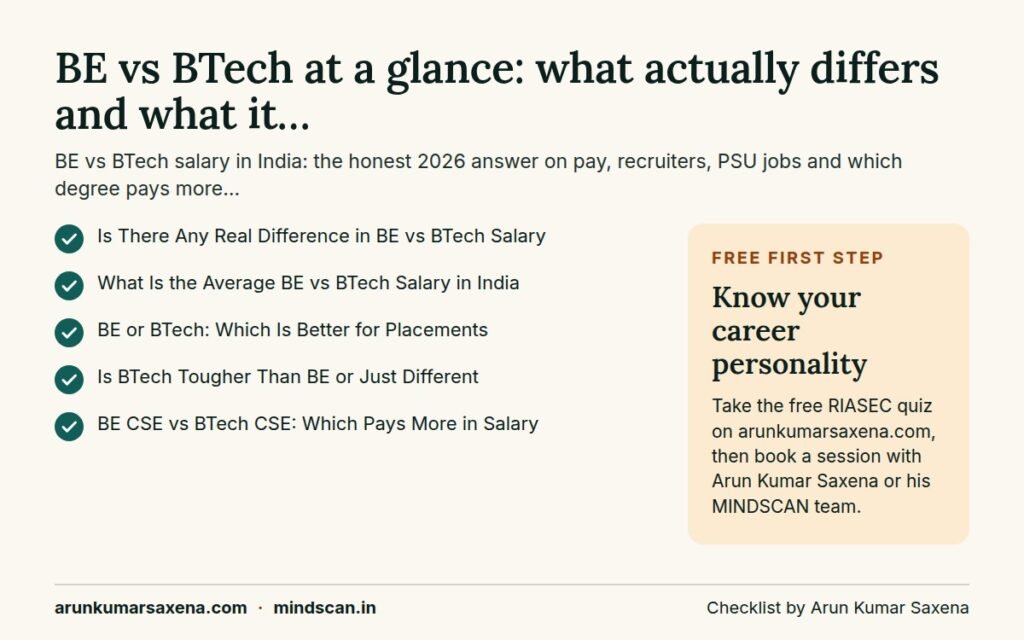
Is There Any Real Difference in BE vs BTech Salary?
No verified data shows a salary gap between BE and BTech graduates in India. Both are equivalent 4-year engineering degrees for employers, PSUs and higher studies, and starting packages fall in roughly the same ₹3 to 8 LPA range. The real drivers of pay are college, branch and skills, not the degree title.
Public sector units, private recruiters and foreign universities treat BE and BTech as interchangeable. A student with a BE in Computer Science from a tier-1 college will get the same shortlist as a BTech CSE candidate from the same tier. Any salary difference students see comes from college, branch and skills, not the degree title.
Blogs that claim ‘BTech always pays more’ have no verified data to support them. The placement report of a college never splits offers by BE versus BTech, because the industry does not care. When you search ‘be vs btech salary’, you are asking a question the job market answered years ago: the acronym does not set your pay.
“When parents use adjectives like ‘power’, ‘prestige’, ‘respect in society’ or ‘security’ but never use words like ‘aptitude’, ‘interest’, ‘growth’, or ‘skills’, I immediately understand that they are heading in the wrong direction.” (Arun Kumar Saxena)
The obsession with BE vs BTech salary is often a proxy for status anxiety. Families want the ‘better’ label, not the better fit. My sessions repeatedly show that the student who picks a branch and college based on aptitude and placement data will out-earn the one who picked a degree title to satisfy a relative at a wedding.

What Is the Average BE vs BTech Salary in India?
BE vs BTech salary in India is effectively identical, with freshers from both degrees falling in the same approximate range of ₹3 to 8 LPA (as per online sources).
The honest fresher range for BE and BTech graduates is approximately ₹3 to 8 LPA, as per online sources. Tier-1 college and in-demand branch offers go far higher; unknown colleges often see much lower. Converted to a monthly view, gross pay works out to roughly ₹25,000 to 65,000 depending on college, branch and city.
These are estimates from online sources, not official figures. No government body publishes a BE vs BTech salary survey, because the degrees are treated as one category. The range is wide because engineering in India spans IIT Bombay and a college that struggles to fill its seats. The degree title explains none of that variance.
Picture a typical Indian home: the Class 12 results are out, and the family has two admission offers, a BE in Electronics at a state university with a strong placement cell, and a BTech in the same branch at a private college with no placement data. The parent searches ‘be vs btech salary’ and picks the BTech because it sounds modern. The BE college would have given the child a campus placement; the BTech college leaves him searching for off-campus jobs. The salary difference was real, but it came from the college, not the acronym.
| Factor | BE | BTech | Salary Impact |
|---|---|---|---|
| Degree type | Bachelor of Engineering, often offered by older legacy institutions | Bachelor of Technology, common at universities | None; both are equivalent |
| Duration | 4 years / 8 semesters | 4 years / 8 semesters | None |
| Orientation | Commonly described as more theory-oriented | Commonly described as more application-oriented | Negligible; curriculum differs by university, not by title |
| Employer recognition | Fully recognised and equivalent | Fully recognised and equivalent | None |
| PSU eligibility | Eligible for PSU and GATE routes | Eligible for PSU and GATE routes | None |
| Fresher salary | Approximately ₹3 to 8 LPA (as per online sources) | Approximately ₹3 to 8 LPA (as per online sources) | Range is the same |
| What decides pay | College tier, branch, skills and internships | College tier, branch, skills and internships | Degree title has no measurable effect |
BE or BTech: Which Is Better for Placements?
Placement outcomes depend on the institute’s placement cell, recruiter list and student preparation, not on whether the certificate says BE or BTech. A legacy BE college with a fifty-year recruiter network will place students better than a new BTech university with no industry ties.
Before you admit a student to any engineering college, check its actual placement report and recruiter list. Look for the names of companies that visit the campus, the number of students placed and the median salary offered. Do not let the degree title distract you from this data. Legacy BE colleges and newer BTech universities can both have strong or weak placement cells; the acronym tells you nothing.
Off-campus and referral hiring increasingly decides outcomes for students at weak-placement colleges. A BTech student from a college with no campus drives will compete in the same open market as a BE student from a similar college. Their BE vs BTech salary will be set by the skills they can demonstrate, not by the degree they hold. Read our guide on off-campus placement strategies if your college does not bring recruiters to you.
Which Has More Demand, BE or BTech?
Recruiter demand does not split by BE versus BTech. Employers hire for branch, skills and college brand. A BE in Computer Science from a reputed college has the same market demand as a BTech CSE from an equivalent college. The degree title is not a demand filter.
Job portals and campus placement drives list openings by branch and specialisation, not by degree abbreviation. A company hiring for a software developer role will accept both BE CSE and BTech CSE candidates. The demand you see in the market is for skills like Python, cloud computing or VLSI design, not for a three-letter suffix on a certificate.
The BE vs BTech salary question is often a hidden question about demand. Students ask which degree pays more because they assume one is more wanted. The truth is simpler: the market wants engineers who can do the work. Your degree title will not get you shortlisted; your projects and internship experience will.
Is BTech Tougher Than BE or Just Different?
Difficulty is near-identical. Both are 4-year, 8-semester engineering degrees. The perceived difference is that BE programmes are often described as more theory-oriented and BTech as more application-oriented, but the actual workload and rigour depend on the university, not the acronym.
Same duration, similar core subjects, same JEE-style entrance ecosystem for most seats. A BTech student at a demanding university will work harder than a BE student at a relaxed one, and vice versa. Students should not pick a degree based on ‘easy’ versus ‘tough’, because the effort level evens out, and employers do not pay a premium for suffering.
The curriculum emphasis differs slightly by university. One BTech programme may include more lab work; one BE programme may assign more theory papers. Neither pattern is universal enough to guide a career decision. If you are choosing between two colleges, compare the syllabus document, not the degree title.
BE CSE vs BTech CSE: Which Pays More in Salary?
In Computer Science, employers pay for coding skill, projects and internships. A BE CSE and BTech CSE graduate from similar colleges get similar offers. Recruiters test data structures, algorithms and portfolio work; they do not check whether the degree says BE or BTech.
Branch choice matters far more than BE vs BTech within the same branch. A CSE graduate from either degree stream will typically out-earn a Civil Engineering graduate from the same college, because the market demand for software skills is higher. The BE vs BTech salary question disappears the moment you control for branch and college.
A warning: CSE seats at unknown colleges do not guarantee tech salaries. A BTech CSE from a college with no coding culture and no placement cell may graduate with an offer of approximately ₹3 LPA or none at all. The degree title will not save you; your GitHub profile and internship experience will. For a wider view of paths after engineering, see career options after BTech.
Which Factors Actually Decide Your Engineering Salary?
The real salary drivers, in order, are college tier, branch and specialisation, skills and internships, city and sector, and then negotiation. BE vs BTech is not on the list. College tier and brand create the biggest jump in starting packages.
High-demand branches like Computer Science, AI and Data Science out-earn traditional core branches at the fresher level, but only when the student has built the skills those branches require. A Mechanical Engineering graduate with a strong CAD and simulation portfolio can out-earn a CSE graduate with no projects. The portfolio of projects and internships outweighs syllabus orientation every time.
City and sector play a role too. A Bengaluru startup may offer more than a manufacturing unit in a smaller town, even for the same branch. Negotiation adds the final layer, but a fresher can negotiate only if they have competing offers or rare skills. None of these factors cares about BE versus BTech.
What most guides miss: the salary trap of the ‘safe’ first job
Most BE vs BTech salary pages talk about packages but ignore the career trap that follows a panic decision. A pattern seen in counselling sessions: a graduate sits at home for months after college, the parents grow anxious, and the family pushes the child to accept any job that comes, tele-calling, back-office data entry, a low-paying role that has nothing to do with engineering. The family tells itself some experience is better than no experience.
That decision stains the CV. A year later, when the graduate applies for an engineering role, recruiters assess them not on their potential but on the low salary label and the irrelevant work profile. The candidate is trapped in a salary band that can take years to escape. The BE vs BTech salary debate is a distraction; the real salary risk is accepting a low-value first job out of panic.
If you are in that waiting period, upskill aggressively. One project on your GitHub will do more for your salary than a year of back-office work. For a structured way to check whether engineering even fits you, take the free RIASEC career personality quiz before you commit to a branch or a panic job.
Which Engineering Has the Highest Salary After Engineering?
As per online sources, in-demand branches like Computer Science, AI, Data Science and Cybersecurity typically command higher fresher packages than traditional core branches. But the premium applies only when backed by skills. A CSE graduate with no coding projects may get a lower offer than a Mechanical engineer with a strong design portfolio.
Which Engineering Has a 1 Crore Salary?
The ₹1 crore salary figure you see in headlines comes from a tiny fraction of graduates at top IITs or those placed abroad. These are outliers, not averages. For most engineering graduates, the salary is built over time through upskilling, job switches and specialisation, not handed out on day one because of a branch name.
Focus on the branch that matches your aptitude and has a growing market, not the one that topped last year’s placement headline. A branch you enjoy will keep you learning; a branch you picked only for the salary will burn you out before you reach that salary. The BE vs BTech salary question is irrelevant here too; the branch and your skill in it set the number.
How Do You Choose Between BE and BTech This Month?
Shortlist by branch and placement record, compare college tiers, verify recognition, test fit with a career assessment, then decide. The degree label is the last criterion. Follow the steps below to make a decision you will not regret in four years.
- List 8 to 10 engineering colleges you can realistically get, ignoring whether they offer BE or BTech.
- For each, verify the branch you want, AICTE or University Grants Commission recognition and the latest placement report with recruiter names.
- Rank colleges by branch strength and placement record, never by the degree abbreviation.
- Take the free RIASEC career personality quiz to confirm engineering, and which branch, actually fits you.
- Map your top 2 branches against your interests using a structured self-assessment; self-knowledge comes before any career choice.
- Build one skill for your target branch, coding, design software, data, and start a small project this month.
- If confused, book an online career counselling in India session to review options with data before you lock a choice.
Check the National Career Service portal by the Ministry of Labour and Employment for verified career and job information while you research. The degree title will not appear in any salary report that matters; the college name and branch will.
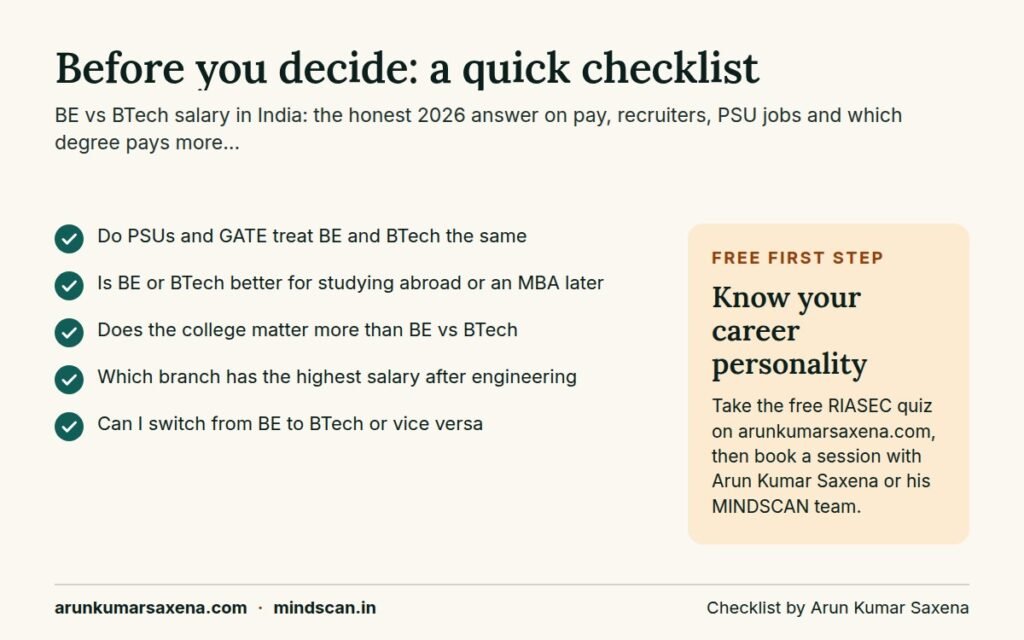
Do PSUs and GATE Treat BE and BTech the Same?
PSUs, GATE and most government recruitment treat BE and BTech as equivalent 4-year engineering degrees. Eligibility depends on the discipline, Mechanical, Electrical, Civil, not on whether the certificate says BE or BTech. Both degrees enter at the same grade and pay band.
The equivalence is formal. The All India Council for Technical Education (AICTE) and the National Career Service portal both treat BE and BTech as equivalent for employment purposes. The BE vs BTech salary question does not arise in PSU pay scales because both degrees enter at the same grade and the same pay band. A GATE score in Mechanical Engineering opens the same PSU doors whether your degree reads BE or BTech.
Can You Earn 1 Lakh Per Month After BTech or BE?
Yes, but not by degree name. ₹1 lakh per month is approximately ₹12 LPA, achievable mainly from tier-1 campuses or high-skill off-campus offers. Most freshers start well below that and grow with upskilling and a strong portfolio.
Avoid panic-accepting a low-value first job just to start earning. The CV trap is real and can keep you below the ₹1 lakh mark for years. Upskilling and a strong portfolio are the realistic route for most students. A BTech graduate who spends six months building a data science portfolio will get closer to that number than a BE graduate who takes the first back-office offer that comes.
The question behind ‘be vs btech salary’ is often ‘which degree will make me rich faster’. Neither will. The college you get, the branch you pick, the skills you build and the internships you complete will. Focus your energy there. For a different comparison that families often face at the Class 12 stage, read engineering vs medical after 12th.
Frequently asked questions about be vs btech salary
Do PSUs and GATE treat BE and BTech the same?
Yes. PSUs, GATE and most government recruitment treat BE and BTech as equivalent 4-year engineering degrees. Eligibility depends on the discipline, Mechanical, Electrical, Civil, not on whether the certificate says BE or BTech. The BE vs BTech salary question does not arise in PSU pay scales because both degrees enter at the same grade.
Is BE or BTech better for studying abroad or an MBA later?
Both are equally accepted for foreign universities, MTech and MBA admissions. What matters is your grades, test scores, statement of purpose and profile, not the degree nomenclature. An admissions committee in the US or Europe does not split applicants by BE vs BTech; they look at your college, GPA and GRE score.
Does the college matter more than BE vs BTech?
Yes. College tier and brand create the largest difference in starting packages. The degree label has no measurable salary effect. A BE from a top state university will open more doors than a BTech from an unknown private college, and the BE vs BTech salary comparison within the same college tier shows no gap at all.
Can I switch from BE to BTech or vice versa?
You generally cannot switch the degree title mid-course, and you do not need to. Since employers treat both equally, focus on branch, college and skill-building instead. Spending energy on a title change is a waste of time that could go into a project or internship that actually moves your BE vs BTech salary.
How much do BE and BTech graduates earn per month as freshers?
At approximately ₹3 to 8 LPA (as per online sources), monthly gross works out to roughly ₹25,000 to 65,000 depending on college, branch and city. These are estimates, not official figures. The BE vs BTech salary per month is the same range for both degrees; the variation comes from where you study and what you can do.
Who earns more after engineering: a BTech or an MBA graduate?
It is not directly comparable. MBA pay depends on the b-school tier and prior profile. An MBA from a top institute typically out-earns a fresher engineer, but at the cost of two more years and significant fees. A BTech graduate with four years of work experience and upskilling can match or exceed that salary without the MBA debt.
Can I become CEO after BTech?
Yes, a BTech can lead to a CEO role, but the degree alone is not the path. It takes years of work experience, business acumen, leadership skills and often an MBA from a top school. The BE vs BTech salary question fades at senior levels; your track record, industry and network decide whether you reach the corner office.
The BE vs BTech salary question has one honest answer: the acronym does not set your pay. Your college, branch, skills and internships do. If you are choosing an engineering college this month, rank your options by placement data and branch fit, not by the degree title. A decision based on labels is a decision based on noise.
If the choice still feels unclear, get a data-verified view of your options. The MINDSCAN AI Career Clarity Report maps you to 20+ career groups and costs ₹1,499; add a counselling session for ₹2,999. Book online career counselling in India with me, Arun Kumar Saxena, or my MINDSCAN team, and walk into your engineering choice with clarity, not confusion.