
What is a Polytechnic Course? A Complete Guide After 10th
By Arun Kumar Saxena, Certified Advanced Career Coach · Updated October 2026
Quick answer: What is polytechnic course? It is a practical, job-oriented diploma, usually 3 years after Class 10, teaching hands-on technical skills. Career coach Arun Kumar Saxena says it is a strong option only when it matches the student’s real interests and strengths, verified scientifically before admission.
Definition: A polytechnic course is a 3-year technical diploma after Class 10, approved by AICTE and state boards of technical education, leading to junior engineer roles or B.Tech lateral entry.
What is polytechnic course? It is a technical diploma that thousands of Indian students consider right after their Class 10 board exams, often before they have fully understood what it demands and where it leads. This page is for students and parents standing at that exact crossroads, comparing a polytechnic diploma against Class 11, ITI, or simply following the crowd.
With 22 years of experience and 20,000+ students and professionals guided, I see the same pattern every admission season: families pick a stream based on a neighbour’s suggestion or a college brochure, and only check for fit after the first year goes wrong.
This guide gives you an honest, fit-first look at what is polytechnic course really about, which streams exist, how it compares to ITI and Class 11, what jobs and salaries are realistic, and the exact steps to choose a diploma that matches your child’s actual strengths. If you want the shortest path to a confident decision, take the free RIASEC career personality quiz, get your data-verified direction with the MINDSCAN AI Career Clarity Report at mindscan.in, then read the framework below.
Table of Contents
What is polytechnic course and who is it for?
A polytechnic course is a technical diploma awarded by state boards of technical education and approved by AICTE (All India Council for Technical Education), focused on practical lab work, workshops and industry skills rather than heavy theory. It suits Class 10 students who want an earlier, cheaper route into engineering careers, and Class 12 or ITI students via lateral entry.
Typically the program runs 3 years (6 semesters) after Class 10, or around 2 years via lateral entry after Class 12 with Science or PCM, or after an ITI certificate. The diploma is a recognised formal qualification approved by state boards of technical education, which means it carries weight with both private employers and government recruiters. You can verify approved institutes on the National Career Service portal (Government of India) or your state’s technical education board website.
In my sessions, I tell families that what is polytechnic course is a fit question first and a course question second. It should never be a default escape from Class 11 board exams. When a student chooses a polytechnic course without verifying interest, the three years can feel longer than any academic stream.
What most guides miss: the fit-first check before you even look at a college list
Most polytechnic guides start with a list of streams and colleges. I start with the student. In my practice, I have seen too many diploma students who picked mechanical because an uncle said it had scope, or computer science because a friend enrolled. Two semesters later, the practical workshops feel like punishment and the attendance drops. The fix is simple and scientific. Before you open a single college brochure, verify two things.
First, does the student genuinely enjoy hands-on work, or does she prefer reading, writing and abstract problem-solving? Second, which type of hands-on work pulls her: machines, structures, circuits, code or design? The free RIASEC quiz gives you a starting answer in approximately ten minutes. A full psychometric assessment, like the MINDSCAN AI Career Clarity Report at ₹1,499, or the report with a counselling session at ₹2,999, maps the student to 20+ career groups and removes guesswork from the decision. You can book a session of online career counselling for a personalised fit check.
Either way, the rule is the same: self-knowledge before stream selection. Learn more about my approach on my profile page. My book ‘3 Steps to Knowing Yourself’ was written for exactly this moment.
Which polytechnic courses after 10th are most popular?
The most common polytechnic courses after 10th are diploma programmes in mechanical, civil, electrical, computer science, electronics and communication, and automobile engineering, plus applied fields such as fashion design, interior design, hotel management, pharmacy and modern office management. Choice should follow the student’s interests and strengths, not popularity lists.
Engineering streams dominate the intake: mechanical, civil, electrical, computer science, electronics and communication, and automobile engineering fill most seats in state polytechnic colleges. Non-engineering options have grown steadily and now include fashion designing, interior design, hotel management, pharmacy and modern office management. A course being popular says nothing about whether it suits your child.
I have seen students thrive in a less famous stream like modern office management while their friends struggled in a crowded computer science diploma. Popularity is a marketing metric. Fit is a career metric. Pick the metric that matters when asking what is polytechnic course right for you.
Which course in polytechnic is best for you?
3-step decision flow for choosing a polytechnic course
- Step 1 – Verify interest: take the free RIASEC quiz or a psychometric assessment to confirm the student genuinely prefers hands-on technical work.
- Step 2 – Compare routes: weigh polytechnic against ITI and Class 11 on duration, cost and career exits before committing.
- Step 3 – Check demand: confirm the chosen stream has real job and lateral-entry opportunities in your own state.
The best polytechnic course is the one that matches the student’s natural interests, abilities and long-term goal. Mechanical, civil and computer science diplomas are widely chosen, but the right pick depends on whether the student prefers machines, structures, computers, design or people-facing work. A scientific assessment beats guesswork.
Start by matching the stream to the interest. Does the student gravitate toward hands-on machines, buildings and structures, coding and circuits, creative design, or management and people-facing roles? Next, check realistic demand in the state or region where the student wants to work. A diploma in automobile engineering may have stronger placement pipelines in a manufacturing hub like Pune or Chennai than in a city with fewer auto firms.
Mechanical suits a student who enjoys machines, tools and how things move. Computer science suits a student who likes logic, coding and problem-solving on a screen. Civil suits a student who is drawn to structures, sites and outdoor project work. Each stream leads to different exits: mechanical and civil often feed manufacturing, infrastructure and government junior engineer roles, while computer science leans toward IT support, software testing and further study. Pick the stream whose daily work the student would actually enjoy, not the one that sounds most impressive.
Finally, use the free RIASEC career personality quiz or a full psychometric assessment to verify fit before paying admission fees. A short assessment now can prevent a three-year wrong turn when deciding what is polytechnic course best for you.
Polytechnic vs ITI vs Class 11: which should you choose after 10th?
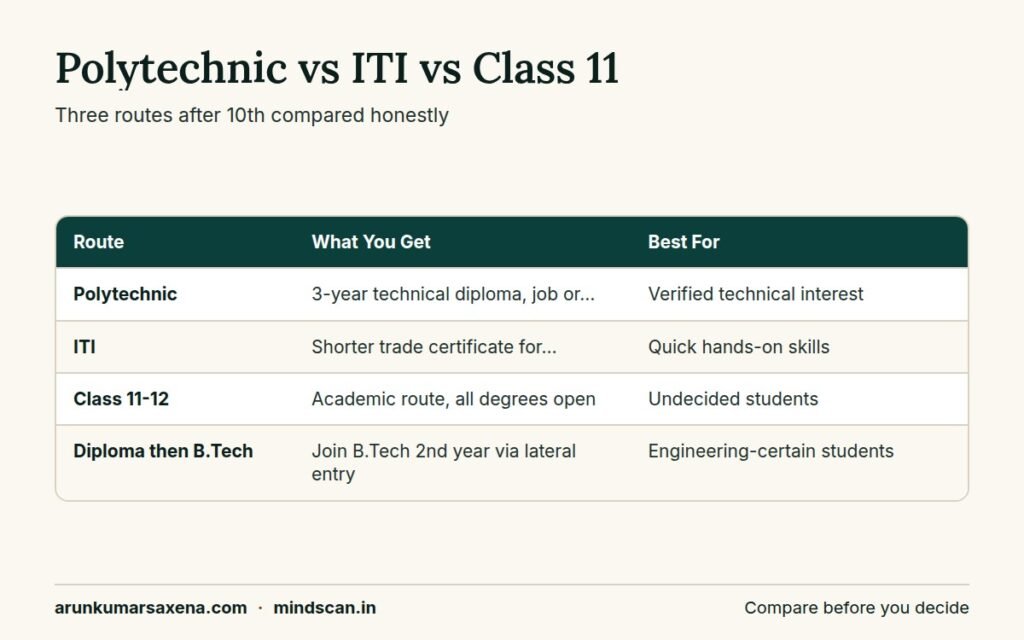
Polytechnic gives a 3-year technical diploma leading to junior engineer roles or lateral entry into B.Tech second year. ITI gives shorter trade certificates for technician-level work. Class 11-12 keeps the conventional academic route open to any degree. The right choice depends on the student’s clarity of goal and academic strength.
Each path serves a different student profile. Polytechnic is the longest commitment of the three but delivers the earliest technical qualification and a B.Tech shortcut. ITI is shorter and trade-focused, best for students who want quick, hands-on technician careers. Class 11-12 is the safest route for undecided students; it keeps every degree option open and buys two more years of clarity. I tell parents never to pick polytechnic just to escape board exams. That decision should be data-verified, not emotion-driven. Understanding what is polytechnic course compared to these alternatives is essential before committing.
| Route | What You Get | Best Suited For |
|---|---|---|
| Polytechnic diploma | 3-year technical diploma, job or JE exams or B.Tech lateral entry | Students with verified technical interest wanting an early qualification |
| ITI certificate | Shorter trade-focused certificate for technician roles | Students wanting quicker, hands-on trade skills |
| Class 11-12 (any stream) | Academic route keeping all degree options open | Undecided students or those aiming for professional degrees |
| Polytechnic then B.Tech lateral entry | Diploma plus B.Tech starting from 2nd year (3 more years) | Students certain about engineering who want a practical foundation first |
Is polytechnic hard or easy compared to Class 11 and 12?
Polytechnic is not easier, it is different. It demands consistent practical work, labs, workshops and semester exams, but suits students who learn better by doing than by heavy theory. A student who struggles with pure academic study may actually perform better in a polytechnic’s hands-on environment.
Six semesters with continuous practical assessments replace the single big board exam model of Class 12. Workshops and industrial training form a large part of the curriculum, so attendance and hands-on participation matter every week. I often tell students that ‘easy’ is the wrong question. Ask instead whether the learning style fits. A child who hates sitting with textbooks but can spend hours fixing a motorcycle or assembling circuits may find polytechnic far more rewarding than a conventional classroom. This is a key insight into what is polytechnic course difficulty really like.
What jobs and salary can you get after a polytechnic diploma?
Polytechnic graduates work as junior engineers, technicians and supervisors in private manufacturing firms, public sector undertakings and service workshops, and can appear for government junior engineer exams such as SSC JE and RRB JE. As per online sources, entry-level diploma salaries are commonly listed at approximately ₹15,000 to ₹40,000 per month, varying widely by role, employer and state, so treat any single figure online as an estimate only.
Direct employment routes include:
- Junior engineer in private manufacturing or infrastructure firms
- Technician in public sector undertakings and service workshops
- Supervisor on shop floors and project sites
- Government junior engineer exams like SSC JE and RRB JE
- B.Tech lateral entry to complete a full engineering degree
The lateral entry path into B.Tech 2nd year shortens the full engineering degree to just 3 more years, which is one of the strongest long-term plays a diploma student can make. For government job updates, check the official SSC JE and RRB JE recruitment pages. You can also explore skill development schemes on the Skill India Digital Hub.
A diploma opens doors, but the student’s skill depth decides the salary. Two graduates from the same polytechnic, same stream, can earn very different amounts depending on what they actually learned and built during those three years. This is the reality behind what is polytechnic course worth in the job market.
Is polytechnic good for a career in the long run?
Yes, polytechnic is a good career foundation for students who genuinely want technical work, because it leads to jobs, government exams or a B.Tech via lateral entry. It becomes a poor choice when chosen under family pressure or as an escape route, without checking the student’s actual aptitude and interests.
Three clear exits make the diploma versatile: a direct job, government junior engineer exams, or B.Tech lateral entry. The common thread across all three is that the student must have a genuine technical interest, verified by something more reliable than a relative’s opinion. I have seen the diploma’s value depend almost entirely on the decision quality behind it.
A well-matched student with a clear plan can build a solid career from a polytechnic start. A mismatched student, pushed into a stream by family pressure, often drops out or drifts for years. Asking what is polytechnic course long-term value means asking whether the student truly fits the path.
“Analyse your child’s aptitude scientifically and check the scores critically before taking any decision.” (Arun Kumar Saxena)
How do you choose the right polytechnic course this month?
Choosing the right polytechnic course this month requires you to first assess the student’s interests and strengths scientifically, then shortlist streams that match, verify college approvals and placement records, compare fees, and only then apply. Following a structured sequence this month prevents an expensive wrong-turn admission.
Start with self-knowledge, not college brochures. Verify that every institute on your shortlist is approved by the state board of technical education before you pay a single rupee. Talk to current students or alumni before finalising; their unfiltered experience is worth more than any placement poster. A few phone calls this week can save years of regret. This is the practical answer to what is polytechnic course selection process.
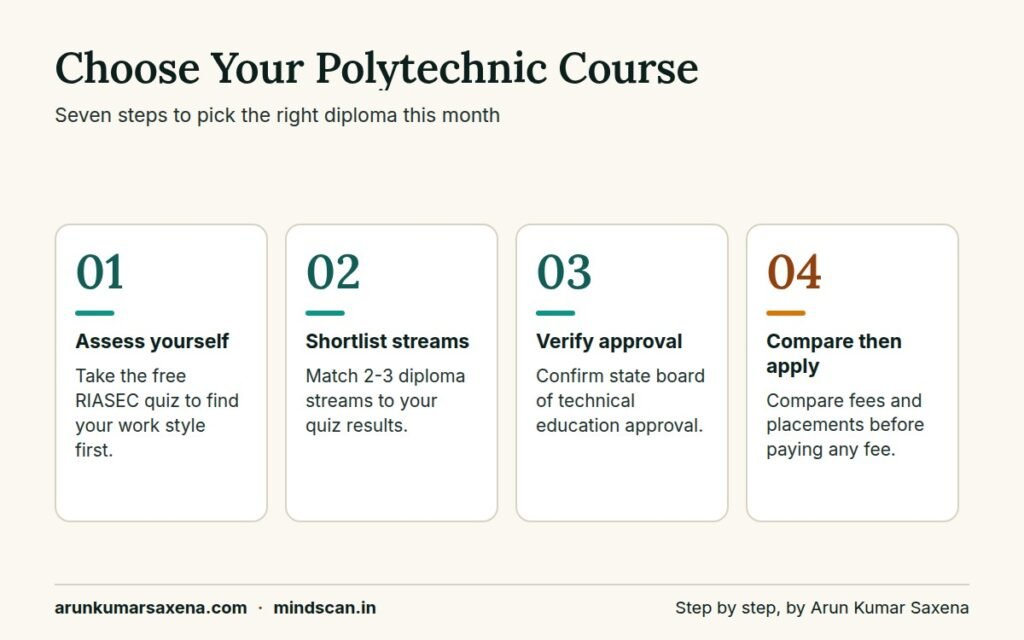
- Take the free RIASEC career personality quiz to see which work style genuinely suits you.
- Shortlist 2-3 polytechnic streams that match your quiz or assessment results.
- Check each stream’s job and lateral-entry exits in your own state.
- Verify that shortlisted institutes are approved by your state board of technical education.
- Compare total fees and placement records; treat online fee figures as approximate.
- Talk to one current student or alumnus of each institute before applying.
- If still unsure, book a career counselling session before paying any admission fee.
What should parents check before admitting their child to polytechnic?
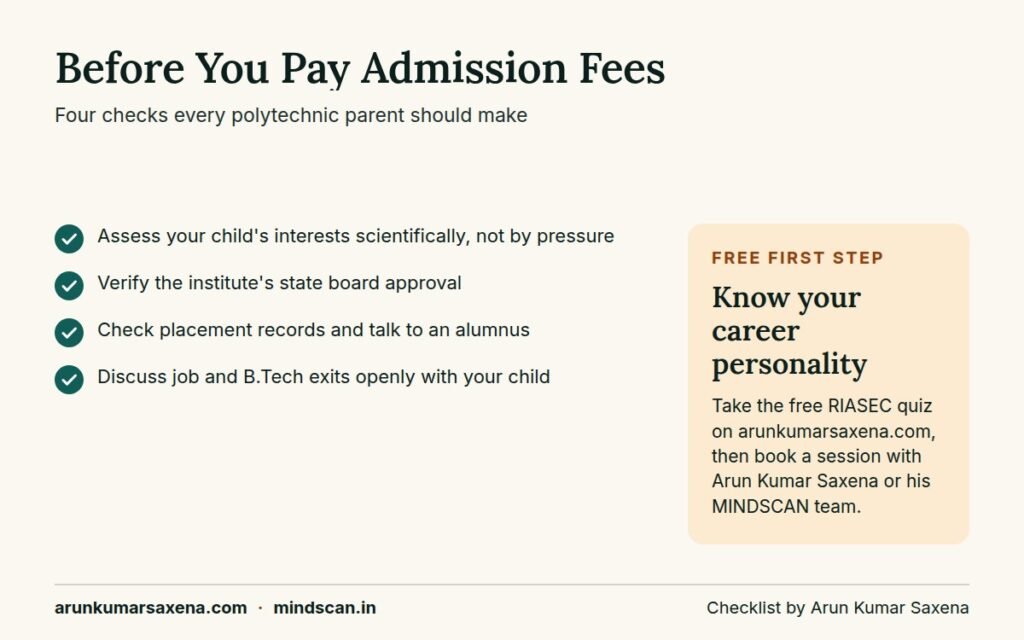
Parents should check the child’s genuine interest through a scientific assessment, the institute’s approval status and placement track record, the total cost over three years, and whether the child understands and accepts the path. Pressure-based admissions are the most common and costly mistake I see in my practice.
Analyse aptitude scientifically before deciding, not after the first year goes wrong. The same assessment-first logic should decide polytechnic versus Class 11. Also check whether the inspiration is the child’s own or copied from a relative or neighbour.
Admiration for a cousin who got a government job after a civil diploma is not the same as personal aptitude. Finally, discuss the lateral entry and job exits openly with the child. A Class 10 student may not know the term ‘lateral entry’, but she should understand that polytechnic can lead to a B.Tech, a government exam or a technician job, and she should have a say in which exit she is working toward. This is the core of what is polytechnic course readiness for a young student.
What is polytechnic diploma course duration?
The duration of a polytechnic diploma course depends on the entry route. A clear breakdown helps families plan the timeline accurately.
| Entry Route | Typical Duration | Structure |
|---|---|---|
| After Class 10 | 3 years | 6 semesters of theory, labs and workshops |
| Lateral entry after Class 12 (Science/PCM) | Approximately 2 years | 4 semesters, joining directly in the second year |
| Lateral entry after ITI | Approximately 2 years | 4 semesters, with credit for trade skills |
Some applied programmes may differ in structure, so confirm the exact duration with the specific state board of technical education before applying.
Frequently asked questions about what is polytechnic course
Can I do a polytechnic course after 12th?
Yes. After Class 12 with Science or PCM, or after an ITI certificate, students can join polytechnic through lateral entry, usually completing the diploma in around 2 years instead of 3. Check your state board’s lateral entry rules for exact eligibility criteria before applying.
How long is lateral entry after 12th or ITI?
A polytechnic diploma typically lasts 3 years (6 semesters) after Class 10, and around 2 years via lateral entry after Class 12 or ITI. Some applied programmes may differ in structure, so confirm the exact duration with the specific state board of technical education.
Which diploma has a high salary after polytechnic?
There is no guaranteed high-salary diploma. Salaries depend more on the employer, role, skill depth and state than on the stream name. Treat any online salary figure as an approximate estimate, and prioritise fit and skill-building over chasing ‘highest paying’ lists. A free RIASEC career personality quiz can help you verify which stream actually fits your interests before you commit.
What type of job can I get after polytechnic?
Common roles include junior engineer, technician and supervisor in private manufacturing firms, public sector undertakings and service workshops. Diploma holders can also appear for government junior engineer exams such as SSC JE and RRB JE, or continue to B.Tech through lateral entry.
Can I do B.Tech after polytechnic?
Yes. Diploma holders can join the 2nd year of a B.Tech or B.E. programme through lateral entry, completing the full engineering degree in 3 more years. This is one of the biggest advantages of the polytechnic route and a strong reason to choose it.
Is polytechnic good for government jobs?
Yes. A polytechnic diploma qualifies students for junior engineer exams conducted by bodies like SSC, RRB and state technical boards, plus technician roles in public sector undertakings. Competition is real, so focused preparation matters as much as the qualification itself.
What subjects are taught in a polytechnic course?
The curriculum combines core technical subjects for the chosen stream, for example mechanical, civil or computer engineering, with practical lab work, workshops, industrial training and some applied subjects. As per typical state board curricula, a mechanical diploma includes subjects like thermodynamics, manufacturing processes and CAD/CAM, while a civil diploma covers surveying, structural mechanics and construction materials. It emphasises hands-on skill over heavy academic theory throughout all six semesters.
Can I do a polytechnic course after ITI, and how does lateral entry work?
Yes. ITI certificate holders can join a polytechnic course through lateral entry, usually starting in the second year and finishing in around 2 years instead of 3. Your ITI trade skills carry credit, so confirm the exact lateral entry rules with your state board of technical education before applying.
Is a polytechnic diploma a certificate or a full qualification for government jobs?
A polytechnic diploma, often searched online as politecnic or politeknik course, is a full formal qualification, not just a certificate. It is awarded by state boards of technical education and recognised by private employers and government recruiters for junior engineer exams like SSC JE and RRB JE, plus technician roles in public sector undertakings.
Can I do a diploma after 12th without Science or PCM?
For polytechnic lateral entry after Class 12, the common requirement is Science with PCM subjects, so without them lateral entry may not be open to you. The regular 3-year polytechnic course after Class 10 remains available. Always check your own state board’s eligibility rules before deciding.
How do polytechnic and Class 11 differ in daily study style, exams and fees pressure?
Polytechnic runs on six semesters of continuous practical assessments, labs and workshops, so weekly attendance matters more than one big board exam. Class 11 keeps the theory-heavy academic exam model and often adds coaching pressure. Polytechnic is generally the cheaper early route, though exact fees vary by state and institute.
Which government job roles can a polytechnic diploma lead to?
A polytechnic diploma can lead to junior engineer roles through government exams such as SSC JE and RRB JE, technician and supervisor posts in public sector undertakings, and state technical board recruitments. Career coach Arun Kumar Saxena advises verifying your aptitude scientifically before choosing this path, not after.
Polytechnic vs ITI vs Class 11 after 10th: comparison table
| Factor | Polytechnic | ITI | Class 11-12 |
|---|---|---|---|
| Qualification type | Technical diploma from state boards of technical education, AICTE-approved | Trade-focused certificate | Academic schooling keeping all degree options open |
| Duration | 3 years (6 semesters) after Class 10 | Shorter than a diploma | 2 years of school |
| Learning style | Hands-on: labs, workshops, industrial training | Hands-on trade skills | Theory-heavy academic study |
| Entry after Class 12 or ITI | Yes, lateral entry in around 2 years (Science/PCM or ITI needed) | ITI holders can enter polytechnic via lateral entry | Continues toward a degree after Class 12 |
| Typical career exits | Junior engineer, technician, supervisor, SSC JE and RRB JE exams, B.Tech lateral entry | Technician roles in workshops and public sector undertakings | Any degree course and professional exams |
If this comparison leaves you unsure which route fits your child, read about online career counselling for students across India or take the free career personality test based on RIASEC before paying any admission fee.
हिंदी में जवाब: पॉलिटेक्निक कोर्स क्या है: 10वीं के बाद पूरी गाइड
10वीं के बाद कौन सी परीक्षा देनी चाहिए?
10वीं के बाद कोई एक परीक्षा सभी के लिए सही नहीं होती। यह छात्र की रुचि और लक्ष्य पर निर्भर करता है। पॉलिटेक्निक प्रवेश परीक्षाएं राज्य तकनीकी शिक्षा बोर्ड आयोजित करते हैं। अरुण कुमार सक्सेना के अनुसार, परीक्षा चुनने से पहले छात्र की वास्तविक योग्यता और रुचि की वैज्ञानिक जांच जरूर करें। पॉलिटेक्निक कोर्स के बारे में और जानें।
12 वीं के बाद सबसे अच्छा कोर्स कौन सा है?
12वीं के बाद सबसे अच्छा कोर्स वही है जो छात्र की प्राकृतिक रुचियों, क्षमताओं और दीर्घकालिक लक्ष्य से मेल खाता हो। पॉलिटेक्निक में लेटरल एंट्री एक व्यावहारिक विकल्प है, लेकिन अरुण कुमार सक्सेना सलाह देते हैं कि किसी भी कोर्स का चयन साइकोमेट्रिक आकलन के बाद ही करें, लोकप्रियता की सूची देखकर नहीं।
कौन सी पढ़ाई ज्यादा सैलरी देती है?
कोई भी पढ़ाई गारंटी के साथ अधिक वेतन नहीं देती। वेतन नियोक्ता, भूमिका, कौशल स्तर और राज्य पर निर्भर करता है। पॉलिटेक्निक डिप्लोमा धारकों का वेतन लगभग 15,000 से 40,000 रुपये प्रति माह के बीच हो सकता है, लेकिन यह केवल एक अनुमान है। अरुण कुमार सक्सेना कहते हैं कि कौशल की गहराई ही अंततः वेतन तय करती है।
Choosing a polytechnic course is a decision that shapes the next three to six years of your child’s life. It can lead to a solid technical career, a government job or a faster B.Tech degree, but only if the stream matches the student’s real interests and strengths. If you are still unsure which diploma fits, do not leave it to guesswork or a neighbour’s advice. Book a session of online career counselling in India with Arun Kumar Saxena and get a scientific, honest answer before you pay any admission fee.
You can also start with the MINDSCAN AI Career Clarity Report, which maps your child to 20+ career groups and gives you a clear, data-verified direction in one report. A small investment in clarity now can prevent a much larger cost of a wrong turn later.