
Class X Subject Combination: The Complete Guide
By Arun Kumar Saxena, Certified Advanced Career Coach · Updated October 2026
Quick answer: A class x subject combination is the exact set of subjects a student studies in Class 10. In CBSE, this means 5 compulsory subjects plus 1 or 2 optional skill subjects. Your choice of optional subjects and Maths level should be made with your Class 11 stream in mind, because this decision quietly shapes your future options.
A class x subject combination decision looks small on a school form but it can open or quietly close doors to Class 11 streams and careers. This page is for parents of Class 9 and 10 students and for students themselves who want one clear, board-wise answer without the marketing noise of coaching institutes. With 22 years of experience and 20,000+ students and professionals guided, I have seen how a single subject choice in Class 9 or 10 changes a student’s entire path.
We will walk through CBSE and ICSE subject rules, the Maths Standard versus Basic dilemma, the full class 11th subject list, and a self-knowledge first method that no top-ranking page offers. If you are searching ‘class x subject combination’ tonight because your child’s form is due, you are in the right place.
Table of Contents
What is class x subject combination in CBSE?
A class x subject combination in CBSE consists of 5 compulsory subjects and 1 optional sixth subject, often a skill subject. English is compulsory as Language 1, a second language such as Hindi Course A or B, Sanskrit or a regional language is Language 2, and every student studies Mathematics, Science and Social Science. The sixth subject is where families have a real choice, and it is the one I ask about first in a counselling session.
CBSE offers two levels of Mathematics. Mathematics Standard (code 041) is the paper you must take if you plan to study Mathematics in Class 11. Mathematics Basic (code 241) covers the same syllabus but with an easier board exam paper, and a Basic student generally cannot switch to Class 11 Maths. Science is a combined paper covering Physics, Chemistry and Biology. Social Science covers History, Geography, Political Science and Economics in one paper.
For the sixth subject, schools commonly offer a range of skill electives. The most common options include:
- Information Technology (code 402)
- Artificial Intelligence (code 417)
- Retail
- Financial Literacy
- A third language
- Painting
- Home Science
- Physical Education
This sixth subject can act as a replacement if a student does not pass a compulsory subject, though CBSE rules on this have tightened in recent years. In my sessions, parents often ask whether the sixth subject matters for college admissions. It does not directly affect the best-of-five percentage in most cases, but a skill subject like AI or IT adds a certification that can help a student’s profile later.
More importantly, the class x subject combination you choose signals to the school what stream you are likely to request in Class 11, and popular schools fill their Science and Commerce sections fast.
What most guides miss: the hidden link between your Class 10 optional subject and Class 11 stream allotment
Most online guides treat the sixth subject as a throwaway. In my counselling practice I see a different pattern. My advice to a Class 9 parent is this. If your child is even slightly inclined toward Science, choose a skill subject like IT or AI as the sixth subject. It costs nothing, builds a useful skill, and supports your stream goal. If your child is certain about Humanities, choose a subject they genuinely enjoy. The class x subject combination is not just a list on a marksheet.
What is the subject code of Mathematics in CBSE?
Mathematics in CBSE Class 10 has two distinct subject codes. Mathematics Standard is code 041, and Mathematics Basic is code 241. The code you enter on the registration form is a binding choice that determines your eligibility for Class 11 Mathematics, so it must be made carefully.
Mathematics Standard (041) is the full-level paper. A student who passes Standard can take Mathematics in Class 11 and 12 without any restriction. Mathematics Basic (241) covers the same chapters but the board exam paper is designed to be less demanding. A student who passes Basic generally cannot take Mathematics (041) in Class 11, but can usually opt for Applied Mathematics; confirm with your school. The syllabus for both codes is identical. The difference lies only in the difficulty of the board examination and the post-Class-10 pathway.
I often tell parents to think of Basic as a terminal choice. It is perfect for a student who finds Maths genuinely difficult and is certain about Humanities or a vocational path. For everyone else, Standard keeps doors open. The class x subject combination form asks for this code, and changing it after submission is a bureaucratic headache.
What are the subject combinations for CBSE Class 10?
The standard CBSE Class 10 subject combination includes five compulsory subjects and one or two optional subjects. The compulsory set is English (Language 1), a second language (Language 2), Mathematics (Standard or Basic), Science, and Social Science. The optional sixth and seventh subjects are chosen from a school’s offered skill electives or languages.
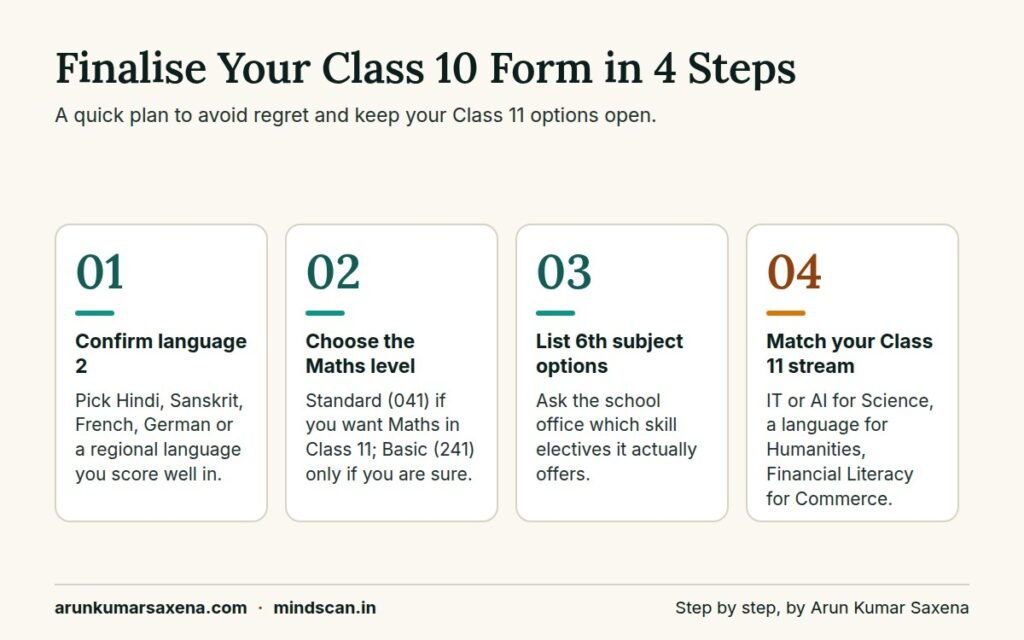
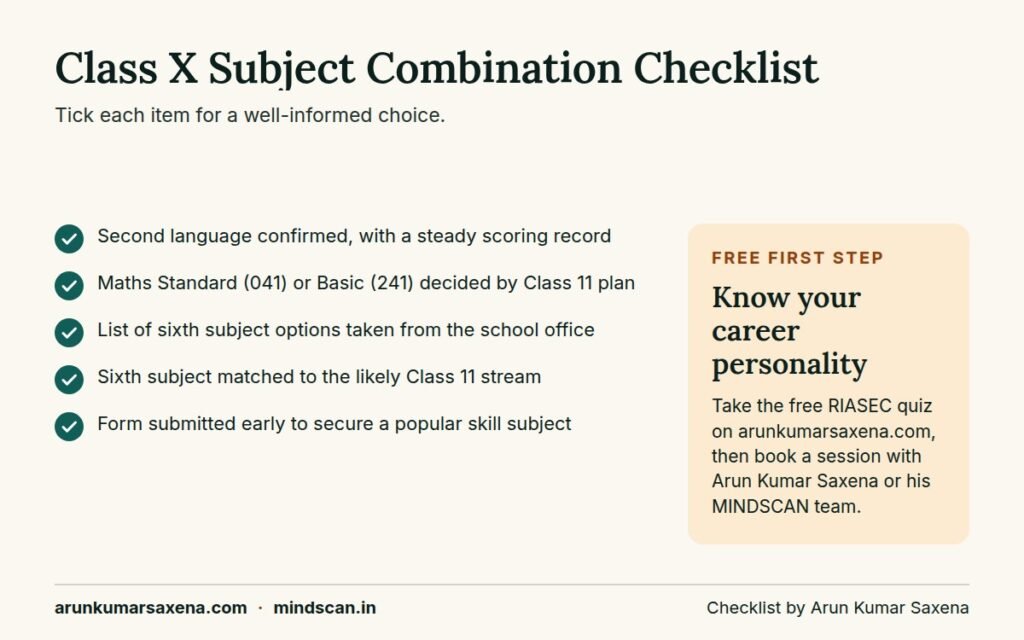
Here is a step-by-step checklist I use with parents to finalize a CBSE Class 10 form:
- Confirm the second language. Hindi Course A, Hindi Course B, Sanskrit, French, German, or a regional language are common options. Pick the one your child can score in consistently.
- Decide between Mathematics Standard (041) and Basic (241). Ask the school if Basic students can switch to Standard later. If the answer is no, choose Standard unless your child is certain about a non-Maths stream.
- List the sixth-subject options your school actually offers. Do not go by the CBSE circular alone. Visit the school office or talk to the Class 10 coordinator.
- Match the sixth subject to your likely Class 11 stream. IT or AI for Science, a language or creative subject for Humanities, and Financial Literacy or IT for Commerce.
- Fill the form early. Popular sixth subjects like AI fill up fast in many schools.
This class x subject combination checklist takes about fifteen minutes but can save a year of regret. I have seen too many families rush through the form and then spend Class 11 trying to fix a choice that was made in haste.
What subject combinations are available for ICSE Class 10?
ICSE Class 10 students study English (compulsory), a second language, and choose from three groups. Group I has compulsory subjects like History, Civics, Geography and a second language. Group II offers Mathematics, Science (Physics, Chemistry, Biology), Commercial Studies and others. Group III has electives like Computer Applications, Physical Education and Art. The class x subject combination in ICSE is more flexible than CBSE because students pick from each group rather than following one fixed set.
This three-group structure gives ICSE students a genuine advantage. A student can combine Science from Group II with Computer Applications from Group III and a language from Group I. The trade-off is that ICSE papers are longer and more detailed. A typical ICSE student writes more in a single exam than a CBSE student writes in two. The class x subject combination in ICSE therefore rewards students who are strong in written expression and can handle a larger syllabus volume.
When an ICSE parent asks me for a subject formula, I suggest one high-scoring elective in Group III, one future-relevant subject in Group II, and a second language they are already comfortable with. This combination keeps the best-of-five percentage healthy and leaves Class 11 stream options open.
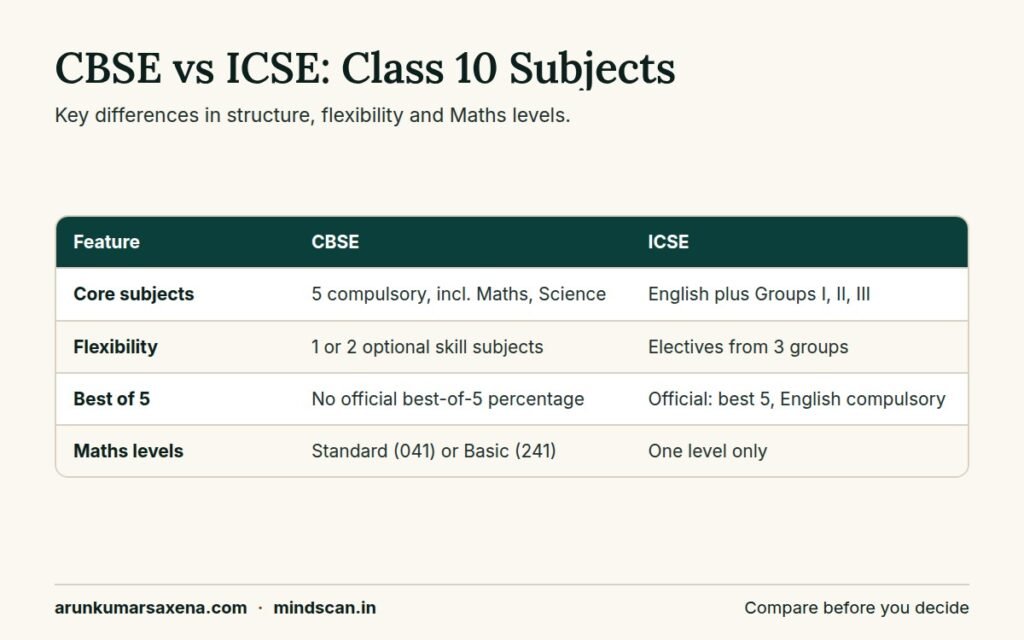
CBSE vs ICSE: Class 10 subject combination comparison
| Feature | CBSE | ICSE |
|---|---|---|
| Compulsory subjects | 5 (English, Language 2, Maths, Science, Social Science) | English plus Group I subjects (History, Civics, Geography, Language 2) |
| Flexibility | Limited to 1-2 optional skill subjects or languages | High; students pick from three distinct groups |
| Best-of-5 rule | Applied by some schools for internal promotions; not an official CBSE percentage rule | Official ICSE rule: best 5 written subjects, English compulsory |
| Maths levels | Two levels: Standard (041) and Basic (241) | One level; no Basic option |
| Exam depth | Concise, application-based | Detailed, analytical, longer papers |
This table is one I wish every Class 8 parent saw before choosing a board. The class x subject combination difference between CBSE and ICSE is not just about subjects. It is about the style of learning and examination your child will live with for two years.
Is 70 good in 10th ICSE?
Yes, 70 percent in ICSE Class 10 is a solid score. ICSE papers are known for their depth, and scoring above 70 percent places a student comfortably in the top third of most cohorts, as estimated. Many good Class 11 schools and streams accept students with 70 percent and above.
What matters more than the number alone is whether the score reflects consistent effort and whether the student’s chosen class x subject combination prepared them for their Class 11 stream. A student with 70 percent in ICSE who took Commercial Studies and Computer Applications is well placed for Commerce with IT in Class 11. A student with the same percentage who took Science and Mathematics can comfortably handle the Science stream. The score is a gateway, but the subject choices behind it determine which gate opens.
Do we take top 5 subjects in Class 10 in ICSE?
Yes. ICSE counts the best 5 subjects out of the written papers for the final percentage. English is compulsory and is always counted. From the remaining subjects, the best 4 scores are selected. This rule gives ICSE students a small advantage: one weaker subject can often be excluded from the percentage calculation, which is why the class x subject combination in ICSE should include at least one elective where the student is genuinely strong.
This best-of-5 rule is official ICSE policy and is printed on the marksheet. It means a student who scores 90 in English, 88 in Science, 85 in Maths, 82 in Computer Applications, 78 in History and 65 in a second language will have the 65 dropped. Their final percentage will be calculated from the four highest scores plus English.
I advise ICSE students to treat one Group III elective as their percentage booster. Pick a subject you enjoy and can score in without excessive effort. That one subject can lift your final percentage by several points. The class x subject combination in ICSE is a percentage strategy as much as a learning choice.
What to do after 12th CBSE?
After Class 12 CBSE, students typically choose between college admission, a professional course, or a gap year for entrance exam preparation. The right path depends on the stream studied and the student’s long-term goal. A Science student may aim for engineering, medicine, or pure sciences. A Commerce student may target CA, B.Com, or BBA. A Humanities student may pursue law, design, psychology, or civil services.
The mistake I see most often is a student picking a degree because their friends are picking it or because a relative suggested it. After Class 12, the first step should be a clear-eyed look at aptitude and interest, not at what is popular. The class x subject combination chosen three years earlier often determines which of these paths are even available. A student who took Basic Maths in Class 10 and dropped Maths in Class 11 cannot suddenly pursue a B.Sc. in Economics that requires Class 12 Maths. The chain starts in Class 10.
For a structured way to think about this, I recommend a simple three-question test I use in my sessions. First, what did you genuinely enjoy studying in Class 11 and 12, not what you were told to enjoy? Second, which of your skills do others consistently praise, and can you build a career on them? Third, what is the realistic entry path to that career, and are you willing to walk it for the next three to five years?
Answer these honestly, and the post-Class-12 fog begins to clear. The National Career Service portal (Ministry of Labour and Employment, Government of India) also offers a free interest assessment that can give you a starting point.
If the answers are still unclear, a session with a career coach can save months of drifting. I have worked with students who spent a full year after Class 12 trying different coaching classes because they never sat down and asked these three questions. The class x subject combination they chose years ago had already narrowed their options, and they did not know it until we mapped it out.
What is the full class 11th subject list after a CBSE class x subject combination?
The Class 11 subject list depends entirely on the stream a student chooses. CBSE offers three main streams: Science, Commerce, and Humanities (Arts). Each stream has a set of compulsory subjects and a choice of optional electives. The class x subject combination a student took, especially the Maths level, directly determines which of these lists they can access.
For the Science stream, the typical subjects are English (compulsory), Physics, Chemistry, and either Mathematics or Biology as the fourth main subject. A student who took Basic Maths in Class 10 generally cannot take Mathematics (041) in Class 11 but may take Applied Mathematics, or choose Biology or a subject like Psychology or Computer Science instead. The optional fifth and sixth subjects often include Physical Education, Fine Arts, or an additional language. Some schools offer Engineering Graphics or Informatics Practices.
For the Commerce stream, the core subjects are English, Accountancy, Business Studies, and Economics. Mathematics is an optional but highly recommended subject. A student without Class 11 Maths cannot pursue a B.Com (Hons) or BBA from a top college that requires Maths. Other Commerce electives include Entrepreneurship, Informatics Practices, and Physical Education. The class x subject combination that included Standard Maths keeps the Commerce with Maths option alive.
For the Humanities stream, the compulsory subjects are English and a choice from History, Political Science, Geography, Economics, Sociology, and Psychology. Students can also take Mathematics, Fine Arts, Home Science, or a language. Humanities is the most flexible stream, but a student who took Basic Maths and later wants to study Economics at a university that requires Maths will face a barrier. The chain from Class 10 to college is longer than most families realise.
I tell every Class 10 student to look at the Class 11 subject list for their intended stream before they finalise their class x subject combination. Print the list from the school website. Circle the subjects you want. Then check if your Class 10 choices allow them. This one exercise, done in December of Class 10, prevents the March panic I see in my counselling sessions every year.
What most guides miss: the self-knowledge gap that makes any subject list useless
Every top-ranking page lists the Class 11 subjects. None of them ask the student to look inward first. In my sessions, I see a pattern that repeats across cities and boards. A student picks Science because their best friend picked it or because their parents said it is the only respectable stream. They have never spent thirty minutes asking what they actually enjoy doing. They do not know their own RIASEC personality type. They have never taken a psychometric assessment. The subject list is in front of them, but they have no internal compass to read it with.
My book “3 Steps to Knowing Yourself” was written for exactly this gap. Before you look at any Class 11 subject list, know your interests, your aptitude, and your personality. A student with a high Artistic and Social RIASEC profile will be miserable in a pure Science stream, no matter how many subject options the school offers. A student with a high Investigative and Realistic profile will thrive there. The class x subject combination is the first practical expression of self-knowledge.
Without self-knowledge, it is just a random selection of words on a form. I recommend every Class 10 student take the free RIASEC career personality quiz before filling the subject choice form. It takes about fifteen minutes and gives you a language to describe what you are naturally drawn to. That language makes the Class 11 subject list readable.
Learn more about my approach and credentials on my profile page. If you want a detailed, data-backed recommendation, book an online career counselling session and we will map your child’s aptitude to a specific stream and subject set.
Frequently asked questions about class x subject combination
What subject combinations are available for ICSE Class 10?
ICSE Class 10 students study English (compulsory), a second language, and choose from three groups. Group I has compulsory subjects like History, Civics, Geography and a second language. Group II offers Mathematics, Science (Physics, Chemistry, Biology), Commercial Studies and others. Group III has electives like Computer Applications, Physical Education and Art. The class x subject combination in ICSE is more flexible than CBSE because students pick from each group rather than following one fixed set.
Is 70 good in 10th ICSE?
Yes, 70 percent in ICSE Class 10 is a solid score. ICSE papers are known for their depth, and scoring above 70 percent places a student comfortably in the top third of most cohorts, as estimated. Many good Class 11 schools and streams accept students with 70 percent and above. What matters more is whether the student’s class x subject combination prepared them for their Class 11 stream.
Do we take top 5 subjects in Class 10 in ICSE?
Yes. ICSE counts the best 5 subjects out of the written papers for the final percentage. English is compulsory and is always counted. From the remaining subjects, the best 4 scores are selected. This rule gives ICSE students a small advantage: one weaker subject can often be excluded, which is why the class x subject combination in ICSE should include at least one elective where the student is genuinely strong.
What are the subject combinations for CBSE Class 10?
The standard CBSE Class 10 subject combination includes five compulsory subjects: English, a second language, Mathematics (Standard or Basic), Science, and Social Science. Students also choose one or two optional skill subjects like Information Technology, Artificial Intelligence, or a third language. This class x subject combination forms the foundation for stream selection in Class 11.
What is the subject code of Mathematics in CBSE?
Mathematics in CBSE Class 10 has two codes. Mathematics Standard is code 041, and Mathematics Basic is code 241. A student who passes Standard (041) can take Mathematics in Class 11. A student who passes Basic (241) generally cannot take Mathematics (041) in Class 11, but can usually opt for Applied Mathematics. The code you enter on the registration form is a binding choice that affects your entire class x subject combination.
What to do after 12th CBSE?
After Class 12 CBSE, students typically choose between college admission, a professional course, or a gap year for entrance exam preparation. The right path depends on the stream studied and the student’s long-term goal. The class x subject combination chosen three years earlier often determines which paths are available, so the decision chain starts in Class 10.
What is the full class 11th subject list after CBSE Class 10?
The Class 11 subject list depends on the stream. Science offers Physics, Chemistry, and Mathematics or Biology. Commerce offers Accountancy, Business Studies, Economics, and optional Mathematics. Humanities offers History, Political Science, Geography, Economics, and others. The class x subject combination a student took, especially the Maths level, directly determines which of these lists they can access.
Your child’s class x subject combination is not just a formality. It is the first career decision they make, and getting it right saves years of regret. If you are unsure which optional subject to pick or whether to choose Maths Standard or Basic, book an online career counselling with Arun Kumar Saxena session. My MINDSCAN team and I will assess your child’s aptitude scientifically and give you a clear, data-backed recommendation.
For a quick start, take the free RIASEC career personality quiz or order the MINDSCAN AI Career Clarity Report at ₹1,499. The AI Career Clarity Report with a counselling session costs ₹2,999. Both are available online across India. Do not leave a Class 10 decision to guesswork when a clear answer is one session away.