
Class 11 Humanities Subjects: List, Combinations and Careers
By Arun Kumar Saxena, Certified Advanced Career Coach · Updated October 2026
Class 11 humanities subjects: the direct answer
Class 11 humanities subjects are the Arts-stream subjects a student chooses after Class 10. CBSE requires a minimum of five subjects: one compulsory language (usually English) plus four electives. The elective list includes History, Political Science, Geography, Economics, Psychology, Sociology, Legal Studies, Fine Arts, Physical Education and Mathematics, that is approximately 10 elective choices, as per the CBSE curriculum.
Source: CBSE Senior Secondary Curriculum 2025-26, cbseacademic.nic.in. Last verified October 2026.
Quick answer: A class 11 humanities subject is any Arts-stream elective offered after Class 10. The CBSE list includes English, History, Political Science, Geography, Economics, Psychology, Sociology, Legal Studies, Fine Arts, Physical Education and Mathematics. Most schools require five subjects. The right combination matches your verified aptitude and career goal, not a topper’s choice. Updated October 2026.
Every year, in thousands of Indian homes, a Class 10 results day turns into a tense dinner-table argument about streams. Parents push for Science, relatives compare children at weddings, and a student who actually enjoys reading history or analysing human behaviour feels cornered. This page is for that student and for parents who want a decision based on data, not pressure. It lays out every class 11 humanities subject, the combinations that work, the honest difficulty of each subject and a step-by-step way to choose.
With 22 years of experience and 20,000+ students and professionals guided, I have watched students thrive in Humanities while others, pushed into Science, struggled for years. The Humanities stream is not a consolation prize. It is a deliberate launchpad for law, civil services, psychology, media, design, academics and management, provided you pick the right class 11 humanities subject set for your particular mind. Let us get the list clear first, then build a combination that fits you.
Table of Contents
What is a class 11 humanities subject and which subjects can you choose?
A class 11 humanities subject is any subject offered under the Arts or Humanities stream in senior secondary school. One language is compulsory, and you add three or four electives from the social sciences and creative fields.
The standard CBSE options for a class 11 humanities subject include History, Political Science, Geography, Economics, Psychology, Sociology, Philosophy, Legal Studies, Fine Arts, Home Science, Physical Education and Mathematics. Many schools also offer foreign languages, Informatics Practices or new subjects like Data Science. The CBSE Senior Secondary Curriculum 2025-26 (cbseacademic.nic.in) is the authoritative source, but your school’s actual list matters most. Electives vary school by school, so always confirm the printed list before shortlisting any combination.
For board-level verification, also see the CISCE official website for the ISC curriculum and the UPMSP official website for the UP Board Class 11 syllabus. Confirm the printed subject list with your own school before admission.
Humanities is not ‘the easy stream’. It rewards consistent reading, structured writing and conceptual analysis. A student who picks a class 11 humanities subject assuming it needs no effort often struggles sharply by mid-term, especially in Economics and Psychology.
How many class 11 humanities subjects are compulsory?
CBSE requires a minimum of five subjects in Class 11 Humanities. One must be a language, and the rest are electives. Many students opt for a sixth subject as an additional elective or a vocational subject.
ICSE and state boards have their own rules. A sixth class 11 humanities subject, such as Fine Arts, Physical Education or a foreign language, is common and can act as a percentage booster or a backup. You cannot freely mix and change subjects after Class 11 begins. Changing electives mid-session is difficult; check your school’s rules. The combination you lock in July stays with you until the Class 12 board exam. Choose each class 11 humanities subject with the end goal in mind.
Which class 11 humanities subject combination is best for you?
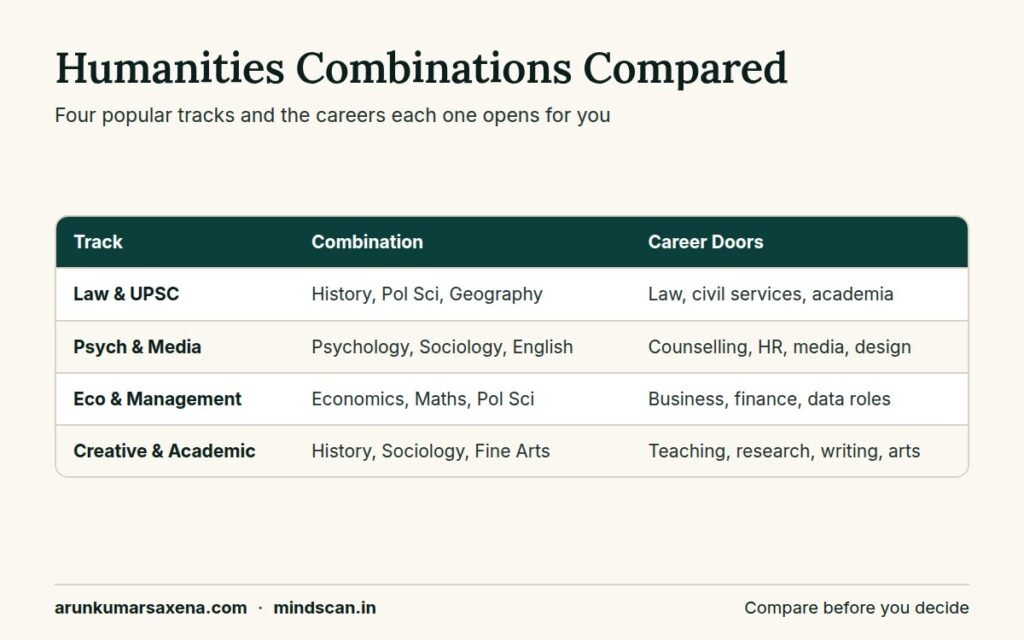
The best combination depends on your target career. Political Science and Economics suit law and civil services. Psychology and Sociology suit counselling, media and design. History and Geography suit academia and UPSC. Verify your aptitude first instead of following friends. For the full subject-wise breakdown, see the detailed guide to 11th class humanities subjects.
The table below compares four popular tracks. Competitive exams like CUET reward specific class 11 humanities subject pairings, and a psychometric assessment removes the guesswork. School availability constrains the ideal combination, so check the actual list before deciding.
| Option | Typical Combination | Suits You If… | Career Doors |
|---|---|---|---|
| Law and UPSC Track | History, Political Science, Geography, Legal Studies | You enjoy reading, writing and current affairs | Law, civil services, academia |
| Psychology and Media Track | Psychology, Sociology, English, Fine Arts | You like understanding people and behaviour | Counselling, HR, media, design |
| Economics and Management Track | Economics, Mathematics, Political Science, Psychology | You are comfortable with numbers and logic | Economics, business, data roles |
| Creative and Academics Track | History, Geography, Sociology, Philosophy | You love ideas, culture and expression | Teaching, research, writing, arts |
Remember, a combination that worked for a school topper may fail for you if your aptitude profile is different. Picture a student who thrived in the Psychology and Media track while another, who copied it because her friend chose it, struggled with the research-methods vocabulary and switched streams after a wasted year. Let your own verified strengths, not someone else’s result, decide your class 11 humanities subject set.
Quick combination-matching checklist
Tick every statement that is true for you. Four or more ticks in one track means that combination deserves a closer look with your school list in hand.
Law and UPSC track
- I enjoy long reading and structured writing
- I follow current affairs and political news regularly
- My target is CLAT, CUET law programmes or UPSC
Psychology and media track
- I am curious about why people behave the way they do
- I prefer discussion and observation over numerical work
- My target is psychology, counselling, HR, media or design
Economics and management track
- I handled Class 10 Mathematics comfortably
- I like data, logic and business problems
- My target is economics honours, BBA or data-related fields
Every school’s actual class 11 humanities subjects list differs. Confirm availability before locking any combination.
Is class 11 humanities easy or tough? The honest answer.
Humanities is not easy, it is different. Success depends on consistent reading, structured writing and conceptual depth, not rote learning. Students who assume it needs no effort often struggle, especially in Economics and Psychology.
Economics, with its statistics component, is the most technically demanding class 11 humanities subject. Psychology and Sociology introduce entirely new vocabulary and demand analytical writing that Class 10 does not prepare you for. Answer-writing practice matters far more in board exams than in Class 10. YouTube debates on ‘tough or easy’ miss the point entirely: difficulty is personal. The hardest class 11 humanities subject for you is the one that mismatches your natural aptitude, no matter what a popular video says.
| Humanities feels easy when… | Humanities feels tough when… |
|---|---|
| You enjoy long-form reading and can summarise an argument in your own words. | You rely on rote memorisation and struggle with open-ended questions. |
| Your chosen subjects match your RIASEC personality type and verified aptitude. | You picked a combination because a friend or relative recommended it. |
| You write one structured answer daily and revise weekly, not monthly. | You treat Humanities as a light stream and study only before exams. |
Is class 11 easy or tough overall?
Class 11 is a jump in every stream. The syllabus depth, the shift to analytical writing and the independence demanded of you make it tougher than Class 10. A class 11 humanities subject feels manageable when your reading and writing habits are already in place. It feels overwhelming when you are building those habits from scratch while keeping up with the syllabus.
Which is the toughest subject in class 11 CBSE?
Across streams, Physics and Accountancy are often named, but in Humanities, Economics is the most common answer because it combines theory with numerical application. Psychology runs close behind for its new terminology and research-methods component. The toughest class 11 humanities subject for you is the one farthest from your natural aptitude, a fact a psychometric assessment can verify.
What most guides miss: the fit-decides-difficulty rule
Most stream-selection guides list subjects and career options but skip the one truth I see in counselling sessions year after year. Difficulty is not inside the syllabus, it is in the gap between the syllabus and the student’s verified strengths. A student with high verbal aptitude and average numerical ability will find History absorbing and Economics draining. Another with strong logical reasoning will sail through Economics and feel lost in the open-ended essays of Sociology.
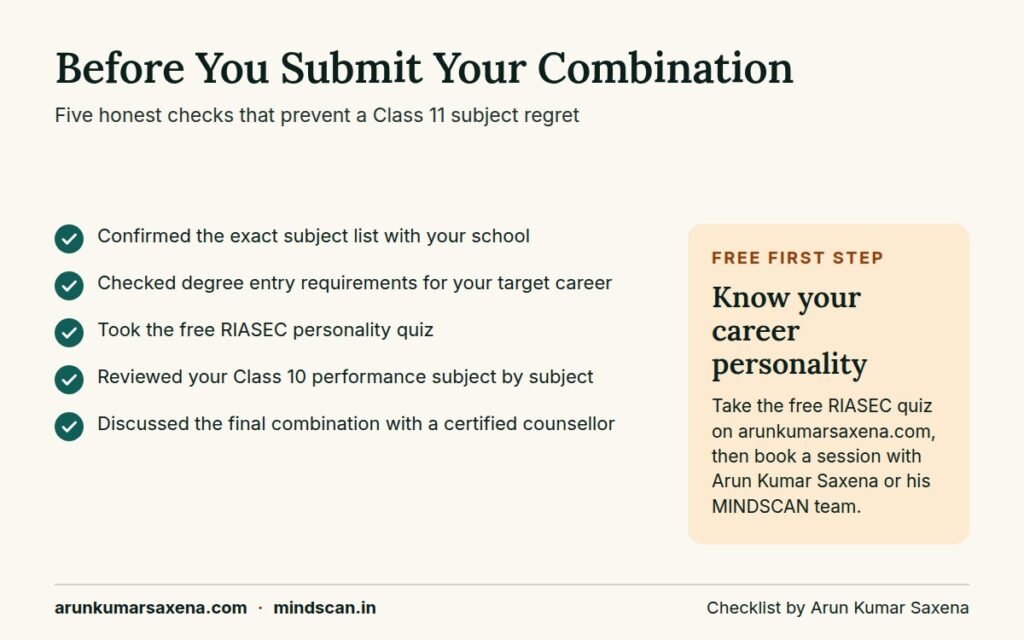
Before you label any class 11 humanities subject as tough or easy, check where you actually stand. Take the free RIASEC career personality quiz. It gives you an instant first filter on whether the Humanities stream fits your personality at all. My book ‘3 Steps to Knowing Yourself’ puts self-knowledge before any subject choice, the reverse of how most students decide. A scientific assessment like the MINDSCAN AI Career Clarity Report takes this further, mapping your aptitude to 20 plus career groups.
When you know your aptitude profile first, the question ‘is humanities tough?’ changes into ‘which class 11 humanities subject combination is tough for me, and which one fits?’ That is a question you can answer and act on.
How do you choose between humanities, commerce and science after 10th?
Match the stream to your verified strengths and career goals, not to marks alone. Humanities leads to law, civil services, psychology, media, design and academics. Commerce leads to finance and business, and if you want the exact commerce subject list, this guide explains which subjects come in commerce after Class 10. Science leads to engineering and medicine.
| Factor | Humanities | Commerce | Science |
|---|---|---|---|
| Core subjects | History, Political Science, Geography, Psychology, Sociology | Accountancy, Business Studies, Economics | Physics, Chemistry, Maths/Biology |
| Suits you if… | You enjoy reading, writing and analysing people and society | You like numbers, business logic and structured problems | You enjoy experiments, formulas and technical problem-solving |
| Top career doors | Law, civil services, psychology, media, design, academics | Finance, chartered accountancy, business, management | Engineering, medicine, research, technology |
| Key entrance exams | CLAT, CUET, UPSC later | CUET, CA Foundation, IPMAT | JEE, NEET, CUET |
| Main workload | Reading, structured writing, concepts | Practice problems, accounts formats | Daily numerical problem-solving |
A career personality test plus an honest aptitude review settles this in days, not months. Marks in Class 10 subjects hint at aptitude but do not confirm it. A student who scored 90 in Social Science may still lack the analytical writing stamina that a class 11 humanities subject like History demands.
Class 8 onwards is the right age to start structured career counselling, so the Class 11 decision becomes a confirmation, not a gamble made in a week of admission pressure. Compare the full list of subjects for the science stream and the complete 10th class all subjects list before deciding. Here is the step-by-step process I recommend.
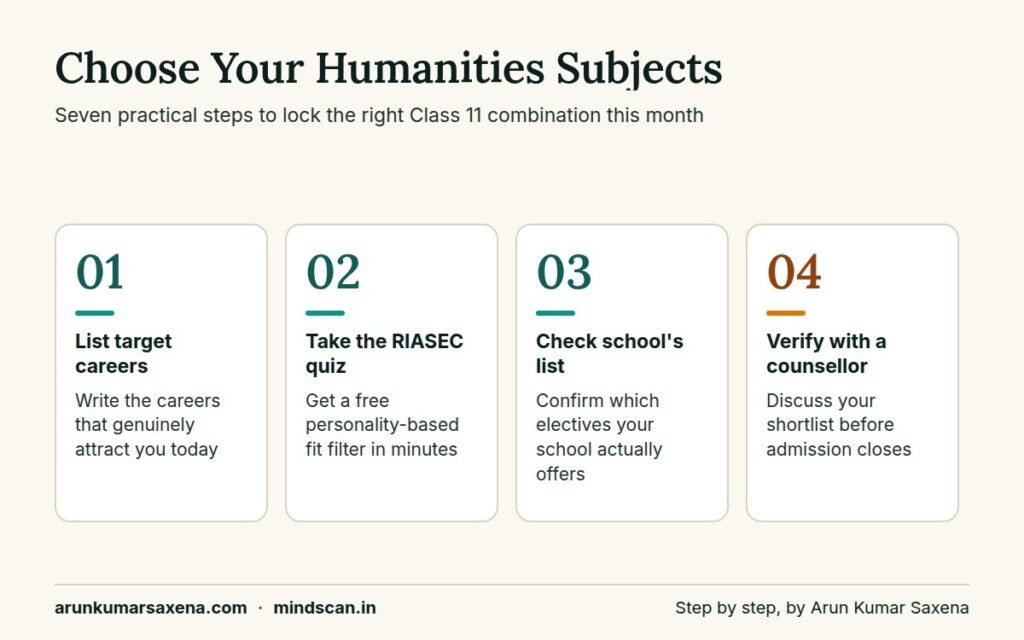
- Write down the careers that genuinely attract you: law, psychology, media, civil services or anything else. Be honest. Do not write what your parents or relatives want.
- Take the free RIASEC career personality quiz to see which career groups match your personality. This is a reliable first filter.
- Compare your Class 10 performance subject by subject to spot real strengths and weak spots. A high mark in a memorised subject is not the same as a genuine aptitude for it.
- Get your school’s exact class 11 humanities subject list. Availability varies by school, and an ideal combination on paper is useless if your school does not offer it.
- Shortlist two combinations and check the entry requirements of the degrees they lead to. Some BA Economics programmes demand Mathematics. Some psychology degrees expect Psychology as a class 11 humanities subject.
- Discuss the shortlist with a certified career counsellor before admission season closes. A single session can catch a mismatch that costs two years.
- Lock the combination, buy the NCERT books early and start light reading over the break. Familiarity reduces the Class 11 shock.
Which humanities subjects are best for a psychology career?
Psychology in Class 11 is the strongest base. Pair it with Sociology to understand group behaviour and English for communication-heavy fields like counselling, media and HR. Some university psychology programmes also expect Mathematics or Economics, so check target prerequisites early. Before locking any combination, verify your aptitude with a psychometric assessment, it shows whether the fit is real, not just interesting.
Which careers open up after class 11 humanities subjects?
Humanities opens doors to law through CLAT, civil services through UPSC, psychology and counselling, journalism and mass communication, design, hotel management, teaching, social work and management. CUET now makes specific Class 12 subject choices matter for top university programmes.
Plan the combination with the end career in mind. Law aspirants should prioritise Political Science and Legal Studies as a class 11 humanities subject. Psychology in Class 11 is a strong base for a psychology degree. Check university prerequisites early. Some programmes demand Mathematics or Economics, and skipping them in Class 11 closes that door. See the complete career options after 12th in Arts guide for a detailed roadmap. You can also explore career pathways on the National Career Service portal.
What is the hardest subject in class 11 humanities?
Ask ten students and most will name Economics, because it combines microeconomics theory with statistics and numerical work. Psychology is next for its research methods, and History for sheer volume. ‘Hardest’ is personal: the hardest class 11 humanities subject for you is the one that mismatches your aptitude.
Economics without Mathematics is a lighter option in some schools. History rewards structured notes and timeline charts. Difficulty often drops sharply when interest is genuine. Consistent weekly revision beats last-month cramming in every class 11 humanities subject. If a subject feels disproportionately hard even after honest effort, treat that as data. It may signal a stream mismatch worth checking with a counsellor.
Should you take Maths with humanities in class 11?
Take Mathematics if you are targeting economics honours, management, data-related fields or certain CUET programmes. Skip it if it pulls down your overall percentage and your career path does not need it. Check the entry requirements of your target degrees before deciding.
BA Economics and BBA programmes at top universities often expect Mathematics as a class 11 humanities subject. Applied or Basic Mathematics may not satisfy all university requirements, so verify with the specific institution. Ask yourself honestly: did you cope with Class 10 Mathematics comfortably, or was it a struggle that consumed all your study time? There is no shame in skipping Mathematics if your strengths lie elsewhere. A clean, high percentage in a Mathematics-free combination opens more doors than a mediocre score dragged down by a mismatched class 11 humanities subject.
“Don’t pressurise your child either to appear for NEET or to drop after the first setback. Analyse your child’s aptitude scientifically and check the scores critically before taking any decision.” (Arun Kumar Saxena)
That same principle applies here. Whether the pressure is to take Science, to avoid Mathematics or to pick the combination a cousin picked, stop and check the data first. The error students make when picking Humanities as an escape route is the same error, and the fix is the same: assessment-based choice beats peer pressure every time.
Frequently asked questions about class 11 humanities subject
Can I take humanities without Economics in class 11?
Yes, in most schools Economics is an elective, not a compulsory class 11 humanities subject. You can build a combination around History, Political Science, Psychology, Sociology or Geography instead. Confirm your school’s allowed combinations, because not every school offers every alternative. A Humanities combination without Economics is perfectly valid for law, media, design and many CUET programmes. Before you finalise your stream, it helps to understand how your class x subject combination shapes your Class 11 choices.
What is humanities in class 12 and does it differ from class 11?
The subjects you choose in Class 11 continue into Class 12 with deeper syllabi. Political Science moves to Indian governance and global politics. History moves to modern themes. You generally cannot change subjects between Class 11 and 12 in CBSE, so choose each class 11 humanities subject carefully the first time. The foundation built in Class 11 determines your Class 12 board performance and your CUET domain options.
Do class 11 humanities subjects matter for CUET?
Yes, heavily. CUET admission to top universities depends on your Class 12 subjects and the domain tests you pick. Choices made in Class 11, like whether you took Mathematics or Economics as a class 11 humanities subject, directly shape which CUET programmes you can apply for two years later. Check the CUET domain-to-programme mapping before locking your combination. See the subjects for the science stream page to compare how stream choices affect CUET options.
Is humanities good for UPSC preparation?
Humanities builds a strong base for UPSC because History, Political Science, Geography and Economics overlap significantly with the General Studies syllabus. But UPSC success depends on graduation-level depth and consistent preparation over years. A class 11 humanities subject set aligned to the GS papers is an advantage, not a guarantee. The reading and writing habits it builds do help.
Which board is better for humanities, CBSE, ICSE or state board?
CBSE aligns best with national competitive exams like CUET, CLAT and UPSC because of its syllabus overlap. ICSE offers strong English and project work. State boards vary widely in syllabus depth and evaluation standards. Check how your target university and exam treat each board before switching boards after Class 10. The board matters less than the specific class 11 humanities subject combination you pick within it.
When should we start career counselling for stream selection?
The ideal time is Class 8 onwards, well before the Class 10 stream decision. Early counselling builds a verified picture of aptitude and interests so the stream choice in Class 11 is a confirmation, not a gamble made in a week of admission pressure. Book online career counselling in India with Arun Kumar Saxena early. A single session at the right time saves years of mismatch.
What is the minimum number of subjects required in CBSE humanities?
CBSE requires a minimum of five subjects in Class 11 Humanities. One must be a language, and the rest are electives. Many students opt for a sixth class 11 humanities subject as an additional elective or a vocational subject. The same set of subjects continues into Class 12. You can also explore career pathways on the National Career Service portal by the Government of India.
हिंदी में जवाब: कक्षा 11 मानविकी (ह्यूमैनिटीज़) के विषय: सूची, संयोजन और करियर
10वीं के बाद 11वीं में कौन-कौन से सब्जेक्ट होते हैं?
10वीं के बाद 11वीं में आप तीन मुख्य स्ट्रीम में से एक चुनते हैं: विज्ञान, वाणिज्य या मानविकी। मानविकी में एक अनिवार्य भाषा होती है, आमतौर पर अंग्रेजी, और वैकल्पिक विषयों में इतिहास, राजनीति विज्ञान, भूगोल, अर्थशास्त्र, मनोविज्ञान, समाजशास्त्र, कानूनी अध्ययन, ललित कला और गणित शामिल हैं। अरुण कुमार सक्सेना सलाह देते हैं कि दोस्तों की नकल करने के बजाय अपनी सत्यापित योग्यता के अनुसार विषय चुनें।
A class 11 humanities subject combination is a two-year commitment that shapes your degree options, your CUET domain tests and your early career path. Do not leave it to a hurried conversation in the admission queue. Book a session of online career counselling in India with Arun Kumar Saxena at MINDSCAN Career Guidance. You will get a data-verified picture of your aptitude and a clear recommendation on the exact combination that fits you.
If you want the clarity of a scientific assessment first, start with the MINDSCAN AI Career Clarity Report at ₹1,499 or add a counselling session for ₹2,999. The report maps you to 20 plus career groups and removes the guesswork from the biggest academic decision you have made so far. Your stream is a launchpad. Make sure it is pointed in the right direction.
Who wrote this guide?
This guide was written by Arun Kumar Saxena, a Certified Advanced Career Coach and the founder of MINDSCAN Career Guidance. He has 22 years of experience and 20,000+ students and professionals guided, and is the author of 3 Steps to Knowing Yourself. I review every MINDSCAN report and work with my team to offer online career counselling across India, replacing peer pressure with data-verified, assessment-first guidance.