
LLB After BA: Eligibility, Exams and Career Guide
By Arun Kumar Saxena, Certified Advanced Career Coach · Updated November 2026
Quick answer: Yes, LLB after BA is a fully valid path. After any bachelor’s degree from a recognised university, you can enrol in a 3-year LLB programme, as per Bar Council of India rules. Admissions are based on university-level entrance tests or merit, and you must clear the AIBE after graduation to practise.
LLB after BA is a three-year graduate-entry law degree open to any bachelor’s degree holder under Bar Council of India rules. This page is for BA graduates, career changers, and parents who want a clear, honest guide to eligibility, entrance exams, and the real career prospects of a 3-year law degree. It cuts through the marketing noise to help you decide if this three-year commitment is the right move for you.
With 22 years of experience and 20,000+ students and professionals guided, I have seen many BA graduates thrive in law, and many others realise too late that it was not their true fit. The difference almost always comes down to self-knowledge. At MINDSCAN Career Guidance by Arun Kumar Saxena, this guide will give you the facts, the honest comparison, and a practical planning framework so you can make a decision without regret.
Table of Contents
Can I do LLB after BA?
Yes, any BA graduate from a recognised university is eligible to pursue a 3-year LLB after BA, regardless of the subjects you chose in your bachelor’s degree. The Bar Council of India does not restrict entry based on whether you studied English, History, Political Science, or Economics.
The BCI mandates a minimum marks rule for eligibility. General category students need approximately 45% in their bachelor’s degree. There are relaxations for OBC, SC, and ST categories as per the norms in force. However, remember that individual universities often set higher cutoffs or require you to clear their own entrance tests. Always check the current year’s prospectus of the specific university you are targeting and verify the latest Bar Council of India educational criteria.
There is no age bar for the 3-year LLB as per current norms. This makes it a viable option for mature graduates and those considering a career shift. The key is not just your marks but whether the daily work of a legal professional suits your natural strengths. A common mistake I observe is graduates enrolling in an LLB after BA only because a parent or relative suggested it, without ever checking if they enjoy the kind of dense reading and analytical writing that law demands every single day.
Picture a History graduate who loved storytelling and broad narratives suddenly facing hundreds of pages of bare acts and case law every week. That shift is real, and it is the reason some struggle in the first semester.
LLB after BA: how many years does it take?
An LLB after BA takes three academic years to complete, making the total journey after Class 12 approximately six years: three years for your BA and three years for the LLB programme.
This is often compared with the 5-year integrated BA LLB course that students take directly after Class 12. The integrated route takes about five years after school, while BA plus a 3-year LLB takes about six. The 3-year route gives you an extra year to complete a broader first degree and the chance to decide on a law career with greater maturity at around 21 or older.
The extra time is not a delay; it is a period of intellectual and personal growth that often produces a more focused law student. Many legal professionals who took the graduate-entry route brought a richer perspective to their legal studies. A student who spent three years studying Political Science and Sociology, for instance, often grasps constitutional law and jurisprudence with a depth that a younger student may take longer to develop.
Is a 3-year LLB better than a 5-year BA LLB?
Neither option is universally better. The right choice depends entirely on your stage of life and your certainty about a legal career.
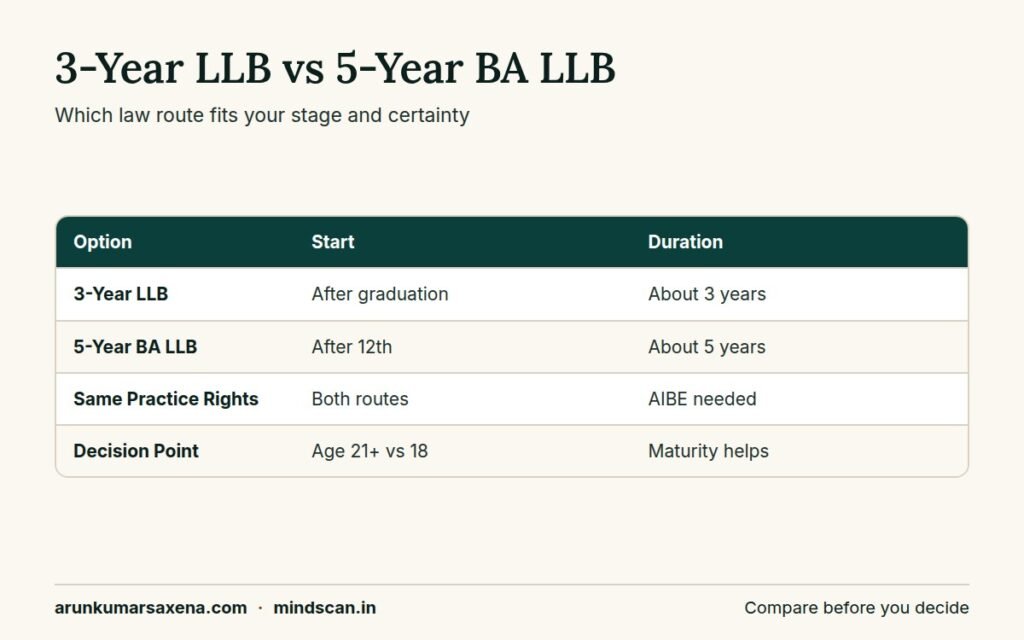
The 5-year integrated BA LLB is designed for students fresh out of Class 12 who are absolutely sure they want to be lawyers. It offers early immersion in legal studies and awards two degrees. The 3-year LLB after BA is the graduate-entry route. It fits those who discovered their interest in law during their bachelor’s, working professionals wanting a career change, or anyone who needed more time to decide. Both paths lead to the same All India Bar Examination and grant identical rights to practise law in India.
| Option | When You Start | Duration | Best For |
|---|---|---|---|
| 3-Year LLB | After any graduation | Approximately 3 years | Graduates and career changers |
| 5-Year BA LLB | After 12th | Approximately 5 years | Students sure about law early |
My view is simple: the right choice depends on self-knowledge, not on college marketing. A student who rushes into a 5-year programme because of parental pressure often struggles as much as a graduate who picks the 3-year LLB without checking their aptitude first. The real question is not which degree is better, but which one matches where you stand right now.
What entrance exams are needed for LLB after BA?
Admission to a 3-year LLB after BA does not go through CLAT. CLAT is primarily for 5-year integrated courses and NLU postgraduate programmes. For the 3-year LLB, you will face university-level and state-level entrance tests.
Common entry routes include:
- University-Specific Entrance Exams: Tests like the DU LLB entrance exam and the BHU LLB exam are conducted by individual central and state universities for their own law faculties.
- State-Level Law Entrance Exams: Many states hold a common law entrance test for 3-year LLB admissions across multiple government and private colleges within the state.
- Private University Admissions: Several private universities admit students based on merit in the qualifying degree or through an internal interview process, often without a written test.
Because patterns change yearly, you must visit each university’s official website and download the current admission notification. Do not rely on last year’s dates or second-hand information from social media. A practical step is to create a simple spreadsheet with four columns: university name, exam date, application deadline, and eligibility criteria. Update it every week during admission season so you never miss a deadline. One mistake I see often is a graduate preparing for an exam that has already been replaced by a new pattern. A weekly check of the official site prevents that.
What are the career options after BA LLB or 3-year LLB?
A law degree opens multiple structured career paths. The most common are litigation, judicial services, corporate legal roles, and public sector appointments.
Your path after the degree can branch into several distinct directions:
- Litigation: Practise as an advocate under a senior lawyer after clearing the AIBE. This path demands patience and networking, with a slow but steadily building income.
- Judicial Services: Clear the state-level PCS-J or higher judiciary exams to become a civil judge or magistrate. This is a highly competitive and respected government career.
- Corporate Counsel: Work as an in-house legal advisor, compliance officer, or law firm associate for companies. This path values strong academic records and multiple competitive internships.
- Public Sector and Academia: Pursue roles as a public prosecutor, a bank law officer, or an LL.M. for academic specialisation and teaching.
The degree alone is a foundation; your career is built on the specialisation and skills you layer on top of it. For a broader view of where your BA can take you, read about career options after BA before you commit to law.
What most guides miss: the personality check before the degree
Most career guides list jobs and stop there. In my sessions, I have observed that the graduates who succeed in law are not always the ones with the highest marks. They are the ones whose natural working style matches the demands of a legal career: comfort with dense reading, patience for delayed rewards, and a genuine interest in argument and analysis.
Before you commit three years to an LLB after BA, verify whether law fits your personality. Use a scientific career assessment. As I often tell parents,
“Analyse your child’s aptitude scientifically and check the scores critically before taking any decision” (Arun Kumar Saxena)
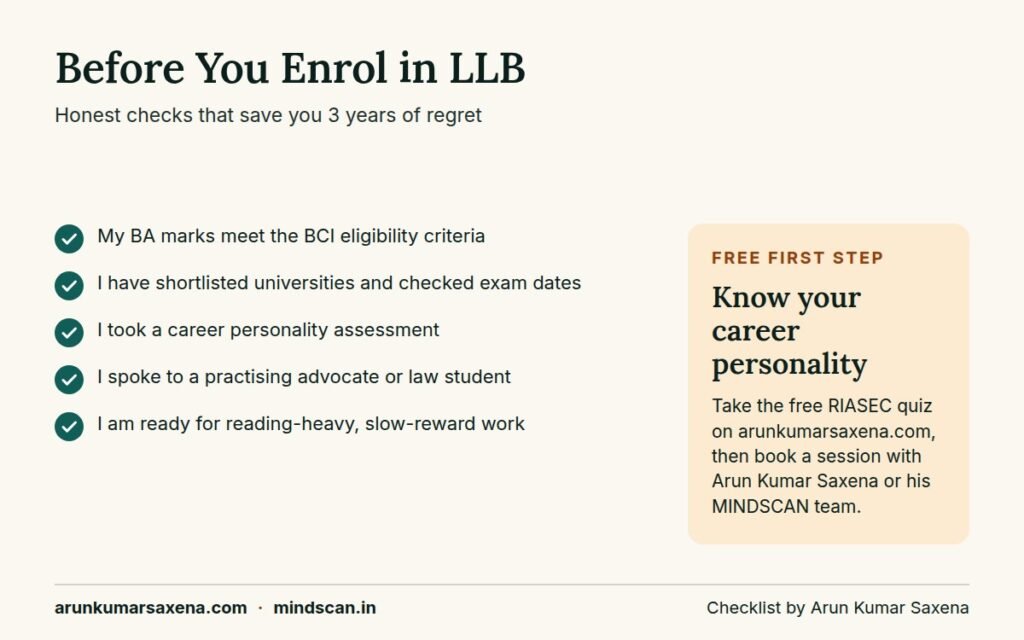
A free RIASEC career personality quiz can give you a first signal. The MINDSCAN AI Career Clarity Report goes deeper and maps you to over 20 career groups, helping you see whether law is truly the right group before you enrol.
Which government jobs can I get after BA LLB?
A 3-year LLB degree qualifies you for several prestigious government positions. The most sought-after is the judicial services exam, specifically the State PCS-J for civil judge posts.
Other options include public prosecutor and law officer exams conducted by state public service commissions, legal advisor roles in public sector undertakings (PSUs), bank law officer posts recruited through IBPS or SBI exams, and legal positions in the armed forces. These all demand separate competitive exams. The LLB degree makes you eligible to apply, but it does not guarantee a government job.
Preparation for these exams is a dedicated effort that often requires years of focused study alongside or after your degree. You can explore more on the National Career Service portal. If you are unsure about your direction, a career counselling session can help you map your LLB to a specific government service target before you start preparing.
Is LLB after BA worth it, honestly?
An LLB after BA is worth it only if law matches your genuine interests and working style, and you are prepared for the slow financial start that litigation demands. If you do not enjoy heavy reading, constructing arguments, and dealing with delayed financial rewards, the three years can feel like a burden and the degree may not pay back what you invest.
Litigation income starts low and grows slowly. It takes years of dedicated work under a senior before you build your own practice and a stable income. Corporate law demands strong academic performance and multiple competitive internships. A self-assessment before you commit is not a delay; it is a safeguard. Spending a small amount of time and money now on a data-verified career assessment can save you three years of expensive education and a career you resent.
My book, “3 Steps to Knowing Yourself”, is built on this very principle: self-knowledge must come before any career choice. If you are still in school and exploring law, read about which stream is best for law after 10th to build the right foundation early.
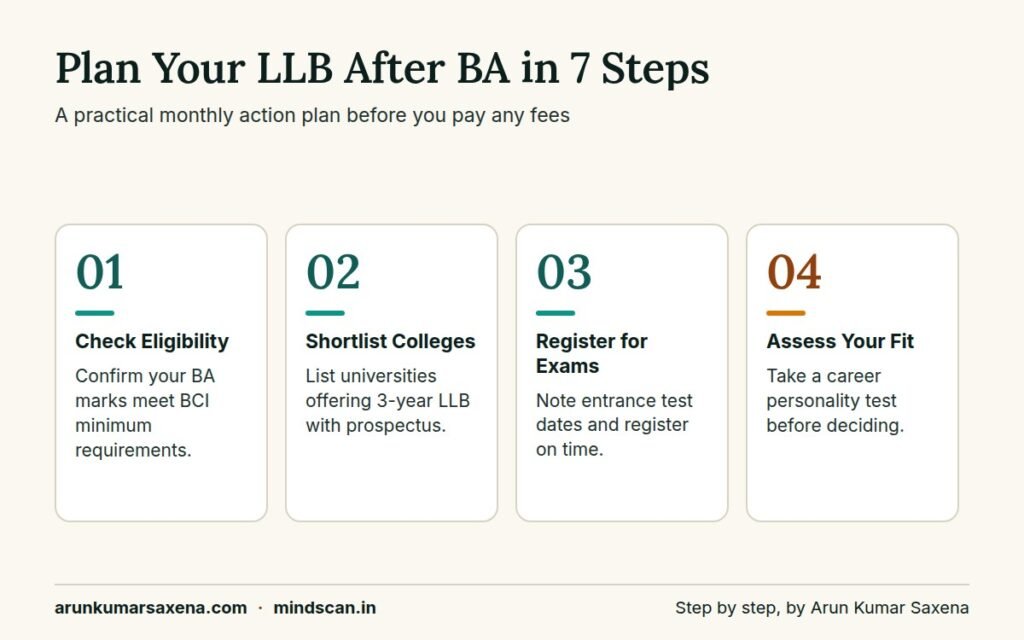
How should I plan my LLB after BA this month?
Start with official verification, not social media opinion. Your first task is to confirm your eligibility and shortlist universities, then move to preparation and self-assessment.
- Confirm you meet BCI eligibility: a recognised bachelor’s degree with the required minimum marks.
- Shortlist 4-5 universities offering the 3-year LLB and download their current prospectus.
- Note each university’s entrance exam dates and register before the deadlines.
- Start legal aptitude, reasoning and current-affairs preparation 1-2 hours daily.
- Take the free RIASEC career personality quiz to check whether law fits your profile.
- Talk to one practising advocate or law student before paying any fees.
- If unsure, book a data-verified career counselling session before locking your decision.
Frequently asked questions about llb after ba
What percentage is required for LLB after BA?
The Bar Council of India sets a minimum of approximately 45% marks in your bachelor’s degree for the general category, with relaxations for OBC and SC/ST categories. This is the baseline. Many universities and state-level entrance exams set higher cutoffs, so you must check the specific admission notification of the college you are applying to.
Is LLB difficult or easy?
LLB is reading-heavy and analysis-intensive but manageable with consistent effort. The real challenge is not just passing the exams but building a career afterwards through internships, networking, and clearing the AIBE. Difficulty depends far more on your genuine interest in law than on your raw intelligence.
Do I need to write CLAT for LLB after BA?
No, CLAT is mainly for admission to 5-year integrated BA LLB courses and LL.M. programmes at National Law Universities. For a 3-year LLB after BA, you typically need to appear for university-specific entrance tests like the DU LLB exam, state-level law entrance exams, or apply through merit-based private admissions.
Is LLB after BA a good option for a career change at 30?
Yes, there is no age bar for the 3-year LLB. Mature graduates often bring strong analytical skills and life experience that help them excel in corporate law, compliance, and advisory roles. Be realistic about the slow early income in litigation and plan your finances to cover the study period and initial practice years.
Can I do LLB after BA in English?
Yes, a BA in English is an excellent and common foundation for law. The reading, writing, and critical analysis skills you develop in an English degree directly support legal drafting, case law research, and courtroom argument. It is a strong background for litigation, judiciary, and corporate legal work.
Is B.Ed. or LLB better after BA?
B.Ed. leads to a career in teaching, while LLB leads to legal practice. Neither is objectively better. The answer depends on whether you enjoy teaching and mentoring, or argument, analysis, and dense reading. Use a personality assessment to match your natural interests to the right career, rather than following a trend.
Do I need the AIBE after LLB to practise?
Yes, after completing your LLB degree, you must pass the All India Bar Examination conducted by the Bar Council of India. Clearing the AIBE is mandatory to enrol as an advocate and practise law in any Indian court. Without it, your law degree does not grant you the right to appear before a court.
Choosing an LLB after BA is a decision that deserves more than a quick online search. It demands an honest look at your strengths, your interests, and the real demands of a legal career. I invite you to book a session of online career counselling in India with me or my MINDSCAN team. We will help you move beyond guesswork and make a decision based on data and self-knowledge.
If you want a first clear signal, start with the MINDSCAN AI Career Clarity Report priced at ₹1,499. It maps your profile to over 20 career groups. For a complete decision, the report with a counselling session is available at ₹2,999. Your three years of law study are too valuable to begin with a guess. Let’s find your clarity first.