Career Options After 12th Science PCB (2026 Guide)
By Arun Kumar Saxena, Certified Advanced Career Coach · Updated October 2026
Quick answer: Career options after 12th science PCB fall into four groups: NEET-gated medical degrees, allied health courses, life science and research paths, and open careers like management or law. According to career coach Arun Kumar Saxena, founder of MINDSCAN Career Guidance, with 22 years of experience, the right choice depends on verified aptitude and interests, not on social pressure or coaching-centre hype.
Choosing career options after 12th science PCB can feel like standing at a crossroads with a hundred signboards, each pointing in a different direction. This page is for the PCB student who has just finished board exams and the parent who lies awake wondering if not choosing medicine will close every door. It cuts through the noise of endless course lists and coaching-centre pressure to give you a clear, honest decision framework.
With 22 years of experience and 20,000+ students and professionals guided, I have seen the same confusion play out in thousands of homes. A student picks a degree because a cousin did it, or a parent pushes a career because of social prestige. This guide replaces that guesswork with a step-by-step way to match your own strengths to the career options after 12th science PCB that will actually work for you.
Table of Contents
What are the main career options after 12th science PCB?
The main career options after 12th science PCB fall into four practical buckets: NEET-gated medical degrees, allied health degrees that do not need NEET, life science and research degrees, and open career paths that accept students from any stream.
- NEET-gated medical degrees: MBBS, BDS, BAMS, BHMS and BUMS. These require clearing the National Eligibility cum Entrance Test (NEET) conducted by NTA.
- Allied health degrees (no NEET): B.Sc Nursing, B.Pharm, BPT, MLT, Radiology and OT Technology. Admission is usually through university merit lists or their own entrance tests, and in most states, check each college for specific requirements.
- Life science and research degrees: Biotechnology, Microbiology, Genetics, Forensic Science, Agriculture, and Nutrition and Dietetics. These typically admit students through merit or university-level tests.
- Open paths (any stream): Management, law, design and civil services. These accept PCB students and do not require a science-specific entrance exam.
As per online sources, MBBS takes around 5.5 years to complete, most B.Sc degrees take approximately 3 years, B.Pharm and Nursing take approximately 4 years, and BPT takes approximately 4.5 years. A fact many students overlook is that PCB students can also sit for government job exams after Class 12 as a parallel safety net, keeping a stable option open while they explore higher education. The National Career Service portal (Ministry of Labour and Employment, Government of India) lists such opportunities and is a useful reference.
Too many students believe that if they do not wear a white coat and a stethoscope, they have failed. That belief is simply wrong. The allied health and life science sectors in India are expanding fast, and they need skilled graduates who understand biology deeply. Your PCB background is a strong foundation, not a limitation, and the full range of career options after 12th science PCB is far wider than most coaching institutes will ever admit.
Which career options after 12th science PCB do not need NEET?
The career options after 12th science PCB that do not need NEET include B.Pharm, B.Sc Nursing, BPT, Biotechnology, Microbiology, Genetics, Forensic Science, MLT, Radiology, Agriculture, Food Technology, Nutrition and Dietetics, plus non-science options like BBA, law and design.
Choosing a path without NEET does not mean choosing a second-class career. Many of these roles are in acute shortage across India, which means strong demand and real job security for graduates who are skilled and serious. Some private universities hold their own entrance tests for these courses, so students must verify each institution’s admission process on its official website. A common worry I hear is that PCB without mathematics will block these degrees.
That is not true. Every option listed above is open to a pure PCB student. Mathematics is not a barrier for any of these allied health or life science degrees, and you do not need to have taken it in Class 12 to apply or to succeed.
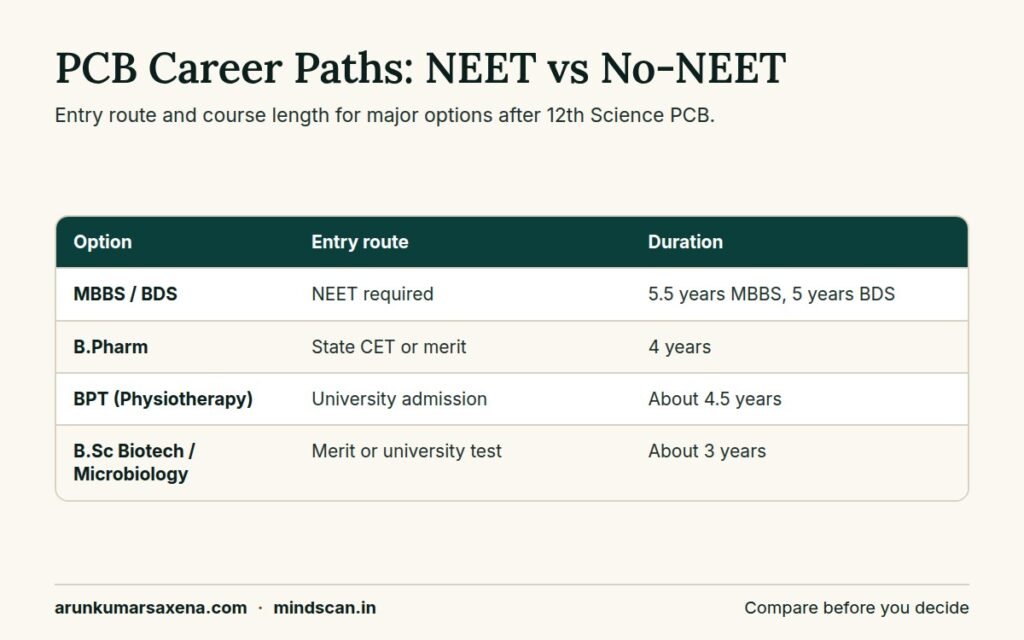
The table below compares the major PCB career paths side by side, so you can see at a glance how the entry route, duration and work style differ across the options that do and do not require NEET.
PCB career paths: NEET vs no-NEET at a glance
| Option | Entry Route | Typical Duration | Work Style |
|---|---|---|---|
| MBBS / BDS | NEET required | Around 5.5 years for MBBS and 5 years for BDS as per online sources | Hospital-based, high-stakes patient care |
| BAMS / BHMS (AYUSH) | NEET required | Around 5 to 5.5 years as per online sources | Clinical practice in alternative medicine |
| B.Sc Nursing / B.Pharm | University admission, no NEET in most cases | Approximately 4 years | Hospital, community or pharma industry roles |
| BPT (Physiotherapy) | University admission, no NEET | Approximately 4.5 years as estimated | Rehabilitation and clinic work |
| B.Sc Biotechnology / Microbiology | Merit or university test, no NEET | Approximately 3 years plus higher study for research roles | Lab and R&D work |
| Forensic Science | Merit or university test, no NEET | Approximately 3 to 4 years | Crime labs and investigation support |
| Nutrition & Dietetics | Merit or university test, no NEET | Approximately 3 years plus internship or practice | Clinics, wellness and consulting |
Is MBBS the only ‘best’ option for a PCB student?
No, MBBS is the best option only for a student whose aptitude, interest and stamina for the NEET journey are verified by data, not by hope. A student who loves biology but dreads the pressure of a hospital ward may find a far better fit in research, nutrition or forensic science.
In many Indian homes, MBBS is treated as the only respectable destination for a PCB student. Families often chase it because of social prestige, and a child who scores 90 percent in Class 12 biology is automatically labelled a future doctor. That pressure can push a student into a drop year, or two drop years, without ever checking whether the gap between their score and the cut-off is actually closing.
My advice to parents is this:
“Don’t pressurise your child either to appear for NEET or to drop after the first setback. Analyse your child’s aptitude scientifically and check the scores critically before taking any decision.” (Arun Kumar Saxena)
The drop-year decision has a simple rule. Look at the gap between the marks obtained and the marks needed to get a seat.
“Suppose a student has given two attempts, the marks have improved, and he or she is now close to that mark; then the student should go for a third attempt. If the gap is big and not narrowing, I suggest switching to other fields.” (Arun Kumar Saxena)
Never pressure a child into NEET or a drop year based on a relative’s success story. Your neighbour’s son who cracked NEET in his second attempt is not a data point that applies to your child. Every student’s aptitude profile is different, and a scientific assessment will show you whether the NEET path is a realistic goal or a costly detour.
How do I know which PCB career actually fits me?
Fit comes from self-knowledge first. You need a scientific aptitude and interest assessment, an honest look at your PCB marks versus the effort you put in, and a reality check on each career’s daily work, not just its title.
My book “3 Steps to Knowing Yourself” is built on the principle that self-knowledge must precede any career choice. Without it, you are simply guessing with your future, and a guess that costs four or five years of your life is too expensive to make. You can learn more about my approach and experience on my profile page. A psychometric assessment measures three things in plain language: your natural aptitude for different kinds of thinking, your genuine interests, and how your personality fits with various work environments.
It does not label you or put you in a box. It gives you a verified map of your strengths, and that map shows you which career options after 12th science PCB align with who you actually are. You can take a first step right now with our free RIASEC career personality quiz, which gives you a quick snapshot of your interest profile.
One of the most common mistakes I see is a student choosing a career from a salary list alone. A high-paying job that makes you miserable every morning is a trap, not a goal. The daily texture of the work matters more than the salary figure on a website. A physiotherapist spends hours on their feet, working one-on-one with patients.
A biotechnologist spends long stretches in a lab, running protocols and analysing data. A dietitian builds trust with clients over months. Which of those rhythms actually suits you? Self-knowledge answers that question, and you can get that clarity through structured online career counselling with Arun Kumar Saxena.
What most guides miss: the daily-work reality check
Most career guides stop at the course name and the salary range. In my sessions, I have observed that students who make lasting, satisfied career choices do one thing that others skip: they investigate the texture of a typical Tuesday. They find out what a professional in that field actually does between 10 a.m. and 6 p.m. A Forensic Science student who loves the idea of solving crimes may not love the reality of spending hours documenting evidence in a lab with no human interaction.
A Nutrition and Dietetics aspirant who pictures a glamorous clinic may not realise that the first two years involve building a client base one referral at a time. Before you lock in any of the career options after 12th science PCB, do this three-question test.
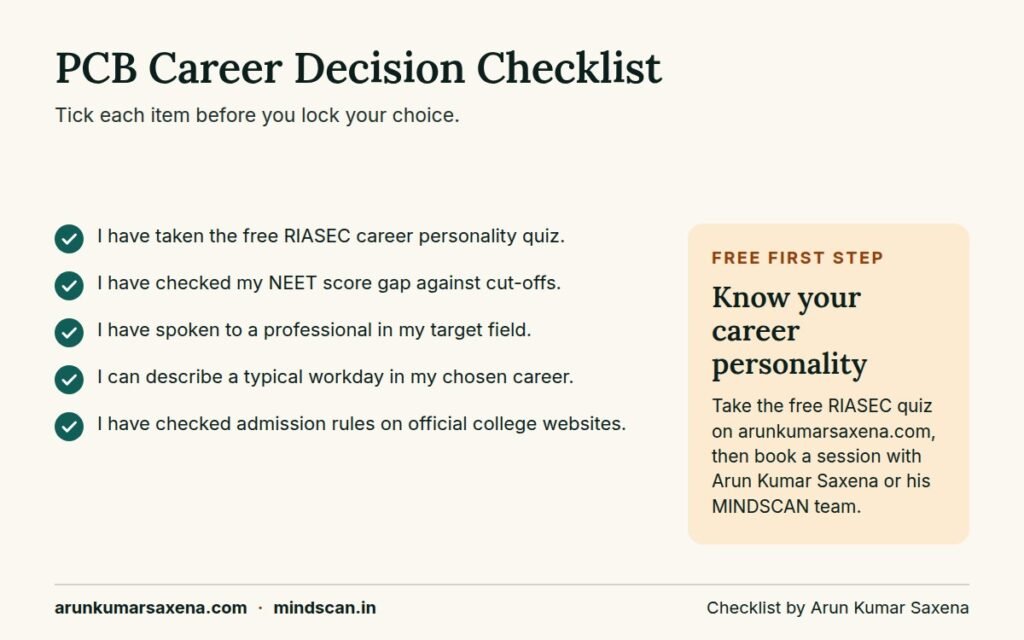
- Can I describe what this professional does in a typical workday without using the degree name? If you cannot, you do not yet know the career.
- Have I spoken to a real person doing this job, not just watched an online video about it? A ten-minute conversation with a practitioner reveals more than an hour of online research.
- Does the daily environment, quiet lab, busy hospital ward, community clinic, match the setting where I do my best work? Your environment shapes your energy and satisfaction more than the job title ever will.
Answering these three questions honestly will filter out options that look good on paper but will drain you in practice.
What are the highest paying careers for PCB students?
The highest pay usually follows scarce expertise and years of experience, not the degree name alone. A specialist doctor, a senior pharmacist in regulatory affairs, or a biotechnologist leading an R&D team can all reach high earning levels, but the path is long and demands deep skill-building.
Specialist doctors, dentists with super-specialisation, pharmacists who move into regulatory affairs or clinical research, nursing professionals who work abroad or rise into hospital administration, biotechnologists in R&D, and dietitians who build successful private practices can all earn well. But any salary figure you see online must be read with a qualifier such as “as estimated,” because pay differs hugely by city, institution and specialisation. A list quoting one fixed number for a “Biotechnologist” is misleading you.
Research careers in life sciences often pay modestly in the early years but grow significantly with a PhD, postdoctoral work and research grants. The curve is longer, but the ceiling can be high for those who persist. A practical point many students miss is that AI-resistant, hands-on healthcare roles hold long-term value. A physiotherapist, a nurse, a dentist, a dietitian who sits across from a real patient cannot be replaced by a chatbot.
That human element is a form of career security that no algorithm can erode.
Which PCB careers are best for girls and for long-term stability?
No career is “for girls.” Nursing, pharmacy, dentistry, nutrition, biotechnology, forensic science and research are all open to anyone with the aptitude and interest to pursue them. The question usually comes from a parent who is really asking about safety and long-term stability, and the answer lies in fields with steady demand and flexible work models.
Careers with stable demand, flexible work models and steady growth include allied health fields like physiotherapy and diagnostics, nutrition and dietetics, and life science research roles in government labs or universities. PCB courses without NEET are among the most searched options by girl students and parents, as per related search trends, and many of these paths offer work models that can adapt to different life stages.
Nutrition and dietetics, health writing and diagnostic lab work all offer flexible or work-from-home-adjacent roles once you build experience. Every single career option on this page is open to all genders, and the best choice is the one that matches the individual student’s verified aptitude, not a social assumption about what is suitable.
What should I do this month to finalise my PCB career path?
Within one month, you can take a free career personality quiz, list your shortlisted options, talk to two real professionals in those fields, compare entrance requirements, and, if you are still confused, book a psychometric assessment and counselling session to lock a roadmap before admission season closes.
The biggest mistake is waiting until results are out and cut-offs are announced, because that is when rushed, panicked choices happen. Act now, while you still have the headspace to think clearly. Here is a practical sequence you can follow this month.
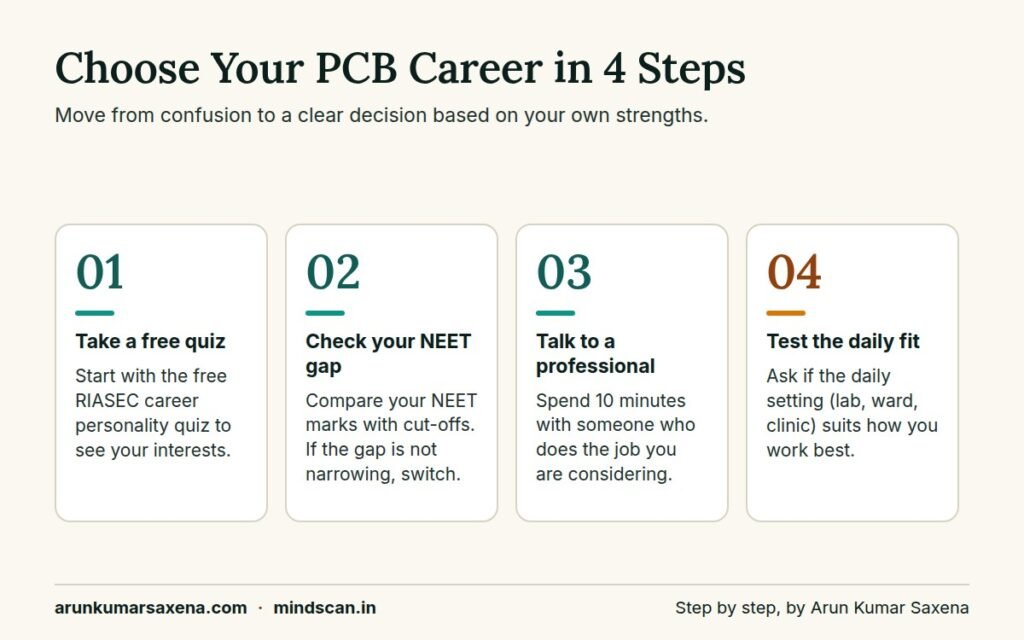
- Take the free RIASEC career personality quiz to get a first snapshot of your interest profile.
- Write down three to five career options after 12th science PCB that match your RIASEC result and feel genuinely interesting to you.
- For each option, verify the exact eligibility criteria and admission route on the official website of at least two universities or colleges.
- Find and speak to two real professionals, one early-career and one senior, working in your top two choices. Ask them what a typical workday looks like.
- Sit with your parents and share the data you have gathered, not just your hopes or their expectations. Make it a data conversation, not a pressure conversation.
- If the picture is still foggy, book a psychometric assessment and a one-on-one counselling session. The MINDSCAN AI Career Clarity Report from MINDSCAN Career Guidance maps you to 20+ career groups and gives you a verified roadmap, not a guess.
Can a PCB student switch to non-medical careers later?
Yes, a PCB background keeps doors open to management, law, civil services, design, healthcare management, medical coding and health-tech roles after graduation. Your biology foundation is an asset, not a cage.
Many students pivot at the degree or postgraduate level once their strengths and interests become clearer, and that switch is a planned step forward, not a failure or a retreat. For example, a B.Sc Biotechnology graduate can move into an MBA in healthcare management and shape hospital policy. A B.Sc graduate with strong analytical skills can train in data analysis and work in health-tech, where biology knowledge and data fluency combine into a rare and valuable skill set.
These paths are AI-proof and human-centric, built on judgment and context that machines cannot replicate. If you are a PCB student who is drawn to business, law or technology, do not let anyone tell you that your stream has locked you out. Your career options after 12th science PCB are a starting point, not a life sentence, and the best careers often grow at the intersection of two fields, not inside a single box.
Frequently asked questions about career options after 12th science pcb
Can I go to ISRO with PCB?
Yes, but the direct path is narrow. ISRO recruits scientists and technical staff mainly through its own entrance exam or GATE scores, and most technical roles ask for a background in physics, engineering or computer science. A PCB student can aim for life-science support roles in space biology or astrobiology research after a B.Sc and higher study in a relevant field. Check the latest eligibility on the official ISRO careers page, because requirements change with each recruitment cycle.
Which job is best for girls in biology?
No single job is best for girls, because the right job depends on individual aptitude and interest, not gender. That said, many female students in my sessions find strong, satisfying career options after 12th science PCB in nursing, pharmacy, physiotherapy, nutrition and dietetics, forensic science and biotechnology. These fields offer stable demand, scope for specialisation and work models that can adapt across different life stages.
What are 5 future jobs?
Five future-ready career options after 12th science PCB include genetic counsellor, health data analyst, regulatory affairs specialist in pharma, clinical research associate and telemedicine coordinator. These roles sit at the intersection of biology, technology and human judgment, which makes them harder to automate. Each requires a degree plus targeted skill-building, but the demand is growing as healthcare becomes more data-driven and personalised.
What are 20 careers in biology?
Medical: Doctor, Dentist, Ayurveda Practitioner, Homeopathy Practitioner, Nurse, Pharmacist, Physiotherapist.Allied Health: Medical Lab Technologist, Radiology Technologist, OT Technologist.Life Science: Biotechnologist, Microbiologist, Geneticist, Forensic Scientist, Agriculturist, Food Technologist, Wildlife Biologist.Open Paths: Nutritionist, Dietitian, Science Writer.Each path has a different entry route and daily work style, so shortlist based on your own aptitude, not just the title. For government roles, check the National Career Service portal and the official ISRO careers page.
What career is Gen Z most interested in?
As per online trend reports, Gen Z in India shows strong interest in careers that blend creativity, purpose and flexibility. Among PCB students, this includes nutrition and wellness coaching, health content creation, forensic psychology and environmental science. These career options after 12th science PCB appeal because they offer autonomy and visible impact, but a student should still verify whether their interest is backed by real aptitude before committing to a degree.
What is the highest paid biology job?
The highest paid biology jobs are typically those that combine deep specialisation with scarcity. A super-specialist surgeon, a dentist with a maxillofacial surgery fellowship, a pharmacologist in clinical research or a senior biotechnologist leading R&D in a top firm can all reach high earning levels. Any exact salary figure you see carries a qualifier such as "as estimated," because pay depends on city, institution, experience and individual negotiation skill far more than on the degree name alone.
What are the best career options after 12th science PCB without maths?
All allied health and life science degrees listed on this page are open to pure PCB students without mathematics. This includes B.Sc Nursing, B.Pharm, BPT, Biotechnology, Microbiology, Genetics, Forensic Science, MLT, Radiology, Agriculture, Food Technology, and Nutrition and Dietetics. Mathematics is not a barrier for any of these career options after 12th science PCB, and you do not need to have taken it in Class 12 to apply or to succeed.
Choosing among the many career options after 12th science PCB is not about finding the one perfect answer on a list. It is about finding the answer that fits your own mind, your own way of working and your own idea of a good life. That clarity does not come from a relative’s advice or a coaching institute’s brochure. It comes from verified data about your own strengths, paired with honest, experienced guidance that has no stake in pushing you toward one particular college or entrance exam.
If you are ready to stop guessing and start knowing, book a session of online career counselling with Arun Kumar Saxena. The MINDSCAN AI Career Clarity Report (₹1,499) maps you to 20+ career groups, and the report with a counselling session (₹2,999) gives you a complete, personalised roadmap. Your PCB background has opened more doors than you realise. Let us find the one with your name on it.
About the author: Arun Kumar Saxena is a Certified Advanced Career Coach and the founder of MINDSCAN Career Guidance, with 22 years of experience and 20,000+ students and professionals guided. A former corporate leader at Airtel and Reliance, a CBSE Resource Person and the author of 3 Steps to Knowing Yourself, he and his MINDSCAN team counsel students, parents and professionals online across India. Call +91-9140604743 or visit mindscan.in.