
Career Choice: How to Make the Right One With Confidence
By Arun Kumar Saxena, Certified Advanced Career Coach · Updated November 2026
Quick answer: The best career choice matches your verified strengths and interests with market reality and family constraints. Start with self-knowledge, shortlist 3-5 options, research daily realities, and test before you commit. Most wrong career choices come from copying others, not from lack of ability.
A career choice is one of the few decisions that shapes your daily life, your financial future, and your sense of purpose for decades. This page helps students (Class 9 to graduates), working professionals thinking of a switch, and parents who want to guide without controlling. It gives you a clear, step-by-step method to move from confusion to a shortlist you can trust.
With 22 years of experience and 20,000+ students and professionals guided, I have seen that most wrong turns happen not because of a lack of options, but because the decision was made on borrowed dreams. A career choice built on verified data, honest market facts, and your own tested interests rarely fails. This guide puts that process in your hands, starting today.
Table of Contents
How do I know which career choice is right for me?
A career choice is a decision that matches your verified strengths, interests, market demand and family constraints. Self-assessment (interest, aptitude and personality) plus real-world research gets you there. A scientific psychometric assessment before Class 10 stream decisions is the surest start.
Picture a Class 10 student who loves drawing and is good at maths. Family pressure points to engineering. Without data, the student may end up in a branch that kills the creative spark. A simple interest-and-aptitude check could reveal architecture or design as a stronger fit, and the stream choice changes to include maths and a creative subject. The right career choice feels like a natural extension of who you already are, not a forced mould.
- List your strengths, interests, values and constraints honestly, not what impresses others.
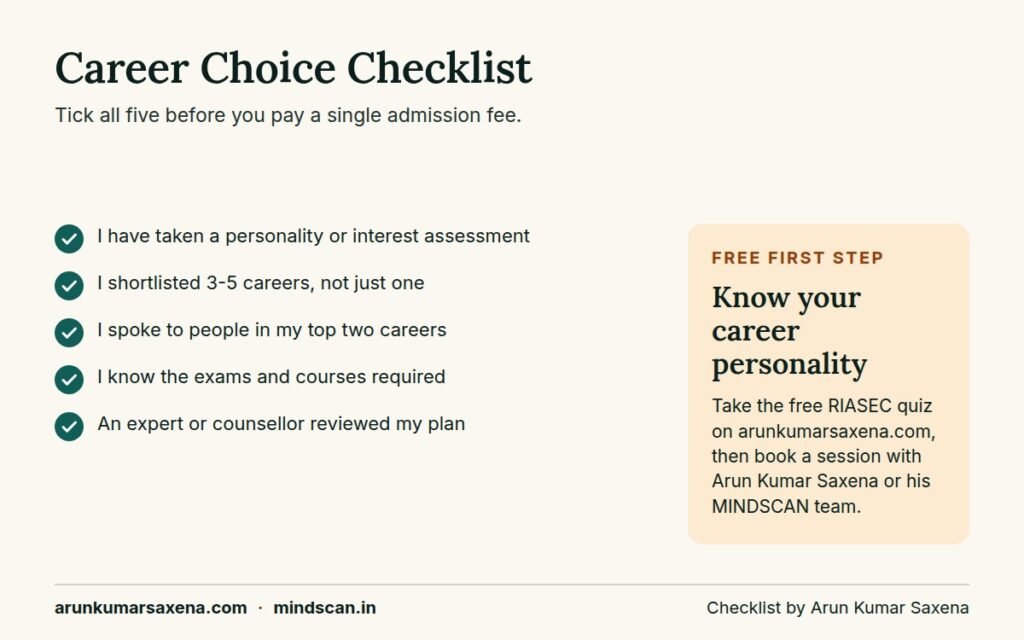
- Validate with a structured tool like the free RIASEC career personality quiz or a full psychometric assessment.
- Shortlist 3-5 careers, not one ‘dream’ career.
- Talk to people actually working in each option before deciding.
What most guides miss: the family-constraint filter
The family-constraint filter means testing every career shortlist against hard limits such as maximum annual fee, location and the timeline by which the family needs a second income. Filtering early prevents falling in love with a career choice that cannot realistically happen.
Most career choice guides stop at interest and aptitude. In my sessions across India, I see a third factor that quietly overrules the first two: the family’s real constraints. A student may have the perfect profile for marine engineering, but if the family cannot fund the upfront fees or a parent’s health means the student must stay within a few hours of home, that career choice collapses. I ask every student to write down their hard constraints before we even look at a career list.
Typical constraints are a maximum annual fee, a city limit, or a timeline by which the family needs a second income. Filtering the shortlist through these constraints early saves the heartbreak of falling in love with a career choice that cannot happen. It also ends the guilt: the student knows the choice was practical, not a failure of ambition. A good career choice works on paper and at the dinner table.
What steps lead to a confident career choice?
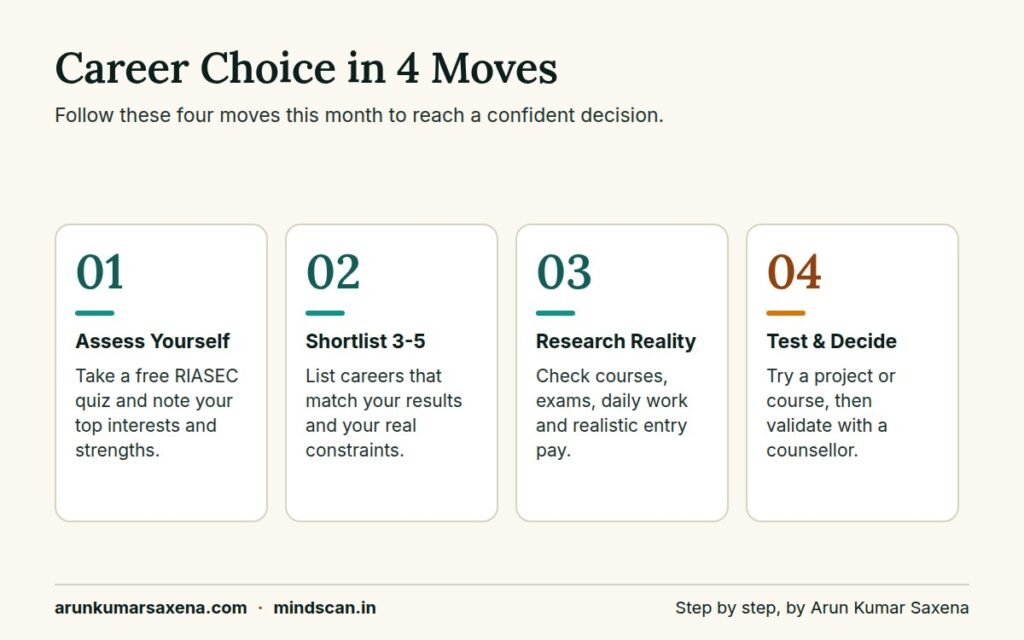
A confident career choice follows a sequence that starts with you and ends with a tested decision. Skipping steps, especially the self-assessment, is why most students often change streams or courses within the first year.
- Self-discovery: Map your interests, aptitudes, personality and values using a free quiz like the RIASEC test or a detailed psychometric assessment. Write down what you actually enjoy doing, not what sounds impressive.
- Career exploration: Research 3-5 careers that match your profile. Read course syllabi, watch day-in-the-life videos, and talk to at least two professionals in each field. Use the National Career Service portal by the Ministry of Labour and Employment for official career information.
- Reality check: Filter your shortlist through your family’s budget, location needs, and timeline. Check the gap between your current marks and the required cutoff. If the gap is large and not narrowing, switch to other fields early.
- Test before you commit: Take a short online course, do a project, or shadow someone for a day. A small investment of time now prevents a costly wrong career choice later.
- Decide and plan: Pick the career choice that survives all filters and build a 12-month action plan with clear milestones.
- Review and adjust: Revisit your plan every six months. A career choice is a direction, not a life sentence.
How to find which career to choose?
Finding which career to choose is the same process as the six steps above: start with self-knowledge, explore, filter, test, decide and review. The key is to treat it as a research project, not a one-time guess. Use the free RIASEC quiz to get your first data point today.
What factors should I weigh before making a career choice?
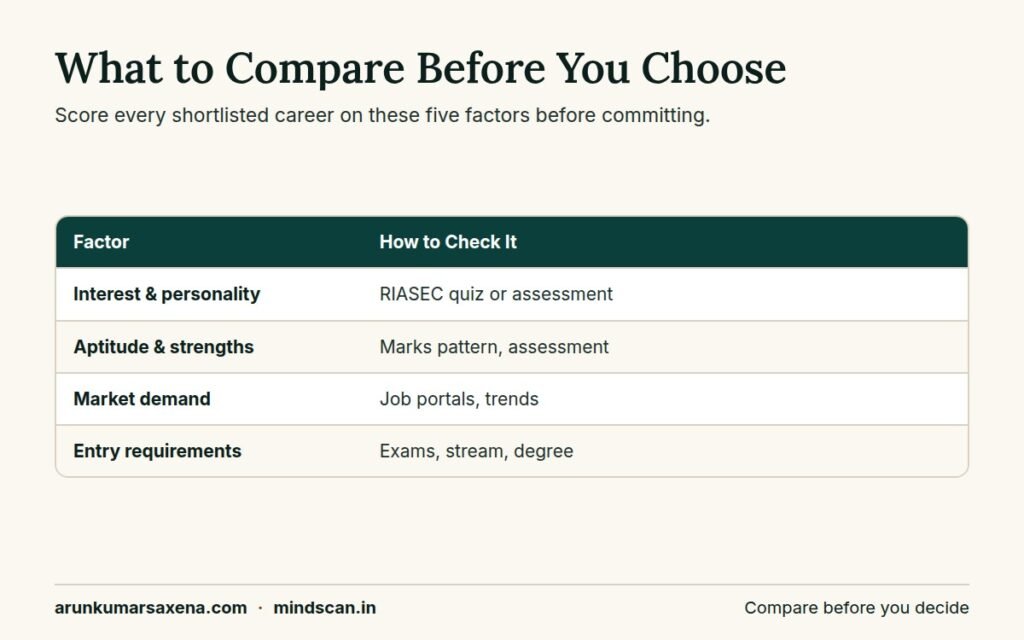
Four factors decide whether a career choice sticks or fails: interest, aptitude, market demand and family constraints. Interest without aptitude leads to struggle. Aptitude without interest leads to boredom. Demand without either leads to unemployment. A table makes the trade-offs clear.
| Factor | What to check | Tool to use |
|---|---|---|
| Interest | Activities you enjoy and lose track of time doing | RIASEC quiz, hobbies journal |
| Aptitude | Skills you learn quickly and perform well consistently | Psychometric assessment, school marks pattern |
| Market demand | Jobs available today and likely to grow in five years | NCS portal, LinkedIn job trends, industry reports |
| Family constraints | Budget, location, timeline for income | Honest family discussion, written constraint list |
Weigh these four factors equally. A career choice that scores high on only one or two will cause regret within a few years. The MINDSCAN AI Career Clarity Report maps your profile to 20+ career groups, giving you a data-verified starting point for this table.
When should I start thinking about my career choice?
The best age to start career counselling is Class 8 onwards. By Class 10, stream selection forces an early career choice, and waiting until Class 12 results leaves you with fewer options and more pressure. Early exploration gives you time to test and change direction without losing a year.
Many parents ask me whether Class 8 is too early. It is not. At that age, the goal is broad exposure, not a final decision. A student who explores five fields between Class 8 and Class 10 makes a far better career choice in Class 11 than one who picks a stream based on a relative’s advice the night before the form is due. Start with the free RIASEC quiz and a conversation about what subjects feel easy and what feels like a chore.
How do I avoid the most common career choice mistakes?
The most common career choice mistakes are copying a friend’s path, chasing a title for family pride, and ignoring aptitude data. I also see students pick a career based on a movie portrayal or a single success story, without checking the daily reality. These mistakes are avoidable with a simple rule: no career choice is final until you have spoken to someone doing that job and taken one small test of the actual work.
Another mistake is waiting for the “perfect” career choice. Perfection does not exist. A good enough career choice that fits your profile and constraints, made with data, is far better than a dream career choice that exists only in your head. Start with the four-factor table above and move forward. You can adjust later.
Can ChatGPT be a career coach?
AI tools like ChatGPT can help you explore career options, draft pros-and-cons lists, and find basic information. But a certified career coach adds verified assessment data, accountability, and the ability to read between the lines of what a student says. The MINDSCAN psychometric assessment provides a data layer that no chatbot can replicate, and a session with a coach turns that data into a personalised action plan. Use AI for exploration, but make the final career choice with a human expert.
What if my career choice fails or I change my mind later?
A career choice is not a life sentence. Stream changes, course switches, and career pivots are common and fixable. The earlier you detect a mismatch, ideally through assessment data and not just a feeling of unhappiness, the cheaper and faster the fix. A planned switch at 25 is far easier than an unplanned one at 40.
Picture an engineering student who realises midway through the degree that the real interest is design. They finish the degree, add a design certification, and move into UI/UX roles within a year. The engineering foundation is not wasted; it becomes a strength. A wrong career choice is only a failure if you refuse to course-correct. Read my career switch guide for a step-by-step plan to change paths without starting from zero.
“One NEET aspirant who could not make it in her last two attempts reached out to me in a gloomy state. Her parents were equally worried and sad. When I examined her last two scores, I found the gap to fill was huge. There was a big gap between expectation and reality. I conducted a psychometric assessment for her, and it confirmed my apprehension: she wasn’t the right fit for medicine.
When I grilled her a little about where her inspiration for medicine came from, I found that she admired her aunt, who is a doctor, and therefore wanted to become one too. After two rounds of consultation, she herself realised that clearing NEET was demanding much more than she could offer. Today she is happily doing a B.Sc. in Biotechnology, with career clarity and a roadmap.” (Arun Kumar Saxena)
How does career counselling improve a career choice?
Career counselling replaces guesswork with data. A psychometric assessment measures your interests, aptitude and personality, and a trained counsellor maps those results to real careers. The MINDSCAN AI Career Clarity Report gives you a shortlist of 20+ career groups that fit your profile, and a session turns that shortlist into a concrete plan with course names, entrance exams, and timelines.
Without counselling, most students rely on three sources: friends, family, and social media. These sources are biased and narrow. A friend recommends the only career they know. A parent recommends the career they wish they had. Social media shows highlights, not the daily grind. Career counselling adds a fourth source: verified data interpreted by an expert who has guided thousands of students. That is the difference between a career choice you hope works and one you know works.
What is the role of psychometric tests in a career choice?
Psychometric tests provide an objective baseline for a career choice. They measure your interests (what you enjoy), aptitude (what you are good at), and personality (how you work best). The MINDSCAN assessment maps these to career groups, showing you options you may never have considered. A test alone is not enough; you need a counsellor to interpret the results and connect them to real courses and jobs.
Many students discover through testing that their true interest is in investigative or artistic work, even though they have been pushed toward conventional or enterprising careers. That data point alone can save years of dissatisfaction. Take the free RIASEC quiz as a first step, and when you are ready for a full report, the MINDSCAN AI Career Clarity Report gives you a detailed map for your career choice.
“Don’t pressurise your child either to appear for NEET or to drop after the first setback. Analyse your child’s aptitude scientifically and check the scores critically before taking any decision.” (Arun Kumar Saxena)
How can I explore career choices for free?
Start with the free RIASEC career personality quiz on this site. Then use the National Career Service portal by the Ministry of Labour and Employment for official career information and the Skill India Digital Hub for free skilling courses to test a field before committing. Talk to professionals on LinkedIn; most are happy to give approximately 15 minutes to a sincere student. Free exploration builds a solid foundation before you invest in a paid assessment.
Free tools give you a direction. A paid assessment gives you a verified map. Both have a place in a smart career choice. I recommend starting with free resources to narrow your focus, then using the MINDSCAN report to confirm your direction and build a detailed plan.
What are the best career choices for the future?
A future-proof career choice is one where the core human skill, judgement, creativity, care, negotiation, cannot be easily automated. Look at fields that blend technology with a human touch: bioinformatics, geriatric care, sustainable design, or AI ethics. The Skill India Digital Hub offers free courses to explore these emerging areas before you commit to a degree.
Rather than chasing the “hottest” career, build a skill stack that is rare and valuable. For example, a commerce graduate who adds data analysis and behavioural economics has a career choice advantage over a generic MBA. The MINDSCAN report helps you identify your unique skill stack and match it to careers that will grow over the next decade.
Frequently asked questions about career choice
What is career counselling and how does it work?
Career counselling is a structured process of assessment plus guided discussion that matches a student’s interests, aptitude and personality to suitable careers. It typically involves a psychometric test, a report mapping career groups, and a session to build an action plan. Sessions with Arun Kumar Saxena or the MINDSCAN team are available online across India.
How much does career counselling cost in India?
Costs vary widely by provider and depth. The MINDSCAN AI Career Clarity Report is priced at ₹1,499, and the report with a counselling session at ₹2,999. Book at online career counselling or get the psychometric assessment. A full assessment with expert interpretation is usually worth far more than the cost of one wrong course year.
Is there any free career counselling available?
Yes. The government’s National Career Service portal by the Ministry of Labour and Employment offers free career information and guidance resources, and the free RIASEC career personality quiz on this site gives you a starting personality profile. Free tools are a good first step; deep personalised guidance needs a counsellor.
What is Holland’s theory of career choice?
Holland’s RIASEC theory says people and work environments fit six types: Realistic, Investigative, Artistic, Social, Enterprising and Conventional. Matching your dominant types to matching careers leads to higher satisfaction and success. The free RIASEC quiz on this site applies exactly this model.
Can a wrong career choice be fixed?
Yes, at almost any stage, through stream change, course switch, additional certifications or a planned career switch. The earlier you detect the mismatch (ideally via assessment data, not just unhappiness), the cheaper the fix. Read my career switch guide for changing paths to see how to change without starting over.
Do parents have a role in a student’s career choice?
Parents should be advisors and data-gatherers, not deciders. Their role: fund assessments, arrange conversations with professionals, and voice real constraints like budget. The final call should rest on the student’s verified aptitude and interests, or the choice fails in year two of the course.
What is the best career choice for the future?
Start by identifying your skill stack with the free RIASEC quiz. Then look at fields where human judgement, creativity and care cannot be easily automated, such as geriatric care, sustainable design or AI ethics. A future-proof career choice blends your verified strengths with a growing market need.
हिंदी में जवाब: करियर चॉइस: आत्मविश्वास के साथ सही निर्णय कैसे लें
12 वीं के बाद सबसे अच्छा कोर्स कौन सा है?
12वीं के बाद का सबसे अच्छा कोर्स वही है जो आपकी रुचि, योग्यता और करियर लक्ष्यों से मेल खाता हो। विज्ञान के छात्र इंजीनियरिंग, मेडिकल, B.Sc. या डिज़ाइन देख सकते हैं। कॉमर्स वाले B.Com, BBA या CA पर विचार कर सकते हैं। अरुण कुमार सक्सेना सलाह देते हैं कि कोर्स का चुनाव साइकोमेट्रिक असेसमेंट के बाद ही करें, न कि दोस्तों की देखादेखी में।
10वीं के बाद 11वीं में कौन-कौन से सब्जेक्ट होते हैं?
10वीं के बाद तीन मुख्य स्ट्रीम हैं: साइंस (PCM या PCB), कॉमर्स (अकाउंट्स, बिज़नेस स्टडीज़, इकोनॉमिक्स) और ह्यूमैनिटीज़ (इतिहास, राजनीति विज्ञान, समाजशास्त्र, मनोविज्ञान)। हर स्ट्रीम में वैकल्पिक विषय भी होते हैं। सही स्ट्रीम चुनने के लिए पहले यह तय करें कि आप आगे कौन से करियर में जाना चाहते हैं।
कौन सी पढ़ाई ज्यादा सैलरी देती है?
ऊंची सैलरी केवल पढ़ाई के नाम पर नहीं, बल्कि आपकी योग्यता, अनुभव और उद्योग की मांग पर निर्भर करती है। डेटा साइंस, आर्टिफिशियल इंटेलिजेंस, फाइनेंस और मेडिकल स्पेशलाइजेशन में अच्छी सैलरी की संभावना है। लेकिन अगर आपकी रुचि नहीं है, तो आप उसमें शीर्ष पर नहीं पहुंच पाएंगे। पहले अपनी रुचि और क्षमता को प्राथमिकता दें।
Science में सबसे अच्छी नौकरी कौन सी है?
साइंस में ‘सबसे अच्छी’ नौकरी हर व्यक्ति के लिए अलग होती है। किसी के लिए डॉक्टर बनना सर्वोत्तम है, तो किसी के लिए डेटा साइंटिस्ट या रिसर्च साइंटिस्ट। अरुण कुमार सक्सेना के अनुसार, साइकोमेट्रिक टेस्ट से पता चलता है कि आपकी पर्सनैलिटी रिसर्च के लिए बनी है या मरीज़ों के इलाज के लिए। अपनी प्रोफाइल जाने बिना किसी नौकरी को ‘सबसे अच्छी’ मान लेना गलत है।
A career choice is too big to leave to a last-minute conversation. Start this week with the free RIASEC career personality quiz. When you are ready for a deeper, data-verified plan, the MINDSCAN AI Career Clarity Report maps your profile to 20+ career groups, and a session turns that report into a 12-month action plan. Book an online career counselling session and make your next career choice the one you never have to undo.