Government Jobs After 12th: Your Complete 2026 Guide
By Arun Kumar Saxena, Certified Advanced Career Coach and founder of MINDSCAN Career Guidance
Last updated: October 2026
Quick answer: Government jobs after 12th include SSC CHSL, SSC GD Constable, SSC MTS, SSC Stenographer, RRB NTPC undergraduate posts, Railway Group D, defence entries like NDA, and various state police and clerical posts. Arun Kumar Saxena, founder of MINDSCAN Career Guidance, advises students to keep a Plan B degree running alongside preparation.
Government jobs after 12th are central and state government positions, clerical, constabulary, railway and defence roles, that Class 12 pass candidates can enter through official recruitment exams. This page helps you and your parents cut through the noise: which exams are real, what each role actually pays and demands, and how to pick the one that matches your personality rather than just following your cousin’s choice.
With 22 years of experience and 20,000+ students and professionals guided, I have seen too many bright students drop three years chasing an exam that never suited them, or worse, fall for fake job offers. Let us build a clear, honest roadmap with a Plan B baked in so your effort takes you somewhere, whatever the result.
Table of Contents
What government jobs can you get after 12th in India?
After Class 12 you can enter government service through four main channels: SSC, railways, defence and state government boards. Each releases its own notifications, age limits and eligibility criteria, so build your complete list first, then narrow it down.
SSC CHSL recruits Lower Division Clerks, Junior Secretariat Assistants, Postal Assistants and Data Entry Operators. These are desk-based roles with a structured workday. SSC GD Constable fills constable vacancies in Central Armed Police Forces such as CRPF, BSF and ITBP, which are field-oriented and physically demanding. Railways recruit undergraduates through RRB NTPC for posts like Junior Clerk cum Typist and Trains Clerk, while RRC Group D hires track maintainers, helpers and other Level-1 staff.
State government boards release constable, forest guard, clerk and MTS vacancies throughout the year, often with domicile requirements. Check the list of government exams after 12th for the most recent notifications.
Too many students fill forms for government jobs after 12th without reading the official notification. That one mistake costs them at the document-verification stage. Download the PDF for every exam you shortlist and highlight the eligibility, age limit and physical standards before you pay the fee.
“I always recommend students to have a plan B to be on the safer side while maintaining their focus on the goal that they have set.” (Arun Kumar Saxena)
Which exams for government jobs after 12th should you actually target?
Target SSC CHSL, SSC GD Constable, SSC MTS, SSC Stenographer, RRB NTPC undergraduate-level posts, RRC Group D, NDA and state-level police or clerk exams. Do not prepare for all of them. Pick two or three with overlapping syllabus so one preparation covers multiple attempts, and check the National Career Service portal of the Ministry of Labour and Employment, Government of India for verified vacancies.
SSC CHSL and SSC MTS share a similar syllabus structure, so preparing once serves both exams. RRB NTPC undergraduate posts and RRC Group D follow a comparable aptitude pattern with an added technical or general-science section. NDA, conducted by UPSC, needs an additional SSB interview and stringent medical and fitness standards, making it a very different commitment from clerical exams. State police and clerk exams are announced more frequently, giving you more attempts per year than many central exams. The smart move is to pick one central and one state exam so you always have a live target.
When you chase government jobs after 12th without an overlapping-syllabus strategy, you end up studying different topics for each exam. That spreads you thin and helps nobody.
Are government jobs after 12th with good salary a realistic goal or a myth?
Entry-level salaries for government jobs after 12th are modest, not the viral figures you see on YouTube. The real advantage is a combination of benefits that build decade over decade. Do not expect a high first salary. Compare total career value instead.
| Post | Approximate monthly pay range (as per online sources) |
|---|---|
| SSC CHSL (LDC/JSA) | ₹25,000 to ₹35,000 |
| SSC GD Constable | ₹23,000 to ₹30,000 |
| RRC Group D | ₹18,000 to ₹25,000 |
- Job security with a stable monthly income
- Dearness Allowance that rises with inflation
- House Rent Allowance based on the posting city
- Medical benefits for the employee and dependents
- A pension-linked retirement corpus under the National Pension System
Pay grows through time-bound promotions and departmental exams. A Lower Division Clerk can rise to Section Officer and beyond over approximately 15 to 20 years. Allowances such as housing, travel and medical add meaningfully to the in-hand pay, often pushing total compensation well past the basic scale. Be cautious of coaching-centre claims and social-media posts promising immediate high salaries for 12th-level posts.
Claims of 20 lakh per month for 12th-pass posts are myths. The Reserve Bank of India or UPSC officer-level salaries you see quoted belong to graduate-entry exams, not 12th-pass posts. The official Department of Expenditure, Ministry of Finance publishes the pay matrix that governs these scales.
Many families compare government jobs after 12th with a private-sector fresher salary and feel disappointed. That comparison misses the point. Government service rewards longevity and stability, not a fast start. If your priority is a high income within three years, build a degree and a private-sector skill stack first.
Government jobs after 12th vs a private career: which should you choose?
You do not have to choose one or the other. Pursue a regular degree while preparing for government exams after 12th, so that if the exam does not come through, your degree gives you a Plan B. This dual-track approach protects you from the single biggest risk, which is spending years with nothing to show.
A degree opens higher-level exams later that demand graduation, such as SSC CGL, UPSC Civil Services and banking officer posts. Full-time preparation without any backup suits only a small, financially secure minority. For most Indian families, dropping college is an unnecessary gamble. Fit matters equally: a clerical desk job in a secretariat and a uniformed constable role in a CAPF suit very different personalities.
Use a free RIASEC career personality quiz early on to check which side you lean towards. Set a time limit of two or three attempts, then honestly reassess. That keeps your Plan B alive and your mental health intact.
Which government jobs after 12th are best for female candidates?
SSC CHSL clerical posts, railway NTPC undergraduate roles, state police women’s cadres and defence entries for women are all suitable options. Choose based on posting conditions, shift patterns and your own comfort with transfers, not on gender stereotypes or someone else’s idea of a “safe” job.
Clerical and secretariat posts in ministries and central government offices offer fixed, predictable hours, which works well if you plan to pursue further studies alongside. Women’s cadres in state police and Central Armed Police Forces are expanding with dedicated vacancies, and the physical standards are tailored separately. Railway NTPC posts offer nationwide postings, so consider your willingness to relocate. Before you pick a uniformed role, ask yourself honestly about shift duty, field postings and transfers every few years. Government jobs after 12th are not one-size-fits-all, and what suits a friend may not suit your own circumstances.
Too many female candidates are guided only towards teaching or clerical roles without being shown the full list. Read the official notifications yourself and compare the job description, not the label.
How do you know if a government job actually suits your personality?
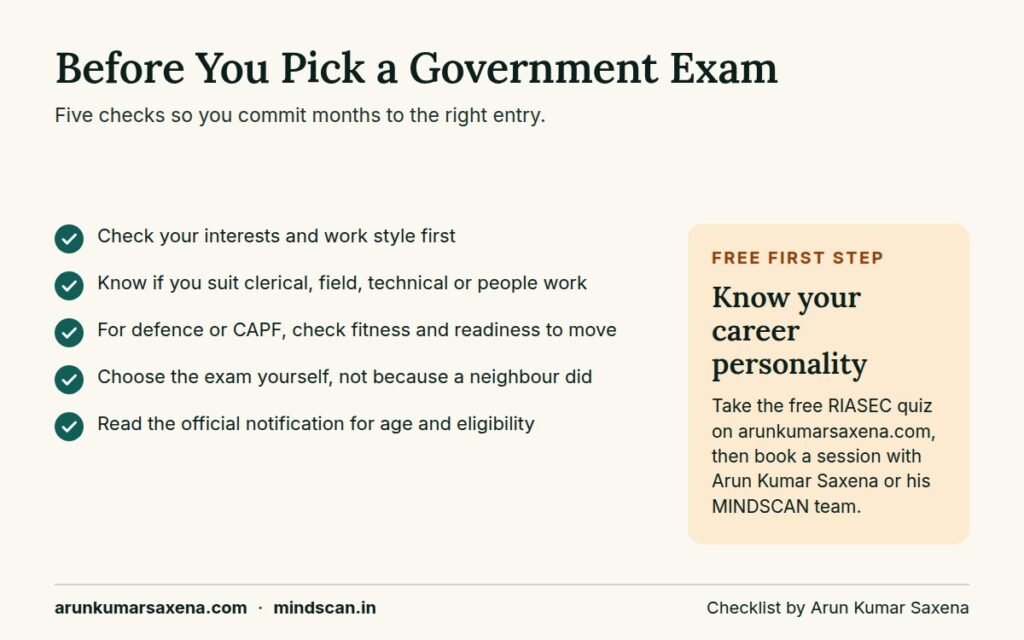
Most students pick exams because a neighbour or coaching institute said so, then quit mid-preparation. Before you commit months of your life, check your interests and work style. Self-knowledge should come before any career choice, and a quick personality check tells you whether structured, rule-driven government work fits you or will frustrate you.
Structured roles with clear processes suit some personalities deeply and suffocate others. Defence and CAPF roles demand discipline, physical rigour and readiness to move, which is a complete mismatch for someone who values a fixed desk and predictable hours. A career personality test reveals whether you are suited to clerical, field, technical or people-facing work. MINDSCAN’s assessment maps students to a wide range of career groups for a fuller picture, and I review every report personally.
Consider reading my book “3 Steps to Knowing Yourself” to build your self-understanding before you lock an exam choice. Once you know your natural bent, matching it to the right type of government jobs after 12th becomes a logical step, not guesswork.
Parents often push the exam with the most perceived status. A neutral counselling session helps both sides see what actually fits the student’s personality, not just the family’s expectations. You can book online career counselling in India with Arun Kumar Saxena for exactly this clarity.
What does a realistic month-by-month preparation plan look like?
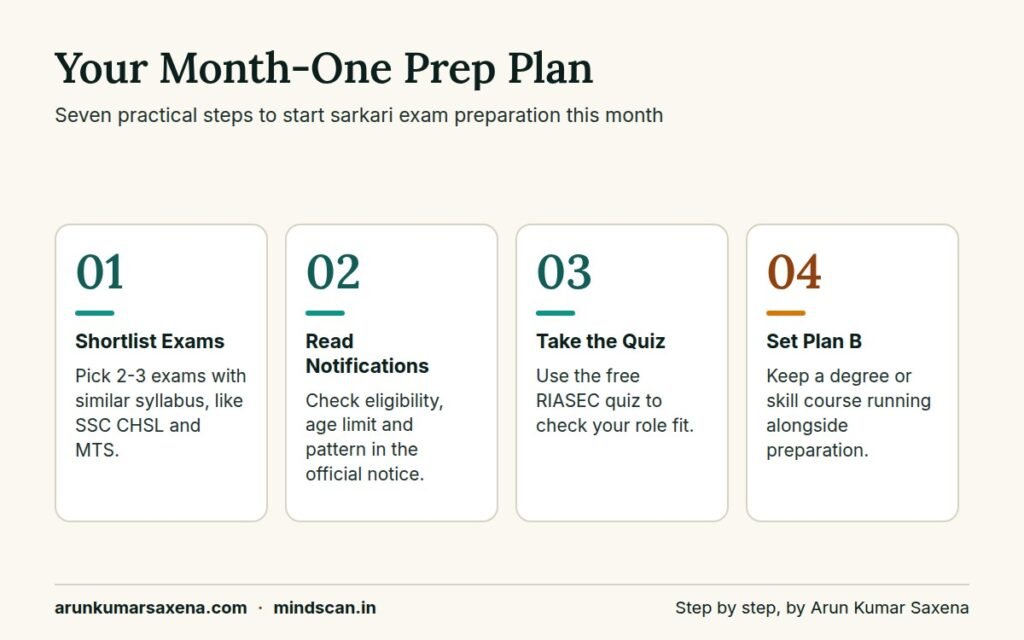
Start by shortlisting two or three exams with overlapping syllabus, then build a fixed weekly routine of quant, reasoning, English and general awareness with one full mock test on Sundays. Keep your college or Plan B studies running in parallel. Do not drop everything for preparation.
- Shortlist 2-3 exams after 12th with overlapping syllabus (for example SSC CHSL + MTS).
- Download the latest official notification for each and note eligibility, age limit and exam pattern.
- Take the free RIASEC career personality quiz to confirm the type of role suits you.
- Discuss and set your Plan B: a regular degree or skill course running alongside preparation.
- Build a weekly timetable covering quant, reasoning, English and general awareness.
- Solve one previous-year paper or mock test every week and track your scores honestly.
- Check the National Career Service portal regularly for verified vacancy updates.
Fix two hours daily per subject rather than trying unfocused all-day study. Previous-year papers reveal the real difficulty level, which is often lower than what coaching centres project, but the competition is far higher. Track cut-offs for your category honestly so you know exactly where you stand. If you are targeting defence or police entries, start your physical fitness routine on day one, not one month before the physical test.
The biggest reason students fail government jobs after 12th is not the exam difficulty. It is running out of attempts while still unprepared. A calendar with monthly targets and a hard stop keeps you honest.
SSC CHSL, GD Constable, NDA or Railways: which entry is right for you?
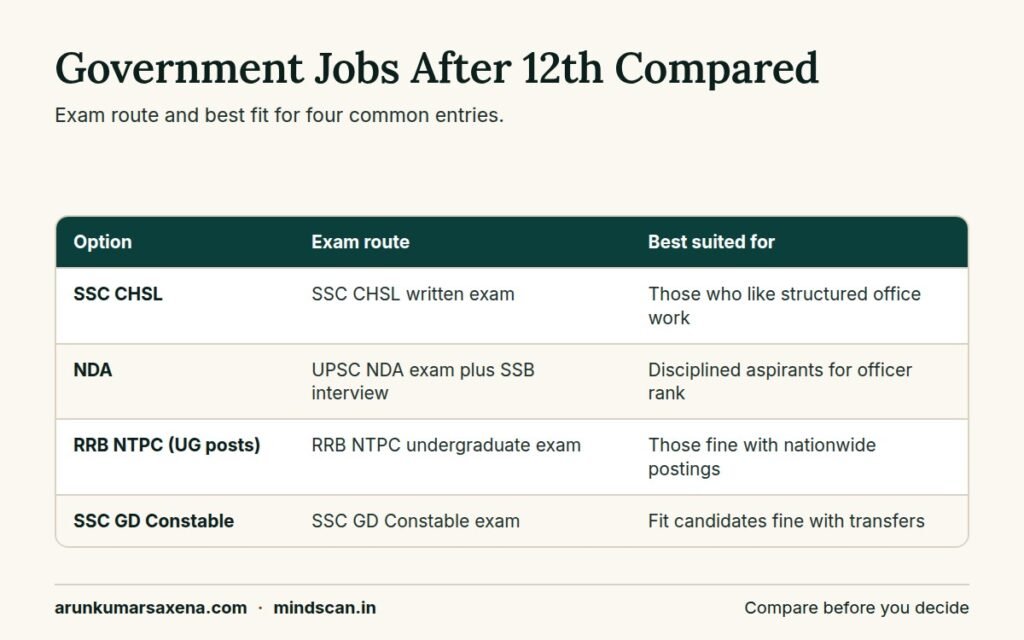
Pick by role, not by hype. SSC CHSL suits office and clerical work. GD Constable and NDA suit uniformed, physically demanding careers. Railways offer a mix of desk, ticketing and field roles. Compare eligibility, nature of work, posting pattern and growth path side by side before you fill any form.
Government job entries after 12th: how the main options compare
| Option | Type of work | Exam route | Best suited for |
|---|---|---|---|
| SSC CHSL | Office/clerical roles | SSC CHSL written exam | Students who prefer structured office work |
| NDA | Officer entry, defence | UPSC NDA written + SSB interview | Disciplined students aiming for officer rank |
| RRB NTPC (UG posts) | Clerk cum typist, ticketing | RRB NTPC undergraduate exam | Students okay with nationwide postings |
| SSC GD Constable | Constable in CAPFs | SSC GD Constable exam | Physically fit candidates comfortable with transfers |
NDA leads to a permanent commission as an officer through a rigorous UPSC exam plus an SSB interview and medical board. SSC CHSL roles are largely desk-based with predictable routines and fixed office hours. Railways posts range from track maintenance and station duties to clerical and ticketing work, so check the specific post code. CAPF constable roles involve demanding duty conditions, field postings and transfers across the country. Government jobs after 12th cover a wide spectrum, and the right entry is the one that matches your daily life, not just the job title.
Before you fill any form, read about how to choose the right career after 12th. Your stream matters too: if you are from Arts, see career options after 12th in Arts. If you are from Commerce, check best courses after 12th Commerce to weigh a private degree path alongside these exams.
How can a career counsellor help you decide after 12th?
A career counsellor helps you match exam choices to your personality, academic strengths and family situation, and builds a Plan B so preparation does not become a dead end. I offer online career counselling in India for exactly this crossroads, and every MINDSCAN report is reviewed by me personally.
Counselling prevents the most expensive mistake: years lost on exams that never fit you in the first place. A structured assessment maps your interests to realistic career groups rather than chasing every notification. Parents and students often disagree sharply on government versus private paths. A neutral session brings both sides onto the same page with data and personality evidence, not emotion. Know more about my approach on the Arun Kumar Saxena profile page. You can also start with the free RIASEC career personality quiz to get an early read on your fit before booking a full session.
The MINDSCAN AI Career Clarity Report, available at ₹1,499, or with a counselling session at ₹2,999, is often the first time a student sees their own strengths reflected back clearly. That clarity is worth far more than the fee when it stops you from walking the wrong path for years.
हिंदी में जवाब: सरकारी नौकरी या प्राइवेट नौकरी
12वीं के बाद कौन-कौन सी सरकारी नौकरी मिल सकती है?
12वीं के बाद SSC CHSL, SSC GD Constable, SSC MTS, SSC Stenographer, रेलवे की RRB NTPC अंडरग्रेजुएट पोस्ट और RRC Group D जैसी सरकारी नौकरियाँ मिल सकती हैं। रक्षा क्षेत्र में NDA और राज्य पुलिस की कांस्टेबल व क्लर्क भर्तियाँ भी खुलती हैं। करियर कोच अरुण कुमार सक्सेना सलाह देते हैं कि तैयारी के साथ डिग्री भी जारी रखें।
10वीं के बाद सरकारी नौकरी के लिए क्या करना चाहिए?
10वीं के बाद आप RRB Group D, SSC MTS और राज्य स्तर की भर्तियों के लिए आवेदन कर सकते हैं, पर 12वीं पूरी करना ज़रूरी है क्योंकि ज़्यादातर अच्छे पदों के लिए 12वीं मांगी जाती है। अरुण कुमार सक्सेना, MINDSCAN Career Guidance के संस्थापक, कहते हैं कि पढ़ाई के साथ क्वांट, रीज़निंग और जनरल अवेयरनेस की रोज़ तैयारी शुरू करें।
12th के बाद कौन-कौन सी वैकेंसी निकली है?
वैकेंसी हर महीने बदलती रहती है, इसलिए किसी एक लिस्ट पर भरोसा न करें। SSC, RRB, राज्य बोर्ड और NDA की आधिकारिक वेबसाइट और National Career Service पोर्टल पर नई 12वीं पास वैकेंसी अपडेट होती रहती हैं। ऑनलाइन स्रोतों के अनुसार हर साल लाखों उम्मीदवार इन भर्तियों में आवेदन करते हैं, इसलिए आधिकारिक नोटिफिकेशन ही देखें।
12वीं के बाद लड़कियों के लिए कौन सी नौकरी सबसे अच्छी है?
12वीं के बाद लड़कियों के लिए SSC CHSL जैसी क्लर्कियल नौकरियाँ, रेलवे NTPC पोस्ट, राज्य पुलिस की महिला कैडर और रक्षा विभाग की एंट्रियाँ अच्छी श्रेणियों में आती हैं। सबसे अच्छी नौकरी वही है जो आपकी रुचि, शिफ्ट और ट्रांसफर की स्थिति के अनुसार सही बैठे। MINDSCAN Career Guidance में psychometric test से यह मैच जाना जा सकता है।
अपनी परीक्षा की रणनीति साफ़ करने के लिए आज ही ऑनलाइन करियर काउंसलिंग बुक करें।
Frequently asked questions about government jobs after 12th
Can I get a government job after 12th without any exam?
Almost all regular central and state government jobs require a written exam, often plus physical tests or interviews. Be wary of agents promising direct government roles for money; these are scams. Legitimate entry for 12th-level posts always goes through official notifications and published merit lists. Cross-check every vacancy on the recruiting board’s website.
What is the minimum age for government jobs after 12th?
Most 12th-level government exams require candidates to be 18, though some like NDA allow candidates in the 16 to 19 age band, as per official notifications. Age relaxations apply for reserved categories as per central government rules. Always check the exact age limit and cut-off date in the official notification of the specific exam, as these vary by post and recruiting body.
Can I prepare for government exams while doing a regular degree?
Yes, and I recommend exactly this dual track. A regular degree gives you a Plan B and keeps you eligible for graduation-level exams later. Evening and weekend preparation, with a disciplined two-hour daily routine, is sufficient for most 12th-level government jobs after 12th in the early months. Avoid dropping college unless you have a very strong reason and full family support.
Which government job after 12th is easiest to crack?
No exam is genuinely easy. Easier often means more applicants, pushing the cut-off higher. SSC MTS and Group D posts have simpler syllabi but face lakhs of candidates. The smarter question is which 12th-level posts fit your strengths and personality, and where you can sustain preparation across multiple attempts without burning out.
Do government jobs after 12th offer promotion opportunities?
Yes. Clerical and constable-level staff can rise through time-bound promotions and departmental exams to supervisory and officer-level posts over a full career. Growth is slower than the private sector initially but steadier. Long-term benefits like pension-linked security add significant value over approximately 30 years of service, which private jobs rarely match.
Are bank jobs available after 12th?
Direct bank officer and clerk posts in public sector banks require graduation, so they are not open for 12th-level government roles. After completing 12th, most students target SSC, railways or state police exams instead. You can appear for banking exams conducted by IBPS after finishing your degree, which is another reason to keep your graduation on track.
How do I spot fake government job offers?
Any offer demanding money for a guaranteed government job, or a selection letter that arrives without a written exam and an official merit list, is a scam. Genuine 12th-level posts are advertised only on official websites ending in .gov.in or on the National Career Service portal. Never pay an agent for a form or a result.
Government jobs after 12th are a solid path, but only when chosen with clear eyes and a Plan B. Do not let coaching-centre hype or social-media noise decide your next three years. Get your personality mapped, shortlist two or three exams that actually fit, and run your degree in parallel. That approach protects your time, your parents’ money and your future options.
Book your online career counselling session or start with the MINDSCAN AI Career Clarity Report at ₹1,499. You will see your strengths on paper and know exactly which government jobs after 12th deserve your effort, and which ones you should leave for someone else.
About the author: Arun Kumar Saxena is a Certified Advanced Career Coach and the founder of MINDSCAN Career Guidance, with 22 years of experience and 20,000+ students and professionals guided. A former corporate leader at Airtel and Reliance, a CBSE Resource Person and the author of 3 Steps to Knowing Yourself, he and his MINDSCAN team counsel students, parents and professionals online across India. Call +91-9140604743 or visit mindscan.in.