JEE Main Syllabus 2027: Subject-Wise Guide for Class 12
By Arun Kumar Saxena, Certified Advanced Career Coach · Updated October 2026
Quick answer: The JEE Main syllabus 2027 for Paper 1 follows the NCERT Class 11 and 12 curriculum in Physics, Chemistry and Mathematics: 75 questions, 300 marks, +4 for correct and -1 for wrong. Prepare from the latest official NTA syllabus until the 2027 bulletin is out.
The JEE Main syllabus 2027 is the NCERT Class 11 and 12 curriculum you are already studying, and thousands of serious aspirants are covering it right now while others wait for a PDF. This page gives you the subject-wise breakdown, the exam pattern, a Class 12 start plan and something coaching centres rarely say aloud: a readiness check to know whether JEE is truly your race.
With 22 years of experience and 20,000+ students and professionals guided, I have seen too many bright students burn two years on a goal that never matched their aptitude. The syllabus is the easy part. Knowing whether engineering fits you is the real work. Let us walk through both.
Table of Contents
What is the official JEE Main syllabus 2027 for Paper 1 (B.E./B.Tech)?
The JEE Main syllabus 2027 for Paper 1 is the NCERT Class 11 and Class 12 curriculum in Physics, Chemistry and Mathematics, as prescribed by NTA in its latest official syllabus document.
Mathematics units include Sets, Relations and Functions, Complex Numbers, Quadratic Equations, Matrices and Determinants, Permutations and Combinations, Binomial Theorem, Sequences and Series, Calculus, Coordinate Geometry, 3D Geometry, Vectors, Statistics, Probability and Trigonometry.
Physics covers Mechanics, Thermodynamics, Kinetic Theory, Oscillations and Waves, Electromagnetism, Optics, Modern Physics and Experimental Skills.
Chemistry is split into Physical (mole concept, atomic structure, thermodynamics, equilibrium, redox), Organic and Inorganic, all drawn from the NCERT curriculum.
Do not rely on coaching summaries that repackage old lists. Download the official NTA JEE Main syllabus document and keep it as your master checklist. The Ministry of Education, Government of India sets the broader curriculum framework, but NTA decides what appears in the exam.
What is the JEE Main 2027 exam pattern and marking scheme?
Paper 1 has 75 compulsory questions, 25 per subject, with +4 for a correct answer and -1 for a wrong one, for a total of 300 marks across three hours.
Section A holds the 20 MCQs per subject. Section B holds the 5 numerical value questions. Negative marking applies equally to both sections, but numerical questions punish blind guessing less because the answer is a computed value, not a lucky option pick. Accuracy still matters more than speed here.
With 300 marks on the table and three subjects to juggle in 180 minutes, time management is as important as knowing the JEE Main syllabus 2027. A common mistake is spending 90 minutes on a strong subject and leaving too little for the other two. Practice full-length mocks early to build a pacing rhythm.
Pattern details can change. Always confirm the marking scheme in the official NTA information bulletin when it is released for 2027.
Has NTA released the JEE Main syllabus 2027 PDF yet?
No separate 2027 PDF has been released. NTA publishes the syllabus in its information bulletin closer to the exam year, and the latest published syllabus on the NTA JEE Main portal is the one to follow until then. Beware of coaching sites branding old PDFs as 2027.
How to verify: visit the NTA JEE Main portal and look for the current syllabus document. If a website offers a download labelled “JEE Main syllabus 2027 PDF” before NTA has published anything, it is an old file with a new name.
Recent years saw syllabus trimming aligned to NCERT rationalisation. The official PDF matters more than any downloaded copy from two years ago. Once NTA releases the 2027 bulletin, download the PDF and check for added or dropped units before you finalise your revision plan. A single dropped chapter can free up a week of study time, and a single added topic can cost you four marks if you miss it.
Is the JEE Main syllabus 2027 the same as JEE Advanced?
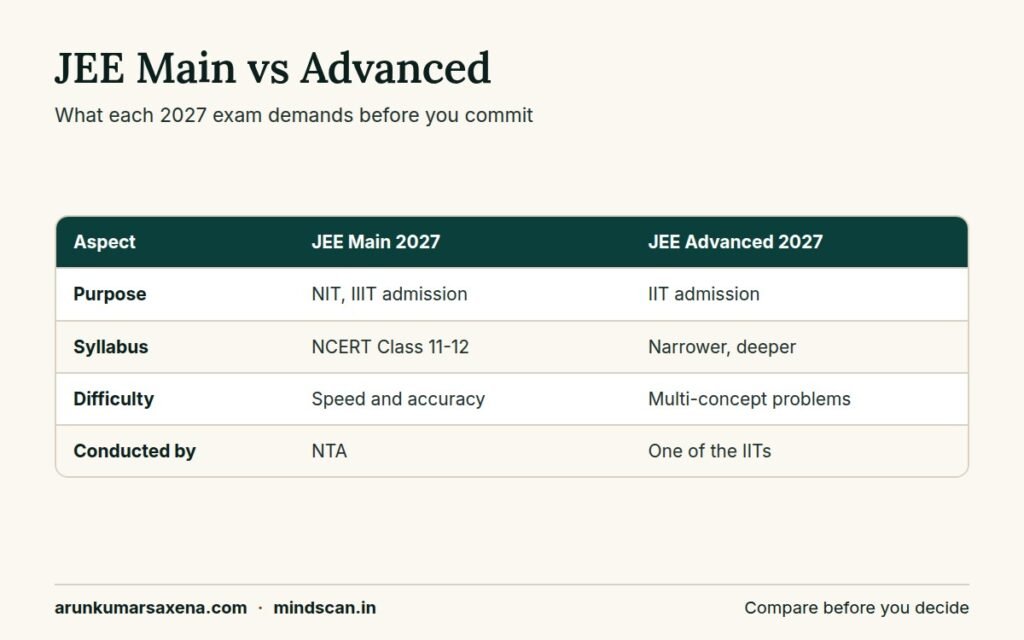
No. JEE Main follows the NCERT Class 11-12 curriculum, while JEE Advanced covers a narrower but deeper set of topics with its own syllabus and harder problem-solving. Students targeting IITs should treat Main as the base and layer Advanced-level practice on top.
The two-exam ladder works like this: JEE Main is the gateway to NITs, IIITs and GFTIs, and it also serves as the qualifier for JEE Advanced. Advanced is exclusively for IIT admission. Main tests speed and accuracy on NCERT-level topics. Advanced tests multi-concept problems that often combine two or three chapters into a single question.
Do not study Advanced topics while ignoring Main-only scoring chapters. A student who masters Calculus for Advanced but loses easy marks in Statistics in Main is making a tactical error. Build the full JEE Main syllabus 2027 first, then deepen your preparation for Advanced.
| Aspect | JEE Main 2027 | JEE Advanced 2027 |
|---|---|---|
| Purpose | NIT, IIIT and GFTI admission plus Advanced qualifier | IIT admission only |
| Syllabus base | NCERT Class 11 and 12 curriculum | Narrower, deeper official Advanced syllabus |
| Difficulty | Speed and accuracy on NCERT-level topics | Multi-concept, high-depth problem solving |
| Attempts | Limited sessions per year as per NTA rules | Two consecutive years after qualifying Main |
| Conducted by | NTA | One of the IITs (rotating) |
When should a Class 12 student start preparing for JEE Main 2027?
Start now. Lakhs of students are already preparing, and every day planned strategically gives you an edge over others. Class 11 students in 2026-27 will appear in 2028, but if you are in Class 12 now, the 2027 attempt is yours.
A rough month-wise split looks like this: finish Class 12 NCERT thoroughly, unit by unit, with one problem bank per subject, while revising Class 11 material in parallel. The coaching-hype narrative that only a dropper year succeeds is false. Plenty of first-attempt candidates crack the JEE Main syllabus 2027 with a disciplined plan.
Set up a weekly self-check: which concepts did you revise, how many questions did you solve, and which weak units did you log in your error notebook. If a week passes without adding solved problems to your count, you are drifting.
“Most families wait for the date to be announced before they press the accelerator, and that is a huge mistake. When you know you have to appear for NEET, there is no point waiting for the date announcement to shift into top gear. Every day counts, and lakhs of students are preparing. In this scenario, it is not every day but every minute, planned strategically, that gives you an edge over others.” (Arun Kumar Saxena’s advice on competitive-exam preparation)
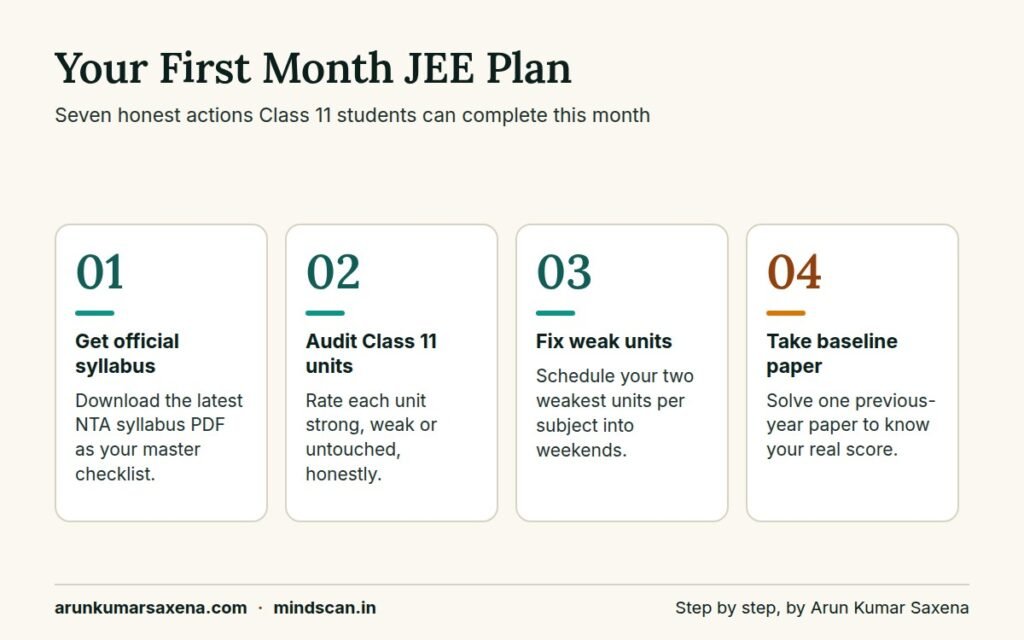
- Download the latest official syllabus PDF from the NTA JEE Main portal and keep it as your master checklist this month.
- List every Class 11 and 12 unit you have covered so far and honestly rate each as strong, weak or untouched.
- Pick your two weakest units per subject and schedule them into your next four weekends.
- Attempt one previous-year JEE Main paper to get a real baseline score, not an imagined one.
- Set up an error notebook per subject and review it every Sunday.
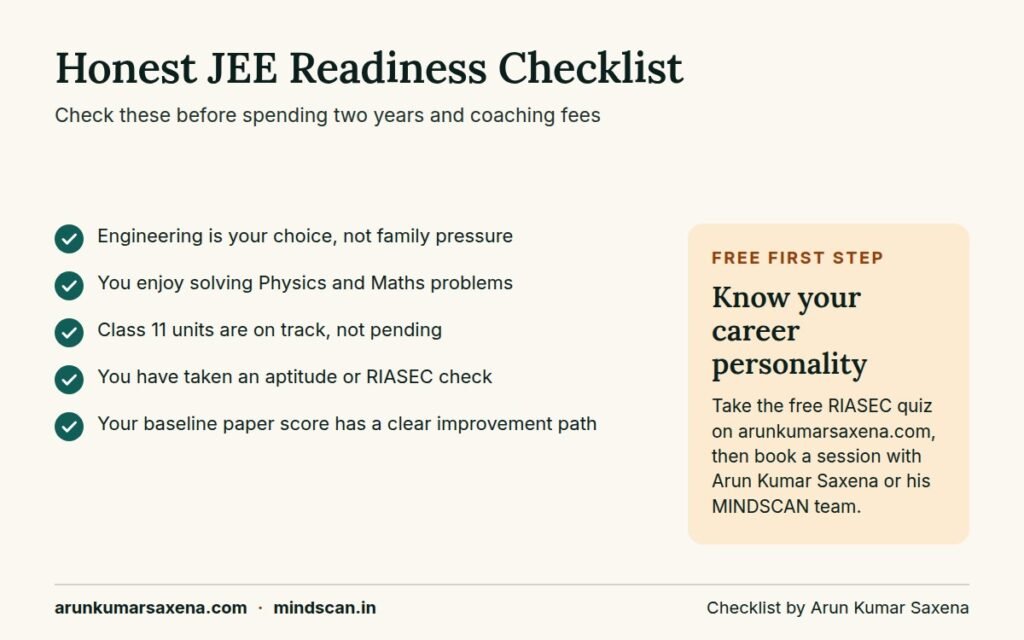
- Take the free RIASEC career personality quiz to sanity-check that engineering truly fits you.
- If your baseline and aptitude both look weak, book a psychometric assessment and counselling session before spending on coaching.
Which chapters matter most in the JEE Main syllabus 2027?
High-frequency areas per online sources include Calculus and Coordinate Geometry in Maths, Electrodynamics and Mechanics in Physics, and Physical plus Organic Chemistry fundamentals. Weightage shifts every year, so build the full syllabus first and prioritise weak high-weight units in revision.
Avoid “skip these chapters” shortcuts. Dropped chapters have cost aspirants easy marks in past papers because NTA does not publish official weightage. Use previous-year papers to judge which units appear often, but treat every weightage table you find online as an estimate, not a fact.
A chapter that gave two questions last year might give four this year. The safest strategy with the JEE Main syllabus 2027 is to cover everything, then use the last four months to drill your weak high-frequency zones.
Is JEE 2027 the right goal for my child, or just family pressure?
Do not pressurise your child either to appear for JEE or to drop after the first setback. Analyse your child’s aptitude scientifically and check the scores critically before taking any decision. A psychometric assessment plus honest performance tells you more than peer pressure does.
A pattern repeats every year in competitive-exam counselling: a student scores 90 percent in school board exams, assumes that translates to JEE readiness, and spends two years discovering that board marks and competitive-exam aptitude are not the same thing. The student who stops to ask “Does engineering fit me, or am I just good at school exams?” saves far more time than the one who blindly starts solving Calculus.
Here is a simple gap test: compare marks obtained with marks needed. If a student has given two attempts, the scores have improved, and the gap is narrowing, persistence makes sense. If the gap is big and not narrowing, switching fields is the smarter move.
“Don’t pressurise your child either to appear for NEET or to drop after the first setback. Analyse your child’s aptitude scientifically and check the scores critically before taking any decision.” (Arun Kumar Saxena’s general advice on competitive-exam families)
Before committing two years to the JEE Main syllabus 2027, use the free RIASEC career personality quiz as a no-cost first filter. If the result raises doubts, book an online career counselling in India session that includes a scientific aptitude and interest assessment. The MINDSCAN assessment maps the student to 20+ career groups and is delivered as a report with a counselling session for ₹2,999. Arun Kumar Saxena’s book “3 Steps to Knowing Yourself” argues self-knowledge must come before any career choice, including choosing the JEE track.
What most guides miss: the aptitude-first readiness check before the JEE Main syllabus 2027
Every coaching centre hands you the JEE Main syllabus 2027 and a timetable. Almost none hands you a mirror. A student who scores 90 percent in school board exams often assumes that translates to JEE readiness, and then spends two years discovering that board marks and competitive-exam aptitude are not the same thing. The student who stops to ask “Does engineering fit me, or am I just good at school exams?” saves far more time than the one who blindly starts solving Calculus.
Here is a simple three-question filter.
- When you solve a hard Physics numerical, do you lose track of time or do you watch the clock?
- Have you scored consistently above 80 percent in Maths and Science without tuition crutches?
- If engineering were off the table tomorrow, would you still have a clear second choice, or would you feel lost?
Honest answers to these three questions tell you more about JEE readiness than any diagnostic test. If two answers are weak, do not abandon the JEE Main syllabus 2027. But do pause and take a psychometric assessment before you invest in two years of coaching.
What are the biggest mistakes students make with the JEE syllabus?
The three common mistakes are ignoring NCERT for fancy reference books, postponing Class 11 topics until Class 12, and choosing engineering by default without checking aptitude or interest. Fix all three and the 2027 attempt becomes far more predictable.
- Mistake one: collecting PDFs and checklists instead of solving problems. A folder full of syllabus documents and weightage charts is not preparation. Open your book and solve.
- Mistake two: treating Class 11 syllabus as “done in school” and relearning it under panic in Class 12. Class 11 units form the foundation for Class 12 topics. If your Mechanics is shaky, your Electrodynamics will suffer. Revise Class 11 material in parallel with Class 12.
- Mistake three: following a friend’s career choice. Your best friend may thrive in engineering while you would flourish in design, law or pure sciences. Use the free RIASEC career personality quiz and the self-knowledge framework to verify fit. Also review the subjects in the science stream after Class 10 to confirm you picked the right combination. If you are still undecided, read the engineering vs medical after 12th comparison to rule out the other default option.
How do you build a realistic study plan from the JEE Main syllabus 2027?
Break the syllabus into weekly targets: Class 12 units with NCERT plus one problem bank, parallel Class 11 revision, previous-year papers in the final six months, and full mock tests well before the January 2027 session.
Adopt a 6-day study, 1-day review weekly rhythm. On the review day, do not study new topics. Revisit your error notebooks, re-solve flagged questions and test yourself on the week’s weak areas.
Solve at least one previous-year paper every fortnight. This builds exam temperament and reveals which units leak marks under time pressure. Keep one error notebook per subject and revise it weekly. A mistake logged and never reviewed is a mistake that will repeat on exam day.
The JEE Main syllabus 2027 is large, but a plan that runs on weekly targets rather than monthly intentions makes it manageable. If you need help building that plan or verifying that engineering is your genuine fit, learn more about Arun Kumar Saxena and how MINDSCAN Career Guidance works with students across India.
Will JEE 2027 be tough?
Yes, JEE 2027 will be tough because it is a high-competition exam, but difficulty is relative to your preparation and aptitude. A student with a clear plan and honest self-assessment can handle it; a student relying on hype will struggle.
Frequently asked questions about jee main syllabus 2027
Is 97 percentile good in JEE Main?
Yes, for most categories and branches, 97 percentile is a strong score that can open doors to NITs and IIITs, though exact cut-offs vary by category, branch and home-state quota. As per online sources, it places you near the top few percent of candidates.
Can 150 marks get 98 percentile in JEE Main?
Marks-to-percentile conversion shifts with each session’s difficulty and candidate pool, so 150 marks have landed near the 97-99 percentile range in some sessions as per online estimates. Never plan on a fixed conversion; check the official normalised percentile after each attempt.
Can I get an NIT at 75 percentile?
At 75 percentile, a general-category NIT seat through the regular quota is very unlikely as per past trends, though category-specific quotas, home-state quotas and later CSAP rounds sometimes surprise. Verify with the latest JoSAA/CSAP cut-offs rather than forum claims.
Is 70 a bad score in JEE Mains?
70 marks typically map to a modest percentile, so for NIT ambitions it is low, but it is a useful diagnostic: it shows which units are leaking marks. One data-verified revision cycle targeting weak units can move it substantially in the next attempt.
How many times can I attempt JEE Main 2027?
As per NTA’s recent pattern, candidates can appear in both sessions of the exam year and the better score counts, with eligibility tied to the year of passing Class 12. Confirm attempt rules in the official 2027 information bulletin when released.
Do I need coaching to cover the JEE Main syllabus 2027?
Coaching helps structure but is not mandatory; disciplined self-study with NCERT, one problem bank per subject and previous-year papers has produced top rankers. What is non-negotiable is knowing whether engineering fits you at all, which a psychometric assessment answers honestly.
What subjects in Class 11 and 12 are required for JEE Main?
Paper 1 requires Physics, Chemistry and Mathematics in Class 12 with the minimum aggregate percentage set by NTA; see the eligibility section of the official bulletin. Students still choosing streams can review the science stream subject guide before locking their combination.
The JEE Main syllabus 2027 is a known quantity. Your child’s aptitude is not, at least until you measure it. Do not wait for the NTA bulletin to start. Do not let a neighbour’s opinion decide whether engineering is the right track. Book an online career counselling in India session and get the MINDSCAN AI Career Clarity Report (₹1,499) or the report with a counselling session (₹2,999) at mindscan.in/psychometric-assessment. Clarity saves years of regret later.
About the author: Arun Kumar Saxena is a Certified Advanced Career Coach and the founder of MINDSCAN Career Guidance, with 22 years of experience and 20,000+ students and professionals guided. A former corporate leader at Airtel and Reliance, a CBSE Resource Person and the author of 3 Steps to Knowing Yourself, he and his MINDSCAN team counsel students, parents and professionals online across India. Call +91-9140604743 or visit mindscan.in.