Skill-Based Courses in India: An Honest 2026 Guide
By Arun Kumar Saxena, Certified Advanced Career Coach · Updated October 2026
Quick answer: Skill-based courses are short, practical training programmes that teach a job-ready capability in months, not years. The right course depends on your verified aptitude, not trending lists. With 22 years of experience and 20,000+ students and professionals guided, I recommend matching any skill-based course to your career personality before you pay.
Every week, I meet families stuck on one question: should the child do a regular degree, a skill-based course, or both? The argument is rarely about learning. It is about fear. Parents fear a future without a degree certificate. Students fear a future without a job. This page cuts through the noise and answers the real question with honest cases, a self-knowledge framework and a free quiz, so you can decide what works for your family, not what worked for an influencer.
With 22 years of experience and 20,000+ students and professionals guided, I have seen the same costly mistakes repeat across dining tables in small towns and big cities. This guide is for Class 12 students choosing a path, graduates stuck in low-salary roles, and working professionals who need a practical skill-based course upgrade without quitting their job.
Table of Contents
What are skill-based courses and how are they different from a degree?
Skill-based courses teach a specific, practical capability in months rather than years, while degrees build broad theoretical foundations. Employers increasingly test skills directly through assignments and portfolios, but a degree still matters for many government jobs, corporate eligibility filters and higher studies. The two are not enemies; they solve different parts of the career puzzle.
A degree proves you can stick with something for three or four years and absorb a wide syllabus. A skill-based course proves you can deliver a specific outcome today. Picture a Class 12 student who completes a six-month digital marketing bootcamp while enrolled in a private B.Com programme. By the time her classmates are collecting their degree certificates, she already has a portfolio, client testimonials and an income. The degree still matters for her long-term safety net, but the skill-based course gives her immediate earning power.
In many homes, the dinner-table argument pits Science against Commerce as if one choice guarantees success. The real question is simpler: what will you be able to do on day one of a job? A degree alone often cannot answer that. A skill-based course can. But a skill-based course alone, without any degree, may shut doors you did not know existed. This is why I rarely recommend one over the other. I recommend a mix that fits the student’s personality, family finances and market reality.
“When parents use adjectives like ‘power’, ‘prestige’, ‘respect in society’ or ‘security’ but never use words like ‘aptitude’, ‘interest’, ‘growth’, or ‘skills’,I immediately understand that they are heading in the wrong direction.” (Arun Kumar Saxena)
Skill-based courses are short, practical and outcome-focused. Degrees are long, theoretical and eligibility-focused. A skill-based course earns you an interview. Aptitude decides whether you survive the job. The smartest families I have worked with treat both as tools, not as identities.
Which is the best skill-based course for 2026?
The honest answer is that “best” depends entirely on the person. Demand areas, as per online sources, include data analytics, digital marketing, coding, AI tools, design and skilled trades. The best skill-based course is the one matching your verified aptitude and career personality, not the one trending on YouTube this month.
High-demand categories right now include data analytics and visualisation, digital marketing and content creation, IT and coding with AI-assisted development, communication and workplace soft skills, and skilled trades with design capabilities. Each of these areas has real hiring demand and decent starting pay. But a skill-based course that fits your friend may bore you to frustration. I have seen extroverted, people-oriented students pushed into coding bootcamps by well-meaning parents. They finish the course but never build a portfolio because the work does not match who they are.
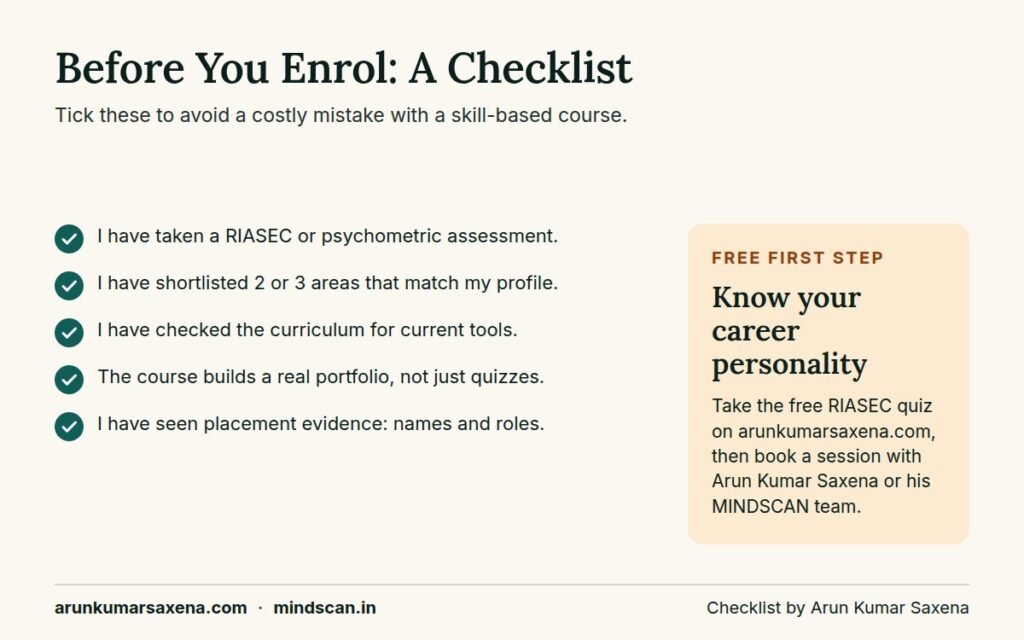
Before you shortlist any skill-based course, verify your career personality. The free RIASEC career personality quiz on this website takes a few minutes and gives you a research-backed starting point. It maps your interests across six work types: Realistic, Investigative, Artistic, Social, Enterprising and Conventional. A student scoring high on Artistic and Enterprising should probably not be pushed into a data analytics bootcamp, no matter how many ads promise high salaries.
Beware of buying any skill-based course based on influencer hype or a YouTube video titled “top 5 highest paying skills in 2026.” Those lists are content, not career advice. They do not know your child. A good skill-based course fits three things: the student’s verified aptitude, the family’s financial timeline, and actual market demand in the city or remote-work ecosystem they can access.
What are the top 5 high-demand skills in India right now?
As per online sources, approximately five skill clusters dominate hiring demand in India currently. Each earns money because businesses need these outputs daily and are willing to pay for proof of work, not just certificates. The clusters are data and analytics, digital marketing, coding and AI tools, communication and workplace soft skills, and a skilled trade or design capability.
- Data and analytics: Companies need people who can clean data, find patterns and present insights in tools like Excel, SQL, Power BI or Tableau. A fresher with a strong portfolio of dashboards can land a remote role faster than a general graduate.
- Digital marketing: Every small business and D2C brand needs someone who can run Meta ads, write SEO-friendly content and track conversions. The barrier to entry is low, but a live portfolio with real campaign results separates a course-completer from a paid professional.
- Coding and AI tools: Full-stack web development, Python for automation and AI tool integration are in demand. The key is building projects, not just watching tutorials.
- Communication and soft skills: I have seen technically brilliant students lose offers because they could not explain their work in a client call. Employers pay for clarity, reliability and the ability to work in a team.
- Skilled trades with a design or technology layer: UI/UX design, video editing, electric vehicle servicing and advanced manufacturing roles combine hands-on training with digital tools and offer solid earning potential without requiring a traditional office job.
These skill-based courses are not equal for everyone. A student scoring high on Investigative and Conventional in a RIASEC quiz may thrive in data analytics. An Artistic and Enterprising student may do better in digital marketing or UI/UX design. The skill cluster must match the person.
Skill-based courses after 12th: should you pick a skill course or a regular degree?
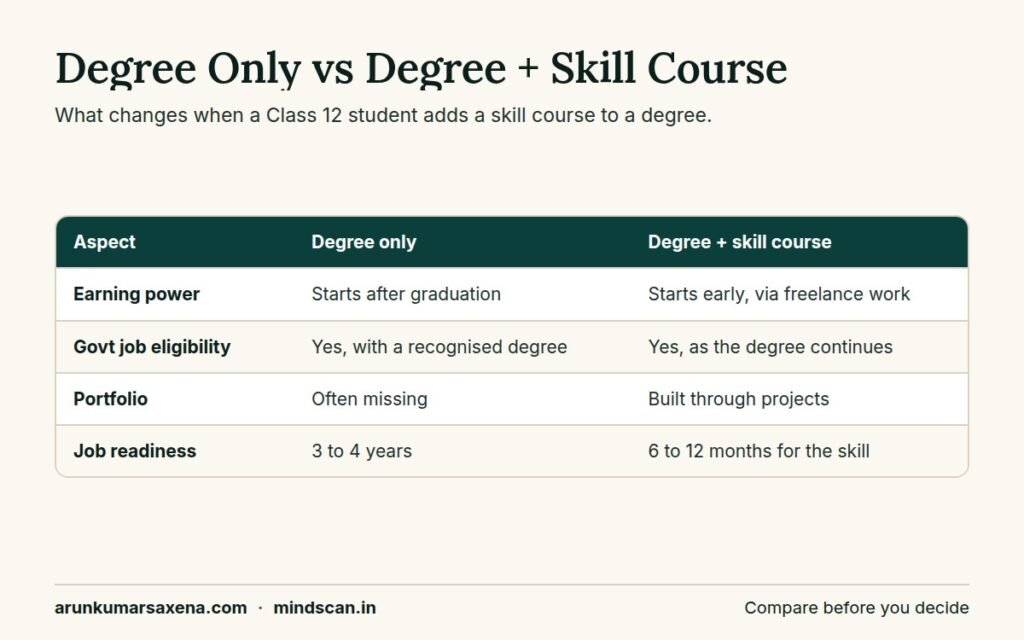
For most Class 12 pass students, the honest answer is both. A degree (even through private or distance mode) preserves eligibility for government exams, postgraduate studies and corporate filters. A parallel skill-based course preserves earning power and builds a CV that stands out. Choosing one over the other is usually a false dilemma.
A degree preserves eligibility for government exams and higher studies. No matter how skilled you are, the UPSC, SSC, banking and many PSU exams still ask for a recognised degree certificate. Even private companies often use degree filters in their applicant tracking systems. Dropping the degree entirely closes doors that a 19-year-old cannot yet see.
A skill-based course preserves earning power and CV strength. While classmates spend three years in lectures, a student with a parallel bootcamp in data analytics or digital marketing can freelance, intern and build a portfolio. By graduation day, she has two things: a degree certificate and proof that she can deliver work.
“A lower middle class family for counseling their son last year. The boy, realizing his family circumstances wanted to start earning money quickly but parents wanted a B.Com degree for him first. After conducting the Psychometric assessment I asked him to take a 6 month intensive data analytics and visualization boot camp and pursue the B.Com degree via Pvt mode instead of the regular. After completing his bootcamp, he landed a remote analyst role at 45K while his friends were still pursuing their Graduation. Next year, he will complete his B.Com also.” (Arun Kumar Saxena)
Skill-based courses after graduation: how do you escape a low-salary job trap?
The biggest mistake families make after graduation is panic-pushing the graduate into any job. Telecalling, back-office data entry, walk-in sales roles. The logic is “any experience is good experience.” It is the most destructive career advice I hear repeated in middle-class homes. That first salary figure becomes a label that follows the candidate into every future switch.
When a graduate sits at home for a few months, parents panic. Their anxiety is real and understandable. But forcing a child into a low-paying job that does not match their potential stains the CV permanently. Next year, when they try for a better role, recruiters assess them not on their graduation marks or their aptitude, but on that low-salary label and the low-skill work profile. The switch becomes harder, not easier.
The better path is to wait briefly and upskill with a targeted skill-based course aligned to verified potential. A two to four month gap spent on a rigorous bootcamp, building a portfolio and applying to roles that match the new skill, yields a completely different career trajectory. More importantly, the work profile sets a foundation for growth rather than a ceiling.
I tell families in this situation to treat the post-graduation window as an investment period, not a panic period. A graduate who spends three months learning data analytics, digital marketing or UI/UX design and builds three solid projects will enter the market at a different level than one who took the first calling job available. The skill-based course often pays for itself in the first two months of the better salary.
Are free government skill courses worth it?
Yes, as a starting point. The Skill India Digital Hub (SIDH) and the National Career Service portal (Ministry of Labour and Employment, Government of India) offer free courses across IT, digital marketing, coding and AI with certificates. These certificates create opportunity. They do not, by themselves, create competence. Depth comes from structured, often paid, learning combined with real projects.
Free government certificates open doors. They signal to an employer that you took initiative. But in an interview, nobody asks to see your certificate. They ask what you built, what problems you solved and how you think. A candidate with one paid, project-heavy bootcamp and a live portfolio will beat a candidate with ten free certificates and no proof of work every single time.
The smart approach is to combine free government courses with real projects. Take a free digital marketing course on SIDH to learn the fundamentals. Then run a small live campaign for a local shop, document the results and add it to your portfolio. Take a free coding course, then build and deploy a working web app. The free course gives you structure. The project gives you proof.
Free skill-based courses are a launchpad, not a destination. Use them to test whether you like a field before paying for an advanced programme. Use them to build foundational vocabulary. But do not expect a free certificate alone to change your earning power. The market pays for output, not for completion badges.
How do you choose the right skill-based course for yourself?
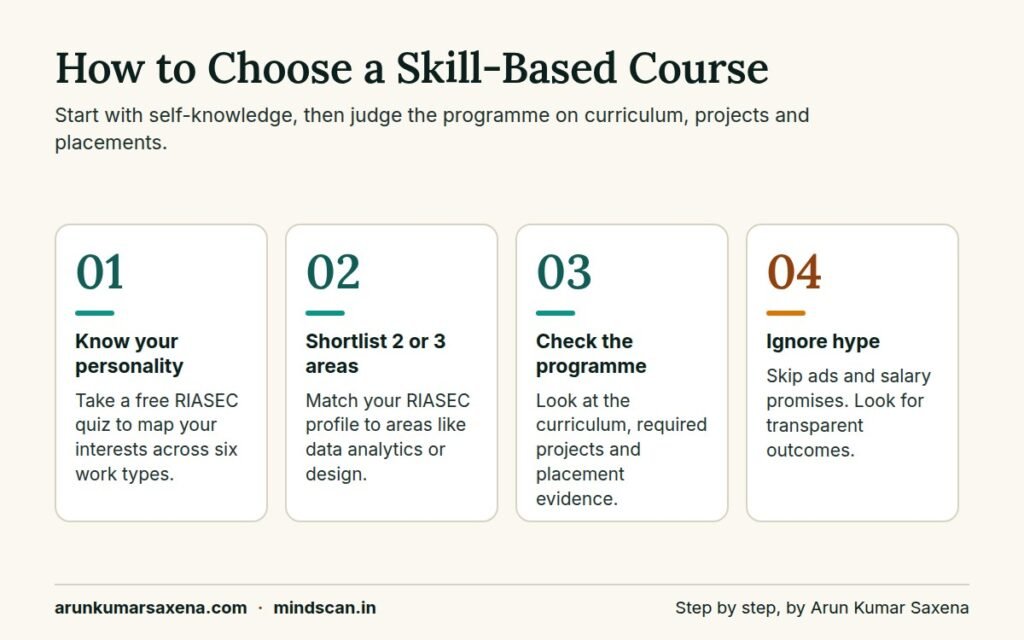
Start with self-knowledge before you open a single course brochure. This ordering is the core framework from my book “3 Steps to Knowing Yourself”: self-understanding comes before any career choice. Verify your career personality with a psychometric or RIASEC-based assessment, shortlist two to three course categories that match, then check curriculum, projects and placement evidence before paying.
- Verify your career personality first. Take the free RIASEC career personality quiz. It maps your interests across six work types and eliminates skill-based courses that are clearly a bad fit for who you are.
- Shortlist two to three course categories that match your RIASEC profile. An Investigative and Conventional student may shortlist data analytics and coding. An Artistic and Enterprising student may shortlist digital marketing and UI/UX design.
- Evaluate specific programmes on three criteria. Check the curriculum for current tools and practices, not a recycled syllabus. Check the projects: does the course require a portfolio, or only multiple-choice quizzes? Check placement evidence: can the institute show you names and roles of placed students?
- Ignore ads, urgency claims and salary guarantees. A good skill-based course is transparent about what you will learn, what you will build and where past students work. If an institute cannot answer these three questions clearly, walk away.
- Commit to building proof of work. The certificate adds zero rupees to your salary. Employers pay for what you can do on day one. Treat the course as a starting point and keep building, freelancing and improving after it ends.
The MINDSCAN approach to this decision is systematic. Our psychometric assessment maps a student to 20+ career groups, not just one or two popular options. This breadth matters because many students discover high-potential paths they had never considered. Once the career personality is clear, the choice of skill-based course becomes obvious rather than overwhelming. You can explore online career counselling with Arun Kumar Saxena to get this clarity in a structured session.
How much can you earn after a skill-based course?
Income varies widely by skill, city, portfolio quality and proof of work. But anyone promising fixed daily earnings like 5000 rupees per day is selling marketing hype, not skills. Reject those guarantees outright.
Earnings depend on three things: your portfolio, the depth of your skill and the market you are accessing. A data analytics bootcamp graduate with a strong portfolio of dashboards and case studies can target remote roles paying approximately 40K to 60K per month. A digital marketing course graduate with live campaign results can charge per client or land an in-house role at approximately 30K to 50K. A coding bootcamp graduate with deployed projects can start at similar ranges in product companies or agencies.
The certificate itself adds zero rupees to your salary. Employers pay for what you can do on day one. This is why project work during the course is non-negotiable. A skill-based course without a portfolio component is incomplete, no matter how famous the brand.
Reject any advertisement that guarantees a fixed daily income. “Earn 5000 per day after our course” is a red flag. Real income depends on your effort, your aptitude and the market. A good skill-based course improves your odds dramatically. It does not print money. The students who earn well after skill-based courses are those who treated the course as a starting point and kept building, freelancing and improving after it ended.
Degree vs skill-based course vs both: quick comparison?
A degree builds broad theory and preserves eligibility for government exams and higher studies. A skill-based course builds a specific, job-ready capability in months and preserves earning power. Doing both in parallel gives most Class 12 students a safety net plus immediate CV strength, while taking any job first and upskilling later risks a permanent low-salary label.
| Option | Time and cost | Best for | Main risk |
|---|---|---|---|
| Regular degree only | 3 to 4 years, moderate to high cost | Students targeting government exams, academia or professions requiring a degree licence | Graduating with no employable skill and facing a low-salary job trap |
| Skill-based course only | 3 to 12 months, low to moderate cost | Students who need immediate income and have a clear, verified aptitude for the skill | Missing eligibility for government jobs, higher studies and corporate filters that require a degree |
| Degree + skill course in parallel | 3 to 4 years, combined moderate cost | Most Class 12 pass students who want both a safety net and immediate earning power | Requires discipline to manage both tracks; poor time management can hurt both |
| Any-job first, upskill later | Immediate start, low initial cost | Families in financial crisis who cannot afford even a short gap | A low-salary label stains the CV and makes future switches harder; upskilling while working is exhausting |
Frequently asked questions about skill-based courses
Which is the best skill course?
There is no single best skill-based course for everyone. The best course matches your verified career personality, your family’s financial timeline and actual market demand. Data analytics, digital marketing, coding and UI/UX design are high-demand areas, but the right pick depends entirely on your aptitude. Take a RIASEC-based assessment first, then shortlist skill-based courses that fit your profile.
What are the 7 types of skills?
Skills are commonly grouped into seven types. 1. Hard skills: technical, job-specific abilities like coding or data analysis. 2. Soft skills: communication, teamwork, problem-solving. 3. Transferable skills: project management, leadership. 4. Digital skills. 5. Creative skills. 6. Trade skills. 7. Life skills. For career decisions, focus on the cluster where your aptitude and market demand overlap rather than trying to learn all seven.
What are the top 5 demand skills?
As per online sources, approximately five skill clusters dominate hiring demand in India: data analytics and visualisation, digital marketing and content creation, coding and AI-assisted development, communication and workplace soft skills, and skilled trades with a design or technology layer. Each of these skill-based courses has real hiring demand and decent starting pay when backed by a portfolio.
Which skills earn money?
Skills that solve a business problem earn money. Data analytics, digital marketing, coding, UI/UX design, video editing and technical trades all have paying demand. The key is not just completing a skill-based course but building proof of work through projects. Employers pay for output, not certificates. A portfolio with real results earns money; a completion badge alone does not.
How to earn ₹5000 daily?
Any advertisement promising a fixed daily income of 5000 rupees after a skill-based course is marketing hype. Real income depends on your skill depth, portfolio quality, market access and consistency. Some experienced freelancers in high-demand fields like software development or performance marketing do earn such amounts, but it takes months or years of work, not a short course.
What is a high income skill?
A high income skill is a capability that businesses pay a premium for because it directly impacts revenue or efficiency. Examples include data analytics, software development, performance marketing, sales and UI/UX design. A skill-based course can teach the foundations, but high income comes from combining that skill with deep practice, a strong portfolio and the ability to communicate results.
Skill-based courses are not a shortcut. They are a tool. Used with self-knowledge and a clear plan, they can change a career trajectory in months. Used blindly, based on a YouTube trend or a relative’s suggestion, they waste time and money. The difference is always the same: know yourself first, then pick the skill-based course.
If your family is debating this decision right now, do not let another results day or another year of “we will figure it out later” pass by. Book a session of online career counselling with Arun Kumar Saxena and get a verified career personality report that maps you to 20+ career groups. Or start with the MINDSCAN AI Career Clarity Report at ₹1,499 on mindscan.in. The report with a counselling session is ₹2,999. Either way, you will walk out with a plan, not just a list of courses.
About the author: Arun Kumar Saxena is a Certified Advanced Career Coach and the founder of MINDSCAN Career Guidance, with 22 years of experience and 20,000+ students and professionals guided. A former corporate leader at Airtel and Reliance, a CBSE Resource Person and the author of 3 Steps to Knowing Yourself, he and his MINDSCAN team counsel students, parents and professionals online across India. Call +91-9140604743 or visit mindscan.in.