Career Options After 12th Commerce Without Maths
By Arun Kumar Saxena, Certified Advanced Career Coach · Updated November 2026
Quick answer: The best career options after 12th commerce without maths include B.Com, BBA, integrated law (BA LLB/BBA LLB), Company Secretary (CS), ACCA, digital marketing, hotel management, journalism and B.A. Economics. For high salary potential, CA, CS, ACCA, BBA+MBA and integrated law lead the pack, with CA and CS professionals earning approximately ₹8-15 lakhs per annum at entry level as per online sources. None of these require maths in Class 12. The right choice depends on your interests and aptitude, which Arun Kumar Saxena verifies scientifically before recommending any course.
Career options after 12th commerce without maths are wider than most students and parents believe. The fear that skipping maths closes doors is common, but the reality is different. This page is for every Class 12 commerce student who chose the stream without maths, and for every parent worried about what comes next. It cuts through the noise of endless course lists and gives you a clear, honest way to decide.
With 22 years of experience and 20,000+ students and professionals guided, I have seen too many bright students pick a course because a cousin did it or because it sounded impressive, only to switch streams a year later. A wasted year is a heavy price. Here I lay out every solid option, compare them honestly, and give you a simple framework to find the one that actually fits you.
Table of Contents
What are the best career options after 12th commerce without maths?
The top options are B.Com, BBA, integrated law, Company Secretary (CS), digital marketing, hotel management, journalism and mass communication, and B.A. Economics. None of these require maths in Class 12. The best option is the one that matches your personality and interests, not the one that sounds most impressive.
B.Com covers accounting, taxation and corporate law without advanced maths. BBA builds management skills and is a strong stepping stone to an MBA. CS focuses on corporate governance, company law and compliance. Each path rewards a different working style, and that is the real filter most students skip.
Picture a Class 12 student who enjoys reading business news and debating company decisions. Law or CS may fit her better than B.Com. Another student who loves organising events and talking to people may find BBA or hotel management far more natural. The course name alone tells you nothing about fit. Exploring career options after 12th commerce without maths means looking past the labels.
Is CA possible without maths?
Yes, CA is possible without maths. The CA course requires strong accounting and tax skills, not advanced mathematics. Basic business arithmetic appears in the foundation modules, which commerce students handle comfortably. What decides success is consistency and interest in accounts, not whether you studied maths in Class 12.
CA entry is open after Class 12 through the foundation route. The heavy subjects are accounting, auditing and taxation. Students who fear maths but enjoy accounts often do well in CA. The real test is discipline over three to five years of articleship and exams, not your Class 11 subject list.
I have seen students who scored modestly in Class 10 maths clear CA Intermediate because they had a genuine feel for accounts. The opposite also happens: students with strong maths who dislike the volume of theory in auditing struggle badly. Interest in the subject matter beats stream labels every time. Among the career options after 12th commerce without maths, CA is one of the most respected.
Which course after 12th commerce has the highest salary?
CA, CS and ACCA lead the professional route; BBA followed by an MBA and integrated law also reach high salary levels. No course pays well automatically. Salary depends on the college, your skills, internships and how deliberately you build your profile from the first year, not on the course name alone.
Professional courses reward persistence with strong earning potential. An MBA after BBA is one of the most reliable high-salary paths. Skills like digital marketing can outpay degrees if built seriously. The common thread is depth: a CA who clears all levels in the first attempt and a digital marketer with a strong portfolio both earn well. For authoritative details on the CA path, visit the official ICAI website.
What hurts earning potential is a passive degree. A student who does a plain B.Com from a local college with no internships and no professional qualification will find the job market tough, maths or no maths. Early career planning makes the difference. When scanning career options after 12th commerce without maths, look at the long-term salary trajectory, not just the starting figure.
How do I choose between B.Com, BBA and law without maths?
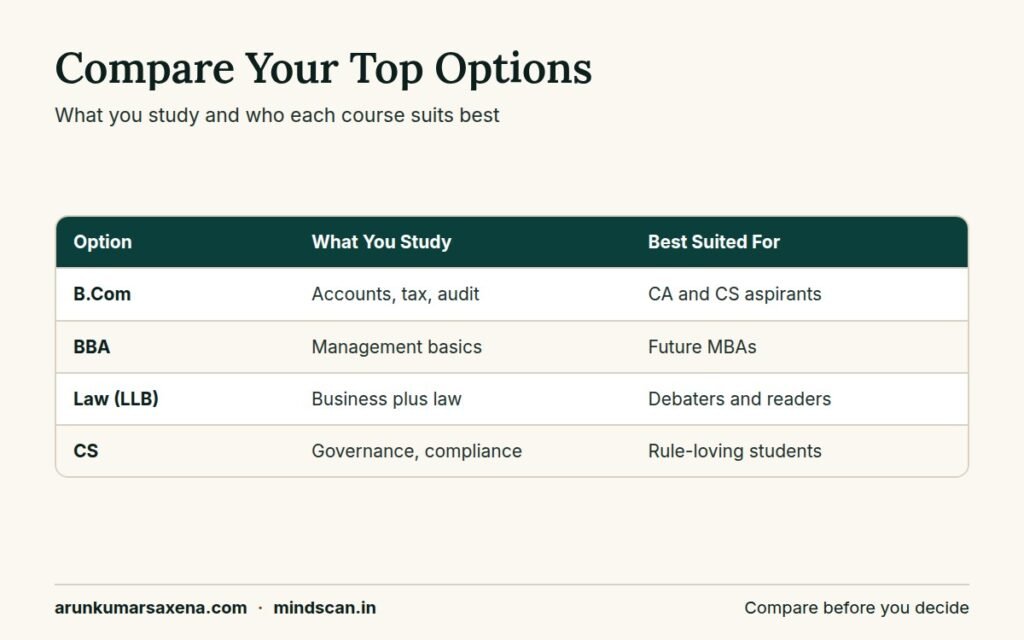
Match the course to your working style: B.Com suits detail-oriented students who like accounts and rules; BBA suits communicators who like leading and organising; law suits debaters who like reading and argument. I use a psychometric assessment plus a self-knowledge framework to confirm this fit before a student commits three or more years.
Use the free RIASEC career personality quiz as a first filter. B.Com leads to CA, CS, M.Com and accounting careers. BBA leads to MBA, marketing, HR and management careers. Law opens corporate litigation, judiciary and legal advisory roles.
In many homes, the dinner-table debate is B.Com versus BBA, with relatives weighing in. A psychometric assessment cuts through that noise. It measures your interests and aptitude against 20+ career groups and shows you, on evidence, which direction fits. That clarity is worth far more than a cousin’s opinion. These career options after 12th commerce without maths are all solid, but only one is solid for you.
What are the career options after 12th commerce without maths with high salary in India?
High-salary paths include CA, CS, CMA, ACCA, corporate law through BBA LLB, investment-related roles via B.Com plus professional certifications, and digital marketing. These careers do not need Class 12 maths. What they do need is professional depth, which is why early guidance matters more than the stream label.
Corporate law through a five-year integrated LLB is a maths-free high-salary route. ACCA offers a globally recognised alternative to CA. Digital marketing rewards skill and portfolio over degrees. Each path demands sustained effort, but none demands trigonometry.
| Option | What You Study | Best Suited For | Salary Potential (as per online sources, approximately) |
|---|---|---|---|
| B.Com | Accounting, taxation, auditing, corporate law | Detail-oriented students aiming at CA, CS or M.Com | ₹3-6 lakhs per annum (entry); higher with professional qualifications |
| BBA | Management, marketing, leadership basics | Communicators aiming at MBA and corporate roles | ₹4-8 lakhs per annum (entry); ₹15-25 lakhs post-MBA from a top school |
| Integrated Law (BA LLB / BBA LLB) | Law combined with business or arts | Students who enjoy reading, argument and corporate or litigation careers | ₹5-12 lakhs per annum (entry at a good firm) |
| Company Secretary (CS) | Corporate governance, company law, compliance | Disciplined students who like rules and structure | ₹6-12 lakhs per annum (entry); rises steeply with experience |
| Chartered Accountancy (CA) | Accounting, auditing, taxation, corporate law | Disciplined students who enjoy accounts and can sustain long-term effort | ₹8-15 lakhs per annum (entry); rises steeply with experience |
| Digital Marketing | Brand promotion, content, analytics basics | Creative, self-driven students who prefer skill over degree | ₹3-7 lakhs per annum (entry); ₹10-20 lakhs with a strong portfolio |
| Hotel Management | Hospitality and tourism operations | Outgoing students who like service and travel | ₹3-6 lakhs per annum (entry); higher in luxury chains and abroad |
| B.A. Economics | Economics theory and policy | Analytical students comfortable with data but not heavy maths | ₹3-5 lakhs per annum (entry); ₹8-15 lakhs with a master’s degree |
This table is your first filter. Read the third and fourth columns carefully. If you see yourself in a description, that option deserves a closer look. If none fits, the problem is not you; it is that you need a scientific assessment to surface options you have not considered. The right career options after 12th commerce without maths will align with both your interests and your financial goals.
What skill-based careers can I start without a traditional degree path?
Digital marketing, event management, travel and tourism, fashion design and mass communication are skill-first careers open to commerce students without maths. In these fields your portfolio and practical work matter more than your degree. A structured skill-based course plus early internships beats a passive three-year degree.
Digital marketing roles reward demonstrated results, not marks. Event and hospitality careers grow through hands-on experience. Government skilling platforms such as the Skill India Digital Hub offer free and low-cost certifications that build a credible portfolio while you study.
A commerce background is actually an advantage here. A digital marketer who understands pricing, margins and client budgets has an edge over one who only knows content creation. The same applies to event managers who can handle vendor negotiations and budgets. Your commerce knowledge is an asset, not a limitation. Many career options after 12th commerce without maths are skill-first and portfolio-driven.
How do I know which career actually fits me?
Start with self-knowledge before course lists. My approach, set out in my book ‘3 Steps to Knowing Yourself’, puts understanding your interests, aptitude and personality before any career choice. A psychometric assessment such as the MINDSCAN AI Career Clarity Report maps you to 20+ career groups so you choose on evidence, not on relatives’ opinions.
Interests and aptitude can be measured scientifically. A career chosen on fit has far lower chances of a mid-course switch. Class 12 is late but not too late; clarity now saves years.
“Analyse your child’s aptitude scientifically and check the scores critically before taking any decision.” (Arun Kumar Saxena)
What most guides miss: the fit-first framework
Most career pages dump a list of courses and stop there. That is like handing someone a menu without asking if they are hungry for South Indian or Chinese. The question is not “which course is best” but “which course is best for this particular student.”
Here is a simple three-question filter. First, what kind of work holds your attention for two hours without a break: numbers, words, people or ideas? Second, what feedback have teachers and friends given you repeatedly about what you are good at? Third, what career stories or professionals do you genuinely admire, and why?
The answers usually point to two or three career groups. A psychometric assessment then confirms or corrects that hunch with data. This sequence, self-reflection first and scientific check second, prevents the most common mistake: picking a course because it sounds good and regretting it by the second semester. This is the missing step in most lists of career options after 12th commerce without maths.
What should I do this month if I am in Class 12 commerce without maths?
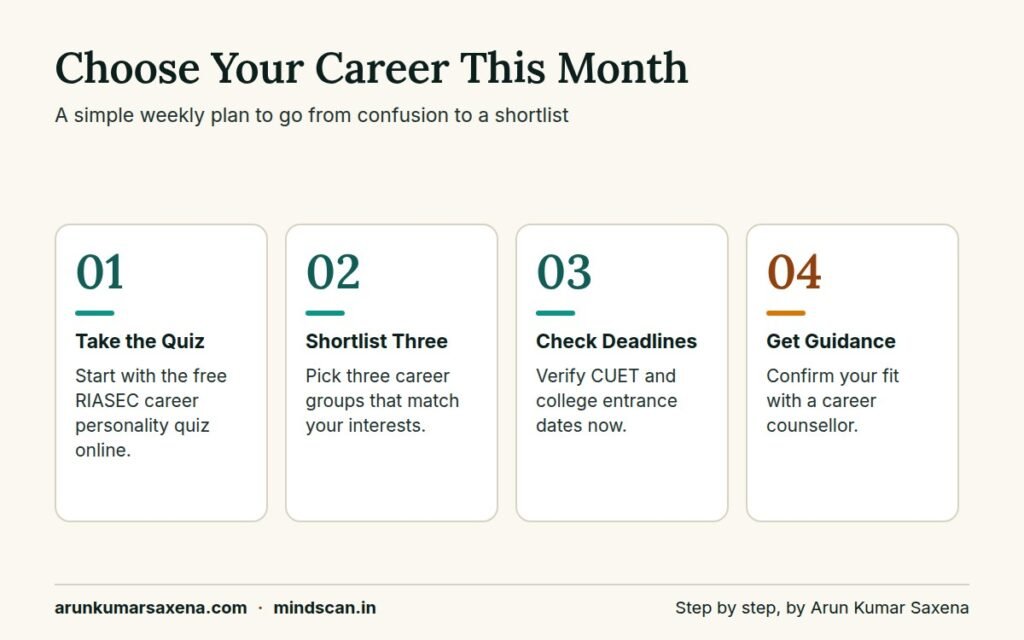
Follow a simple sequence: take a free career personality quiz, shortlist three career groups, verify entrance requirements, check college and CUET timelines, talk to a career counsellor if confusion remains, and start one skill that strengthens your chosen direction. You can complete all of this within a few weeks.
CUET is the main route to central universities for commerce students. Early internships or certifications strengthen any application. A counsellor spots mismatches before they cost you years.
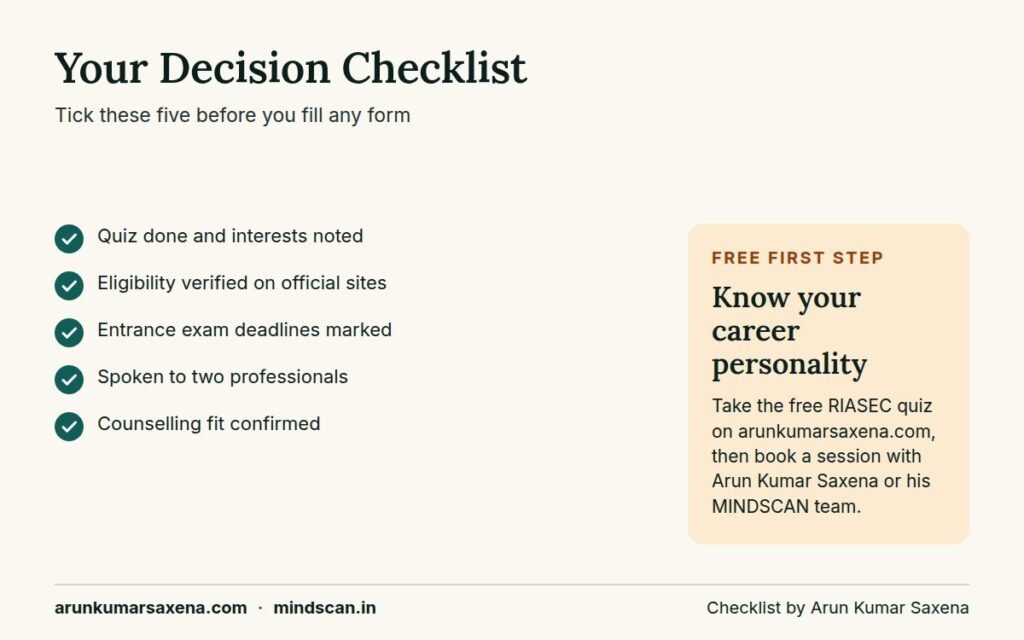
- Take the free RIASEC career personality quiz online today and note your top two interest types.
- Shortlist three career groups from this page that match your quiz result.
- For each group, verify eligibility and entrance requirements on official sources such as the National Career Service portal of the Ministry of Labour and Employment, Government of India.
- Check CUET and other entrance timelines for your target colleges and mark the deadlines.
- Talk to two people working in your shortlisted careers about their real daily work.
- Book a session with a career counsellor if your shortlist is still unclear or family opinions conflict.
- Start one free online skill course (for example digital marketing basics or financial accounting) this month.
This list is designed to move you from confusion to action. Most students spend months scrolling course lists and talking to relatives. You can finish these seven steps in two to three weeks and have a clear direction before your classmates do. Taking action is the only way to turn career options after 12th commerce without maths into a real plan.
Is commerce without maths a disadvantage for jobs?
No. Commerce without maths closes almost no career door that commerce with maths opens at the undergraduate level. Recruiters hire for skills, internships and professional qualifications. The only honest caveat is a few finance specialisations later, where comfort with numbers matters, and even those can be built through practice.
CA, CS, CMA and ACCA all accept students without Class 12 maths. Employers test aptitude at interviews, not your Class 11 subject list. The self-imposed belief that “no maths means no future” is the real disadvantage.
I have seen commerce-without-maths students become successful CAs, corporate lawyers and digital marketing heads. Their common trait was not a subject they studied in school. It was that they built professional depth early and did not waste time feeling inferior about a stream choice that, in practice, hardly matters. The best career options after 12th commerce without maths prove that your stream label does not define your ceiling.
Frequently asked questions about career options after 12th commerce without maths
Can I do B.Com without maths in Class 12?
Yes. B.Com does not require maths in Class 12; the core subjects are accounting, business studies, economics and taxation. Some top colleges prefer maths for B.Com (Hons), but general B.Com is fully open. Check individual college eligibility criteria before applying. For more on this, see the detailed guide on career options after 12th commerce without maths.
Which government exams can I write after 12th commerce without maths?
You can prepare for SSC, banking, most defence and other central and state government recruitment exams after Class 12. None require commerce with maths as a subject. A dedicated guide to exams for government jobs after 12th lists the full set of options and timelines.
Is BBA better than B.Com for students without maths?
Neither is better in general. B.Com suits students who like accounts, taxation and structured professional courses like CA or CS. BBA suits students who prefer management, communication and marketing, usually followed by an MBA. The right answer depends on your personality, which a psychometric assessment can confirm.
Can I become a financial analyst without maths in Class 12?
Yes, through B.Com or B.A. Economics followed by certifications such as CFA. The maths involved is workable statistics and financial modelling, learned during the degree, not Class 12 mathematics. Strong analytical interest matters more than your stream combination.
How much does a career counselling session with Arun Kumar Saxena cost?
The MINDSCAN AI Career Clarity Report costs ₹1,499, and the report with a counselling session costs ₹2,999. Booking is through the online career counselling in India with Arun Kumar Saxena page, which lists all services and pricing.
What is the best age to start career counselling?
Class 8 onwards is the best age to start career counselling, because subject and stream decisions begin early. Class 12 students still gain enormously, since course and college choices made now shape the next five years, but earlier guidance prevents most stream-related regret.
Can I switch from commerce without maths to a design or creative career later?
Yes. Design, mass communication, event management and digital marketing accept students from any stream, and several accept entries through portfolio or entrance tests after Class 12. Commerce knowledge is actually an advantage for freelancers and creative professionals who must price, market and manage their own work.
The list of career options after 12th commerce without maths is long, but a list alone does not tell you which one is yours. That answer comes from understanding your own interests and aptitude first. My MINDSCAN team and I help you find that answer scientifically, in one session, so you do not waste a year on the wrong course. Book your online career counselling in India with Arun Kumar Saxena and start with the MINDSCAN AI Career Clarity Report. Clarity now saves years later.
About the author: Arun Kumar Saxena is a Certified Advanced Career Coach and the founder of MINDSCAN Career Guidance, with 22 years of experience and 20,000+ students and professionals guided. A former corporate leader at Airtel and Reliance, a CBSE Resource Person and the author of 3 Steps to Knowing Yourself, he and his MINDSCAN team counsel students, parents and professionals online across India. Call +91-9140604743 or visit mindscan.in.