Best B Tech Courses for Future in India (2026 Guide)
By Arun Kumar Saxena, Certified Advanced Career Coach · Updated November 2026
B Tech (Bachelor of Technology) is a four-year undergraduate engineering degree that prepares students for careers in technology, manufacturing, infrastructure and research. The search for the best b tech courses for future usually begins with a salary list and ends with a JEE rank. That sequence is backwards. Students and parents spend months chasing a branch name, only to discover after four years that the degree fits a trend, not the student. This page is for Class 11 and 12 students, droppers, and their parents who want to pick a B Tech branch with clarity, not panic.
With 22 years of experience and 20,000+ students and professionals guided, I have seen the same costly mistake repeat itself: a family picks a branch because a neighbour’s son got a high package, then watches their own child struggle through subjects they never wanted to study. The best b tech courses for future are not a fixed list. They are the branches where a student’s natural strengths meet real-world demand. This guide tells you how to find that intersection.
Table of Contents
Which are the best B Tech courses for future in India?
Computer Science, AI and Machine Learning, Data Science, Cybersecurity, Electronics and Communication (VLSI), and Robotics lead future demand, while Mechanical, Electrical and Civil remain evergreen because of EVs, semiconductors and smart infrastructure. The right pick depends on the student’s fit, not just the trend list.
Every year a new list of the best b tech courses for future appears online, and every year it changes slightly. What does not change is the student sitting in front of the screen. A branch that tops a demand chart today may saturate by the time a Class 11 student graduates. Self-knowledge, on the other hand, compounds over time. When you know whether you think in code, circuits, or physical systems, you can map yourself to any future list.
Parents often ask me to name the single best branch. I refuse, because that question assumes all students are identical. They are not. A child who takes apart a mixer-grinder to see how it works belongs in a different branch from a child who builds a Discord bot for fun. Both can earn well. Both can build a future. But only if the branch matches the wiring.
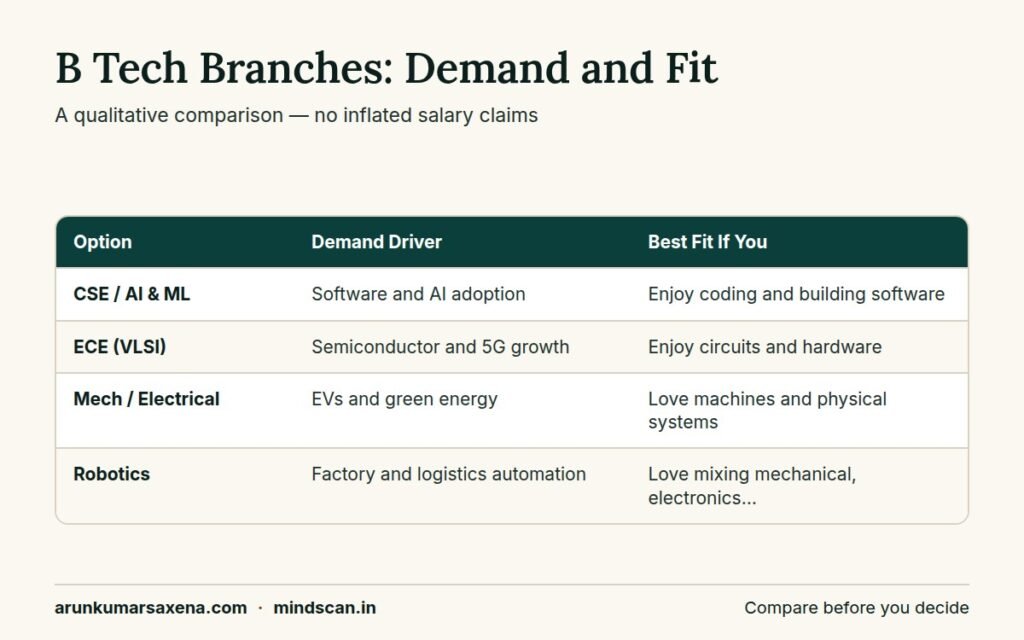
Below is a qualitative look at five branches that consistently appear in discussions of the best b tech courses for future, along with the kind of student each one suits.
| B Tech Course | Future Demand Driver | Best Fit If You… | Salary Outlook |
|---|---|---|---|
| Computer Science / AI & ML | Software everywhere, AI adoption | Enjoy coding and building software | Typically highest entry packages, as per online sources |
| Data Science & Cybersecurity | Data explosion and rising cyber threats | Enjoy maths, patterns and security thinking | Strong entry packages, as per online sources |
| Electronics & Communication (VLSI) | Semiconductor and 5G surge | Enjoy circuits and hardware | Moderate entry, strong for semiconductor specialists |
| Mechanical / Electrical (EV, Green Energy) | EVs and renewable energy | Love machines and physical systems | Moderate entry, strong for EV and energy specialists |
| Robotics / Mechatronics | Automation of factories and logistics | Love blending mechanical, electronics and code | Moderate entry, rising with automation demand |
Notice that every branch in this table has a real demand driver. None is a guess. The semiconductor push, for instance, is backed by the Government of India’s production-linked incentive scheme and visible on the National Career Service portal of the Government of India, and approved courses can be verified on the AICTE portal. The EV surge is visible on Indian roads every day. These are not fads.
Still, a demand driver is only half the equation. The other half is the student’s own pattern. Picture a student who loves thermodynamics but is pushed into CSE because of a placement headline. The best b tech courses for future are the ones a student will actually finish with energy left to build a career.
Which engineering branch has the highest salary in India?
Computer Science, AI and Data Science branches typically show the highest starting packages, especially from top colleges, but salary depends far more on the college tier, skills and internships than on the branch name itself. A mediocre CSE student often earns less than a strong core-branch engineer.
Instagram reels and coaching-institute posters have convinced a generation that CSE equals a crore-plus package. The truth is messier. A student from a tier-1 college with strong coding skills and two good internships may indeed land a high package. A student from a tier-3 college who coasted through CSE with backlogs will not, no matter what the branch is called.
I advise families to check the placement data of the specific colleges they can realistically get, not the headline packages of the top IITs. The Skill India Digital Hub also lists in-demand skills that often matter more to employers than the branch name on the degree. A Mechanical engineer who learned battery-management systems on their own can out-earn a CSE graduate who never built a project.
The best b tech courses for future from a salary angle are the ones where the student will voluntarily put in the extra hours to become excellent. Excellence, not the branch label, drives the package.
Is BTech still worth it in 2030?
Yes, BTech remains worth it in 2030 for students who genuinely enjoy problem-solving, because AI, semiconductors, EVs and cybersecurity are all engineering-driven. It is a poor choice only when taken under parental or peer pressure with no interest in the field.
The question hides a fear: will AI make engineers obsolete? The answer is no, but it will make generic engineers obsolete. A BTech graduate who can use AI tools to design, simulate or secure systems is more valuable than one who cannot. The degree itself is not the risk. The risk is spending four years collecting a certificate without building any skill that a machine cannot replicate faster.
BTech in 2030 is like a gym membership. It gives you access to equipment and a structure, but the results come from what you do inside it. A student who joins a branch out of genuine curiosity will find ways to learn. A student who joins because their parents told them to will find ways to avoid learning. The best b tech courses for future will be the ones where the student’s curiosity and the curriculum overlap.
Before committing four years and several lakhs of fees, a student should take a psychometric assessment to check whether engineering itself is the right fit. I have guided students who discovered, through assessment, that their aptitude lay in design or management, not engineering. That discovery, made early, saves years.
Which B Tech branch should I choose for future employment if AI keeps growing?
Branches where AI is the tool, not the threat, are safest: CSE, AI/ML, Data Science, Cybersecurity, VLSI/ECE and Robotics. Core branches like Mechanical and Electrical survive because AI cannot install, build or maintain physical systems; engineers who use AI tools outperform those who avoid them.
The panic around AI is real, but it is misdirected. AI can write code. It cannot climb a transmission tower, debug a faulty circuit board on a factory floor, or design a thermal management system for an EV battery pack. These tasks need engineers who understand the physical world. The best b tech courses for future in an AI-heavy world are those that either build the AI or build the world AI runs on.
Cybersecurity demand, for instance, rises directly with AI adoption because every new AI system creates new attack surfaces. VLSI and chip design are booming because AI models need custom silicon. These are not guesses. They are visible in the hiring patterns of semiconductor companies and the government’s chip-manufacturing push.
I advise students to think of themselves as AI-augmented engineers, not AI-proof engineers. Learn the branch deeply, then learn how AI tools accelerate work in that branch. A civil engineer who uses AI for structural analysis is more employable than one who does not. The branch itself does not need to be AI-flavoured. The engineer’s approach does.
For a deeper look at careers that resist automation, read the detailed guide on AI-proof careers in 2030 and what to study now.
How do I choose a B Tech branch before my JEE Main 2027 rank comes out?
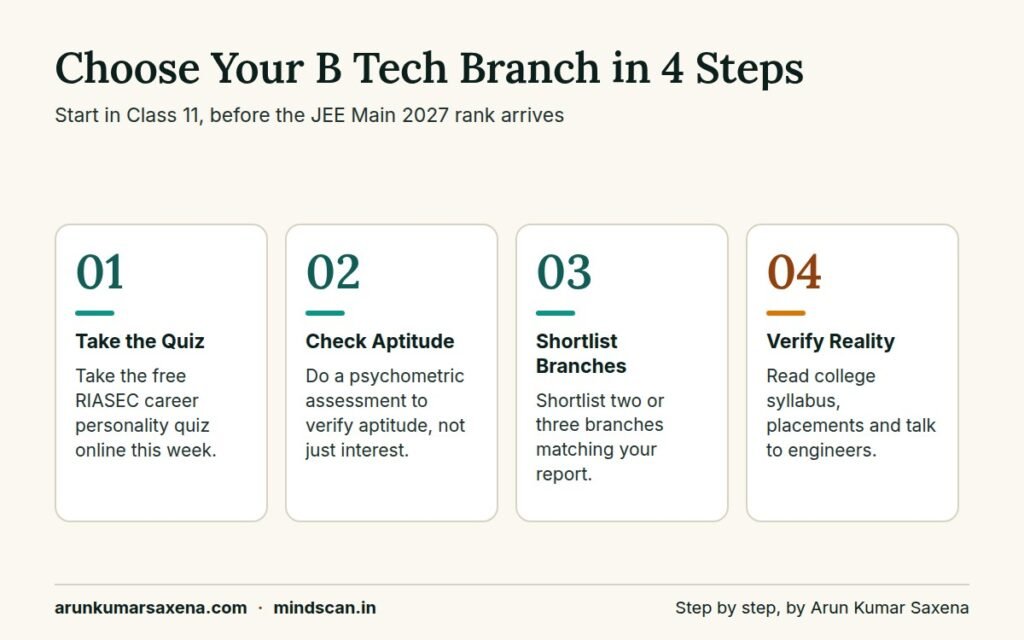
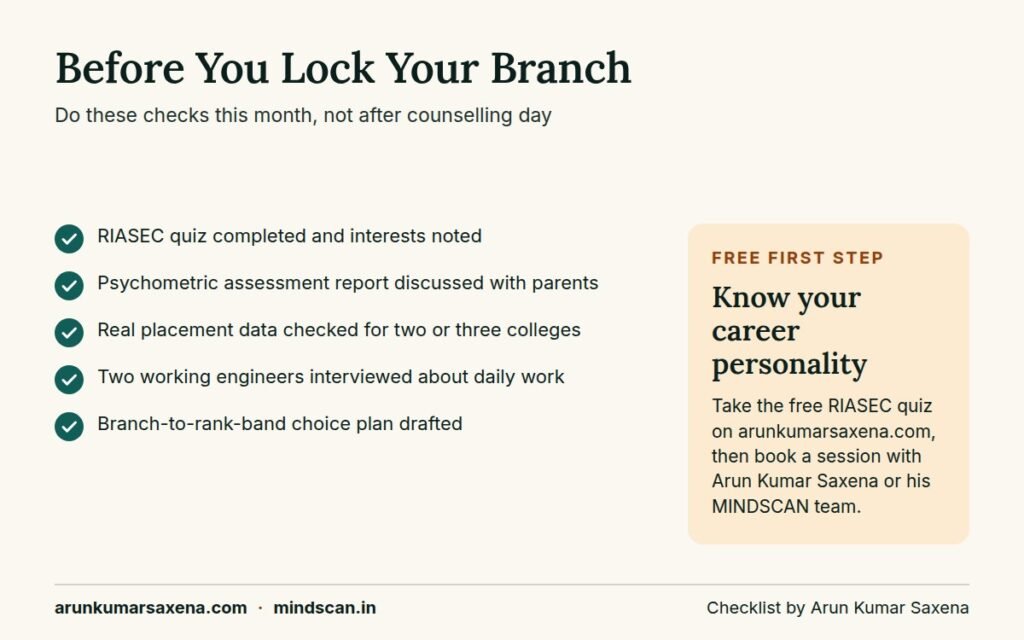
Start in Class 11: take a psychometric or RIASEC assessment, shortlist two or three branches that fit your profile, research their syllabus and placements, and talk to real engineers. Then map each branch to realistic JEE rank bands so choices are filled with clarity, not panic.
Most families do the opposite. They wait for the rank, then scramble through YouTube videos and WhatsApp forwards to pick a branch in three days. That is how a student ends up in a branch they had never heard of, in a college they cannot locate on a map, studying subjects they hate.
Here is a step-by-step sequence that starts with the student. It works because it starts with the student, not the rank.
- Take the free RIASEC career personality quiz online this week to see your interest pattern.
- Get a psychometric assessment done (Class 8 onwards is the right age to start) to check aptitude, not just interest.
- Shortlist two or three B Tech branches that match your report instead of one ‘trending’ branch.
- Read the actual syllabus and placement data of those branches at three or four realistic colleges.
- Talk to at least two working engineers from those branches about their real day-to-day work.
- Match each branch to your realistic JEE Main 2027 rank bands and build your choice-filling plan.
- Book a career counselling session with a certified coach if you and your parents still disagree on the branch.
Step one alone changes the conversation. When a student sees their RIASEC pattern, they often realise that the branch their parents are pushing does not match their interests at all. That data point makes the discussion factual rather than emotional.
The MINDSCAN psychometric assessment goes deeper. It maps the student to 20+ career groups and measures aptitude, not just self-reported interest. Many students say they like a subject because they like the teacher, not the work. An aptitude test catches that gap.
Parents, please hear this.
“Analyse your child’s aptitude scientifically and check the scores critically before taking any decision.” (Arun Kumar Saxena)
That one step prevents four years of quiet suffering. I have seen it too many times. A child nods yes to a branch at the dining table because the alternative is an argument. Two semesters later, the backlogs begin.
What most guides miss: the NEET parallel every engineering family should study
Most articles about the best b tech courses for future talk only about branches and salaries. They miss a pattern I see in my counselling sessions every year. A wrong branch choice costs exactly as much as a wrong entrance-exam target, and the damage looks the same.
In many homes, a similar story plays out with engineering. A student picks a branch because a relative is in it, or because a coaching institute called it ‘high-scope’. The student struggles, the parents blame the student, and nobody questions the original choice. The best b tech courses for future are the ones chosen after checking whether the student actually fits the field, not after copying someone else’s dream.
Can I become a CEO after BTech?
Yes, many CEOs began as engineers, but the BTech branch matters less than leadership skills, business understanding and experience built after the degree. An MBA or entrepreneurial path after BTech is a common route; the degree is a foundation, not a shortcut to the top.
I have met students who chose a branch solely because they read that a famous CEO studied it. That is like choosing a breakfast cereal because a cricketer endorses it. The cereal did not make the cricketer, and the branch did not make the CEO.
Leadership roles demand communication, strategic thinking, and the ability to work with people who are smarter than you in their domains. These skills are not taught in any single B Tech branch. They are built through projects, internships, student teams, and later through an MBA or on-the-job experience.
Pick a branch you can genuinely excel in. Good grades and strong projects open doors to good MBA programmes and good first jobs. A student who scrapes through a ‘CEO branch’ with low marks closes more doors than they open. The best b tech courses for future leadership are the ones where you can build a track record of achievement.
For a wider view of what comes after the degree, see the guide on career options after BTech.
What mistakes do students and parents make while choosing a B Tech course?
The biggest mistakes are choosing by last year’s placement headlines, copying a topper friend, waiting for the rank before researching branches, and ignoring the child’s actual aptitude. Arun Kumar Saxena sees families pressurise children into trending branches, then pay for it in four unhappy years.
Trend-chasing is the most expensive mistake because trends change faster than degrees. A branch that was ‘hot’ when the student entered Class 11 may be saturated when they graduate. The student is left with a degree in a crowded field and no genuine interest to differentiate themselves.
The waiting-for-rank mistake is equally damaging. Families treat the JEE rank as the starting gun for research. In reality, the rank should be the final input into a decision that is already mostly made. When you research branches under the pressure of a three-day choice-filling window, you make emotional decisions. Emotional decisions in career choice are almost always wrong.
Coaching institutes add to the problem. Their marketing is built on placement headlines and topper stories. They have no incentive to tell a student that the branch being pushed may not suit them. My approach at MINDSCAN is the opposite: data-verified guidance that starts with the student’s own assessment report, not with a trend list.
The best b tech courses for future are never found by copying a topper friend. A topper’s strengths, interests and circumstances are different from yours. What worked for them may break you. Choose for yourself, using your own data.
Is CSE better than core branches like Mechanical or Electrical for the future?
| Factor | CSE | Mechanical / Electrical |
|---|---|---|
| Daily work | Software, code, data, cloud systems | Physical systems, machines, power, EVs, manufacturing |
| Demand driver | AI adoption, software everywhere | EVs, renewable energy, semiconductors, infrastructure |
| Competition | Very high at entry level | Moderate; skilled core engineers in short supply |
| Switch options later | Widest: data, product, cybersecurity, management | Strong within engineering; EV and energy roles growing |
| Best fit if you… | Enjoy coding and building software | Love machines, circuits and physical systems |
Quick interactive check: answer these five questions and see which side you lean towards.
1. When something breaks at home, do you open it up to see the parts?
2. Which school activity excited you more?
3. Which problem would you rather solve?
4. Physics maths or programming logic?
5. Ideal first job?
This quick check is indicative only. For a data-verified decision, take the MINDSCAN psychometric assessment.
CSE offers wider entry-level opportunities, but Mechanical and Electrical are strong for students who love physical systems, especially with EV, renewable-energy and semiconductor growth. The better branch is the one matching the student’s interests, because top performers in any branch out-earn average performers in CSE.
The CSE versus core debate is the most common argument I hear in Indian homes. Parents see CSE as safe. Students who love machines feel cornered. The truth is that both paths work, but for different people.
CSE gives breadth. A CSE graduate can work in software, finance tech, e-commerce, or start a SaaS company. The entry-level opportunities are numerous. But the competition is also numerous. Standing out requires strong coding skills and continuous learning.
Core branches give depth in physical systems. A Mechanical engineer who understands EV powertrains or an Electrical engineer who understands grid-scale battery storage is in high demand and short supply. The EV and green-energy transitions are creating roles that did not exist five years ago. These roles cannot be filled by a CSE graduate.
Interest-driven performance beats trend-driven mediocrity every time. A student who loves circuits will build better projects in ECE than a student who joined CSE for the package and never wrote a line of code beyond the lab assignment. The best b tech courses for future are the ones that wake you up excited, not the ones that look good on a neighbour’s LinkedIn profile.
If you are still torn between engineering and other paths, the comparison of engineering vs medical after 12th may help clarify the larger direction.
How to pick your B Tech branch in five steps
Most families pick a B Tech branch in the three days after the JEE rank, when anxiety is highest and research is shallow. That is why half the engineering graduates regret their choice. The five steps below reverse the order: decide your b tech course first, then let the rank decide the college, not the branch.
- Observe what you naturally tinker with. A child who opens a mixer-grinder to see how it works thinks differently from one who builds a Discord bot for fun. Hardware tinkerers fit Electronics, Mechanical or Electrical; software tinkerers fit CSE, AI or Data Science.
- Check the demand driver behind each branch. AI runs on software talent, semiconductors power VLSI and ECE, and EVs and green energy drive Mechanical and Electrical. Choose a branch whose driver will still exist when you graduate.
- Check realistic placement data. Look at the median placements of colleges you can actually get into, not the headline packages of the top IITs. A branch placed well at your target college beats a trending branch placed poorly.
- Test yourself with MINDSCAN career guidance. Start with the free RIASEC career personality quiz, then verify aptitude with a psychometric assessment so interest and ability both get checked before you commit four years.
- Decide before JEE rank pressure begins. Build your shortlist in Class 11, map branches to realistic rank bands, and if the family is still divided, book online career counselling in India with Arun Kumar Saxena so the choice is made on data, not panic.
A b tech course chosen this way survives trend changes because the student picked it with self-awareness and market data, not peer pressure. At MINDSCAN Career Guidance, Arun Kumar Saxena uses this exact sequence in our sessions, reviewing every report himself to ensure the student commits to a branch they can build a career on.
Frequently asked questions about best b tech courses for future
Which are the top 3 B Tech courses right now?
By current demand, the top three are Computer Science, AI and Data Science, and Electronics (VLSI). But every ‘top’ list is a snapshot. The best b tech courses for future for any individual student are the ones that match their aptitude and interests. A rank list should be a starting point for research, not a final answer.
What is the best age to start career counselling for engineering?
Class 8 onwards, in my experience. Starting early means stream selection in Class 11 and entrance-exam choices are made with assessment data, not guesswork. The best b tech courses for future are chosen years before the JEE counselling deadline, not in the panic of choice-filling week.
How much does a career counselling session with MINDSCAN cost?
The MINDSCAN AI Career Clarity Report costs ₹1,499, and ₹2,999 with a counselling session. Both can be booked through the online career counselling in India with Arun Kumar Saxena page. The report maps the student to 20+ career groups and gives a data-verified starting point for branch selection.
Can a BTech student switch careers later if the branch proves wrong?
Yes, careers can be switched with skills, certifications and guidance. But it costs years and money. Prevention through early assessment is far cheaper than correction. If you are already in the wrong branch, a structured switch plan helps. The best b tech courses for future are the ones you do not need to escape from.
Is a diploma followed by BTech a good route?
Polytechnic-to-BTech lateral entry suits hands-on learners who want early technical exposure. It is a valid route, not a downgrade, when matched to the student’s aptitude. Some of the best b tech courses for future in core engineering are pursued through this path by students who learn better by doing than by theory alone.
Does the college matter more than the B Tech branch?
Both matter, but for employability the college tier plus the student’s projects and internships often outweigh the branch name. Check real placement data before choosing. A strong branch at a weak college may offer less than a decent branch at a strong college. The best b tech courses for future are those studied at institutions that actually place their graduates.
Is BTech a good career?
Yes, BTech is a good career for students who enjoy problem-solving and building systems, because engineering drives AI, semiconductors, EVs and infrastructure. It is a poor fit for those who join only under parental pressure. The best b tech courses for future reward genuine interest with strong long-term demand.
What is the difference between BTech and Bachelor of Engineering in India?
In India, a BTech (Bachelor of Technology) and a BE (Bachelor of Engineering) are both four-year undergraduate engineering degrees. A btech is traditionally more skill- and application-focused, while a BE leans towards theory. In practice, universities, recruiters and entrance counselling treat them as equivalent, so your choice of a bachelor of technology or BE programme should depend on the college and syllabus, not the degree title.
Which B Tech branch is easiest to switch from later if interests change?
CSE and ECE offer the widest switch options later because software and hardware-software skills transfer into data, product, cybersecurity and management roles. Core branches switch more easily within engineering than out of it. Instead of planning an escape route, check your fit with the branch before admission, because starting in the right place saves years of catch-up.
How do I match my strengths to a B Tech branch before admission?
Start with a psychometric assessment from Class 8 onwards to list your top aptitudes and interests, then compare them with the demand driver and daily work of each branch. The MINDSCAN assessment maps students to 20+ career groups, so you can see which B Tech branches align with your natural strengths before you commit four years. Arun Kumar Saxena recommends this over guessing based on a friend’s choice.
What should I check in a college besides the B Tech branch name?
Check the median (not headline) placement data, the college tier, faculty quality, labs, internship support, alumni network and the actual syllabus. A branch label on a degree means little if the college offers weak projects and no industry exposure. Employability depends on the college ecosystem plus the student’s own projects more than the branch name alone.
How many B Tech branches are there in India?
India has no single official count of B Tech branches. Across AICTE-approved colleges, the number runs to roughly 100 or more specialisations when you include emerging fields like AI, Data Science, Robotics and IoT alongside traditional branches such as Mechanical, Civil and Electrical. The count keeps growing every year as new technology areas appear.
What is the average age of a BTech graduate in India?
Most B Tech students in India graduate around 21 to 22 years old. They typically join at 17 or 18 after Class 12 and finish a four-year course. Lateral-entry diploma students may graduate a little later. The figure varies by college, entry route and any gap years, so treat this age range as approximate rather than exact.
Choosing the best b tech courses for future is not about finding a magic branch name. It is about finding the branch where your child’s natural strengths, genuine interests, and real-world demand intersect. That intersection exists for every student. It just takes honest assessment to find it.
If you and your family are stuck in the CSE-versus-core debate, or if your child is unsure whether engineering is even the right path, book a session. The MINDSCAN AI Career Clarity Report gives you data, not opinions. Online career counselling in India with Arun Kumar Saxena turns that data into a decision. The rank will come. Be ready before it does.
About the author: Arun Kumar Saxena is a Certified Advanced Career Coach and the founder of MINDSCAN Career Guidance, with 22 years of experience and 20,000+ students and professionals guided. A former corporate leader at Airtel and Reliance, a CBSE Resource Person and the author of 3 Steps to Knowing Yourself, he and his MINDSCAN team counsel students, parents and professionals online across India. Call +91-9140604743 or visit mindscan.in.