
Which Stream is Best for Lawyer After 10th?
By Arun Kumar Saxena, Certified Advanced Career Coach · Updated October 2026
Quick answer: Humanities/Arts is generally the smartest stream for law after 10th, as its subjects overlap with CLAT and AILET. Any stream with 45 to 50 percent in Class 12 makes you eligible. The truly best stream is the one that matches your individual aptitude and interests, verified scientifically, not picked from YouTube advice.
The question “which stream is best for lawyer after 10th” lands in thousands of Indian homes every year when Class 10 results come out. This page helps students and parents cut through the noise and make a data-verified choice for Class 11, a choice that shapes five years of law study and an entire career. With 22 years of experience and 20,000+ students and professionals guided, I have seen too many students pick a stream for the wrong reasons and pay for it later.
I will give you the honest answer upfront, compare Arts, Commerce and Science head to head, and share a self-fit framework you can use this week. No coaching-institute hype. No one-size-fits-all push. Just what works, backed by real counselling cases and the science of career guidance.
What is a 5-year integrated LLB? A 5-year integrated LLB (such as BA LLB, B.Com LLB, or BBA LLB) is an undergraduate professional law degree pursued immediately after Class 12, combining a bachelor’s degree in arts, commerce, or administration with comprehensive legal education, accredited by the Bar Council of India.
Table of Contents
Which stream is best for lawyer after 10th in India?
No stream is compulsory for law in India, and any stream with 45 to 50 percent in Class 12 makes you eligible for the 5-year integrated LLB. Humanities/Arts is generally the best fit because Political Science, History, Sociology and English overlap with CLAT’s legal reasoning, general knowledge and comprehension sections and leave more time for entrance prep. This is the core answer for most students.
CLAT and AILET test English, logical reasoning, legal aptitude, current affairs and quantitative techniques. They do not test stream-specific syllabus. A Science student who reads the newspaper daily can outscore a Humanities student who neglects current affairs. The stream gives you a base; your daily habits build the result. When families ask “which stream is best for lawyer after 10th”, I remind them that habits matter as much as subjects.
The Class 12 minimum mark is usually 45 to 50 percent, with relaxations for reserved categories as per online sources. If you are still weighing options, see my detailed guide on which stream is best for law after 10th, and for a creative path read for fashion designing which stream after 10th. Always verify the latest official CLAT and AILET notifications before locking your plan. The Bar Council of India also publishes updated eligibility norms each year, while the Consortium of NLUs issues the official CLAT notification.
“Don’t pressurise your child either to appear for NEET or to drop after the first setback. Analyse your child’s aptitude scientifically and check the scores critically before taking any decision.” (Arun Kumar Saxena)
My honest view is simple. “Best” means best for that specific student. Aptitude verification beats popular opinion every time. The same mistake happens when a 10th grader picks a stream for law because a relative is a lawyer. Verify your own fit first before deciding “which stream is best for lawyer after 10th” for you.
Science and Commerce students become excellent lawyers too, especially in niche fields. The stream is a starting point, not a cage. The answer shifts with your long-term specialisation goal.
Why do most experts recommend Humanities for law?
Humanities is recommended because its subjects overlap heavily with the CLAT and AILET syllabus, and the lighter workload frees hours for entrance prep from Class 11 itself. Political Science gives constitutional basics, History builds the general knowledge CLAT rewards, Sociology develops social context, and English strengthens reading comprehension.
Here is what each typical Humanities subject contributes to law entrance prep.
- Political Science: Constitution, governance, rights and federal structure, core to legal reasoning.
- History: Legal history, landmark cases and the broad general knowledge CLAT tests.
- Sociology: Social issues, inequality and public policy, useful for essay and interview rounds.
- English: Reading speed, vocabulary and comprehension, a high-scoring CLAT section as per online sources.
- Economics (optional): Basic policy and regulatory awareness, a bridge to corporate law.
On Reddit and Quora, the consensus among CLAT aspirants is clear. Humanities is the most recommended stream, mainly because it leaves more daily hours for mock tests and newspaper reading. Many toppers come from this stream, but correlation is not causation. They succeed because they use the time well, not because the stream works magic. When debating “which stream is best for lawyer after 10th”, remember that free time is a strategic asset.
Choose Humanities only if you genuinely like its subjects. I have met students who picked it under peer pressure and then struggled with boredom. A bored student does not read The Hindu every morning. And without that habit, the stream’s biggest advantage is lost.
Is Commerce good for becoming a lawyer?
Yes, Commerce is good for becoming a lawyer, with a clear direction. It is ideal if the student is drawn to corporate law, taxation, business law, or a B.Com LLB or BBA LLB route. Economics and Accountancy give financial and regulatory insight that pure Arts does not. For many, the answer is Commerce when corporate law is the target.
Commerce subjects map neatly to law specialisations. Economics teaches market regulation and policy logic. Accountancy builds the numerical comfort that tax law demands. Business Studies introduces company structure and compliance, the daily bread of corporate lawyers. A Commerce student who enjoys these subjects walks into a corporate law classroom with a head start.
B.Com LLB and BBA LLB are recognised 5-year integrated programmes after Class 12 Commerce. Many National Law Universities and private law schools offer them. The curriculum blends legal training with business education, and graduates are sought after by law firms and corporate legal departments.
The honest trade-off is time. Commerce maths and accountancy can compete with CLAT prep hours. A student who finds Accountancy heavy may need to budget weekend hours strictly. I advise Commerce students to start CLAT prep early, in Class 11 itself, and to treat the entrance exam as a subject with a fixed weekly timetable, not an afterthought. This time management is key when Commerce is your answer to “which stream is best for lawyer after 10th”.
Can a Science student become a lawyer after 10th?
Science students become lawyers every year and have no eligibility disadvantage. They are well placed for cyber law, environmental law and patent or IP law. The honest cost is that the heavier Science workload leaves less daily time for entrance exam practice. “Which stream is best for lawyer after 10th” can be Science if your interest lies in tech-heavy legal fields.
PCM students fit naturally into cyber law, technology law and patent drafting, where understanding of software, engineering or chemistry gives an edge. PCB students can aim for environmental law, health law or biotechnology-related IP law. These are growing fields in India, and a Science background is a genuine asset, not a compromise.
Entrance prep needs roughly fixed weekly hours regardless of stream. A Science student must time-budget more carefully. One practical approach is to reserve Sunday mornings for CLAT mock tests and to read the newspaper during the school commute. Small, consistent blocks beat occasional marathon sessions.
Students can switch career direction to law from any stream before Class 12 board exams. If you chose Science in Class 11 and now feel law is the real calling, you are not stuck. Your board registration does not lock you out of CLAT.
Arts vs Commerce vs Science for law: which should you pick?
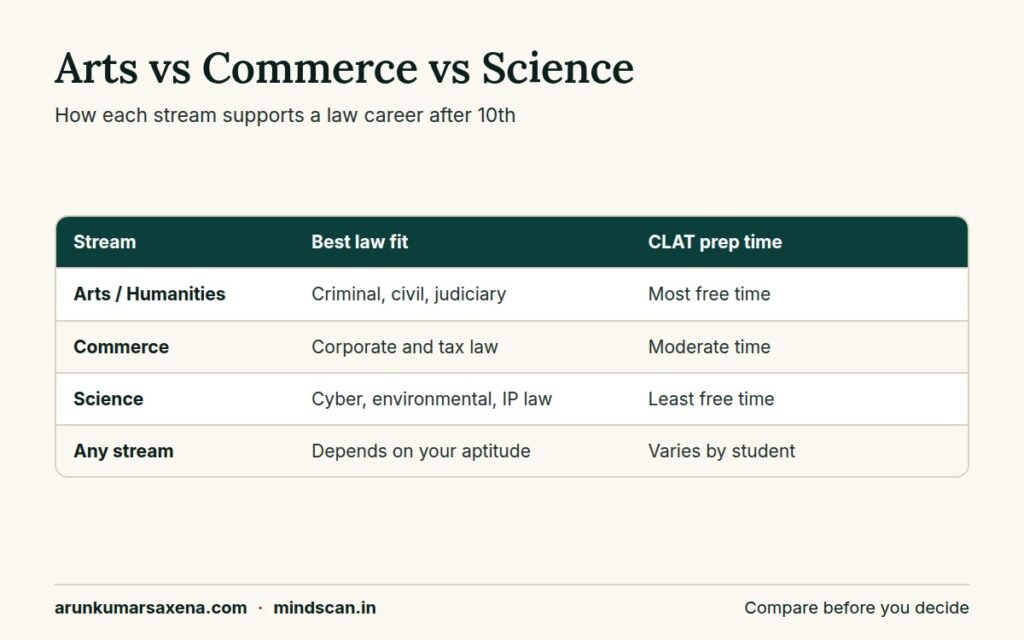
Each stream supports law, but they support it differently. Arts gives the most entrance-exam readiness and suits judiciary-style careers. Commerce fits corporate and tax law. Science opens tech and IP-heavy specialisations. The row to read is the one that matches your own strengths. The question “which stream is best for lawyer after 10th” is answered by matching your strengths to the table below.
Read the table below by matching your interest and aptitude first, then the specialisation. No row is wrong. The free RIASEC career personality quiz and a psychometric assessment are the scientific tie-breakers when you are stuck between two rows.
| Stream | Best law fit | CLAT prep time | Honest caveat |
|---|---|---|---|
| Arts / Humanities | Criminal, civil, judiciary, BA LLB | Most free time | Only if you truly like these subjects |
| Commerce | Corporate, tax, business law | Moderate | Accountancy maths can eat prep time |
| Science (PCM/PCB) | Cyber, environmental, patent/IP law | Least free time | Heavy workload vs entrance prep |
| Any stream + self-fit | Depends on aptitude and interest | Varies by student | Get aptitude verified, not YouTube-advised |
Once you have a tentative stream, read about career options after 12th in Arts or the best courses after 12th Commerce to see the full picture. If you are still unsure, the next section gives you a step-by-step framework to decide before your school admission deadline.
How do you know which stream suits YOU before Class 11?
My book “3 Steps to Knowing Yourself” holds that self-knowledge must come before any career choice. Instead of copying toppers, a student should verify interests, aptitude and personality scientifically, then map them to a stream and a target law specialisation. The stream should follow the direction, not the other way round. This self-fit process is the only reliable way to answer “which stream is best for lawyer after 10th”.
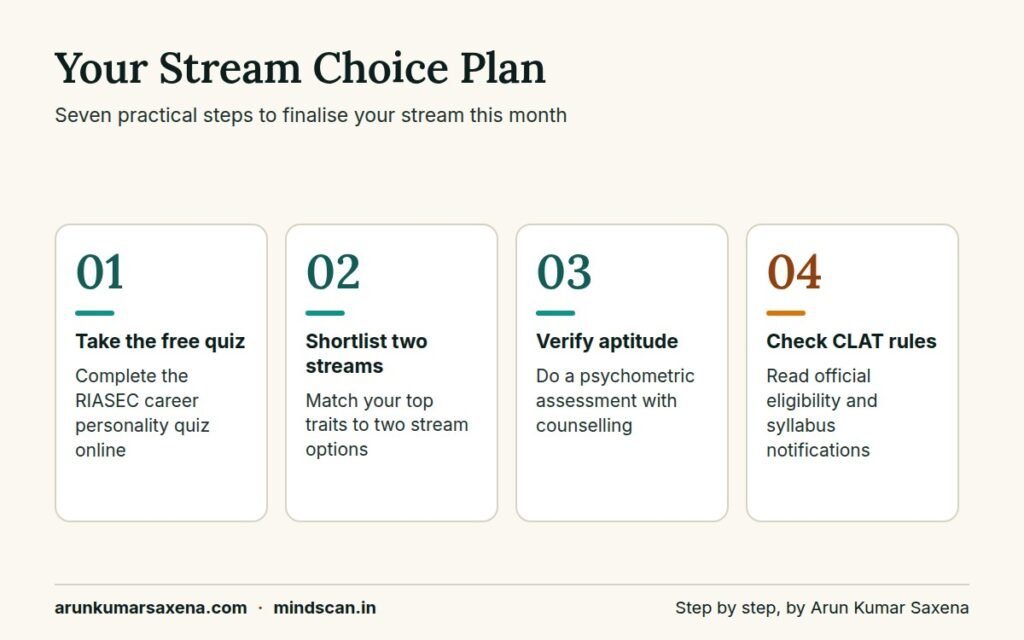
Here is the practical sequence I use in my sessions. First, self-assessment. Take the free RIASEC quiz and note your top traits. List your favourite and least favourite Class 10 subjects and be honest about why. Second, verified shortlist. A psychometric assessment maps students to 20+ career groups. This step catches mismatches early. Third, stream selection with parents. Share the verified shortlist, discuss the workload and prep-time trade-offs, and pick the stream that fits the evidence, not a relative’s opinion.
My rule of radical honesty is this. No stream choice should be made on coaching-institute hype. A stream that keeps all options open but kills your confidence closes more doors than it opens. When you ask “which stream is best for lawyer after 10th”, protect your confidence as much as your options.
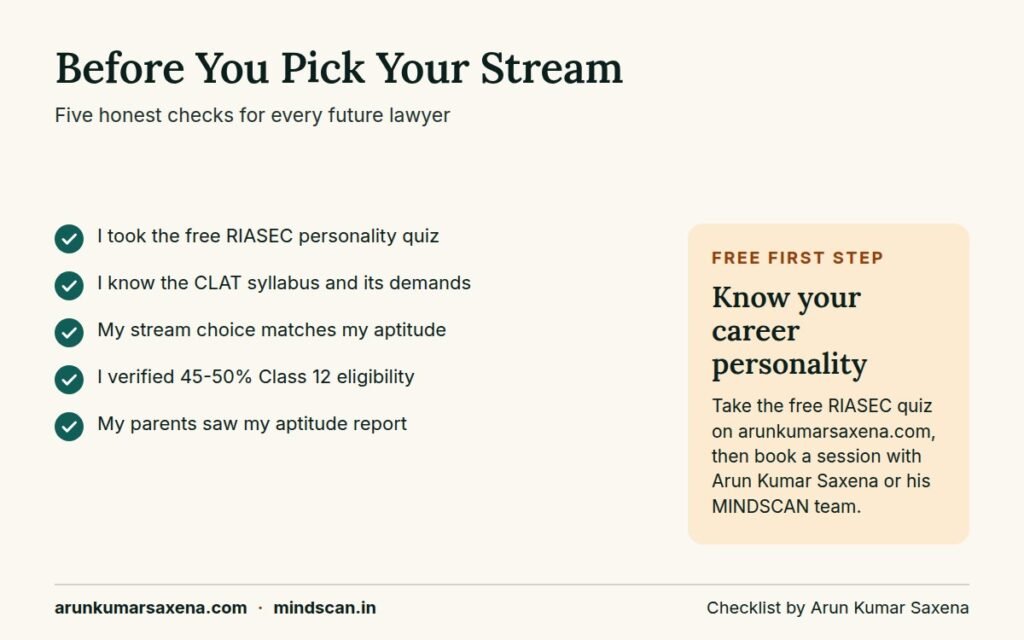
The free RIASEC career personality quiz is your immediate zero-cost first step this week. It takes under ten minutes and gives you a starting vocabulary for your interests. From there, if you need deeper clarity, online career counselling in India with Arun Kumar Saxena combines a psychometric assessment with a one-on-one session where we map your report to a stream and a law specialisation.
What are the steps to become a lawyer in India after 10th?
The clean path is simple. Choose your stream in Class 11, keep Class 12 marks above the 45 to 50 percent bar, prepare for CLAT or AILET alongside boards, take the entrance exam in the Class 12 year, join a 5-year integrated LLB, then register with the State Bar Council to practise. This path starts with the right answer to “which stream is best for lawyer after 10th”.
Law is never entered directly after 10th. A diploma cannot make you a lawyer. Any advertisement that claims otherwise is misleading. The minimum path is Class 12 in any stream, an entrance exam, then an LLB. The 3-year LLB route after graduation is an alternative entry point for those who decide on law later.
CLAT, AILET and state or university-level tests are the main gates. CLAT is the primary route to National Law Universities. AILET is for National Law University Delhi. Several states and private universities conduct their own tests. Prepare for CLAT as the primary option and treat others as backups.
Here is the step-by-step action plan for a Class 10 student who wants to become a lawyer.
- Take the free RIASEC career personality quiz this week and note your top traits.
- List your favourite and least favourite Class 10 subjects; be honest about why.
- Shortlist 2 streams that fit your traits and a tentative law specialisation for each.
- Verify aptitude scientifically with a psychometric assessment and a counselling session.
- Check the latest CLAT/AILET eligibility and syllabus on official notifications.
- Fix a weekly CLAT prep timetable that fits beside your Class 11 workload.
- Share the plan with your parents and school counsellor before admission season.
For a broader framework on making career decisions, read my guide on how to choose the right career after 12th. The principles apply equally to stream selection after 10th.
What is the qualification for a lawyer in India?
Pass Class 12 in any stream with the required minimum marks, usually 45 to 50 percent as per online sources, with relaxations for reserved categories. Qualify a recognised law entrance exam. Complete an LLB, either 3-year after graduation or 5-year integrated, from a recognised university. Enrol with the Bar Council to practise. The stream you pick must simply meet this eligibility bar.
Stream and board, CBSE, ICSE or State, do not restrict eligibility. A State board Humanities student and a CBSE Science student sit the same CLAT paper and compete on the same merit list. The Bar Council of India governs the final enrolment, and its norms apply uniformly.
Check the official CLAT, AILET and Bar Council of India notifications each year. Eligibility criteria can change. The National Career Service portal, Government of India also maintains official career information for lawyer qualifications and pathways.
Which law specialisation should a 10th grader aim for?
Specialisation is chosen years later, so a 10th grader should only keep a tentative direction. Corporate and tax law if Commerce feels natural. Cyber and IP law if tech excites you. Criminal, civil and judiciary if Humanities and public affairs energise you. The stream should follow the direction, not the other way round. This connects directly back to “which stream is best for lawyer after 10th” for your future focus.
Popular specialisations include corporate, criminal, civil, cyber, tax, intellectual property, environmental and legal journalism. Most law students explore these through internships and moot courts in the first three years of the 5-year programme. The real choice sharpens in college, not in Class 11.
Do not lock a specialisation now based on TV dramas or one-off advice from a relative. Keep a direction, stay curious, and let evidence from your own performance guide the final call.
The Finology Legal guide on the best stream for law after 10th offers another useful perspective on how stream and specialisation connect. Read it alongside this page to build your own informed view.
Which stream is best for lawyer after 10th if I am unsure?
If you are genuinely unsure, start with Humanities. It gives you the most free time for CLAT prep and the broadest subject overlap. You can always pivot your specialisation later. The key is to verify your aptitude now, not to wait until Class 12. A psychometric assessment removes the guesswork when you feel stuck between two options.
Frequently asked questions about which stream is best for lawyer after 10th
Can I join law without CLAT?
Yes. CLAT is not the only gate. AILET, state and university-level entrance tests and some college-level admissions exist. The 3-year LLB route after graduation has different entry rules. However, CLAT remains the main route to National Law Universities, so prepare for it as the primary option and treat others as backups.
What is the qualification for a lawyer in India after 12th?
Class 12 in any stream with usually 45 to 50 percent marks, a qualified entrance exam score, and completion of a 5-year integrated LLB or a 3-year LLB after graduation, followed by Bar Council enrolment. Verify current-year criteria on the official CLAT and AILET notifications before applying.
What is a lawyer’s salary in India?
Starting salaries vary hugely by college, city and type of practice. A fresh litigation associate may earn a modest stipend, while a top National Law University graduate placed in a corporate firm can draw a high package. As per online sources, specialisation and reputation drive earnings over time, not the school stream.
Can a lawyer earn 1 crore in India?
Yes, but only at the top tier. Senior advocates, top corporate partners and highly specialised lawyers can reach that level after years of practice. This is a long-tail outcome, not a Class 11 planning assumption. Build your foundation on aptitude first, not on a distant salary figure.
Is Humanities ‘easy’ compared to Science for law?
Reject the ‘easy stream’ framing. Humanities is lighter in workload than Science, which helps CLAT prep, but it still demands reading, writing and current-affairs discipline. The right question is fit, not ease. A Humanities student who skips the newspaper loses the stream’s main advantage.
Can we choose a stream after 10th if we are unsure?
Yes. Stream selection happens after Class 10 results. Students unsure of their fit should complete self-assessment before school admission deadlines. Take the free RIASEC quiz now. If still unclear, a psychometric assessment with counselling gives you a verified shortlist you can discuss with your parents confidently.
How to become a lawyer after 10th directly?
You cannot become a lawyer directly after 10th. The minimum path is Class 12 in any stream, an entrance exam, then an LLB. Any course that says you can practise law without Class 12 and an LLB is misleading.
हिंदी में जवाब: 10वीं के बाद वकील बनने के लिए कौन सी स्ट्रीम सबसे अच्छी है?
10वीं के बाद 11वीं में कौन-कौन से सब्जेक्ट होते हैं?
10वीं के बाद 11वीं में आप तीन मुख्य स्ट्रीम में से कोई भी चुन सकते हैं: आर्ट्स/ह्यूमैनिटीज़ (इतिहास, राजनीति विज्ञान, समाजशास्त्र, अंग्रेज़ी), कॉमर्स (अकाउंटेंसी, बिज़नेस स्टडीज़, अर्थशास्त्र) या साइंस (फिज़िक्स, केमिस्ट्री, मैथ्स/बायोलॉजी)। वकील बनने के लिए कोई भी स्ट्रीम मान्य है, परंतु अरुण कुमार सक्सेना के अनुसार, स्ट्रीम का चुनाव आपकी रुचि और एप्टीट्यूड के आधार पर होना चाहिए, न कि केवल लोकप्रिय राय पर।
10वीं के बाद वकील बनने के लिए कौन सी स्ट्रीम सबसे अच्छी है?
सामान्यतः ह्यूमैनिटीज़/आर्ट्स सबसे अच्छी स्ट्रीम है, क्योंकि इसके विषय CLAT और AILET की तैयारी में सीधे मदद करते हैं और पढ़ाई का बोझ कम होने से प्रवेश परीक्षा की तैयारी के लिए अधिक समय मिलता है। लेकिन अरुण कुमार सक्सेना का स्पष्ट मत है कि यदि आपकी रुचि और एप्टीट्यूड कॉर्पोरेट या टैक्स लॉ में है तो कॉमर्स, और साइबर या पेटेंट लॉ में है तो साइंस बेहतर विकल्प हो सकता है। निर्णय हमेशा वैज्ञानिक एप्टीट्यूड जाँच पर आधारित हो।
10वीं के बाद कौन सी परीक्षा देनी चाहिए?
10वीं के तुरंत बाद वकील बनने के लिए कोई प्रवेश परीक्षा नहीं होती। पहले 11वीं और 12वीं पूरी करें। 12वीं के बाद CLAT (क्लैट) मुख्य राष्ट्रीय परीक्षा है, जो नेशनल लॉ यूनिवर्सिटीज़ में दाखिले का रास्ता है। इसके अलावा AILET, राज्य स्तरीय और विश्वविद्यालय स्तरीय लॉ प्रवेश परीक्षाएँ भी होती हैं। 12वीं में ही इनकी तैयारी शुरू करें।
12 वीं के बाद सबसे अच्छा कोर्स कौन सा है?
12वीं के बाद वकील बनने के लिए 5 वर्षीय इंटीग्रेटेड LLB कोर्स सबसे सीधा रास्ता है। इसमें BA LLB, B.Com LLB और B.Sc LLB जैसे विकल्प शामिल हैं। BA LLB सबसे लोकप्रिय है और सिविल, क्रिमिनल तथा न्यायपालिका क्षेत्रों के लिए उपयुक्त है। B.Com LLB कॉर्पोरेट और टैक्स लॉ के लिए, और B.Sc LLB साइबर तथा पेटेंट लॉ के लिए अच्छा है। अपनी स्ट्रीम और रुचि के अनुसार चुनें।
Choosing which stream is best for lawyer after 10th is a decision that shapes your Class 11, your CLAT prep and your first five years of law study. Do not leave it to a YouTube video or a relative’s casual suggestion. Get your aptitude verified, match your stream to your strengths, and walk into Class 11 with a clear plan.
Book online career counselling in India with Arun Kumar Saxena for a one-on-one session where we analyse your psychometric report together. Or start with the MINDSCAN AI Career Clarity Report at ₹1,499 on mindscan.in/psychometric-assessment. The right stream is waiting. Let us find it scientifically.