
Class 10 All Subject List: 10 Subject Name, Marks Pattern and Stream Links
By Arun Kumar Saxena, Certified Advanced Career Coach · Last updated: November 2026
Looking for the 10 subject name list for class 10? Class 10 all subject is the complete list of subjects a student takes in Class 10: two languages, Mathematics, Science, Social Science and one skill subject. Official source: CBSE Academic circular portal for the secondary curriculum.
Quick answer: A class 10 all subject list covers five core subjects: two languages, Mathematics, Science and Social Science, plus one skill subject. Arun Kumar Saxena, founder of MINDSCAN Career Guidance, advises using these subjects to spot your natural strengths, because they directly shape your Class 11 stream choice.
- The CBSE class 10 all subject list has five core subjects (two languages, Mathematics, Science, Social Science) plus one skill subject, making six in total.
- Every core subject follows the 80+20 pattern: 80 marks board theory plus 20 marks internal assessment, with 33% needed to pass each subject.
- Mathematics Standard keeps Science and Commerce-with-Maths open; Mathematics Basic generally blocks Class 11 Maths.
- Which subject you understand fastest and sustain is a stronger stream signal than your total percentage.
The class 10 all subject list looks simple on a school circular, but every subject on it is already pointing toward a specific stream and career group. This page gives you the complete subject names, the 80+20 marks breakdown, and a clear, data-verified framework to connect each subject to a Class 11 stream choice, something most school blogs never offer.
With 22 years of experience and 20,000+ students and professionals guided, I have seen too many families treat the class 10 all subject list as a set of hurdles to clear. The smarter move is to use this year to read your own subject pattern. Which subject do you understand fastest? Which one do you sustain effort in even when it gets hard? Those signals matter more than your total percentage, and this page will show you exactly how to read them.
Table of Contents
What Are the Subjects in Class 10 (Class 10 All Subject List)?
The standard CBSE class 10 all subject list has five core subjects: English, Hindi, Mathematics, Science and Social Science. Every student also takes Health and Physical Education, and most schools add one skill subject such as Information Technology or Artificial Intelligence.
The core five carry the full 80+20 marks weight and directly determine stream eligibility, and you can see how these same subjects expand in the 11th class science subject list. The skill subject and Physical Education contribute to the overall result but play a smaller role in stream selection. Picture a Class 10 student in a typical CBSE school: her timetable has all five core subjects daily, plus two periods a week for IT and one for Physical Education. Her parents are already asking about Science versus Commerce, but she is still figuring out which subjects feel natural and which ones drain her. That pattern is the real information inside the class 10 all subject list.
The fastest way to verify your stream fit is a psychometric assessment. At MINDSCAN Career Guidance, I use a data-verified approach that maps your natural strengths to 20+ career groups, cutting through the guesswork so your Class 10 subject choices become a clear, confident step towards the right stream.
Core subjects every CBSE student takes
- English Language and Literature (code 184)
- Hindi Course A (code 002) or Hindi Course B (code 085)
- Mathematics Standard (code 041) or Mathematics Basic (code 241)
- Science (code 086, covering Physics, Chemistry and Biology)
- Social Science (code 087, covering History, Geography, Political Science and Economics)
Common skill subjects offered
- Information Technology (code 402)
- Artificial Intelligence (code 417)
- Home Science (code 064)
- Retail (code 401)
- Financial Literacy (code 785)
Your school’s exact class 10 all subject list may differ slightly. Always confirm the subjects offered from your school’s board circular, because state boards like UP Board, SEBA Assam and Maharashtra Board have their own language and elective rules. The board-wise curriculum documents from the Ministry of Education publish board-wise curriculum documents, and the National Career Service portal offers career information linked to subject choices. For state-board students, the official NIOS website lists its open-schooling subject options, the UP Madhyamik Shiksha Parishad (UPMSP) official website publishes the UP Board Class 10 syllabus circular, and the Maharashtra State Board official website carries its own SSC subject rules.
What most guides miss: the subject pattern already predicts your stream
Most school blogs give you the class 10 all subject list and stop there. In my sessions, I see a different picture. A student who scores 85% in Science but takes three times as long to finish a Science chapter as a Social Science chapter is sending a clear signal, and that signal often points toward Humanities or Commerce, not Science. Marks show effort. The time you need to understand a subject, and whether you return to it without being told, shows fit.
Ask yourself two questions: which subject do you open first when you sit down to study, and which one do you keep postponing? The answers almost always line up with the stream they should choose. The class 10 all subject list is not just a set of exams. It is a six-subject mirror. Use it that way.
Pick the subject you finish fastest and the one you postpone most, then see the signal.
Is Maths Standard or Basic Better for Your Stream Choice?
Mathematics Standard keeps every option open, including Science with Maths, Commerce and engineering paths in Class 11 and beyond. Mathematics Basic is easier to pass but closes the door on Class 11 Maths. The decision should rest on verified aptitude data, not fear or peer pressure.
In many homes, the Maths Standard versus Basic conversation happens in ten minutes during a school form submission. A relative says Basic is safer. A neighbour says Standard is the only respectable choice. The child, nervous about low Maths scores, picks Basic. Two years later, that same child wants Commerce with Maths and cannot take it. I have seen this sequence repeat across cities and boards.
“Analyse your child’s aptitude scientifically and check the scores critically before taking any decision.” (Arun Kumar Saxena)
Standard Maths is required for Science with Maths and Commerce with Maths. Basic Maths students generally cannot take Maths in Class 11, though as per online sources, some boards now offer Applied Mathematics as an alternative route for Commerce and Humanities students who took Basic. Choose Standard unless a verified assessment shows genuine, sustained difficulty with Maths, because Basic decisions taken at 15 are hard to reverse in Class 12.
How Are Class 10 Board Exams Structured (80+20 Pattern)?
Every subject in the class 10 all subject list follows an 80+20 pattern: an 80-mark theory paper set by the board and 20 marks of internal assessment covering periodic tests, a portfolio and subject enrichment activities. To pass, you need a minimum of 33% combined in theory plus internal assessment for every subject.
Physical Education and skill subjects follow their own school-based or practical assessment formats. CBSE is also moving toward a two-exam system for Class 10 from 2026, which changes the preparation rhythm. For the latest exam structure, see the CBSE Class 10 Board Exam two-exam system guide.
How Do Core, Skill and Additional Class 10 Subjects Compare?
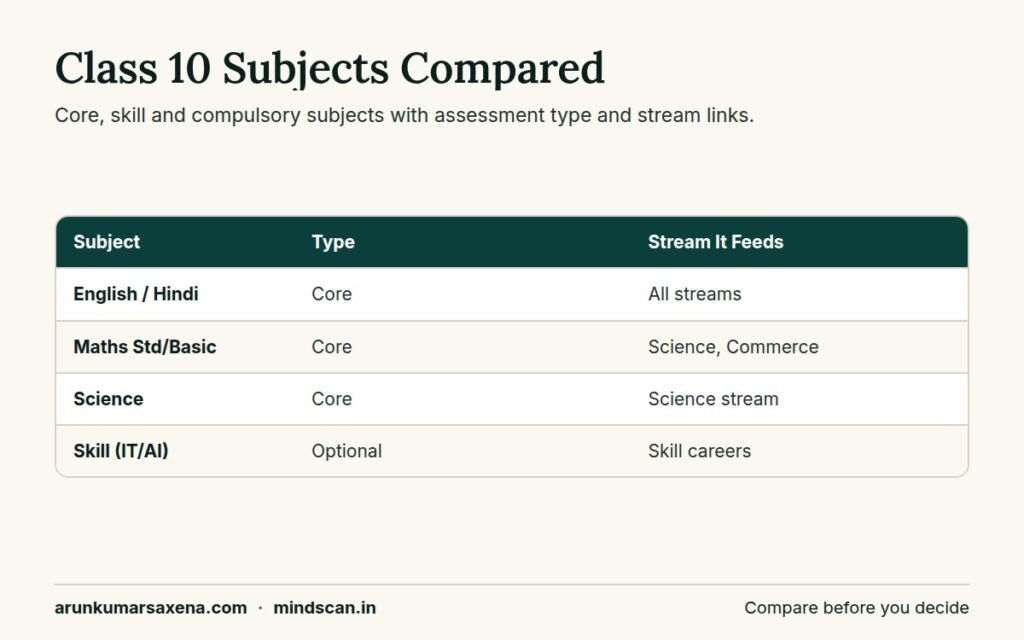
| Subject | Type | Assessment | Stream It Feeds |
|---|---|---|---|
| English | Core | 80+20 | All streams |
| Hindi (Course A/B) | Core | 80+20 | All streams |
| Mathematics (Standard) | Core | 80+20 | Science, Commerce |
| Mathematics (Basic) | Core | 80+20 | Limits Class 11 Maths |
| Science | Core | 80+20 | Science stream |
| Social Science | Core | 80+20 | Humanities, Commerce |
| Skill subject (IT, AI, etc.) | Optional | School/board-based | Skill careers |
| Health and Physical Education | Compulsory grade | School-based | Internal score only |
The 80+20 pattern and 33% passing rule apply to the core five subjects. Skill subjects and Physical Education follow separate school-based or board-based assessment formats.
| Subject | Subject code | Core/Skill/Additional | Marks pattern | Stream it points to |
|---|---|---|---|---|
| English Language and Literature | 184 | Core | 80+20 | All streams |
| Hindi Course A | 002 | Core | 80+20 | All streams |
| Hindi Course B | 085 | Core | 80+20 | All streams |
| Mathematics Standard | 041 | Core | 80+20 | Science, Commerce |
| Mathematics Basic | 241 | Core | 80+20 | Limits Class 11 Maths |
| Science | 086 | Core | 80+20 | Science stream |
| Social Science | 087 | Core | 80+20 | Humanities, Commerce |
| Information Technology | 402 | Skill | School/board-based | Skill careers |
| Artificial Intelligence | 417 | Skill | School/board-based | Skill careers |
Which Class 10 Subjects Matter Most for Science, Commerce and Arts?
Every core subject feeds a stream. Science and Maths Standard open the Science stream; Maths, Social Science and English matter for Commerce; languages and Social Science anchor Humanities. The real signal is not your total percentage but the pattern: which subjects you understand fastest and sustain effort in over the full year.
For Science stream, Science and Maths Standard are non-negotiable. For Commerce, Maths and English carry the most weight, and a strong Social Science score helps. For Humanities, languages, History, Political Science and Economics map directly to Class 11 subjects. A student who scores 90% overall but drags herself through Science every evening is not a Science-stream student. A student with 75% who finds Science chapters genuinely interesting probably is. Read the pattern, not just the marksheet, and you can see how each Arts stream subject builds a career in our dedicated Arts guide. The Class X subject combination guide walks through stream-specific subject requirements in more detail.
How Many Subjects Are There in 10th Class Across Boards?
CBSE students usually take 6 subjects, while state boards range from 5 to 8. The standard CBSE class 10 all subject list has five core subjects plus one skill subject, making six total. State boards like UP Board, SEBA Assam and Maharashtra Board list 6 to 8 subjects with their own language and elective combinations.
| Board | Typical number of subjects | Typical pattern |
|---|---|---|
| CBSE | 6 | Five core subjects plus one skill subject |
| UP Board (UPMSP) | Approximately 6 to 8 | Hindi, English, Maths, Science, Social Science, an optional language such as Sanskrit, plus electives such as Computer or Home Science |
| Maharashtra Board (SSC) | Approximately 6 to 8 | Language subjects plus Maths, Science and Social Science, with board-specific elective rules |
Always confirm your exact class 10 all subject list from your school’s board circular. A CBSE student in Delhi and a UP Board student in Lucknow may both be in Class 10, but their subject counts and compulsory language rules differ. For board-wise detail, see 10th class all subjects explained, and for the next step, the after intermediate bipc courses list shows where a Biology-focused subject mix can lead.
What Is the Step-by-Step Way to Study All Class 10 Subjects This Month?
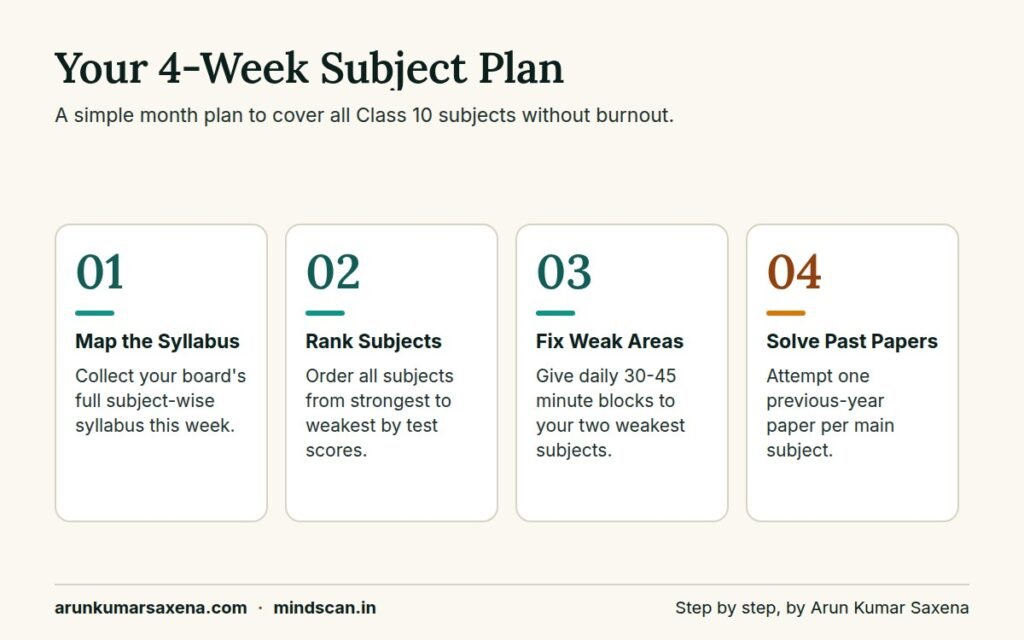
A practical month plan: map your full syllabus subject-wise, rank subjects by your current comfort, give daily time to your two weakest subjects, solve one previous-year paper per subject, and track your internal assessment components. Start with self-knowledge before strategy, and note which subjects energise you, because that pattern predicts stream fit better than marks.
- Write down the exact class 10 all subject list for your board from your school circular or the official board curriculum document.
- Rank all your subjects from strongest to weakest based on your last two test scores.
- Block 30 to 45 minutes daily for your two weakest subjects for the next four weeks.
- Solve one previous-year paper for each main subject and note repeated question patterns.
- Complete all pending internal assessment items: periodic tests, portfolio and enrichment activities.
- Note which subjects you enjoy even when they are hard; this pattern is your stream signal.
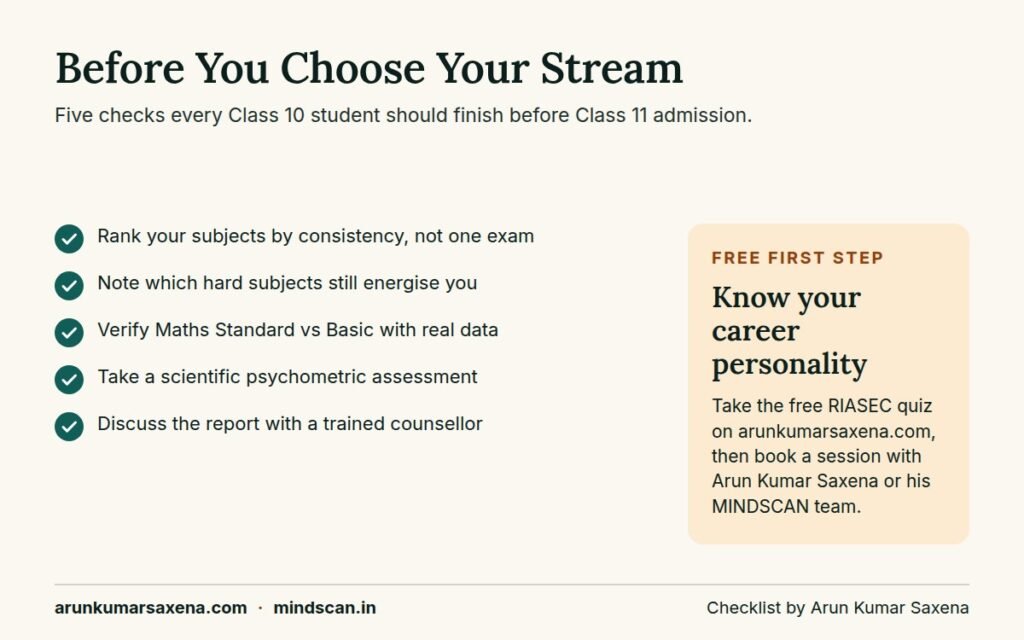
- Book a psychometric assessment or take the free RIASEC career personality quiz before finalising your Class 11 stream.
Many students treat step six as optional. It is the most important one. A subject that feels hard but still interests you is a stronger stream signal than a subject you score well in but dislike. My book 3 Steps to Knowing Yourself establishes that self-knowledge must come before any stream or career choice. Apply that principle to your class 10 all subject reflection this month.
How Do You Choose Your Stream After Class 10 Without Guessing?
Stream selection should not be a rank-order reaction to your Class 10 result. The reliable method is threefold: study your subject-wise performance pattern, take a scientific psychometric assessment to verify aptitude and interests, and discuss the findings with a trained career counsellor. Marks show effort, but only aptitude data shows fit.
The lesson for Class 10 students: verify fit early, before years are invested. Pattern beats percentage. Consistency in a subject is the real signal. A trained counsellor turns data into a concrete stream plan. Book online career counselling in India before your stream choice deadline.
What Do Most Students Get Wrong About Class 10 Subjects?
The biggest mistakes: treating all subjects as equally important for your future, choosing Maths Basic out of fear and regretting it in Class 11, ignoring internal assessment marks that are easy 20s, and never connecting subject performance to career direction. Class 10 is also the right age to start structured career counselling, which is recommended from Class 8 onwards.
No link drawn between subject patterns and stream choice is the costliest mistake, because it turns the class 10 all subject list into a checklist instead of a compass.
Which Question Banks and Notes Actually Help for Class 10 All Subject Preparation?
A single good question bank covering all Class 10 subjects, the official NCERT textbooks and your board’s previous-year papers cover most of what you need. Anything beyond that is optional. One resource used completely beats five resources used halfway. Pick resources aligned to your specific board, since CBSE, UP Board and SEBA papers differ in pattern.
NCERT textbooks are the base for CBSE and many state boards. One complete question bank plus previous-year papers per subject is enough. Board-specific resources matter because the question patterns, chapter weightage and internal assessment rules differ across boards. A CBSE question bank will not serve a SEBA student well, and the other way around. Match your resources to your board’s exact class 10 all subject syllabus and you will save time and avoid confusion. Before you lock your stream, take the free RIASEC career personality quiz to cross-check your subject preferences against your personality type.
How to Read Your Class 10 Subject List as a Stream Signal
Every subject in the class 10th 10 subject name list carries a career signal. Which one you finish fastest and which one you keep postponing show where your natural pull lies. Read that pattern honestly and it points you towards Science, Commerce or Humanities, long before any entrance exam does.
- English: If you finish English fastest, you are comfortable with language, argument and expression. It feeds every stream, but it is the strongest early indicator for Humanities, where reading and writing carry the course.
- Hindi: Finishing Hindi fastest shows comfort with structured language and cultural texts. It feeds all streams and anchors Humanities, especially for students who enjoy literature, poetry or grammar work.
- Mathematics: If Mathematics is your fastest subject, Science and Commerce both open up, provided you take Mathematics Standard. If you keep postponing it, note that Mathematics Basic limits Class 11 Maths options, so the stream choice narrows early.
- Science: Finishing Science fastest is a direct signal for the Science stream. If you postpone Science consistently, that effort drain usually points towards Commerce or Humanities, where the daily load shifts away from lab work and numerical application.
- Social Science: Fastest in Social Science feeds Humanities strongly and supports Commerce through economics, civics and business awareness. It shows you read people, systems and change well.
- Skill subject: If Information Technology, Artificial Intelligence or another skill subject is your fastest, you lean towards applied, skill-based careers. That signal matters more than a single marksheet number when choosing a practical stream later.
Once you have marked fastest and postponed against each subject, match the pattern to the stream it feeds. The Class X subject combination guide explains what each stream demands, and the 10th class all subjects breakdown shows how the pattern shifts across boards.
Frequently asked questions about class 10 all subject
Is Hindi compulsory in Class 10?
In CBSE and most state boards, a second language is compulsory and Hindi Course A or B is the most common choice, though some schools allow Sanskrit or a regional or foreign language instead. Check your school’s subject options; the compulsory part is the second language slot, not Hindi specifically.
Can I change my Class 10 skill subject mid-year?
Skill subject changes are generally allowed only within a short window at the start of the academic session and require school approval plus board registration timelines. After registration deadlines, changing becomes practically impossible, so decide in the first month and confirm deadlines with your school office.
What is the passing criteria in Class 10 boards?
You need at least 33 percent marks combined in theory and internal assessment in each subject to pass. Failing one or two subjects typically allows a compartment exam, but the honest goal should be comfortable passing in all subjects in the first attempt itself.
Do Class 10 marks matter for college admission?
Class 10 marks matter indirectly: they influence stream eligibility in Class 11, some scholarship criteria and a few integrated programmes. Most university admissions weigh Class 12 and entrance exams far more, so use Class 10 mainly to build foundations and identify your stream.
Which subject combination is best after Class 10?
There is no universally best combination, only the best fit. Science with Maths suits engineering and medical paths, Commerce with Maths suits finance, CA and business careers, and Humanities suits law, civil services, design and media. The right combination comes from verified aptitude data plus your subject performance pattern, not from what toppers choose.
Should I take Mathematics Basic if I am weak in Maths?
Only if a verified assessment confirms sustained difficulty, because Basic Maths generally blocks Maths in Class 11 and closes Commerce-with-Maths and engineering routes. Weakness caused by poor fundamentals or bad teaching can often be fixed with focused effort; get an honest diagnosis before locking the choice.
When should Class 10 students start career counselling?
Arun Kumar Saxena recommends starting career counselling from Class 8 onwards, and Class 10 is the critical deadline year because the stream choice locks many later options. A psychometric assessment plus one counselling session before stream selection is the highest-return investment at this stage.
What are the UP Board Class 10 subject names and codes?
The UPMSP class 10th subject list typically covers Hindi, English, Mathematics, Science, Social Science, an optional language such as Sanskrit, and electives such as Computer or Home Science. The up board subject code list class 10 is printed on the official UPMSP syllabus circular and differs from CBSE numbering. As Arun Kumar Saxena advises, always confirm the names and codes from that official circular, never from a third-party list.
What do subject codes like 041 or 086 mean and where are they used?
Codes such as 041 for Mathematics Standard and 086 for Science identify a subject in registration forms, admit cards and marksheets. They do not change the syllabus or difficulty. The subject code class 10 up board numbering differs from CBSE, so always quote the code from your own board’s circular.
Should I choose Hindi Course A or Course B in Class 10?
Course A is more literature-heavy, Course B more applied and often lighter. Choose based on your school’s offering and your past Hindi scores, not peer advice. A second language is compulsory in class 10th, so pick the course you can actually sustain through the board year.
Is the Class 10 subject list the same for the CBSE two-exam system from 2026?
The two-exam system changes how often the board exam is held, not the subject list. The same five core subjects plus a skill subject and the 80+20 pattern apply. See the CBSE Class 10 Board Exam two-exam system guide for the schedule changes.
What is the difference between a core subject, a skill subject and an additional subject in Class 10?
Core subjects, English, Hindi, Mathematics, Science and Social Science, carry the 80+20 board weight and drive stream eligibility. Skill subjects such as Information Technology or Artificial Intelligence add a sixth grade and build practical ability. A subject taken beyond the required set is additional. Core marks matter most for the Class 11 stream choice.
How do I read my Class 10 subject codes step by step?
Find the numeric subject code on your board’s official circular and match it to the subject name. Use this code in registration forms and on your admit card. CBSE codes follow a standard pattern, for example 041 for Mathematics and 086 for Science, but UP Board numbering is different. Always quote the code from your own board’s list to avoid errors.
Which subjects count towards the main Class 10 result and which do not?
The five core subjects, English, Hindi, Mathematics, Science and Social Science, count towards the main Class 10 result, each on the 80+20 pattern. Your skill subject, such as Information Technology (402) or Artificial Intelligence (417), follows a separate school-based or board-based assessment format. Health and Physical Education appears as a compulsory school-based grade rather than a board-exam subject.
What is the difference between Hindi Course A and Course B subject names in the Class 10 list?
Both appear on the class 10 subject list as compulsory second-language options, but their names point to different syllabi. Hindi Course A (code 002) is more literature-heavy, while Hindi Course B (code 085) is more applied and often lighter. The 10th subjects themselves stay the same; only the Hindi course name and syllabus depth differ, so pick the one your school offers and you can sustain.
How do CBSE, UP Board and Maharashtra Board Class 10 subject names differ?
All three boards cover the same 10 subject basics: two languages, Mathematics, Science and Social Science. CBSE names them with codes such as 041 and 086; UP Board typically adds an optional language such as Sanskrit and electives like Computer or Home Science; Maharashtra Board (SSC) follows its own language subjects and elective rules. Always confirm exact subject names from your own board’s official circular.
Which Class 11 stream does each Class 10 subject lead to?
Science and Mathematics Standard point to the Science stream; Mathematics, Social Science and English matter most for Commerce; languages and Social Science anchor Humanities. Read the pattern across your class 10 subject names, not just your percentage, and the Class X subject combination guide shows exactly what each stream demands in Class 11.
How do you read a Class 10 subject code like 041 or 086?
CBSE subject codes for class 10 are numeric identifiers: 041 is Mathematics Standard, 086 is Science, 184 is English, 002 and 085 are Hindi Course A and B. The code changes nothing in the syllabus or difficulty; it identifies the subject on registration forms, admit cards and marksheets. Quote the code only from your own board’s official circular.
Class 10 Subject Answers: Names, Marks Pattern and Stream Links
What should I do to score 95 percent in Class 10?
To score 95 percent, understand the full syllabus for every subject, build on NCERT books, give at least 45 minutes daily to your two weakest subjects, solve previous-year question papers, and secure the approximately 20 internal assessment marks. Do not chase marks alone; also note which subject feels natural, because that decides your stream direction.
See the full answer on the marks patternWhich subjects are there in Class 11 after Class 10?
Class 11 subjects depend on your chosen stream. Science has Physics, Chemistry, Maths or Biology, and English. Commerce has Accountancy, Business Studies, Economics, Maths or another optional subject, and English. Humanities has History, Geography, Political Science, Economics and subjects like Sociology or Psychology. Check a scientific aptitude or psychometric test report, not just Class 10 marks, to choose the right stream.
See the best subject combination after Class 10How can I score 80 percent in Class 10?
To score 80 percent, plan to stay well above the approximately 33 percent passing mark in every subject. Split the syllabus month-wise, give two hours daily to weak subjects, solve one previous-year paper per subject each week, and secure the approximately 20 internal assessment marks. Note which subject does not tire you during preparation; that signal helps your Class 11 stream choice more than marks.
See the full answer on the passing criteriaYour class 10 all subject list is not just a set of exams. It is the clearest signal you will ever get about where your natural strengths lie. Use it. If you want a data-verified answer instead of a guess, start with the MINDSCAN AI Career Clarity Report at ₹1,499, or book the report with a counselling session at ₹2,999.
The report maps you to 20+ career groups and connects your subject patterns to specific career families. Take the report at mindscan.in/psychometric-assessment and then book a session at online career counselling in India. A single counselling session before your stream choice deadline is the highest-return investment you can make this year.