
Archaeology Degree in India: Courses, Eligibility and Careers
Direct answer: An archaeology degree in India begins with a 3-year BA or BSc in Archaeology after Class 12 from any stream, followed by a 2-year MA or MSc for specialisation. For government field roles, the Post Graduate Diploma from the ASI Institute of Archaeology is the recognised qualification.
By Arun Kumar Saxena, Certified Advanced Career Coach and founder of MINDSCAN Career Guidance
Last updated: November 2026
Definition: Archaeology degrees in India are formal university programmes that train students to study human history through material remains such as artefacts, structures, inscriptions and coins.
Quick answer: Archaeology degrees in India follow a fixed pathway: a 3-year BA/BSc in Archaeology after Class 12, a 2-year MA for specialisation, and an ASI-recognised Post Graduate Diploma for government field jobs. The path is long, field-heavy and demands patience alongside academic interest.
An archaeology degree in India is the formal route into studying human history through material remains. This page helps Class 10-12 students, graduates and parents decide whether a career in excavation, museums, epigraphy or heritage management genuinely fits the student before years and fees are committed.
An archaeologist is a professional who studies human history through material remains.
With 22 years of experience and 20,000+ students and professionals guided, I have watched many students pick archaeology degrees for the romance of digs and discoveries, only to realise later that the field demands patience, physical stamina and a tolerance for slow research cycles. My MINDSCAN team and I use scientific assessment to separate genuine fit from passing fascination.
Table of Contents
What Are Archaeology Degrees and What Does an Archaeologist Actually Study?
Archaeology degrees train you to study human history through material remains such as artefacts, structures, inscriptions and coins. The curriculum blends history, anthropology, geology, excavation methods, epigraphy and museology into a mix of humanities and science, not pure history reading.
Core areas across most archaeology degrees include excavation techniques, artefact analysis, epigraphy for inscriptions, numismatics for coins, conservation and museology. Supporting sciences such as geology, chemistry for dating methods, anthropology and ancient history give the field its analytical backbone.
Fieldwork is a compulsory part of most good programmes. Expect surveys and digs, often in demanding outdoor conditions. A student who loves only reading history but dislikes outdoor work or physical labour will struggle on site.
What most guides miss: the field-versus-classroom reality test
Top-ranking pages list subjects and colleges but rarely tell students that archaeology is closer to a field science than to a library discipline. In my sessions I ask one question that changes many decisions: would you still enjoy this work if you spent weeks in summer heat at a survey site, documenting soil layers, with no guarantee of a headline discovery? Many students answer honestly that they would not.
That answer matters more than any college ranking. Before you commit to archaeology degrees, visit a museum as a volunteer, attend an open excavation or speak to a practising archaeologist about a typical week. The classroom version of archaeology and the field version are different careers, and only one of them is the real job.
Quick self-check: is archaeology right for you?
- Would you enjoy weeks of outdoor fieldwork in summer heat?
- Do you prefer patient, long-cycle research over quick results?
- Have you visited a museum or excavation site yet?
- Do your assessment results point to research-and-fieldwork careers?
If you answered no to two or more, test the field with a site visit before committing.
For a scientific check of your fit, take the MINDSCAN AI Career Clarity Report on mindscan.in, which maps you against 20+ career groups.
The ASI Institute of Archaeology in New Delhi runs a Post Graduate Diploma in Archaeology that is the recognised gateway to Archaeological Survey of India field roles. This diploma is a practical, government-recognised qualification that many serious aspirants add after their master’s degree to strengthen their job prospects.
Can I Pursue Archaeology Degrees After 12th?
Yes, you can begin archaeology degrees after Class 12 from any stream, though Humanities with History, Anthropology or Sociology builds the strongest base. Start with a BA in Archaeology or Indian History, Culture and Archaeology, then specialise at the master’s level.
Most universities accept any stream for BA Archaeology. Humanities simply gives an early advantage because the terminology and historical context are already familiar. Common undergraduate options include BA Archaeology, BA Indian History, Culture and Archaeology, and BA Archaeology and Museology.
A related bachelor’s such as History or Anthropology followed by an MA in Archaeology is a perfectly valid route. Students from Science or Commerce backgrounds can enter this way and catch up at the postgraduate stage. For a wider view of available paths, see the guide to career options after 12th in Arts.
What Are the Types of Archaeology Degrees in India?
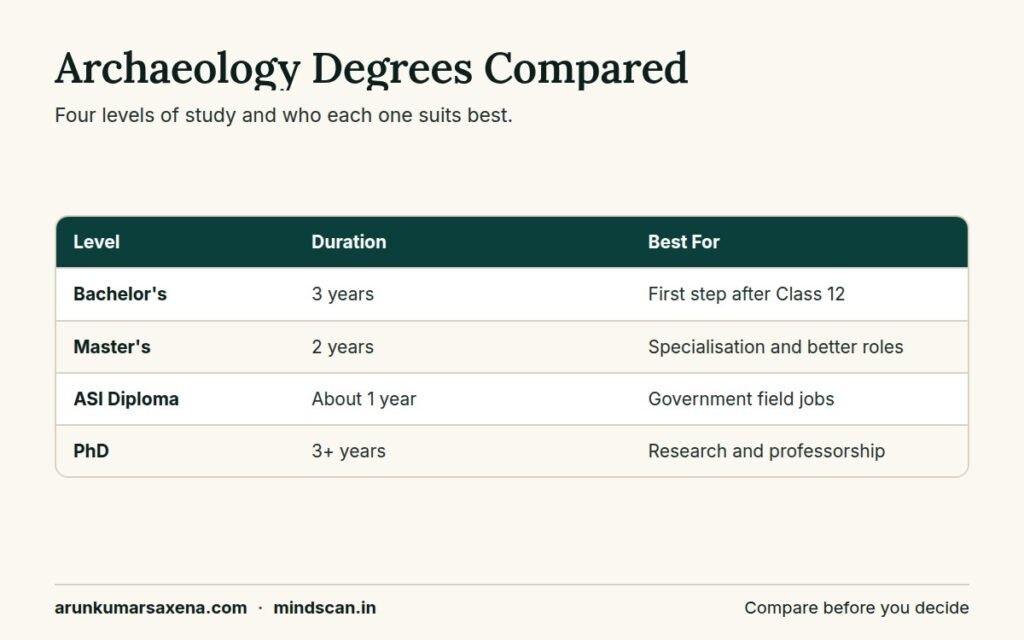
There are three levels: a 3-year undergraduate BA/BSc, a 2-year postgraduate MA/MSc or PG Diploma, and a PhD for research and teaching roles. The ASI’s Institute of Archaeology diploma in New Delhi is a key extra qualification for government field positions.
Undergraduate archaeology degrees run for 3 years and give the foundational survey of the discipline. Postgraduate programmes run for 2 years and allow specialisation in areas such as ancient Indian history, culture and archaeology. A doctorate takes 3 or more years and is required for high-level research, professorships and senior roles.
The PG Diploma in Archaeology from ASI’s Institute of Archaeology is the recognised gateway to ASI field roles in India. Many serious aspirants complete an MA and then add this diploma to strengthen their government job prospects. You can find details on the Archaeological Survey of India official website (asi.nic.in), which lists the diploma syllabus, eligibility and admission notifications.
| Level | Duration | What You Get | Best For |
|---|---|---|---|
| Bachelor’s (BA/BSc) | 3 years | BA/BSc Archaeology or related degree | First step after Class 12 |
| Master’s (MA/MSc) | 2 years | MA/MSc Archaeology specialisation | Serious specialisation and better roles |
| PG Diploma (ASI) | About two years | ASI Institute of Archaeology diploma | Government field jobs in India |
| PhD | 3+ years | Doctoral research degree | Research, professorship, senior roles |
Which Are the Best Colleges for Archaeology Degrees in India?
| College | City | Programme | Fieldwork Exposure |
|---|---|---|---|
| Deccan College Post-Graduate and Research Institute | Pune | MA/PhD in Archaeology | Strong research and excavation depth |
| Banaras Hindu University | Varanasi | BA/MA in Ancient Indian History, Culture and Archaeology | Long-standing department with dig access |
| Nalanda University | Rajgir | 2-year residential MA in Archaeology | Structured fieldwork across four semesters |
| MSU Baroda | Vadodara | Archaeology and Ancient History programmes | Experienced faculty, active department |
Well-known options include Deccan College in Pune, Banaras Hindu University in Varanasi, Nalanda University in Rajgir with a residential MA, MSU Baroda, University of Calcutta and University of Madras. Choose based on fieldwork exposure and faculty, not just name, and verify current details on official sites.
Which college is best for archaeology degrees in India?
Deccan College in Pune, Banaras Hindu University in Varanasi and Nalanda University in Rajgir are the three strongest names for archaeology degrees in India. Deccan College leads in research depth, BHU offers long-standing faculty strength, and Nalanda provides a focused residential MA with structured fieldwork exposure.
Deccan College Post-Graduate and Research Institute in Pune has a strong research reputation. BHU Varanasi and MSU Baroda run long-standing archaeology departments with experienced faculty. Nalanda University offers a 2-year full-time residential MA in Archaeology with four semesters of coursework, and you can check the Nalanda University’s official M.A. Archaeology programme page for current admission details.
Compare colleges on fieldwork opportunities, excavation access and placement support rather than brand name alone. A smaller department with active digs can teach more than a famous campus with no field programme. The National Career Service portal of the Government of India lists related job roles and employer expectations that can guide your college shortlist.
Your path to becoming an archaeologist after Class 12
- Class 12 in any stream, with Humanities the strongest base.
- 3-year BA/BSc Archaeology or a related degree, compare archaeology courses after 12th before shortlisting.
- 2-year MA/MSc in Archaeology for specialisation.
- ASI Institute of Archaeology PG Diploma in New Delhi for government field roles.
- PhD for research and teaching careers.
What Is the Step-by-Step Path to Become an Archaeologist in India?
Choose Humanities after Class 10 if possible, complete a bachelor’s in archaeology or a related subject, do an MA for specialisation, add the ASI diploma for government roles, gain fieldwork and internship experience, and decide early between research, academia, museums or heritage work.
Start self-assessment in Class 8-10 so your stream choice supports the goal. Pick a bachelor’s degree with real excavation exposure rather than only theory. Use internships, site visits and museum volunteering to test the field practically before the commitment deepens.
The clear path from Class 12 to a working archaeologist looks like this:
- Bachelor’s (BA/BSc, 3 years) in Archaeology or a related subject after Class 12.
- Master’s (MA/MSc, 2 years) for specialisation.
- ASI PG Diploma from the Institute of Archaeology for government field roles.
- PhD (3+ years) for research and teaching careers.
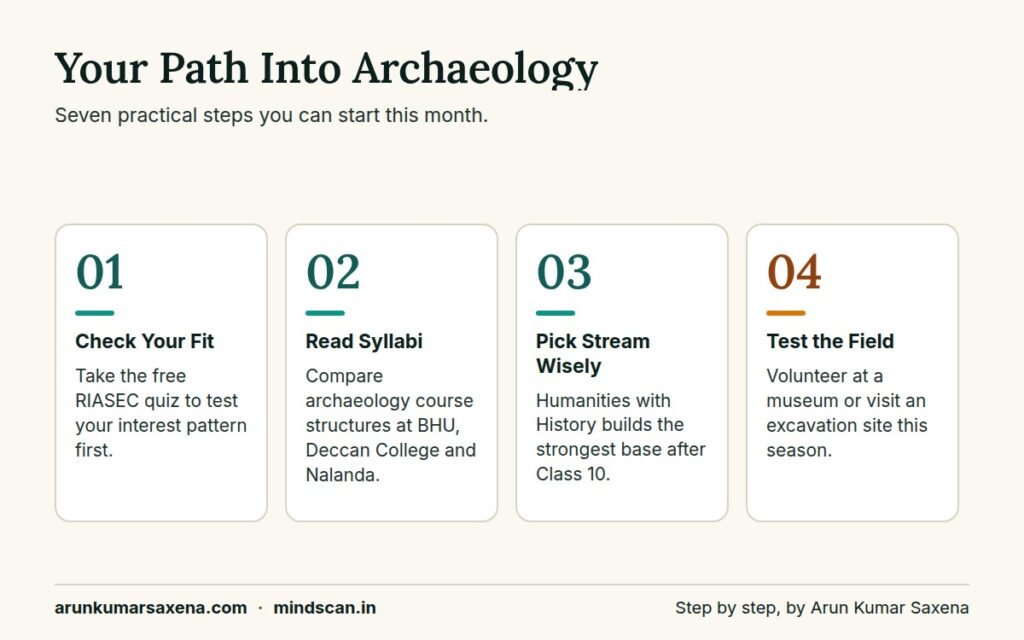
- Take a free RIASEC career personality quiz to check whether your interests genuinely match research-and-fieldwork careers.
- Read the syllabus of 3-4 archaeology degrees at BHU, Deccan College and Nalanda, and note what excites you.
- If you are in Class 10-11, choose Humanities with History and plan your stream accordingly.
- Shortlist five colleges and verify eligibility, entrance route and fieldwork exposure on their official websites.
- Join a museum as a volunteer or attend an open excavation or site visit this season to test the field practically.
- If you are a graduate, research the MA and the ASI Institute of Archaeology diploma and their admission timelines.
- Book a career counselling session to map your assessment results against archaeology and 20+ other career groups before you commit.
For a fuller explanation of the undergraduate route, read the Bachelor’s Degree in Archaeology: the complete guide.
Is Archaeology a High-Paying Job? An Honest Salary Reality Check
Archaeology is not a high-paying field at entry level in India. Government and museum roles offer stability, while academic and international heritage roles pay better with experience. Choose it for genuine interest in the subject, not for salary expectations.
Archaeology pay in India is defined by government pay scales for ASI roles, modest entry salaries in museums and heritage boards, and higher earnings only at senior research or international project levels. Entry-level figures, as per online sources, sit approximately in the low lakhs per year. For official role profiles and expected qualifications, the National Career Service portal of the Government of India lists archaeologist roles, which helps you verify realistic pay bands before committing to this field.
Common employers include:
- Archaeological Survey of India (ASI)
- Indian Council of Historical Research (ICHR)
- State archaeology departments
- Museums and heritage boards
- UNESCO-linked projects
I say this bluntly to students who glamorise the field: if salary is your top priority, archaeology degrees will disappoint you in the early years. Compare honestly with other careers before you commit. A scientific assessment helps here because it shows whether your true drivers are financial, intellectual or creative. If the money question is already making you hesitate, speak with a counsellor before locking in a degree path: online career counselling in India can map your priorities against realistic outcomes.
Will AI Replace Archaeology?
No. AI is a tool, not a replacement. AI and remote sensing speed up site surveys, artefact classification and data analysis, but excavation decisions, interpretation and cultural context still need trained human archaeologists. Learning these digital tools makes you more employable, not obsolete.
AI aids satellite imagery analysis, predictive site modelling and artefact pattern recognition. These tools reduce survey time and help prioritise dig locations. Interpretation, ethics and field judgement remain human skills that no model can currently replicate.
Students comfortable with GIS and digital documentation will have an edge in the job market. The future archaeologist will combine traditional fieldwork with digital analysis, and archaeology degrees that teach both will produce the most employable graduates.
How Do You Know If Archaeology Is the Right Degree for You?
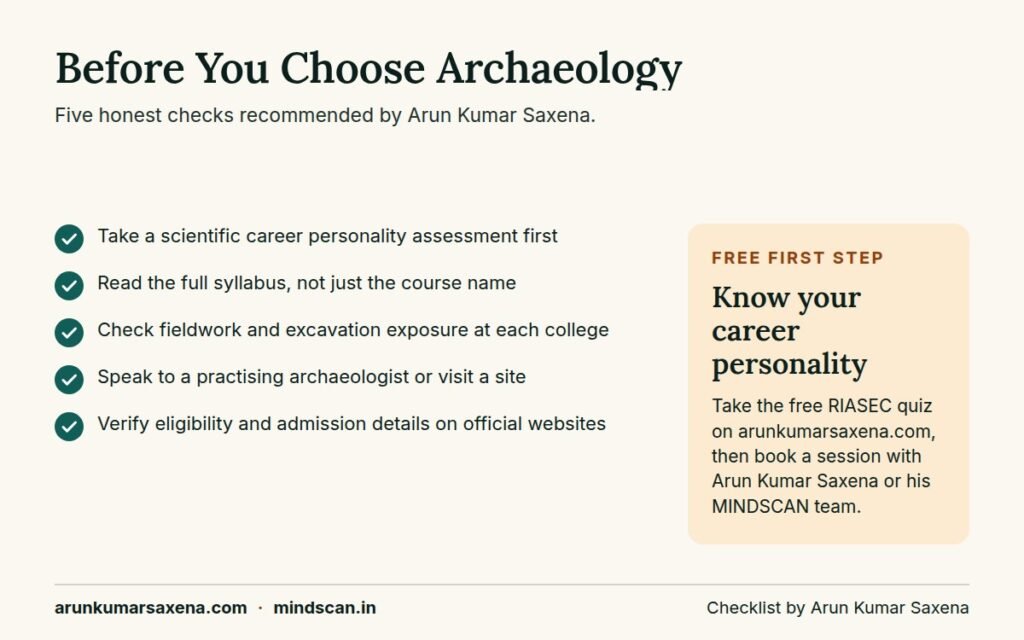
Archaeology suits students who enjoy history, patience, physical fieldwork and long research cycles. Before committing, take a scientific career personality assessment and speak to a career coach. The honest test is whether you would still love it on a dig site, not only in a classroom.
Take the free RIASEC career personality quiz to check your interest-fit pattern. Map your interests against 20+ career groups with a structured psychometric report. Talk to practising archaeologists or join a site visit before finalising. The MINDSCAN AI Career Clarity Report gives you a data-backed comparison of archaeology against adjacent heritage, history and research careers, so the decision is not left to guesswork.
“Analyse your child’s aptitude scientifically and check the scores critically before taking any decision.” (Arun Kumar Saxena)
My book “3 Steps to Knowing Yourself” frames the decision simply: self-knowledge comes before any career choice. Verify who you are before choosing a niche, field-heavy path like archaeology. The MINDSCAN report maps the student to 20+ career groups, so students comparing archaeology with adjacent heritage, history and research careers get a like-for-like comparison, not a yes or no answer.
You can learn more about my approach on the Arun Kumar Saxena profile page.
Archaeological Survey of India Jobs: Qualifications and Eligibility
Archaeological Survey of India jobs are government positions in excavation, conservation, epigraphy and heritage protection. They generally require a postgraduate degree in archaeology or a related subject, and for field roles the Post Graduate Diploma from the ASI Institute of Archaeology is the recognised qualification.
ASI recruitment eligibility varies by post, and candidates should always read the official notification. Generally, a postgraduate degree in archaeology or a related subject is expected. For field roles, the Post Graduate Diploma from ASI’s Institute of Archaeology in New Delhi is the recognised qualification. Check current vacancies on the Archaeological Survey of India official website.
Related reading: online career counselling across India with MINDSCAN and the psychometric assessment for choosing the right career.
Frequently asked questions about archaeology degrees
Is archaeology available after 12th without History?
Yes, most universities accept any stream in Class 12 for BA Archaeology, though Humanities with History gives a foundation advantage. If you took Science or Commerce, you can still enter via a related bachelor’s and switch at the master’s level.
Can I do an MA in Archaeology through distance or online learning?
Yes, distance options exist for some master’s programmes. However, fieldwork is central to archaeology, so a pure online route limits excavation experience and can weaken your job prospects. Check the practical and fieldwork component on the university’s official website before you commit to a distance or online mode.
What jobs can I get with an archaeology degree?
Key roles include field archaeologist, epigraphist, numismatist, conservation architect, museum curator and heritage manager. Main employers are the Archaeological Survey of India, the Indian Council of Historical Research, state archaeology departments, museums, universities and heritage or tourism boards. A master’s degree plus documented fieldwork experience is the practical entry requirement for most of these roles.
Do I need the ASI diploma to work in archaeology in India?
For government field roles with the Archaeological Survey of India, the diploma from ASI’s Institute of Archaeology in New Delhi is widely treated as a key qualification. For museum, academic or private heritage roles, a strong MA and fieldwork record can carry you.
What subjects should I pick in Class 11 for an archaeology career?
Humanities with History, and if available Anthropology, Political Science or Sociology, builds the best base. Geography also helps because of the survey and picture side of archaeology.
How long does it take to become a fully qualified archaeologist in India?
Realistically 5 to 7 years: 3 years for a bachelor’s, 2 for a master’s, plus the ASI diploma or the start of a PhD for specialised roles. It is a long path, which is why fit should be verified before starting.
Can I become an archaeologist after 12th?
Yes, you can become an archaeologist after 12th by enrolling in a 3-year BA or BSc in Archaeology or a related subject like Ancient History. Any stream is accepted, though Humanities with History gives the strongest foundation for the master’s and fieldwork ahead.
What qualifications do you need to become an archaeologist?
An archaeologist in India typically needs a 3-year BA or BSc in Archaeology or a related subject, followed by a 2-year MA or MSc for specialisation. For government field roles with the Archaeological Survey of India, the Post Graduate Diploma from ASI’s Institute of Archaeology is the recognised qualification, alongside documented fieldwork experience.
What qualifications do you need to become an archaeologist in India?
To become an archaeologist in India you need a 3-year BA or BSc in Archaeology or a related subject after Class 12, then a 2-year MA or MSc for specialisation, and for Archaeological Survey of India field roles the Post Graduate Diploma from ASI’s Institute of Archaeology in New Delhi, alongside documented fieldwork experience.
BA Archaeology or BSc Archaeology: which one should you choose after Class 12?
Choose BA Archaeology if your strengths are history, culture and writing; choose BSc if you are comfortable with science subjects such as geology and chemistry, which support dating methods. Both lead to the same master’s programmes, so pick the bachelor of archaeology route that matches your Class 12 subjects. The full Bachelor’s Degree in Archaeology guide compares both in detail.
Archaeology or History: which degree is the better starting point?
A History degree builds a broader base in sources and periods, while an archaeology degree adds excavation methods and material culture from the first year. Either is accepted for an MA in Archaeology. If you already know you want fieldwork, start with archaeology; if you want flexibility, History keeps more doors open.
| Factor | Archaeology Degree | History Degree |
|---|---|---|
| Core focus | Excavation methods, material culture | Sources, periods, historiography |
| Fieldwork | Compulsory digs and surveys from year one | Limited or no excavation work |
| Route to MA Archaeology | Direct progression | Accepted route |
| Best if | You already want fieldwork | You want flexibility |
Can Science or Commerce students switch to archaeology after 12th?
Yes. Most universities accept any Class 12 stream for an archaeology degree, and Science students often find geology and chemistry genuinely useful in the field. Commerce students can enrol directly or enter via a related bachelor’s and catch up at the master’s stage. For stream-level context, see career options after 12th in Arts.
What skills beyond the degree does fieldwork in archaeology actually demand?
An archeology degree alone is not enough for the field. Real digs demand physical stamina, patience with slow research cycles, careful documentation, teamwork and tolerance for weeks of outdoor work with no headline discovery. This is why career coach Arun Kumar Saxena advises students to test the field through a site visit or museum volunteering before committing.
What can you do after an MA in Archaeology besides government field jobs?
Beyond ASI roles, an MA in Archaeology opens museum curation, heritage management, epigraphy and numismatics, academic research through a PhD, cultural tourism, and digital documentation work using GIS and remote sensing. Private heritage consultancies and UNESCO-linked projects also hire archaeology postgraduates with a strong fieldwork record.
What qualifications do you need for Archaeological Survey of India jobs?
ASI recruitment eligibility varies by post and candidates must read the official notification; generally a postgraduate degree in archaeology or a related subject is expected, and for field roles the Post Graduate Diploma from ASI’s Institute of Archaeology in New Delhi is the recognised qualification. Point readers to asi.nic.in for current vacancies.
Is archaeology a good career in India?
Yes, for genuinely interested students; archaeology offers stable government roles in ASI and state departments, museum, heritage and academic careers, but entry salaries are modest and the path takes 5-7 years, so it suits students who love history and fieldwork, not those chasing quick money.
Which subjects in Class 11-12 help most for an archaeology degree?
History is the single most useful subject, with Anthropology, Sociology, Political Science and Geography close behind, since geography supports survey and mapping work. Most universities accept any stream for archaeology courses after 12th, but a Humanities combination gives you the terminology, historical context and analytical habits that an archaeology degree assumes from the first semester.
Is a BA in Archaeology better than a related degree like History or Anthropology followed by an MA?
Neither is strictly better. A bachelor of archaeology gives you excavation methods and material culture from year one, while a BA in History or Anthropology followed by an MA in Archaeology is an equally valid and more flexible route. What matters most for jobs is your master’s specialisation, your fieldwork record and, for government roles, the ASI diploma.
What does fieldwork in an archaeology degree actually involve day to day?
Day to day, fieldwork means early mornings at the site, careful digging in marked grid squares, photographing and drawing finds, recording soil layers in notebooks, labelling artefacts and cataloguing everything in the evening. Weeks of routine documentation far outnumber dramatic discoveries, which is why career coach Arun Kumar Saxena advises students to test a real dig before committing.
Can Commerce students switch to archaeology after 12th?
Yes. Most universities accept any Class 12 stream for an archaeology degree, so Commerce students can enrol directly in a bachelor of archaeology or enter through a related bachelor’s in History and specialise at the master’s level. Comfort with accounts even helps later in heritage project budgeting. For stream comparisons, see career options after 12th in Arts.
What non-government career paths exist after an archaeology degree besides ASI jobs?
Beyond ASI jobs, an archeology degree leads to museum curation, heritage management with private consultancies, cultural tourism, epigraphy and numismatics, archaeological writing and content work, and digital roles using GIS, remote sensing and 3D documentation. UNESCO-linked projects, universities and state tourism boards also hire postgraduates with a documented fieldwork record.
हिंदी में जवाब: पुरातत्व डिग्री: कोर्स, पात्रता और करियर
जल्दी नौकरी पाने के लिए कौन सा कोर्स करें?
अगर जल्दी नौकरी चाहिए तो ASI का पुरातत्व डिप्लोमा एक व्यावहारिक विकल्प है, लेकिन सरकारी भर्ती में समय लगता है। संग्रहालय, हेरिटेज बोर्ड और पर्यटन क्षेत्र में स्नातक के बाद प्रवेश स्तर की भूमिकाएँ मिल सकती हैं। अरुण कुमार सक्सेना (MINDSCAN Career Guidance के संस्थापक) कहते हैं कि पहले अपनी रुचि और योग्यता की वैज्ञानिक जाँच कराएँ, फिर कोर्स चुनें।
बीएससी के बाद कौन सा कोर्स करना चाहिए?
बीएससी के बाद पुरातत्व में एमए या एमएससी करना एक अच्छा मार्ग है, खासकर यदि आपने भूविज्ञान, रसायन विज्ञान या मानव विज्ञान पढ़ा हो। इसके बाद ASI का डिप्लोमा, जिसकी अवधि लगभग दो वर्ष होती है, सरकारी क्षेत्र के लिए उपयोगी होता है। अरुण कुमार सक्सेना की सलाह है कि कोर्स चुनने से पहले करियर असेसमेंट कराकर अपनी दिशा स्पष्ट करें।
करियर की शुरुआत कैसे करें?
करियर की शुरुआत आत्म-जाँच से करें: रुचि, योग्यता और काम करने की शैली को समझें। फिर छोटे कदम उठाएँ जैसे संग्रहालय में स्वयंसेवा, साइट विज़िट और इंटर्नशिप। अरुण कुमार सक्सेना कहते हैं कि वैज्ञानिक असेसमेंट के बाद ही कोई लंबा और महँगा डिग्री मार्ग चुनें।
If archaeology degrees still feel like a genuine possibility, do not decide on instinct alone. Book online career counselling with MINDSCAN and get your interests mapped against 20+ career groups before you commit years to this path.
Start with the MINDSCAN AI Career Clarity Report at ₹1,499, or add a counselling session for ₹2,999. The right decision now saves wasted semesters, wasted fees and years of quiet regret.