
Scope of Psychology in India: Courses, Careers and Salaries
By Arun Kumar Saxena, Certified Advanced Career Coach · Updated November 2026
Quick answer: The scope of psychology in India is expanding fast because mental health professionals remain severely short in number while awareness is rising. Careers span clinical, counselling, organisational, forensic, sports, UX research and academia. My honest angle: the degree alone is not enough. Match your personality to the specialisation first, and know the RCI rules before choosing clinical practice.
The scope of psychology in India is no longer a question of availability but of alignment. Students and parents often ask if psychology is a good career in India. The answer is yes, but with conditions. This page breaks down the specialisations, salaries, RCI licensing rules, the BA versus BSc decision, and the real question every aspirant must answer: does this career actually fit you?
With 22 years of experience and 20,000+ students and professionals guided, I have seen too many bright students pick psychology for the wrong reasons and struggle later. The market is growing. The workforce gap is real. Your personal scope depends on matching your traits to the right specialisation before you invest five or more years in study. Let me show you how.
Table of Contents
What is the scope of psychology in India in 2026?
Psychology is the scientific study of the mind and behaviour, and its scope covers the careers, specialisations and practice routes open to trained professionals. Psychology in India offers careers across hospitals, schools, corporations, sports, forensics, UX research and academia. Demand is rising because India has roughly one mental health professional per 100,000 to 130,000 people, per widely cited estimates, while stigma around seeking help is reducing. The scope is real, but it rewards specialisation and self-awareness, not just a degree.
Clinical, counselling and organisational psychology remain the three biggest employment tracks. Emerging fields include UX research, consumer behaviour, sports, forensic and neuropsychology. Academia and policy research are stable paths for postgraduates and PhD holders. My warning: scope is national, not personal. Your scope depends on fit, not the market.
Picture a Class 12 humanities student who loves listening to friends’ problems. She assumes clinical psychology is her path. But without checking her aptitude for the hard science and diagnostic rigour clinical work demands, she may find herself drained and directionless by the second year of her master’s. That is the gap between market scope and personal scope. The scope of psychology in India rewards those who close that gap early.
What most guides miss: the fit-first framework
Most career guides list specialisations and salaries but skip the step that decides whether you last in this field. In my sessions, I use a simple fit check before discussing any psychology track. Question one: are you genuinely curious about why people think and act the way they do, or are you just good at giving advice to friends? Question two: can you commit to a master’s degree as the realistic minimum for practice?
Question three: which work setting energises you, a quiet research lab, a busy hospital ward, a corporate floor, or a school counselling room? Your answers point to different specialisations. A student who loves data and systems may thrive in organisational psychology but wilt in clinical practice. A student who needs quick, visible results may struggle in the slow-burn work of therapy. The scope of psychology in India opens up only when your daily work aligns with your natural wiring.
My book 3 Steps to Knowing Yourself puts self-knowledge before any career choice. Start there, not with the salary chart.
Which psychology specialisation has the best career scope in India?
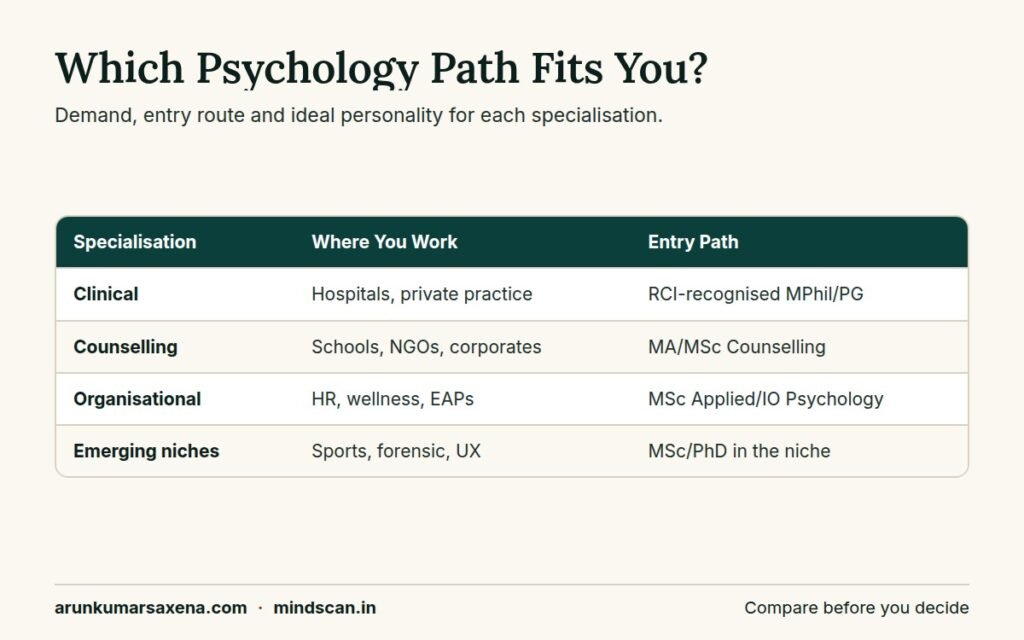
No single specialisation is best. It depends on your strengths. Clinical psychology has the highest demand, as per online sources, but requires RCI-recognised qualifications. Counselling suits patient, empathetic communicators and needs no RCI licence for general practice. Organisational psychology offers the most corporate mobility. Use a psychometric assessment to decide, not peer pressure.
| Specialisation | Where You Work | Entry Path | Best Suited For |
|---|---|---|---|
| Clinical Psychology | Hospitals, clinics, private practice | RCI-recognised MPhil/PG + registration | Resilient, detail-focused, service-minded |
| Counselling Psychology | Schools, colleges, NGOs, corporates | MA/MSc Counselling; no RCI needed for general counselling | Empathetic, patient communicators |
| Organisational/IO Psychology | HR, talent, wellness, EAPs | MA/MSc Organisational or Applied Psychology | Business-minded, data-comfortable |
| Emerging (Forensic, Sports, UX) | Research labs, sports bodies, tech firms | MSc/PhD in the niche; fewer structured roles | Curious, niche-driven explorers |
| Academia & Research | Universities, policy institutes | NET/PhD after master’s | Deep readers, patient learners |
Clinical psychology involves diagnosis and treatment of disorders. RCI registration is mandatory. Counselling covers academic, vocational and relational support in schools, colleges, NGOs and corporates. Organisational psychology spans HR, talent acquisition, leadership coaching and employee assistance programmes. Forensic, sports, UX research and neuropsychology are growing but have fewer structured entry roles. The scope of psychology in India is broad. Your job is to pick the lane that fits your personality.
BA psychology or BSc psychology, which is better for your career?
Both lead to the same postgraduate doors. The difference is emphasis. BSc leans towards science subjects, statistics and research methods, suiting clinical and neuropsychology ambitions. BA includes more humanities electives and suits counselling, HR, social work and organisational tracks. Choose based on your Class 12 stream, maths comfort and intended specialisation.
Entry to either is often via merit or CUET after Class 12. BSc is generally preferred as a base for MSc Clinical or Neuropsychology. BA fits students targeting MA Counselling, Applied Psychology, HR or civil services. The specialisation at master’s level matters more to employers than the BA or BSc label. The scope of psychology in India does not narrow based on this undergraduate choice. It narrows if you pick without knowing your postgraduate goal.
In many homes, the dinner-table argument goes: Science students must take BSc, Arts students must take BA. That is outdated. I have seen commerce students with strong statistics take BSc Psychology and thrive. I have seen science students take BA Psychology because they wanted the humanities breadth for a counselling career. Check the syllabus of the college, not just the degree label. The University Grants Commission website and the National Career Service portal list recognised programmes. Cross-check before applying.
How do you become a clinical psychologist in India (RCI rules explained)?
To practise clinical psychology legally in India, you must register with the Rehabilitation Council of India (RCI). This requires a designated postgraduate qualification such as the RCI-recognised MPhil Clinical Psychology or an approved equivalent, followed by RCI registration. General counselling does not need RCI registration. Many students discover this distinction too late.
Check that your master’s or MPhil programme is RCI-recognised before enrolling. Without RCI registration you cannot legally practise clinical psychology in India. RCI registration is generally not mandatory for school, career or general counselling roles. My honest note: verify the RCI recognition status of any college on the official RCI list, not the brochure. The scope of psychology in India for clinical practice is gated by this licence. Skip this check and you may find yourself with a degree but no legal standing to practise.
What can you do after MSc psychology in India?
After an MSc in psychology you can enter clinical practice with RCI-recognised training, counselling in schools, colleges and NGOs, organisational roles in HR and employee wellness, UX and consumer research, sports or forensic psychology, or academia and research. A PhD or MPhil opens teaching, clinical licensure and senior research positions.
MSc or MPhil Clinical Psychology is the track for hospital and clinical roles. MA or MSc Counselling or Applied Psychology suits the counselling and corporate track. Private practice becomes viable after supervised experience and licences. Research and teaching positions typically require clearing NET or a PhD. The scope of psychology in India after a master’s is wide, but each door needs a specific key. Get the right key for the door you want.

What is the salary of a psychologist in India?
As per online sources and industry estimates, entry-level pay in clinical and counselling roles starts modestly. Roughly ₹15,000 to 35,000 a month is common. Roles in HR, analytics and UX research in corporates can start around ₹4 to 8 lakh a year. Salaries rise sharply with RCI registration, private practice, corporate specialisation and experience.
| Role | Approximate Monthly Pay | Approximate Annual Pay |
|---|---|---|
| Entry-level clinical/counselling psychologist | ₹15,000 – ₹35,000 | ₹1.8 lakh – ₹4.2 lakh |
| Corporate HR/UX research psychologist | ₹33,000 – ₹67,000 | ₹4 lakh – ₹8 lakh |
| Experienced clinical psychologist with RCI registration | ₹50,000 – ₹1,00,000+ | ₹6 lakh – ₹12 lakh+ |
| Private practice (established) | Varies widely | Varies widely |
Hospital and NGO roles pay least at entry. Corporate and UX roles pay most. Private practice income grows with reputation and referrals over years. Government positions in hospitals, defence and universities offer stability and benefits. My honest view: do not choose psychology for quick money. It rewards patience. The scope of psychology in India is not a get-rich-quick story. It is a build-slowly, earn-steadily story.
Will AI replace psychologists in India?
No. Psychology is among the most AI-resistant careers. Its core work is human trust, empathy and judgement in complex, sensitive situations. AI can automate screening, note-taking and self-help content, but diagnosis, therapy, counselling and organisational interventions require a licensed human. Expect AI to become a psychologist’s tool, not a replacement.
AI chatbots can support early screening but cannot handle crisis, severe disorders or accountability. Careers requiring empathy, ethics and licensing are consistently rated as AI-proof. Psychologists who learn AI tools will outcompete those who ignore them. The scope of psychology in India will grow alongside AI, not shrink because of it.
What profession will not be replaced by AI?
Psychology is one profession that will not be replaced by AI. The core work demands human empathy, ethical judgement and a licensed practitioner who takes legal accountability for decisions. Machines can process data, but they cannot build the trust or handle the complex emotional and cultural context that a trained psychologist handles in every session.
Is psychology a good career in India? (honest self-check)
Psychology suits you if you are genuinely curious about people, patient with slow-burn career growth, comfortable with further study after graduation, and emotionally resilient. It does not suit you if you want a quick high-paying job right after a bachelor’s. My framework from my book 3 Steps to Knowing Yourself says self-knowledge must come before any career choice, including this one.
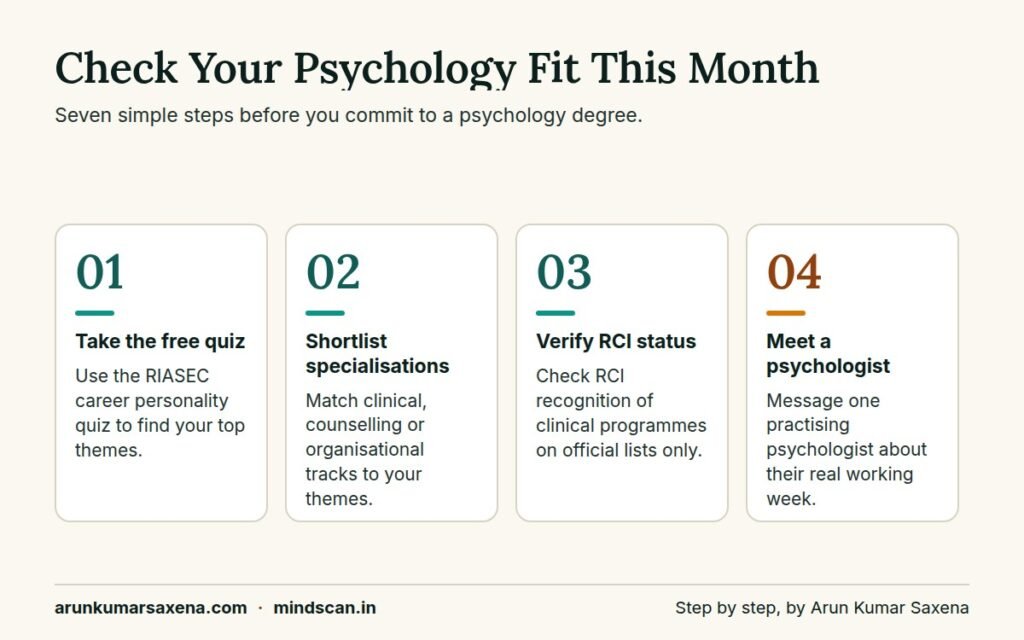
- Take a free career personality quiz. Take the free RIASEC career personality quiz and note your top two themes.
- List three specialisations, clinical, counselling, organisational, or emerging, that match those themes.
- Check the RCI recognition status of every clinical programme on your college shortlist.
- Interview or message one practising psychologist on LinkedIn about their real week.
- Start one book or MOOC in your shortlisted specialisation this month.
- Volunteer or shadow at a helpline, school or NGO for counselling exposure.
- If still unsure, book an online career counselling session with Arun Kumar Saxena for a data-verified decision.
A structured psychometric assessment plus a counselling session shows whether your personality, interests and aptitude actually match psychology and which specialisation fits best, before you spend five or more years studying.
“Analyse your child’s aptitude scientifically and check the scores critically before taking any decision.” (Arun Kumar Saxena)
What skills and steps should a psychology student build this month?
This month, a psychology aspirant should take a validated personality test, shortlist specialisations against their fit, verify RCI recognition of target colleges, shadow or interview a practising psychologist, start a reading habit in one specialisation, and build one applied skill such as statistics, research writing or active listening through volunteering.
Statistics and research methods are the most under-rated skills for psychology careers. Volunteering at helplines or NGOs builds counselling exposure early. Maintain a simple record of readings and observations. It strengthens postgraduate applications. Review your fit honestly every six months as you learn more. The scope of psychology in India favours students who build skills alongside theory. Start now.
Frequently asked questions about scope of psychology in india
Is psychology hard to study in India?
Psychology is conceptually accessible but demands disciplined reading, statistics and research methods, which many students underestimate. The theory is interesting. The rigour comes in research design, diagnostics and supervised practice. Students comfortable with both essays and basic data do best.
Can I become a psychologist without a master’s degree in India?
A bachelor’s alone limits you to entry-level support, research-assistant or corporate people-ops roles. Professional practice as a clinical or counselling psychologist realistically requires a master’s. Clinical practice also requires RCI-recognised training and registration. Plan for postgraduate study from day one.
Do psychologists get government jobs in India?
Yes. Psychologists are recruited in government hospitals, universities, defence and police organisations, prisons and welfare departments, typically through UPSC, state PSC, or institutional exams, usually requiring a master’s degree and sometimes NET or RCI registration depending on the post.
Is there scope for psychology in India and abroad?
The scope of psychology in India and abroad is strong. Countries such as the US, UK, Canada and Australia face similar mental-health workforce shortages, but each has its own licensing bodies. An Indian master’s plus supervised experience is a workable base. Research each country’s registration requirements before planning.
Which stream should I choose after 10th for psychology?
Any stream, science, commerce or humanities, can lead to a BA or BSc in psychology, as most universities admit students from all streams, often via CUET or merit. Humanities with psychology as a subject gives the earliest exposure, but maths or biology strengthens the research or neuropsychology route.
What is the difference between a psychologist and a psychiatrist?
A psychiatrist is a medical doctor (MBBS plus MD Psychiatry) who can prescribe medication. A psychologist holds a psychology degree, cannot prescribe medicines, and works through assessment, therapy and counselling. Severe cases often need both working together.
How does career counselling help before choosing psychology?
A structured psychometric assessment plus a counselling session shows whether your personality, interests and aptitude actually match psychology and which specialisation fits best, before you spend five or more years studying. Arun Kumar Saxena reviews every MINDSCAN report personally.
The scope of psychology in India is real, growing, and waiting for students who match their strengths to the right specialisation. Do not pick based on a brochure or a relative’s suggestion. Get a data-verified picture of your fit first. My MINDSCAN team and I have built the MINDSCAN AI Career Clarity Report for exactly this purpose. It maps you to 20+ career groups. You can get the report alone at ₹1,499, or with a one-on-one counselling session at ₹2,999, on mindscan.in/psychometric-assessment/.
Book an online career counselling session with Arun Kumar Saxena if you want clarity before you commit. A single session can save you years of study in the wrong direction. Your career in psychology should start with self-knowledge, not guesswork.