
IIM Courses After 12th: IPM, BBA & B.Sc. Options
By Arun Kumar Saxena, Certified Advanced Career Coach · Updated November 2026
Quick answer: Yes, you can enter an IIM directly after 12th without CAT. IIM courses after 12th include the 5-year IPM at IIM Indore, Rohtak, Ranchi, Jammu and Bodh Gaya, plus BBA, B.Sc. and BBA LLB programmes. Entry is via IPMAT, JIPMAT, CUET or institute tests. Career coach Arun Kumar Saxena advises checking aptitude fit first, not just brand appeal.
IIM courses after 12th are a real, direct path into India’s top management institutes, and you do not need to wait for graduation or clear CAT. This page lays out every undergraduate route the IIMs offer right now: the 5-year IPM, standalone BBA and BMS degrees, B.Sc. programmes in data science and economics, and even a BBA LLB. If you are a Class 12 student or a parent weighing options, you will find a clear comparison, honest fit checks and step-by-step guidance here.
With 22 years of experience and 20,000+ students and professionals guided, I have seen too many families chase an IIM tag without first checking whether the course and the student actually match. The brand is strong, but a five-year commitment built on peer pressure or coaching-institute hype can cost time, money and confidence. This page gives you the facts, the entrance routes and a framework to decide if IIM courses after 12th are right for you, not just right on a brochure.
Table of Contents
What are the IIM courses after 12th?
IPM (Integrated Programme in Management) is a five-year dual-degree course offered by select IIMs, combining a bachelor’s degree (BBA or BA) with an MBA. Other IIM courses after 12th include standalone BBA, BMS, B.Sc. and BBA LLB programmes with different durations and entry routes.
IIM courses after 12th include the 5-year IPM, standalone BBA and BMS degrees, B.Sc. programmes in economics and data science, and a BBA LLB integrated law programme. Each has a different structure, duration and entrance route, and new programmes are added as IIMs expand their undergraduate offerings under the National Education Policy.
The IPM is the most well-known option. It is a dual-degree programme that combines a bachelor’s degree with an MBA, all within five years at one campus. IIM Indore started the IPM, and IIM Rohtak, Ranchi, Jammu and Bodh Gaya now run their own versions. You exit with a full IIM MBA without ever appearing for CAT, provided you meet the programme’s academic requirements along the way.
Standalone BBA and BMS programmes are 3- to 4-year degrees that follow the NEP’s multiple exit options. IIM Bangalore, IIM Kozhikode and IIM Sirmaur offer these. IIM Bangalore and IIM Sambalpur also run B.Sc. degrees in areas like Economics, Data Science and allied fields. IIM Rohtak adds a BBA LLB for students who want to combine management and law from day one. Always verify the latest programme list on the official IIM website before you apply, because undergraduate IIM courses after 12th are expanding each year.
How can I enter in IIM without CAT?
You can join IIM courses after 12th without CAT by clearing one of the designated undergraduate entrance exams: IPMAT for IIM Indore and Rohtak, JIPMAT for IIM Jammu and Bodh Gaya, or CUET and institute tests for BBA, BMS and B.Sc. programmes.
CAT is built for the two-year MBA after graduation. It has no role in undergraduate IIM admissions. The exams you will face instead test quantitative aptitude, verbal ability and logical reasoning at a level closer to what you have studied in Classes 11 and 12. Your Class 10 and Class 12 aggregate marks also carry weight. Most IIMs set a minimum of approximately 60% aggregate for general-category students and approximately 55% for reserved categories, though the exact cut-off varies each year.
Some programmes accept SAT scores or CLAT scores, so check the specific admission page of the IIM you are targeting. The core point is simple: CAT is not the only door to an IIM. The undergraduate door is open, and it has its own keys.
Is IPMAT tougher than CAT?
IPMAT is not universally tougher than CAT because they test different skills. IPMAT leans heavily on quantitative ability drawn from the Class 11 and 12 maths syllabus, while CAT tests quantitative aptitude, data interpretation and verbal reasoning after graduation with a much wider candidate pool.
If your fundamentals in algebra, arithmetic and geometry are strong, IPMAT’s quantitative section will feel demanding but manageable. If your maths base is shaky, IPMAT can feel harder than CAT because there is no work-experience cushion or graduation-level reasoning to fall back on. The competition level also differs: IPMAT has fewer seats but a younger, less experienced pool. CAT has more seats and far more applicants.
Compare recent cut-off trends for the specific IIM and programme you want. A blanket “IPMAT is easier” or “CAT is tougher” statement helps nobody. Your own subject strengths decide which exam feels harder.
What is the eligibility for IIM UG courses after 12th?
Eligibility for IIM courses after 12th typically requires a minimum aggregate of approximately 60% in both Class 10 and Class 12 from a recognised board, with an approximately 5% relaxation for reserved-category students. You must also have passed Class 12 in the year specified by the institute’s admission policy, and some programmes set an upper age limit.
Certain programmes demand mathematics as a subject in Class 12 or at least in Class 10. IIM Indore’s IPM, for instance, expects quantitative comfort even if maths was not your main subject, but specific subject requirements differ across IIMs. Final-year Class 12 students can apply in most cases, and the application window typically opens months before the board exams.
Always read the official eligibility document for the exact IIM and programme you are targeting. A single missed clause, such as a specific year-of-passing rule, can disqualify an otherwise strong application.
Which IIM offers which course after 12th? (comparison)
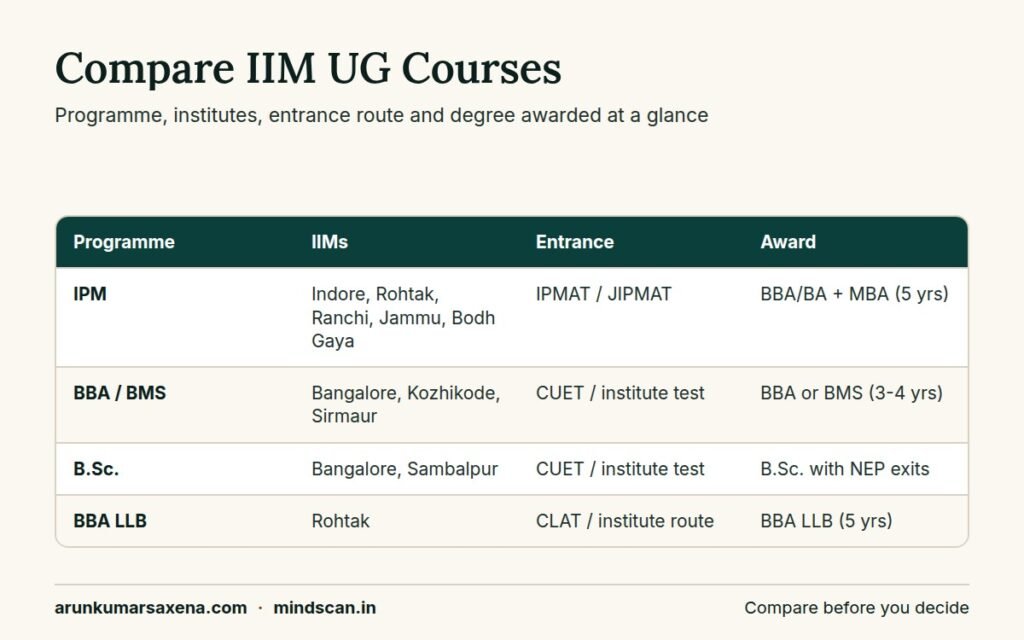
Each IIM runs a specific set of undergraduate programmes with its own entrance exam and final award. The table below maps every major undergraduate IIM course after 12th to its host institute, entrance route and final award so you can shortlist programmes before diving into individual eligibility pages.
| Programme | IIMs Offering | Entrance Route | Award |
|---|---|---|---|
| IPM | IIM Indore, Rohtak, Ranchi, Jammu, Bodh Gaya | IPMAT / JIPMAT | BBA/BA + MBA (5 yrs) |
| BBA / BMS | IIM Bangalore, Kozhikode, Sirmaur | CUET / institute test | BBA or BMS (3-4 yrs) |
| B.Sc. Programmes | IIM Bangalore, Sambalpur | CUET / institute test | B.Sc. degree with NEP exit options |
| BBA LLB | IIM Rohtak | CLAT / institute route | BBA LLB (5 yrs) |
Programme lists change year to year. New IIMs may add undergraduate degrees, and existing ones may tweak entrance criteria. Always confirm the latest details on the official IIM website before you lock your application plan.
How do I apply for IIM courses after 12th? (step by step)
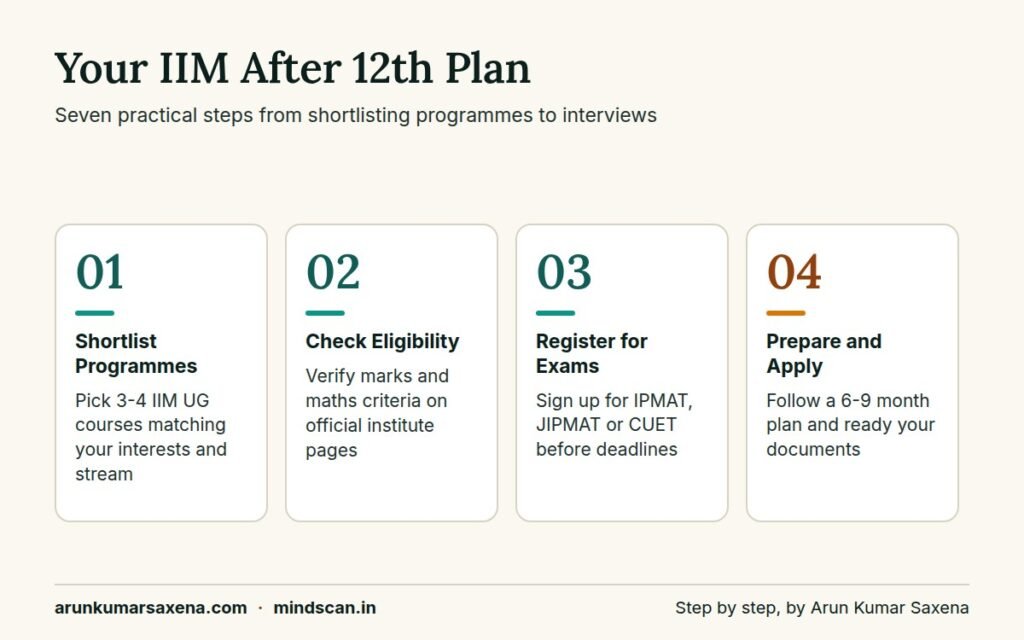
Applying for IIM courses after 12th works best when you follow a clear sequence. Start early, keep documents ready and prepare for both the written test and any interview round. Here are the seven steps I recommend to students in my sessions.
- Shortlist 3-4 IIM UG programmes that match your interest and stream, using the comparison table above. Do not fixate on one institute.
- Check the exact eligibility (marks, age, year of passing) on each institute’s official admission page. A single missed clause can waste an attempt.
- Register for the matching entrance exams: IPMAT (Indore or Rohtak), JIPMAT via NTA, or CUET where accepted. Mark application deadlines on a calendar.
- Take the free RIASEC career personality quiz to confirm that management genuinely fits your interests before committing five years. You can take the free RIASEC career personality quiz to get started.
- Build a 6-9 month prep plan focusing on quantitative aptitude, verbal ability and logical reasoning. Daily practice beats last-month cramming.
- Keep Class 10 and 12 mark sheets, category certificates and photos ready before application windows open. Scanned copies in the right format save panic later.
- After the exam, prepare for interview and writing rounds and keep a backup UG plan (B.Com, BBA elsewhere) in parallel. A backup is prudence, not pessimism.
Is IPM at an IIM right for me, honestly?
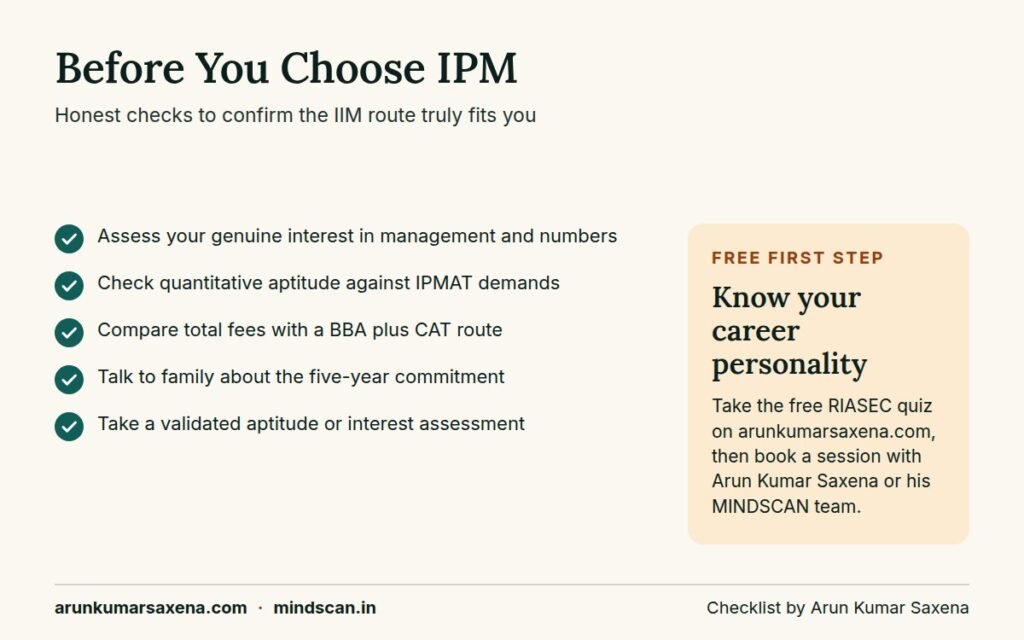
IPM is right for you if you are genuinely drawn to management, comfortable with numbers and ready for a five-year commitment on one campus. It is a poor fit if you chose it only for the IIM brand, because a relative compared you at a wedding or because your coaching centre pushed it as a trophy.
Five years is a long lock-in. A standard 3-year B.Com or BBA degree, followed by work experience and a CAT attempt, gives you more flexibility and often costs less. The total fee for an IPM can run into several lakhs, and you need to compare that with the cost of a good undergraduate college plus a later MBA. The IIM tag is powerful, but it does not cancel a mismatch between your aptitude and the daily demands of a management programme.
Before you decide, invest in a scientific assessment. The MINDSCAN assessment maps students to 20+ career groups so IPM is chosen by evidence, not hype. If you want to book an online career counselling session with Arun Kumar Saxena, we can work through that fit together.
What most guides miss: the self-knowledge test before the IIM tag
Most coaching blogs and admission guides push straight into exam patterns, cut-offs and “top 10 reasons to do IPM.” They skip the one step that determines whether you will thrive or struggle: knowing yourself before you choose the course. My book “3 Steps to Knowing Yourself” was written precisely because I saw students pick high-prestige programmes, realise the daily work did not match their personality, and then either drop out or drag themselves through years of quiet frustration.
A MINDSCAN assessment maps a student to 20+ career groups, giving you data to cross-check before you commit to any IIM courses after 12th. You can also take the free RIASEC career personality quiz as a quick starting point grounded in your own interests.
Before you register for IPMAT or fill a CUET form, answer three questions honestly. One: when you read business news or a case study, do you feel curious or do you skip it? Two: do you enjoy working with numbers and data, or do you avoid them whenever possible? Three: are you choosing this path because the career appeals to you, or because it will make your family proud?
Your answers matter more than any cut-off trend. If you are not sure, take the RIASEC quiz linked in the steps above. It gives you a starting point grounded in your own interests, not in someone else’s expectations.
This self-check is what the top-ranking pages on IIM courses after 12th rarely offer. They list programmes and exams. I want you to list your own reasons first.
“Analyse your child’s aptitude scientifically and check the scores critically before taking any decision.” (Arun Kumar Saxena)
What salary can I expect after IPM?
IPM graduates complete the programme with an IIM MBA, so their placements reflect the institute’s MBA placement record. As per online sources, IIM MBA placement averages are typically in the tens of lakhs per annum, though you must verify with the institute’s audited report. The actual figure depends on the specific IIM, the hiring year and market conditions.
Treat any salary number you see on a coaching blog as indicative, not guaranteed. The placement process is run by the MBA placement cell, and your undergraduate stage does not determine the final offer. Ask the institute for its latest audited placement report and compare it with reports from the previous two years. A single-year spike can be misleading.
Focus on the skills and network you will build over five years, not on a promised number. Employers pay for what you can do, not for the entrance exam you cleared at 17.
IIM courses after 12th: commerce vs science vs arts stream?
Students from science, commerce and arts can all apply to most IIM courses after 12th. There is no commerce-only rule for IPM or BBA programmes. What separates strong applicants from struggling ones is quantitative aptitude, because the IPMAT maths section demands comfort with numbers that arts students without maths may not have built yet.
Science students with mathematics often adapt quickly to the quantitative section. Commerce students get some syllabus overlap from their accountancy and business studies background. Arts students should start dedicated maths practice early, ideally in Class 11, and check whether the specific IIM programme requires mathematics as a subject in Class 10 or Class 12. Stream choice matters far less than your willingness to prepare for the test that is actually in front of you.
| Stream | Advantage | Action Needed |
|---|---|---|
| Science (with Maths) | Strong quantitative base; quick adaptation to IPMAT maths | Build verbal and reading comprehension skills |
| Commerce | Syllabus overlap in business studies and accountancy | Strengthen advanced algebra and geometry |
| Arts | Strong verbal and reading comprehension base | Start dedicated maths practice early, ideally in Class 11 |
For more on choosing a degree that fits your stream, read my guide on the best courses after 12th commerce and the broader article on how to choose the right career after 12th. If you are already thinking about the MBA stage, the page on MBA courses after graduation will help you compare the full path. You can also learn more about my work on my profile page: Arun Kumar Saxena. For official education policies, visit the Ministry of Education, Government of India. For career exploration resources, the National Career Service portal is a useful starting point.
If you are weighing other specialised paths, my guide on how to become a forensic scientist after 12th covers a science-based alternative.
Frequently asked questions about iim courses after 12th
Can I join IIM without a CAT?
Yes. IPMAT, JIPMAT, CUET and institute tests let you enter IIM undergraduate programmes straight after Class 12. CAT is only required for the two-year MBA after graduation, not for IIM courses after 12th. IPMAT is conducted by IIM Indore and Rohtak, while JIPMAT via NTA covers IIM Jammu and Bodh Gaya.
Is IIM harder than IIT?
They are different comparisons. IIT admissions run on JEE’s physics-chemistry-maths depth, while IIM UG admissions test aptitude, verbal and reasoning in IPMAT or JIPMAT. Neither is universally harder; difficulty depends on your strengths. A student strong in maths may find IPMAT manageable but JEE Advanced extremely demanding.
What is the IIM salary after these courses?
UG IIM students who complete the MBA stage are placed through the institute’s MBA placement process. As per online sources, IIM MBA placement averages are typically in the tens of lakhs per annum, though you must verify with the institute’s audited report. Salaries vary by institute, role and year, so rely on the official placement report rather than blog figures for IIM courses after 12th.
Do I need commerce in Class 12 for IIM courses after 12th?
No. Students from science, commerce and arts can apply to most IIM courses after 12th, provided they meet marks criteria and any maths requirements of the specific programme. Stream matters less than aptitude. Arts students without maths should start dedicated quantitative practice early, ideally in Class 11, to build comfort with the IPMAT syllabus.
What is the difference between IPMAT and JIPMAT?
IPMAT is conducted by IIM Indore and separately by IIM Rohtak for their IPM programmes, while JIPMAT is conducted by the NTA for IIM Jammu and IIM Bodh Gaya. Register for the exam that matches your target IIM. Both test quantitative aptitude, verbal ability and logical reasoning, but the exam pattern and difficulty level differ slightly across institutes.
Is a drop year worth it for IPM?
A drop can be considered only if your score gap is small and narrowing. If the gap between your score and the cut-off is large, adding a second UG option or proceeding with another degree plus a later CAT attempt is usually the wiser route. A drop year without a clear, measurable improvement plan often wastes time and adds pressure without results.
Can I leave IPM after three years?
Some integrated programmes offer exit options under NEP with a bachelor’s degree after the UG stage, but exit rules differ by institute. IIM Indore’s IPM, for example, awards a BA or BBA after three years for students who choose to exit, while other IIMs may have different policies. Check the specific IIM’s academic regulations before you join any IIM courses after 12th.
IIM courses after 12th are a genuine opportunity, but they are not the only opportunity. The right decision starts with knowing yourself, not with knowing the cut-off. If you want a clear, evidence-based answer on whether IPM, BBA or a completely different path fits your child, I invite you to book an online career counselling session with Arun Kumar Saxena. We will look at aptitude, interest and the full range of options, not just the most famous one.
If you are also considering vocational alternatives, my guide listing the iti courses name options after school covers that path in detail.
For a structured starting point you can use at home, the MINDSCAN AI Career Clarity Report maps a student to 20+ career groups and costs ₹1,499. Add a counselling session with me and the combined fee is ₹2,999. Either way, you get data, not guesswork. That is how career decisions should be made.