
After Intermediate BiPC Courses List: Your Complete 2026 Guide
By Arun Kumar Saxena, Certified Advanced Career Coach · Updated November 2026
Quick answer: The after intermediate BiPC courses list includes NEET-based medical courses, state-exam courses like BSc Agriculture and BPharm, merit-based BSc degrees, paramedical courses, and non-science options like law. The right course depends on a student’s aptitude and interests, not on salary lists.
The moment intermediate results come out, BiPC students and their parents face a flood of options. This after intermediate BiPC courses list is built to cut through that noise and help you choose the right bipc courses with facts. It organises every major path into clear, exam-based routes so you can decide with facts, not fear.
With 22 years of experience and 20,000+ students and professionals guided, I have seen how a rushed choice costs years and fees. This page gives you the complete after intermediate BiPC courses list, an honest decision framework, and the counselling view that coaching-institute lists never offer.
Table of Contents
What is the complete after intermediate BiPC courses list?
The complete after intermediate BiPC courses list groups into five practical buckets: NEET-based medical courses, EAMCET or state-exam courses, merit-based BSc degrees, paramedical courses and non-science options. Each bucket has its own entrance route, duration and career direction, so a student can compare them side by side before choosing.
NEET-based medical courses include MBBS (5.5 years), BDS (5 years), BAMS (5.5 years), BHMS (5.5 years) and BVSc and AH (5.5 years). These demand a qualifying NEET score and suit students drawn to patient care or animal health.
EAMCET or state-exam courses cover BSc Agriculture (4 years), BPharm (4 years) and BSc Nursing (4 years). In Telangana and Andhra Pradesh, EAMCET is the main gateway. Other states run their own agriculture and pharmacy entrance tests.
Merit-based BSc degrees admit on intermediate marks. The after intermediate BiPC courses list here includes Biotechnology, Microbiology, Nutrition and Dietetics, Forensic Science and Environmental Science, each typically 3 years. These open research, industry and hospital roles.
Paramedical courses range from diploma to degree level. Medical Lab Technology, Radiology and Imaging Technology, Physiotherapy and Optometry are common picks. Admission is often direct or through a state-level paramedical entrance.
Non-science options surprise many families. BiPC students are eligible for BCom, 5-year integrated LLB, and even management programmes. These paths work when a student’s aptitude lies outside the lab.
No list can tell you which course is best for your child. The after intermediate BiPC courses list is a menu, not a rank order. Interest and aptitude must drive the final pick.
“Don’t pressurise your child either to appear for NEET or to drop after the first setback. Analyse your child’s aptitude scientifically and check the scores critically before taking any decision.” (Arun Kumar Saxena)
Start with the free RIASEC career personality quiz to see which bucket fits before you commit to any entrance exam.
What subjects come under BiPC in intermediate?
BiPC stands for Biology, Physics and Chemistry, the core bipc subjects in intermediate, along with the languages your board requires. These bipc subjects build the base for medical, agriculture, pharmacy, nursing and pure-science degrees, while keeping non-science options such as BCom and law open after intermediate.
Which courses after intermediate BiPC do not require NEET?
BiPC students who do not wish to take NEET have a large and growing after intermediate BiPC courses list. These include BSc Agriculture, BPharm, BSc Nursing, BSc Biotechnology, Microbiology, Nutrition and Dietetics, Forensic Science, paramedical courses and even BCom or law. Some need EAMCET or a state exam, others admit purely on intermediate marks.
Courses that typically need EAMCET or a state-level test are BSc Agriculture, BPharm and BSc Nursing in Telangana and Andhra Pradesh. Other states have their own entrance exams for agriculture and pharmacy. Check the specific state portal before applying.
Courses that admit on intermediate marks alone include BSc Biotechnology, Microbiology, Nutrition and Dietetics, Forensic Science and many paramedical diplomas. These are merit-based, so a strong intermediate percentage opens more doors. Competition still exists, especially in good city colleges.
Paramedical and allied health options such as Medical Lab Technology, Radiology Technology, Physiotherapy and Optometry have their own entrance tests in some states and direct admission in others. Always verify recognition with the University Grants Commission or the relevant paramedical council.
A useful rule: “no NEET” does not mean “no competition.” Approximately several thousand BiPC students apply for agriculture and pharmacy seats every year. Treat the non-NEET after intermediate BiPC courses list with the same seriousness you would give NEET itself.
Which BiPC courses can you study without NEET and EAMCET together?
Merit-based courses admit you without NEET and without EAMCET: BSc Biotechnology, Microbiology, Nutrition and Dietetics, Forensic Science, Environmental Science and many paramedical diplomas admit on intermediate marks alone. After inter BiPC, which course is better among these depends on aptitude, so use structured online career counselling before you shortlist.
Which course is best after BiPC without EAMCET?
There is no single best course without EAMCET. The right pick from the after intermediate BiPC courses list depends entirely on the student’s aptitude and interests. Strong merit-based options include BSc Biotechnology, Microbiology, Nutrition and Dietetics, Forensic Science and paramedical diplomas, all of which admit on intermediate marks.
Biotechnology suits students who enjoy molecular biology and lab research. Nutrition and Dietetics fits those drawn to food science, public health and patient counselling. Forensic Science appeals to analytical minds that like criminal investigation and lab evidence. The “best” label changes with the person.
Choosing from salary reels or “top 10” lists leads to regret. I have seen students enrol in a high-sounding course, struggle because the subject does not match their natural interests, and drop out after a year. The after intermediate BiPC courses list is wide enough that no one should pick blind.
Take the free RIASEC career personality quiz as a first filter. It takes a few minutes and points you toward the course families that suit your work style. From there, shortlist three or four courses and verify eligibility on official college portals.
Which 3-year degree courses are available after BiPC?
The merit-based, three-year degrees after BiPC include BSc Biotechnology, Microbiology, Nutrition and Dietetics, Forensic Science and Environmental Science. Non-science BCom is also three years. If you are asking after BiPC which course is best among these, career coach Arun Kumar Saxena advises matching the daily work of each degree to your aptitude rather than to a popularity list.
Which high-salary courses can BiPC students aim for?
Salary after a BiPC course depends far more on skill, college brand and specialisation than on the course name alone. Commonly cited higher-earning paths from the after intermediate BiPC courses list include medicine, pharmacy, biotechnology, nursing abroad pathways, agriculture-sector roles and clinical nutrition. Any salary figure you see online is approximate, not official.
A fresh MBBS graduate in a government hospital earns a fixed pay scale, while a BPharm graduate in a top pharmaceutical company may start at approximately 3 to 5 lakh per annum as per online sources. Biotechnology salaries vary widely, with research roles paying less initially but growing with a PhD. Nursing abroad pathways, especially to the UK, can cross approximately 20 lakh per annum after licensing with the Nursing and Midwifery Council (UK), but the upfront cost and exam requirements are high.
The college premium is real. A BSc Agriculture degree from a state agricultural university with good campus placements often beats a general BSc from a local college. Skill premium matters equally: a nutritionist who builds a clinical practice and a digital presence earns more than one who stops at the degree.
Do not let a salary figure be the only reason you pick a course. Long-term growth, daily work satisfaction and alignment with your aptitude matter more than the first pay cheque. The after intermediate BiPC courses list offers many routes to a stable career; choose the one you will stick with for a decade, not just a year.
NEET, EAMCET or direct admission: which entrance route fits you?
The after intermediate BiPC courses list splits into three clear entrance routes. NEET is for MBBS, BDS, AYUSH and veterinary courses. EAMCET or state exams open agriculture, pharmacy and nursing in Telangana and Andhra Pradesh. Merit-based direct admission covers many BSc and paramedical courses. Lock the route before you lock the course.
Mapping course families to entrances saves months of confusion. NEET covers every clinical and traditional medicine degree. EAMCET, KCET, AP EAMCET and other state tests cover agriculture, horticulture, pharmacy and nursing. Direct admission on intermediate marks covers Biotechnology, Microbiology, Nutrition, Forensic Science and most paramedical diplomas.
Every NEET aspirant should build a backup route from the non-NEET after intermediate BiPC courses list. The competition is intense. In my sessions, I observe that the students who stay calm are those who have a solid Plan B already researched.
Check each state’s exam pattern early. EAMCET syllabus and question format differ from NEET. Registering for multiple state exams increases your chances but demands a clear calendar. Mark every date on a single sheet and work backwards from the first exam.
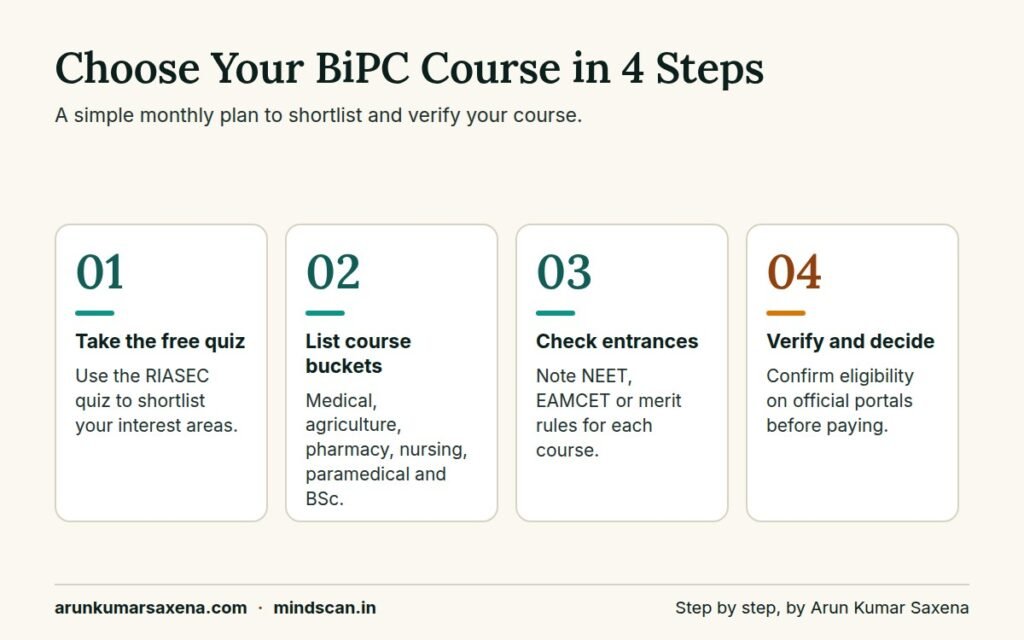
- Take the free RIASEC career personality quiz to shortlist interest areas.
- List your target courses from each bucket: medical, agriculture, pharmacy, nursing, paramedical, BSc.
- Check the exact entrance requirement (NEET, EAMCET, state exam or merit) for each shortlisted course.
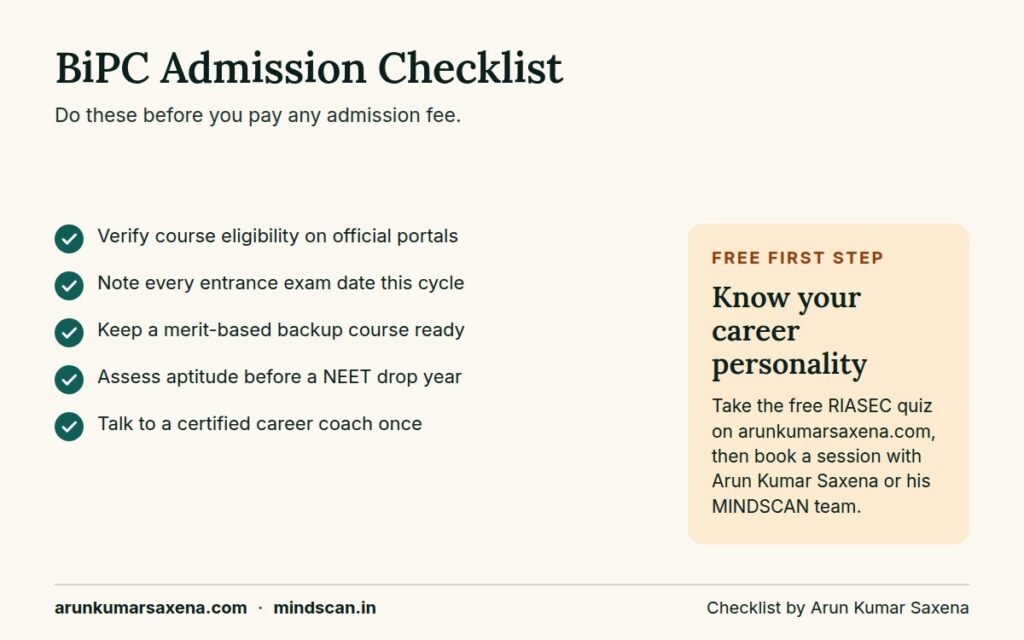
- Register and note every relevant exam date for the current cycle on official portals.
- If aiming for NEET, honestly compare your marks with the qualifying gap before committing to a drop year.
- Visit official college and government portals to verify eligibility, fees and recognition.
- Talk to a career coach or counsellor to validate your shortlist before paying any admission fee.
How do you choose the right BiPC course for your personality?
Course choice should start with self-knowledge: your interests, aptitude and work style. The after intermediate BiPC courses list means nothing until you know what kind of work you actually enjoy. A structured psychometric assessment or the free RIASEC quiz gives you that clarity before you spend a single rupee on admission.
The principle from my book “3 Steps to Knowing Yourself” is simple: self-knowledge comes before any course or career choice. When a student understands her own aptitude first, the after intermediate BiPC courses list shrinks from fifty names to three or four that genuinely fit.
Take the free RIASEC career personality quiz as a starting point. It maps your interests to six broad work styles, realistic, investigative, artistic, social, enterprising and conventional, and connects them to course families. After the quiz, shortlist courses, then verify eligibility and entrance requirements on official college sites.
Involve parents in the discussion, but do not let pressure decide. A father who wants his daughter to be a doctor, or a mother who insists on a “safe” government-job path, often overrides the student’s real interests. The result is a degree completed without engagement, and a career change five years later. Use an objective assessment to ground the conversation in data, not emotion.
Which course has high scope after BiPC?
Biotechnology, agriculture and paramedical courses carry high scope on the after intermediate BiPC courses list because they combine growing industry demand with multiple entry routes. Biotechnology feeds research, pharma and clinical labs. Agriculture opens government jobs, agri-business and food processing. Paramedical courses lead to quick hospital employment and steady demand.
What is the difference between NEET-based, state-exam and merit-based BiPC courses?
NEET-based courses such as MBBS, BDS, BAMS, BHMS and BVSc need a qualifying NEET score. State-exam courses like BSc Agriculture, BPharm and BSc Nursing need EAMCET or a state entrance test in Telangana and Andhra Pradesh. Merit-based BSc and many paramedical courses admit on intermediate marks, so your board percentage decides admission. Each route has a different exam calendar and preparation style, so lock the route before you lock the course.
| Course bucket | Entrance route | Typical duration | Career direction |
|---|---|---|---|
| NEET-based (MBBS, BDS, BAMS, BHMS, BVSc and AH) | NEET | 5 to 5.5 years | Patient care, clinical practice, animal health |
| EAMCET / state-exam (BSc Agriculture, BPharm, BSc Nursing) | EAMCET or state entrance test | 4 years | Agri-business, pharmaceutical industry, hospital and community healthcare |
| Merit-based BSc (Biotechnology, Microbiology, Nutrition, Forensic, Environmental) | Intermediate marks (direct admission) | 3 years | Research, industry and hospital lab roles |
| Paramedical (MLT, Radiology, Physiotherapy, Optometry) | Direct or state paramedical entrance | Diploma to degree, roughly 1 to 4 years | Quick entry into allied health work |
| Non-science (BCom, 5-year integrated LLB, management) | Direct or university-specific test | 3 years (BCom), 5 years (LLB) | Healthcare management, finance, health-related law |
Is BSc Agriculture a good option for BiPC students?
BSc Agriculture is one of the strongest non-NEET options on the after intermediate BiPC courses list. It offers government-job pathways through agricultural officer and bank roles, private agri-business and food-processing careers, and higher-study routes such as MSc and MBA in agri-management. Admission is usually through EAMCET or state agriculture entrance exams.
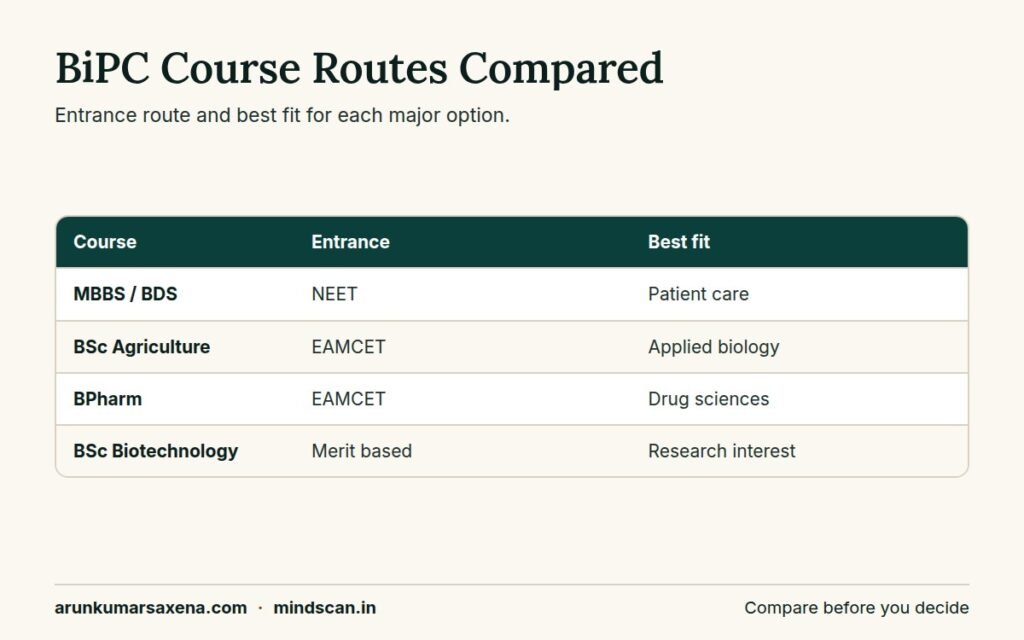
| Course | Entrance route | Best fit for |
|---|---|---|
| MBBS / BDS | NEET | Patient care and clinical practice |
| BSc Agriculture | EAMCET or state exam | Applied biology, land and economics |
| BPharm | EAMCET or state exam | Drug sciences and pharmaceutical industry |
| BSc Nursing | EAMCET or state exam | Hospital and community healthcare |
| BSc Biotechnology | Merit-based direct admission | Lab research and molecular biology |
| Nutrition and Dietetics | Merit-based direct admission | Food and health science |
| Paramedical courses | Merit or state paramedical entrance | Quick entry into allied health work |
Students who like biology applied to land, plants and economics thrive here. The course covers agronomy, soil science, plant breeding, agricultural economics and extension education. It is not “just farming.” It is a professional degree with a structured career ladder.
Initial salaries vary widely. A government agricultural officer starts at a fixed state pay scale. Private agri-business roles may offer approximately 3 to 5 lakh per annum as per online sources, with faster growth for those who move into management or agri-tech startups. The long-term stability and government-job pathways make it a serious contender on the after intermediate BiPC courses list.
Which courses after BiPC are best for girls?
There are no “girls-only” courses. BiPC girls succeed in medicine, nursing, pharmacy, biotechnology, nutrition, agriculture and research. The real question is the student’s own interest and circumstances, not gender. Families should not narrow the after intermediate BiPC courses list by outdated assumptions.
Women lead in several BiPC fields. Nursing and nutrition have strong female representation and clear career tracks. Biotechnology and microbiology labs across India have women researchers at every level. Agriculture universities and agri-business firms increasingly recruit women for extension, research and management roles.
Family concerns about hostels and safety are practical, not gender-biased. Check the college’s hostel facilities, security arrangements and location before applying. Many good women’s colleges offer BiPC-linked degrees with excellent campus placements. The University Grants Commission portal lists recognised institutions.
Start with the free RIASEC career personality quiz for an objective beginning. An aptitude profile cuts through the noise of “safe for girls” lists and points to courses where the student will actually perform well and stay motivated.
Which is the best short-term course after intermediate BiPC?
The best short-term course depends on how quickly you want to enter the workforce. Certificate courses in Medical Lab Technology, ECG Technology or Phlebotomy take approximately three to six months and lead to entry-level lab or hospital jobs. Diploma courses in Radiology Technology, Optometry or Operation Theatre Technology take one to two years and offer more structured allied-health careers. Both routes sit on the paramedical side of the after intermediate BiPC courses list and suit students who want to earn sooner rather than later.
What most guides miss: the aptitude-first decision framework
Most after intermediate BiPC courses list pages treat every student as the same blank slate. In my sessions, I see a pattern: parents bring a printed list of top courses and ask the child to pick one. Nobody has asked the child what she actually enjoys doing for three hours without being told.
Here is a simple three-question framework you can use at home before looking at any course list. First, does the student prefer working with people, with data or with living things? A “people” answer points to nursing, nutrition or clinical medicine. A “data” answer points to biotechnology, microbiology or forensic science. A “living things” answer points to agriculture, veterinary science or environmental science.
Second, does the student want a fixed-location job or is she willing to move? Government agricultural and nursing roles are often location-bound. Research and pharma roles may need relocation. Third, is the family ready to support a longer study path or is early earning important? Paramedical diplomas lead to jobs faster. Medicine and PhD tracks take years but pay later.
Use these three questions to filter the after intermediate BiPC courses list before you touch an entrance-exam form. The framework takes ten minutes and saves years of wrong fit.
Is BiPC harder than MPC for course options?
Neither stream is harder; they open different doors. BiPC leads to medicine, agriculture, pharmacy, nursing, paramedical and biology research routes, while MPC leads mainly to engineering. For course options the BiPC menu is actually wider, because BCom, law and management also stay open. Choose by aptitude and interest, not by which stream sounds tougher.
What mistakes should BiPC students avoid after intermediate?
The most common mistakes are chasing NEET for years without checking the score gap, picking a course from a salary reel, ignoring entrance-exam calendars and having no backup plan. Each mistake has a simple corrective action that keeps the after intermediate BiPC courses list useful rather than overwhelming.
- Chasing NEET without a gap check. After each attempt, compare the marks obtained with the marks needed. If the gap is narrowing and you are close, another attempt may be reasonable. If the gap is big and not closing, switch to other fields from the BiPC course options. Do not wait for a fourth failure to act.
- Picking a course from a salary reel. A 30-second video cannot capture college quality, location, aptitude fit or long-term growth. Verify every claim on the National Career Service portal (Government of India) or the relevant university site before enrolling.
- Waiting for exam dates to start preparing. Most families wait for the date announcement before they press the accelerator. That is a huge mistake. When you know you have to appear for NEET or EAMCET, every day counts. Lakhs of students are already preparing.
- No backup plan. Build a Plan B from the non-NEET after intermediate BiPC courses list before results come out. A merit-based BSc seat confirmed early keeps a year from being wasted if the entrance score falls short.
“One NEET aspirant who could not make it in her last two attempts reached out to me in a gloomy state. Her parents were equally worried and sad. When I examined her last two scores, I found the gap to fill was huge. There was a big gap between expectation and reality. I conducted a psychometric assessment for her, and it confirmed my apprehension: she wasn’t the right fit for medicine.
When I grilled her a little about where her inspiration for medicine came from, I found that she admired her aunt, who is a doctor, and therefore wanted to become one too. After two rounds of consultation, she herself realised that clearing NEET was demanding much more than she could offer. Today she is happily doing a B.Sc. in Biotechnology, with career clarity and a roadmap.” (Arun Kumar Saxena)
Frequently asked questions about after intermediate bipc courses list
Can BiPC students do BCom or law after intermediate?
Yes. BiPC students are eligible for BCom and 5-year integrated LLB programmes at most Indian universities. Many use these routes for careers in healthcare finance, hospital management or health-related law. Check each university’s specific eligibility criteria on its official portal before applying, as some may require an entrance test.
Is BiPC only for medical courses?
No. BiPC opens medical, agriculture, pharmacy, nursing, paramedical, pure science, research and even non-science degrees like law and management. The after intermediate BiPC courses list spans at least five distinct career buckets. Limiting BiPC to medicine alone ignores the majority of good options available.
What paramedical courses can BiPC students take?
Paramedical options include Medical Lab Technology, Radiology and Imaging Technology, Physiotherapy, Optometry, Operation Theatre Technology and allied health diplomas and degrees. Admission is often direct or through a state paramedical entrance. Verify recognition with the relevant council and check local job demand before enrolling.
Can I switch from BiPC to engineering later?
BiPC students lack the mathematics requirement for most BTech programmes. Some universities offer bridge courses or accept BiPC students for specific branches like biotechnology engineering, but these are exceptions. Check the specific eligibility rules of the university you are targeting rather than relying on general claims.
How many attempts of NEET should a BiPC student give?
Compare the marks obtained with the marks needed. If the gap is narrowing over your attempts and you are close to the qualifying score, another attempt may be reasonable. If the gap is big and not closing, it is wiser to switch to other fields from the after intermediate BiPC courses list rather than lose more years.
When should BiPC students start career counselling?
From Class 8 onwards is ideal, but after intermediate is not too late. A structured psychometric assessment can still redirect a student to a better-fit course before admission fees are paid. The MINDSCAN report maps students to 20+ career groups, and every report is reviewed personally before it reaches the family.
What is a biotech course salary after BiPC?
A fresh BSc Biotechnology graduate may start at approximately 2.5 to 4 lakh per annum as per online sources, with higher pay in pharmaceutical and clinical research organisations. Salaries rise significantly with an MSc or PhD, especially in R&D roles. The college brand and lab skills matter more than the degree name alone.
हिंदी में जवाब: 12वीं के बाद BiPC कोर्स की पूरी सूची: आपकी 2026 गाइड
12 वीं के बाद सबसे अच्छा कोर्स कौन सा है?
कोई एक ‘सबसे अच्छा’ कोर्स नहीं है। BiPC के बाद MBBS, BDS, BSc एग्रीकल्चर, फार्मेसी, नर्सिंग, बायोटेक्नोलॉजी और पैरामेडिकल जैसे कई रास्ते हैं। सही कोर्स विद्यार्थी की रुचि और योग्यता पर निर्भर करता है, न कि किसी सामान्य सूची पर। अरुण कुमार सक्सेना की सलाह है कि पहले अपनी एप्टीट्यूड को वैज्ञानिक तरीके से समझें, फिर कोर्स चुनें।
Science में सबसे अच्छी नौकरी कौन सी है?
सबसे अच्छी नौकरी वह है जो आपकी रुचि और कौशल से मेल खाती हो। BiPC स्ट्रीम से डॉक्टर, फार्मासिस्ट, रिसर्च साइंटिस्ट, एग्रीकल्चर ऑफिसर और न्यूट्रिशनिस्ट जैसे करियर बनते हैं। किसी एक नौकरी को सबसे अच्छा कहना भ्रामक है। लगभग हर क्षेत्र में मेहनत और सही संस्थान से अच्छा वेतन और संतोषजनक करियर संभव है।
कौन सी पढ़ाई ज्यादा सैलरी देती है?
सैलरी कोर्स के नाम से नहीं, बल्कि कॉलेज की गुणवत्ता, आपके कौशल और विशेषज्ञता पर निर्भर करती है। मेडिसिन, फार्मेसी और नर्सिंग (विदेश में) के रास्ते ऊंची कमाई दे सकते हैं, लेकिन हर आंकड़ा लगभग है। अरुण कुमार सक्सेना का सुझाव है कि केवल सैलरी के आधार पर कोर्स न चुनें, लंबे समय की वृद्धि और रोज़ की नौकरी की संतुष्टि ज़्यादा मायने रखती है।
The after intermediate BiPC courses list is a starting point, not a decision. What turns a course name into a career is fit: the match between a student’s aptitude and the daily work the course leads to. A wrong guess costs a year. A rushed admission costs three or four.
Book a session of online career counselling in India with Arun Kumar Saxena and get a personalised shortlist built on data, not hearsay. The MINDSCAN AI Career Clarity Report maps your child to 20+ career groups and is available at ₹1,499, or ₹2,999 with a counselling session. Every report is reviewed personally. Call +91-9140604743 to speak with us directly. Let us find the course that fits before you pay an admission fee.