
Art Ke Subject: Full Arts Subject List, Combinations and Careers
By Arun Kumar Saxena, Certified Advanced Career Coach · Updated November 2026
Quick answer: The common art ke subject in class 11 and 12 include History, Political Science, Economics, Geography, Psychology, Sociology, and Fine Arts. This arts subject guide uses CBSE’s official scheme of studies and the National Career Service portal to help you pick the right combination. Verify your choice with a psychometric assessment before class 11.
Art ke subject open doors to law, civil services, psychology, design, journalism and many other careers, yet most students pick them without checking whether the subjects actually fit their natural strengths. This page gives you the complete CBSE and state-board subject list, the best art ke subject combinations mapped to real careers, and a self-knowledge-first method that helps you decide which subjects suit you, not just what exists on paper.
With 22 years of experience and 20,000+ students and professionals guided, I have seen too many class 11 students realise by December that they picked the wrong art ke subject. My MINDSCAN team and I built this guide so you can lock the right combination before admissions close, using a free RIASEC quiz and a simple step-by-step plan you can finish this month.
Main points
- The arts stream offers approximately over 15 elective art ke subject choices, from History and Psychology to Fine Arts and Computer Science.
- You typically study 5 or 6 subjects in total, including two compulsory languages.
- Four career-mapped combinations: Law/UPSC (History, Political Science, Economics); Psychology/HR (Psychology, Sociology, Home Science); Media (Political Science, a language, Psychology); Design (Fine Arts, Computer Science, a language).
Table of Contents
What are all the art ke subject in class 11 and 12?
Arts students in class 11 and 12 study two compulsory languages and choose three to four elective art ke subject from a list that includes History, Political Science, Economics, Geography, Psychology, Sociology, Philosophy, Home Science, Fine Arts, Music, Dance, Physical Education and Computer Science.
Every student must study English as the first compulsory language. The second language is usually Hindi, but many CBSE and state-board schools also offer Sanskrit, a regional language or a foreign language such as French or German. The real decision lies in the electives.
Some schools also offer Mathematics as an optional elective with arts subjects, which keeps economics and data-related careers open.
Exact availability varies by board and by school. CBSE publishes an official scheme of studies every year, and a school may offer only a subset of the full CBSE list because of timetable or faculty constraints. Before you fall in love with a combination, check your school’s subject options sheet. A combination that exists on paper but not in your school is not a plan.
Which art ke subject combination is best?
The best art ke subject combination is the one that matches your target career and your natural work style, not a universal list. Four strong combinations are Law/UPSC (History, Political Science, Economics), Psychology/HR (Psychology, Sociology, Home Science), Media (Political Science, a language, Psychology) and Design (Fine Arts, Computer Science, a language).
Here are four example combinations mapped to broad career directions. If law or civil services is your goal, History plus Political Science plus Economics is a strong core because it builds the analytical and constitutional knowledge those exams demand. For psychology, counselling or HR, Psychology plus Sociology plus Home Science or a language gives you the human-behaviour foundation.
If journalism, media or content careers interest you, Political Science plus a language plus Psychology or Computer Science works well. For design, fine arts or creative careers, Fine Arts or Music plus Computer Science plus a language builds both the portfolio and the digital skills.
| Combination | Elective Subjects | Careers It Keeps Open |
|---|---|---|
| Law / UPSC | History, Political Science, Economics | Law (BA LLB via CLAT), civil services, UPSC, policy |
| Psychology / HR | Psychology, Sociology, Home Science or a language | Psychology, counselling, HR |
| Media | Political Science, a language, Psychology or Computer Science | Journalism, mass communication, content careers |
| Design | Fine Arts or Music, Computer Science, a language | BFA, design, media and creative industries |
A combination that worked for a topper or a cousin may fail you completely. I have watched students pick the exact subjects their friend picked, only to discover later that they have no interest in reading political theory or memorising historical dates. The step list later in this page shows you how to shortlist combinations based on your own career personality, not someone else’s results.
Which subject should I choose in arts after 10th?
Start with your career personality and interests, not with the subject list. Identify what you enjoy doing and what kind of work suits you, shortlist two or three careers, and only then work backwards to the art ke subject that support those careers.
I recommend starting career counselling from Class 8 onwards because by Class 10 the pressure to decide in a hurry leads to mistakes. My book “3 Steps to Knowing Yourself” is built on one idea: self-knowledge must come before any subject or stream choice. When a student picks subjects first and thinks about careers later, that sequence almost always creates regret. I meet those students in my sessions every month, usually in November or December of class 11, asking whether they can switch their art ke subject. By then, most schools say no.
After you have a shortlist of careers, check which subjects are required or helpful. Then look at your pre-board marks and family expectations, but keep them third and fourth in the decision order. Marks fluctuate. Interest, verified by a psychometric assessment, is more stable.
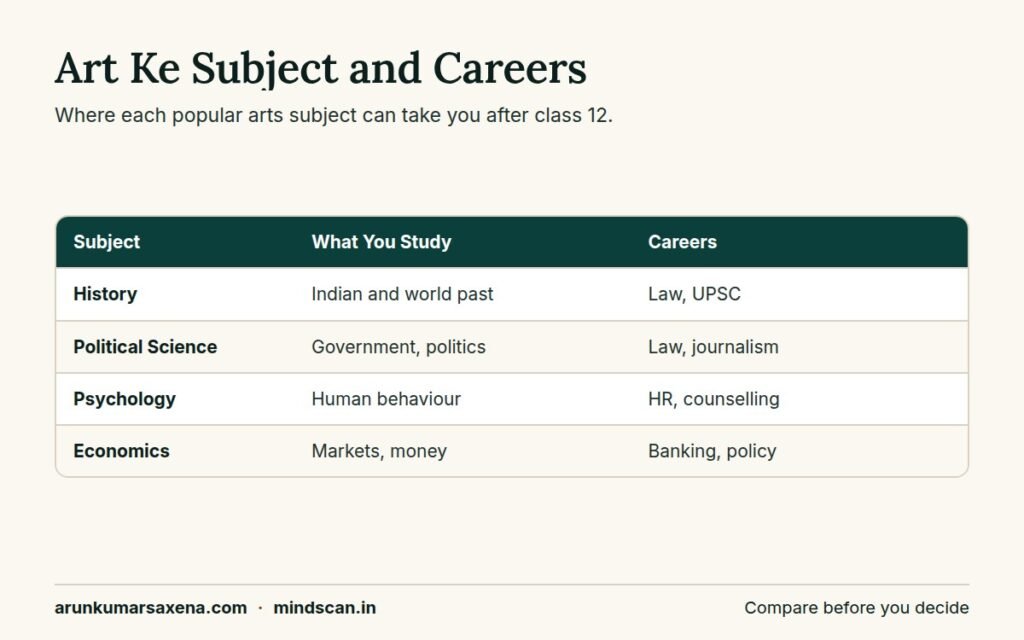
| Subject | What You Study | Careers It Supports |
|---|---|---|
| History | Past societies and Indian and world history | Law, civil services, archaeology, teaching |
| Political Science | Government, constitutions, politics | Law, civil services, journalism |
| Psychology | Human behaviour and mental processes | Psychology, HR, counselling |
| Economics | Markets, money, development | Economics, banking, policy, UPSC |
| Geography | Land, climate, resources | UPSC, urban planning, environment careers |
| Fine Arts / Music | Drawing, painting, performance | BFA, design, media, creative industries |
How many subjects come in arts stream?
A student in the arts stream typically studies five or six subjects in total, made up of two compulsory languages and three or four elective art ke subject chosen from the school’s offered list.
CBSE usually requires five subjects, and many schools allow a sixth additional subject that can be changed or dropped later. State boards sometimes mandate six subjects including a compulsory environmental studies or general studies paper. The exact count matters less than which electives you pick, because those electives determine your college course eligibility. A student with History, Political Science and Economics can apply to most BA and law programmes. A student who drops Economics for a language may lose eligibility for economics honours at some universities. Check the college course prerequisites before you finalise the count.
What if I choose art after 10th – what careers open up?
Choosing arts after 10th opens careers in law (BA LLB), civil services, journalism and mass communication (BJMC), design (BFA, fashion, interior), psychology, teaching, social work, hotel management, BBA and many more. The stream does not limit ambition; poor planning does.
Here are six career directions with their entry courses. Law: BA LLB through CLAT or state law entrances. Civil services: any BA degree plus UPSC preparation. Media and journalism: BJMC or BA in journalism. Design and fine arts: BFA, B.Des or diploma courses at NID, NIFT or private institutes. Psychology: BA Psychology followed by MA and specialisation.
Teaching and academia: BA plus B.Ed, then NET or state eligibility tests. Business and management: BBA or integrated MBA programmes that accept arts students. You can explore more options on the National Career Service portal (Government of India) and the Ministry of Education, Government of India website for official course and career information.
Is arts only for weak students? (The honest answer)
No, arts is not only for weak students. Arts students dominate UPSC, law, journalism, civil services and academia. Stream difficulty is a myth; what matters is whether the stream fits your natural strengths and career goal.
As per online sources, many UPSC toppers come from humanities backgrounds because the syllabus overlaps heavily with History, Political Science, Geography and Economics. CLAT and law entrances test logical reasoning and reading comprehension, skills that arts subjects sharpen daily. Journalism and media roles require exactly the research, writing and argument-building that arts students practise for two years. The idea that arts is a fallback for students who scored lower in board exams has damaged more careers than any subject ever has.
In my sessions, I have met students who scored high in class 10, switched to arts because they loved political science, and built outstanding careers in law and policy. I have also met arts students who picked the stream because someone told them it was easy, and spent two years bored and directionless. The stream itself is not weak or strong. The decision behind it is.
“Parents Panic. When they see their Graduate child sitting at home without a job, their anxiety levels shoot up.” (Arun Kumar Saxena)
That panic often starts with a blind stream choice in class 11. When a student picks art ke subject without a career plan, the degree years drift, and the panic at graduation is the bill that comes due four years later. The fix is not to avoid arts. The fix is to choose art ke subject with your eyes open.
Art ke subject vs Commerce vs Science: which stream suits you?
Science focuses on physics, chemistry, biology and mathematics and leads to engineering, medicine and pure sciences. Commerce focuses on accounts, business studies and economics and leads to finance, banking and management. Arts focuses on humanities and social sciences and leads to law, civil services, media, psychology and creative careers.
| Stream | Core Subjects | Careers It Leads To |
|---|---|---|
| Arts | History, Political Science, Psychology, etc. | Law, civil services, media, psychology, design |
| Commerce | Accounts, Business Studies, Economics | Finance, banking, management, CA, CS |
| Science | Physics, Chemistry, Biology, Mathematics | Engineering, medicine, pure sciences, research |
The stream that suits you is the one that matches your RIASEC career personality profile and your long-term goal, not social pressure. Many careers accept all three streams. Law, management, design and journalism do not care which stream you took in class 12. They care about your entrance exam score, your portfolio or your skills. If you are unsure, take the free RIASEC career personality quiz. It takes ten minutes and gives you a clear starting point based on your work style, not on what your relatives think.
What is fine arts and what is the salary after it?
Fine arts is a specialised branch within the arts stream covering painting, sculpture, applied art and art history, leading to a BFA degree. As per online sources and the National Career Service portal, a fresh BFA graduate may start at approximately 15,000 to 25,000 rupees per month, while experienced professionals earn more.
Salary after fine arts varies widely by specialisation, portfolio quality, city and experience. A skilled UI designer, animator or art director with a strong portfolio and five years of experience can earn several times that. Any fixed salary figure you see online should be treated as an estimate only.
The most reliable way to check real openings and pay ranges is the National Career Service portal (Government of India). My practical advice to fine arts students is to build a portfolio from school days itself. Your class 11 and 12 sketchbooks, digital art projects and competition entries become your first body of work. A degree certificate alone, without a portfolio, will not open doors in creative industries.
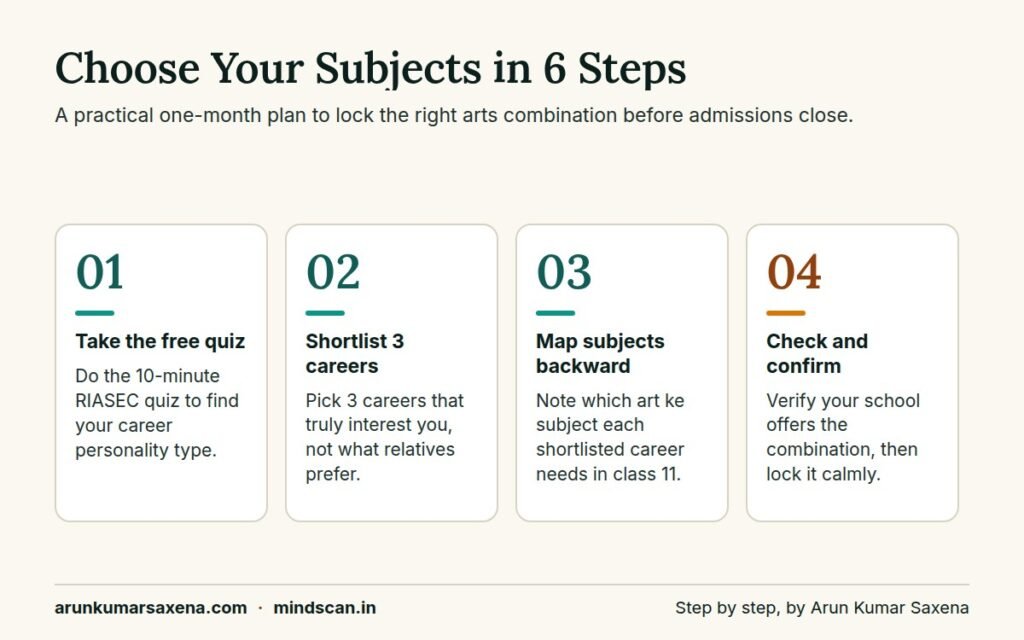
How to pick your art ke subject combination this month: 6 steps
You can pick the right art ke subject combination in under a month if you follow a career-first sequence instead of a subject-first guess. Here are the steps students can follow every admission season.
- Take the free RIASEC career personality quiz (10 minutes) to learn your natural work-style type.
- Write down 3 career options that genuinely interest you, not what relatives approve of.
- For each career, note which art ke subject are required or helpful in class 11 and 12.
- Check your school’s scheme of studies to see which art ke subject combinations are actually offered.
- Shortlist 2 possible combinations and discuss them with a parent or teacher calmly, not under pressure.
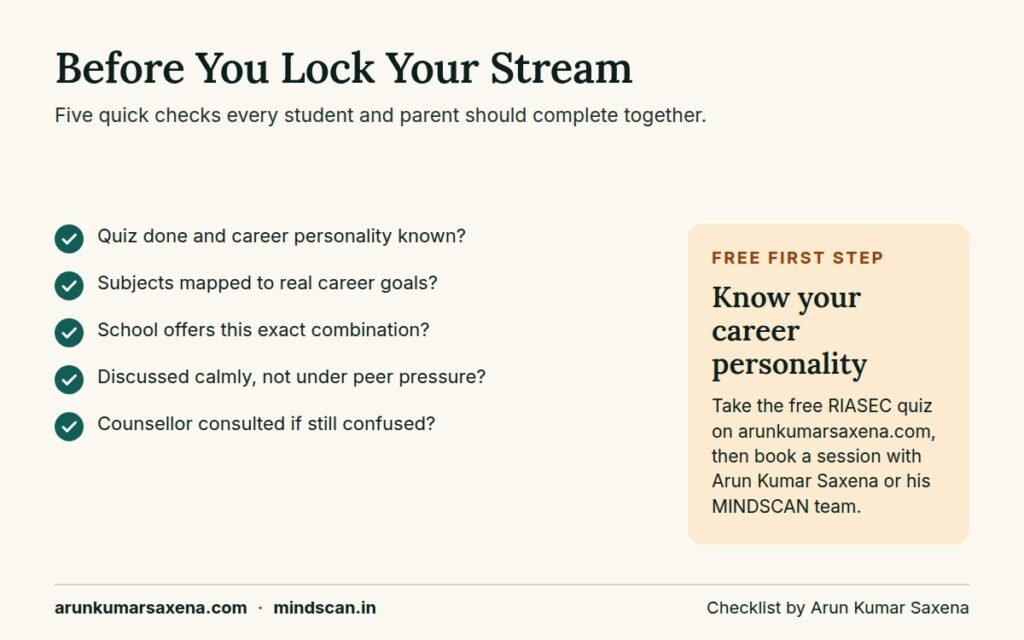
- If still confused, book an online career counselling session before admissions close. Lock your combination in writing and keep a note of why you chose it; you will need this confidence later.
What most guides miss: the psychometric check before the subject list
Most websites dump the complete art ke subject list and stop there. In my sessions, I see a pattern that no subject-list page addresses: a student’s interest in a subject name often has nothing to do with the actual daily work of studying it. A class 10 student says “I want psychology” because they watched a crime drama. Six months into class 11, they discover psychology involves research methods, statistics and biological chapters, and the interest collapses. The same happens with economics, where students expect stock-market tips and get microeconomic theory.
The MINDSCAN psychometric assessment maps a student to 20+ career groups and measures work-style preferences, not just subject-name familiarity. When a student’s RIASEC profile shows a strong Social and Artistic combination, psychology or journalism makes sense. When it shows Conventional and Enterprising, law or management fits better. The subject list becomes useful only after this filter. Without it, you are picking art ke subject by the cover, not by the content.
That is why I ask every student to complete an assessment before circling subjects on a school form. The full class 11 humanities subject list and combinations page explains how the subjects connect to careers, and the scope of psychology in India page gives a deeper look at one popular elective. Learn more about my approach on my profile page.
Frequently asked questions about art ke subject
Is arts a good stream after 10th in 2026?
Yes, if it matches your career goal. Arts leads to law, UPSC, media, design, psychology and more. It is not a fallback stream, and treating it as one is the real mistake. Check your career personality with a psychometric assessment before deciding.
Can arts students become IAS or lawyer?
Yes. Humanities subjects like History and Political Science directly support UPSC and law entrances such as CLAT and BA LLB. Many successful civil servants and lawyers come from arts. The stream builds exactly the reading and writing skills these careers demand.
Which art ke subject is easiest to score in?
Score-ability depends on your interest and writing style, not the subject. Students score highest in subjects they enjoy reading. Chasing easy scoring subjects is a trap I warn against because a subject that bores you will never produce marks, no matter how simple the syllabus looks.
Can I switch from arts to commerce or science later?
Switching to commerce after class 11 is possible in some schools, but science is usually not allowed because of lab-work requirements. This is exactly why the art ke subject combination decision should be made carefully the first time, ideally with an assessment.
Do arts students get jobs?
Yes. Jobs exist in law, media, government, teaching, HR, design and more. The real problem I see is unskilled graduates taking panic jobs at low salaries that stain their CV. Students should upskill alongside their degree through internships, certifications and portfolio projects.
Should I take psychology in arts stream?
Take psychology only if you are genuinely curious about people and behaviour. It supports careers in psychology, counselling and HR. A psychometric check will tell you if your work-style profile fits the subject. Do not pick it because a web series made it look exciting.
What are the 20 types of art?
Art is commonly categorised into visual arts (painting, sculpture, photography, printmaking, digital art), performing arts (music, dance, theatre), literary arts (poetry, prose), applied arts (graphic design, fashion, interior design, architecture, filmmaking), and craft arts (pottery, weaving, metalwork, woodwork). The exact count varies by tradition.
Which careers beyond the table can the arts subject list lead to, and how do you prepare for law and civil services?
Beyond the table, the arts subject jobs list stretches into law, civil services, teaching, policy and social work. For law, prepare through CLAT after class 12; for UPSC, take any BA degree and start NCERT-based preparation early. The full class 11 humanities subject list and combinations page maps each elective to these exams.
Should you combine arts and science by keeping Mathematics in the arts stream?
Mathematics is optional in many schools and pairs well with the subjects in arts like Economics and Psychology. Keeping Maths opens economics honours, data analysis and actuarial-style careers that otherwise stay closed. If you enjoy numbers, take it; if you dislike them, a language subject serves you better in the arts stream.
What is a sixth subject and how can you choose or drop it?
A sixth subject is an extra elective that CBSE and many state boards allow beyond the compulsory five. Students often add Physical Education, Fine Arts or Computer Science to widen their arts subject list. Most boards let you drop the sixth subject before class 12 exams, so treat it as a low-risk experiment.
How do art ke subject in state boards differ from CBSE?
The core subjects in arts are similar, but state boards often mandate six subjects, sometimes including compulsory environmental or general studies papers that CBSE does not. Electives like Psychology, Fine Arts or Computer Science may be limited in state-board schools. Always check your school’s offered subject sheet before finalising a combination.
How do you order family advice against your own career personality?
Family and friends mean well, but their advice rests on their experience, not your work style. Keep your verified career personality first, your career goal second and family expectations third. Arun Kumar Saxena uses this exact decision order in his sessions, and you can start today with the free RIASEC career personality quiz.
हिंदी में जवाब: आर्ट के सब्जेक्ट: पूरी सूची, बेस्ट कॉम्बिनेशन और करियर
10वीं के बाद 11वीं में कौन-कौन से सब्जेक्ट होते हैं?
11वीं और 12वीं में आर्ट्स स्ट्रीम में अंग्रेजी और दूसरी भाषा अनिवार्य होती है। वैकल्पिक विषयों में इतिहास, राजनीति विज्ञान, भूगोल, अर्थशास्त्र, मनोविज्ञान, समाजशास्त्र, दर्शनशास्त्र, गृह विज्ञान, ललित कला, संगीत, शारीरिक शिक्षा और कंप्यूटर साइंस शामिल हैं। अरुण कुमार सक्सेना सलाह देते हैं कि विषय चुनने से पहले अपना करियर व्यक्तित्व जांच लें।
आर्ट्स और कॉमर्स में से कौन सा स्ट्रीम बेहतर है?
दोनों स्ट्रीम अपने आप में बेहतर हैं, चुनाव आपके करियर लक्ष्य पर निर्भर करता है। आर्ट्स से लॉ, सिविल सेवा, मीडिया और मनोविज्ञान में जा सकते हैं, जबकि कॉमर्स से बैंकिंग, फाइनेंस और मैनेजमेंट के रास्ते खुलते हैं। अरुण कुमार सक्सेना के अनुसार, स्ट्रीम का फैसला सोशल प्रेशर से नहीं, बल्कि साइकोमेट्रिक असेसमेंट से करें।
ललित कला (फाइन आर्ट्स) के बाद कितनी सैलरी मिलती है?
ललित कला में BFA करने के बाद शुरुआती सैलरी लगभग 15,000 से 25,000 रुपये प्रति माह हो सकती है। अनुभव और पोर्टफोलियो की गुणवत्ता के साथ यह कई गुना बढ़ सकती है। सटीक आंकड़ों के लिए नेशनल करियर सर्विस पोर्टल देखें। अरुण कुमार सक्सेना सलाह देते हैं कि स्कूल के दिनों से ही अपना पोर्टफोलियो बनाना शुरू करें।
Your art ke subject combination is a two-year commitment that shapes your college options and your first career step. A wrong pick costs time and confidence. A right pick, made with self-knowledge and honest data, gives you a clear path from class 11 to your target career. If you are still unsure which combination fits you, do not guess.
Book an online career counselling session with my MINDSCAN team. We use the MINDSCAN AI Career Clarity Report, available at ₹1,499, or the report with a counselling session at ₹2,999, to map your strengths to the right art ke subject before admissions close.
Start with the MINDSCAN AI Career Clarity Report or the free RIASEC quiz linked on this page. A decision made with clarity today saves you the regret of a switch attempt in December. Lock your combination, own your choice, and build the career you actually want.