
MCA Course Is of How Many Years? Full 2026 Answer
By Arun Kumar Saxena, Certified Advanced Career Coach · Updated November 2026
Quick answer: An MCA course is of how many years? Under current AICTE guidelines, the Master of Computer Applications is a 2-year postgraduate programme. A few traditional universities may still offer a 3-year format, and integrated BCA+MCA programmes run about 5 years. Duration matters less than whether MCA fits your aptitude, so take the free RIASEC quiz before deciding.
The first question every BCA, BSc or BTech graduate asks is, “MCA course is of how many years?” This page gives you the verified 2026 answer without the outdated claims that still clutter most search results. Whether you are a student planning your next degree or a parent checking options for your child, you will find the exact durations, a clear comparison of 2-year and 3-year formats, and a self-knowledge-first decision framework no course-listicle site can copy.
With 22 years of experience and 20,000+ students and professionals guided, I see one pattern repeat itself every admission season. Students fixate on course duration and entrance exam dates while skipping the one question that determines whether the degree will actually pay off: does MCA fit your aptitude? This page answers how many years an MCA course is directly and then walks you through a step-by-step method to decide if MCA is the right course for you.
Table of Contents
MCA course is of how many years in India?
The Master of Computer Applications is a 2-year postgraduate programme split into 4 semesters under current AICTE guidelines. Before February 2020, many universities ran a 3-year format, and a handful of traditional institutions still offer longer structures today, so always verify with the specific university before applying.
The All India Council for Technical Education reduced the MCA from 3 years to 2 years in February 2020, as per online sources citing the AICTE public notice on MCA duration. The change was made to benefit students by cutting one year of fees and bringing the programme in line with other postgraduate degrees. Today, the 2-year format is standard across most universities and colleges in India.
A few traditional or specialized universities may still offer a 3-year structure, especially for students from non-computer-science backgrounds who need a foundation year. If you hold a BCom, BA or BSc without a strong IT component, check whether the university adds bridge modules or still runs the older 3-year track. Never assume the duration. Always check the university’s current prospectus or AICTE approval status before you apply, because an outdated assumption about how many years an MCA course is can cost you a year of time and tuition.
What is MCA?
MCA (Master of Computer Applications) is a 2-year postgraduate programme focused on advanced computer science, software development, and IT applications. It prepares graduates for roles in software engineering, data analytics, cloud computing, and IT consulting. The degree is designed for students who already hold a bachelor’s degree, typically BCA, BSc, or BTech, with a strong foundation in mathematics and programming.
What is the difference between a 2-year MCA and a 3-year MCA?
The older 3-year MCA included a foundational first year for students from non-IT backgrounds, while the 2-year MCA assumes an IT-related bachelor’s degree such as BCA or BSc Computer Science and goes straight into advanced subjects. The 2-year option saves a year of fees and lost earnings but demands stronger prior fundamentals.
In the 3-year format, year one typically covered basic programming, discrete mathematics and introductory computer science. Students with no prior coding experience could build a base before moving to advanced topics. The 2-year format skips that foundation year entirely. It starts at an advanced level with subjects like data structures, algorithms and database management systems, expecting you to already know the basics of programming.
Non-IT graduates should check whether their target university adds bridge or foundation modules inside the 2-year structure. Some universities compress the foundation into the first semester. Others require you to complete a bridge course before the programme begins. A saved year means lower total fees and one extra year of salary, but only if you can handle the pace. Pick the format that matches your current skill level, not the one that sounds faster. The core question of how many years an MCA course is depends on this format choice.
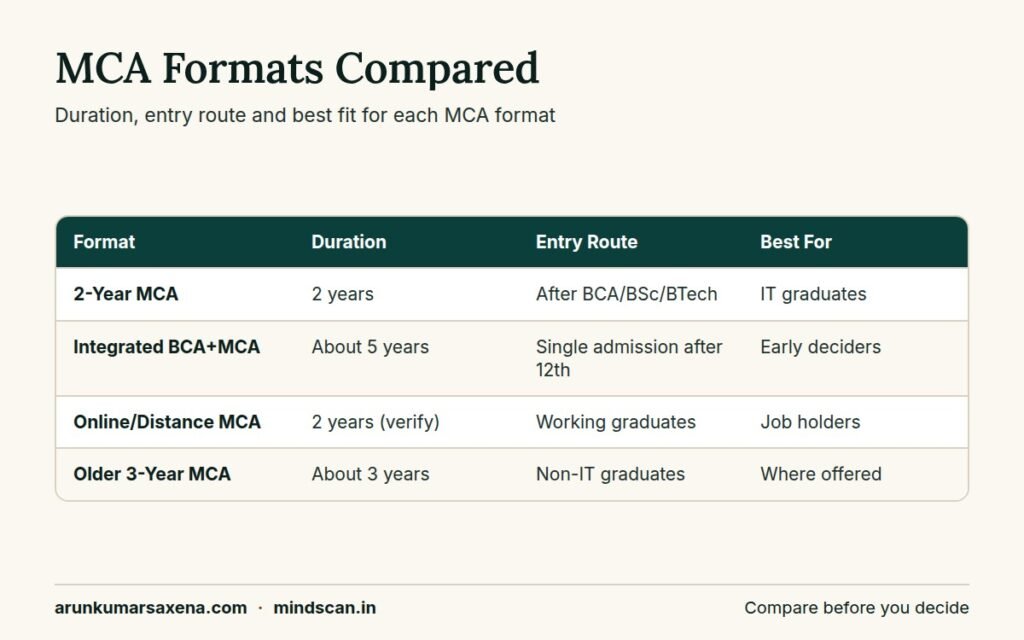
| Option | Duration | Entry Route | Best Suited For |
|---|---|---|---|
| 2-year MCA (standard) | 2 years (4 semesters) | After BCA/BSc/BTech with maths | IT graduates wanting fast advanced skills |
| 3-year MCA (older/some universities) | About 3 years | Direct after graduation, includes foundation year | Non-IT graduates needing fundamentals (where offered) |
| Integrated BCA+MCA | About 5 years total | Single admission after 12th | Students certain of an IT career early |
| Online/Distance MCA | 2 years (verify) | Online admission, usually needs a relevant degree | Working professionals upgrading skills |
How many years is an MCA course after BCA?
After a BCA, the MCA takes 2 years, making the total BCA plus MCA journey roughly 5 years of study. An integrated BCA+MCA programme compresses both degrees into about 5 continuous years with a single admission after Class 12.
BCA is a 3-year undergraduate degree. Add the standard 2-year MCA, and you spend about 5 years earning both qualifications. The integrated route removes the separate MCA entrance exam and admission process, which appeals to students who are certain of an IT career early. Some universities now offer a 4-year BCA under the National Education Policy, and students ask whether that changes the MCA course duration.
The answer depends on the university. A few may grant lateral entry or reduce the MCA to one year for 4-year BCA graduates, but this is not yet a uniform rule. Check each university’s structure.
After a BSc in Computer Science, the MCA is still typically 2 years at most universities. The key point is that your undergraduate degree subject matters less than whether you have mathematics at 10+2 or graduation level, which is the common eligibility gatekeeper for MCA admission across India.
Can I complete MCA in one year?
The regular MCA cannot be completed in one year under AICTE norms. No AICTE-approved regular MCA programme runs for one year. Some private bodies market fast-track or one-year MCA degrees that may not carry recognized approval, and such degrees can be rejected by employers and for higher studies.
One-year MCA offers usually come from unrecognized or distance-mode shortcuts that promise speed over recognition. A non-recognized degree can fail background verification at employers, especially in IT services firms and product companies that check credentials thoroughly. If time is a genuine constraint, consider recognized online MCA programmes from UGC-entitled universities instead of risking a shortcut that may not hold up when you need it most. Verify the university’s current entitlement status on the University Grants Commission (UGC) official portal before you enrol. The honest answer to how many years an MCA course is remains two, not one.
Is MCA harder than MBA?
MCA is technically demanding, with continuous programming, mathematics and project work. MBA leans on management theory, case studies, communication and networking. Difficulty depends on aptitude. A student who enjoys logic and coding finds MCA manageable. One who prefers people and business finds MBA easier.
MCA demands strong programming practice in languages like Java or Python, plus algorithms, database management and mathematics. The workload is hands-on and project-heavy. MBA requires case analysis, presentations, internships and networking. Neither degree is objectively easier. The experience is shaped entirely by whether your natural interests align with the daily work the course demands.
A psychometric check beats guesswork when you are stuck between the two, and you can start with the free RIASEC career personality quiz to see where your interests actually point. Before you even ask how many years an MCA course is, ask whether an MCA fits you at all.
What most guides miss: the fit question that decides whether MCA pays off
Most course guides treat the MCA duration question as a fact lookup. In my sessions, I see students who spend weeks comparing MCA formats but cannot answer one simple question: what specific job role do you want after MCA, and does this degree’s syllabus actually prepare you for it? The MCA is a generalist IT degree.
It opens doors, but it does not hand you a role. Two graduates from the same MCA batch can land completely different careers, one in cloud engineering and another in technical support, based on the electives they chose and the skills they built outside the classroom.
Apply this three-question test before you commit to any MCA programme. The 30-minute job-description-to-syllabus gap check is the single fastest way to know whether any MCA programme will pay off.
- Open three live job descriptions for the role you want on a job portal.
- Download the university’s MCA syllabus and highlight every subject that directly teaches a skill mentioned in those job descriptions.
- Count the gaps. If more than half the required skills are not covered, the degree alone will not get you that job, regardless of whether it takes two years or three.
This simple check takes thirty minutes and saves you from spending two years on a degree that points somewhere you do not want to go.
My book “3 Steps to Knowing Yourself” argues that self-knowledge must come before any career choice. The duration question, the fee question, the entrance exam question, all of them are secondary. First know whether IT work fits you, then pick the programme that gets you to the exact role you want. Knowing how many years an MCA course is matters only after you know it is the right course for you.
What are the MCA subjects and syllabus year by year?
Year one of the 2-year MCA covers advanced programming, data structures, database management systems, operating systems, computer networks and software engineering. Year two moves to specialization electives like AI and machine learning, cloud computing, cyber security or web technologies, plus a final project or industry internship.
Exact subjects vary by university. Some pack more mathematics into the first semester. Others offer electives from the second semester onward. Here is a typical breakdown of subjects in a 2-year MCA programme.
- Year 1 subjects: Advanced Programming in Java or Python, Data Structures and Algorithms, Database Management Systems, Operating Systems, Computer Networks, Software Engineering, Discrete Mathematics, and Web Technologies.
- Year 2 subjects: Elective specializations such as Artificial Intelligence and Machine Learning, Cloud Computing, Cyber Security, Data Analytics, or Mobile Application Development, plus a Major Project or Industry Internship.
Download the current syllabus from each university’s website before you apply. Pick a university whose electives match the job roles you actually want. If you aim for a data analyst role, a syllabus heavy on networking and light on statistics is a mismatch, no matter how good the university’s placement record looks. The subjects you study over the years of an MCA course define your career path far more than the degree title itself.
What are the eligibility criteria and entrance exams for MCA?
Candidates generally need a bachelor’s degree, commonly BCA, BSc or BTech, with mathematics at 10+2 or graduation level and minimum around 50% marks. Common entrance routes include NIMCET for NITs, plus various state-level and university-level MCA entrance tests. Criteria vary, so confirm from each university’s official prospectus.
Mathematics at 10+2 or graduation level is the single most common requirement. A BCom or BA graduate with mathematics can be eligible at many universities, though some may add bridge conditions. NIMCET is the well-known national-level entrance for NIT MCA programmes. Many states run their own common entrance tests, and private universities often conduct their own exams or accept scores from state-level tests. Eligibility details differ by university. Always confirm from the official prospectus, not from a third-party summary. Before you calculate how many years an MCA course is, first confirm you meet the eligibility gate.
What are the career options and salary after MCA?
Common MCA career paths include software developer, web developer, data analyst, database administrator, cloud engineer, cyber security analyst and IT consultant. IT services firms, product companies, startups and government IT departments all hire MCAs. Salary depends far more on specialization, projects and interview skill than on the degree tag itself.
Treat any single “MCA salary” headline figure with caution. Salaries vary widely by company, city, specialization and interview performance. A cloud engineer with AWS certifications and a strong GitHub portfolio can command multiples of what a generic MCA graduate without specialization earns. Certifications and live project work often matter as much as the degree certificate.
Check live job portals for current salary ranges in your target role and city, and note that skills and projects move pay more than the degree tag. The National Career Service portal, Ministry of Labour and Employment is a useful government resource for checking occupational trends. The return on the years you invest in an MCA course depends entirely on the specialization and skills you build alongside it.
Is MCA the right course for you? A step-by-step decision method
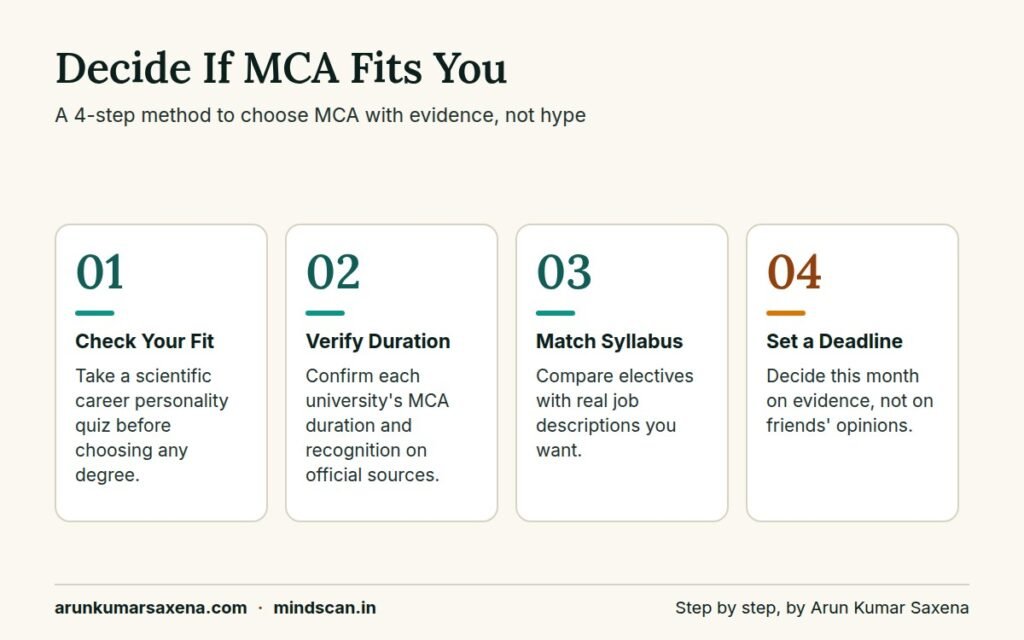
The duration question, whether 2 years or 3, is secondary to fit. My method starts with knowing yourself through a scientific assessment, then verifying university recognition and eligibility, comparing costs against expected roles, and only then committing. Self-knowledge must come before any career choice.
“Don’t pressurise your child either to appear for NEET or to drop after the first setback. Analyse your child’s aptitude scientifically and check the scores critically before taking any decision.” (Arun Kumar Saxena)
That advice applies to MCA decisions too. A scientific assessment beats family pressure every time.
The MINDSCAN report maps a student to 20+ career groups and removes the guesswork that drives so many degree decisions. Here is the step-by-step method I recommend for every MCA aspirant.
- Take the free RIASEC career personality quiz to check whether IT and analytical work actually match your interests.
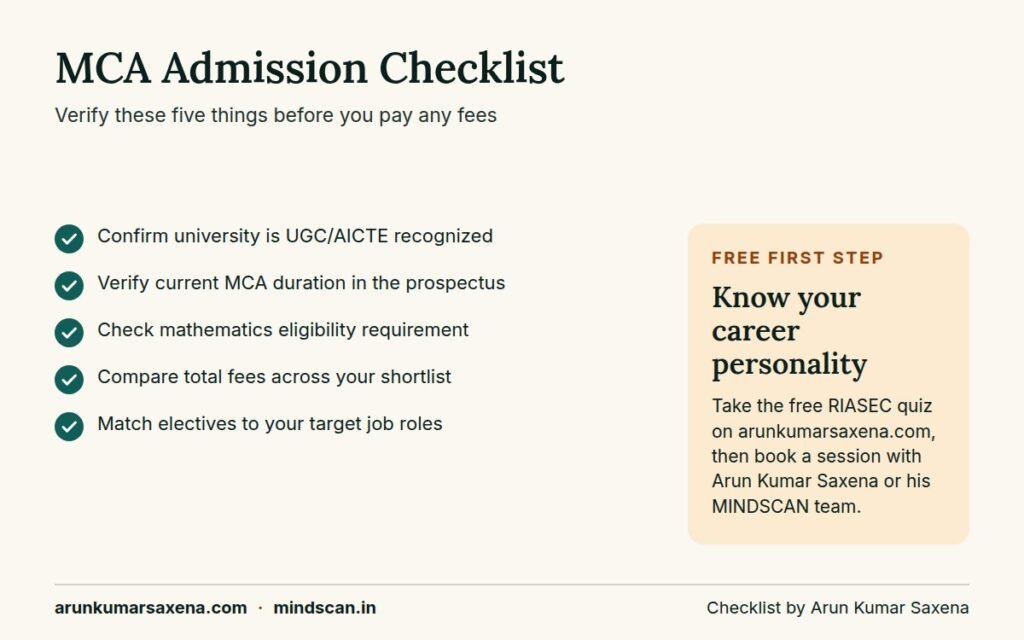
- Shortlist 5 universities and confirm each one’s current MCA duration and AICTE/UGC recognition from official sources.
- Check your eligibility: degree, mathematics requirement and minimum marks against each university’s prospectus.
- Download and compare the syllabus of your top 3 universities; match electives to real job descriptions on job portals.
- Estimate total cost: fees for the full duration plus two years of foregone salary, and note scholarship options.
- If still unsure between MCA, MBA or a job-first route, book an online career counselling in India with Arun Kumar Saxena session for a data-verified verdict.
- Set a decision deadline this month and stop collecting opinions. Decide on evidence, not hype.
For students still exploring undergraduate paths, I have written detailed guides on the best computer courses after 12th and career options after BSc. If you are weighing MCA against management degrees, the page on MBA courses after graduation will help you compare. You can learn more about my approach on the Arun Kumar Saxena profile page.
Frequently asked questions about mca course is of how many years
Is MCA now only 2 years everywhere in India?
AICTE set 2 years (4 semesters) as the standard from 2020, and most universities follow it. A few traditional or specialized institutions may still run longer formats, so confirm with the specific university before applying. The answer to how many years an MCA course is depends on the institution.
Can a BCom or BA graduate do MCA?
Some universities admit non-IT graduates if they had mathematics at 10+2 or graduation level and meet the marks criterion. Such students may need bridge modules, and eligibility varies by university, so check each prospectus carefully.
Which course is better after MCA?
Options include direct IT employment, specializations like data science or cyber security via certifications, a PhD for research, or management roles later. The next step should follow actual job goals, not a default queue.
Is MCA better than CA?
They are different careers, not competitors. CA is a professional accounting qualification with its own rigorous exams. MCA is a technology degree. The better choice depends entirely on whether the student’s aptitude is analytical-finance or logical-technology.
What is the MCA salary for freshers in India?
Salaries vary widely by company, city, specialization and interview performance. Avoid trusting a single headline figure. Check live job portals for current ranges and note that skills and projects move pay more than the degree tag.
Is an online or distance MCA valid in India?
Online and distance MCA degrees from UGC-entitled universities are valid, but recognition status changes. Verify the university is currently entitled to offer the programme online before enrolling, and avoid unrecognized fast-track offers.
When should I start planning for MCA admission?
Final-year graduation students should start approximately 6 to 9 months ahead. Shortlist universities, track entrance exam notifications, and prepare for tests early. Waiting for dates before shifting into top gear is the biggest planning mistake I see.
हिंदी में जवाब: एमसीए कोर्स कितने साल का होता है?
एमसीए कोर्स कितने साल का होता है?
एमसीए कोर्स अब लगभग 2 साल का होता है। एआईसीटीई ने 2020 में इसे 3 साल से घटाकर 2 साल कर दिया था। कुछ पारंपरिक विश्वविद्यालय अभी भी 3 साल का प्रारूप चला सकते हैं, इसलिए आवेदन से पहले संस्थान की वेबसाइट पर अवधि की पुष्टि ज़रूर करें।
बीएससी के बाद कौन सा कोर्स करना चाहिए?
बीएससी के बाद कोर्स का चुनाव आपके विषय और रुचि पर निर्भर करता है। अगर आपने कंप्यूटर साइंस या आईटी लिया है, तो एमसीए एक अच्छा विकल्प है जो अब लगभग 2 साल का होता है। अन्य विकल्पों में एमएससी, एमबीए या डेटा साइंस जैसे सर्टिफिकेशन कोर्स शामिल हैं। अरुण कुमार सक्सेना सलाह देते हैं कि कोई भी कोर्स चुनने से पहले अपनी एप्टीट्यूड की वैज्ञानिक जांच ज़रूर कराएं।
जल्दी जॉब पाने के लिए कौन सा कोर्स करें?
जल्दी नौकरी के लिए स्किल-बेस्ड शॉर्ट-टर्म कोर्स ज़्यादा कारगर होते हैं। वेब डेवलपमेंट, डिजिटल मार्केटिंग, डेटा एनालिटिक्स या क्लाउड कंप्यूटिंग के लगभग 6 से 12 महीने के सर्टिफिकेशन प्रोग्राम तुरंत रोज़गार दिला सकते हैं। एमसीए जैसी डिग्री में लगभग 2 साल लगते हैं, इसलिए अगर समय कम है तो पहले स्किल कोर्स करके नौकरी शुरू करें और बाद में डिग्री पूरी करें।
1 साल के कोर्स कौन से हैं?
एक साल के अंदर पूरे होने वाले कोर्स में पीजी डिप्लोमा, सर्टिफिकेशन प्रोग्राम और कुछ डिप्लोमा कोर्स आते हैं। उदाहरण के लिए, डेटा साइंस में पीजी डिप्लोमा, डिजिटल मार्केटिंग सर्टिफिकेशन, या टैली और अकाउंटिंग का डिप्लोमा। लेकिन एमसीए जैसी मास्टर डिग्री एक साल में पूरी नहीं हो सकती। फास्ट-ट्रैक एमसीए के झांसे में न आएं, क्योंकि ऐसी डिग्री अक्सर मान्यता प्राप्त नहीं होती।
The question “MCA course is of how many years” has a clear answer today: 2 years under AICTE norms, with a few exceptions. But the duration is only one piece of the decision. The degree will serve you only if it matches your aptitude and leads to the job roles you actually want. Do not spend two years and significant fees on a guess.
Start with the free RIASEC quiz. If the results point toward IT and analytical work, get the MINDSCAN AI Career Clarity Report for ₹1,499 or book a full counselling session with the report for ₹2,999. The MINDSCAN report maps you to 20+ career groups and gives you a data-verified answer, not a friend’s opinion. Book your online career counselling in India with Arun Kumar Saxena today and decide on evidence, not hype.