
High-Paying IT Jobs in India: Which One Actually Fits You?
By Arun Kumar Saxena, Certified Advanced Career Coach · Updated October 2026
Quick answer: The best high-paying IT jobs in India in 2026 are AI/ML architect, cloud architect, cybersecurity specialist, and data scientist, with senior packages broadly in the ₹15 to 40+ LPA range. But the role that pays you best is the one that matches your aptitude and survives AI disruption. Start by knowing your fit, then build the skills.
Every list of high-paying IT jobs in India reads the same: a salary figure next to a role title, and a course link. That approach misses the only question that matters, which of those high-paying IT jobs in India actually fits you, and will it still pay well five years from now? This page gives you the honest, unfiltered view that no listicle carries. I will walk you through the roles, the real numbers, the AI risk filter, and the self-fit method that professionals use to switch without wasting months on the wrong specialisation.
With 22 years of experience and 20,000+ students and professionals guided, I have sat on both sides of the hiring table. As a former corporate leader and now a Certified Advanced Career Coach, I have seen what makes a resume land an interview and what makes a career survive disruption. If you are a working professional, a fresher, or someone eyeing a switch into IT, this page will help you decide with clarity, not clickbait.
Table of Contents
Top high-paying IT jobs in India in 2026
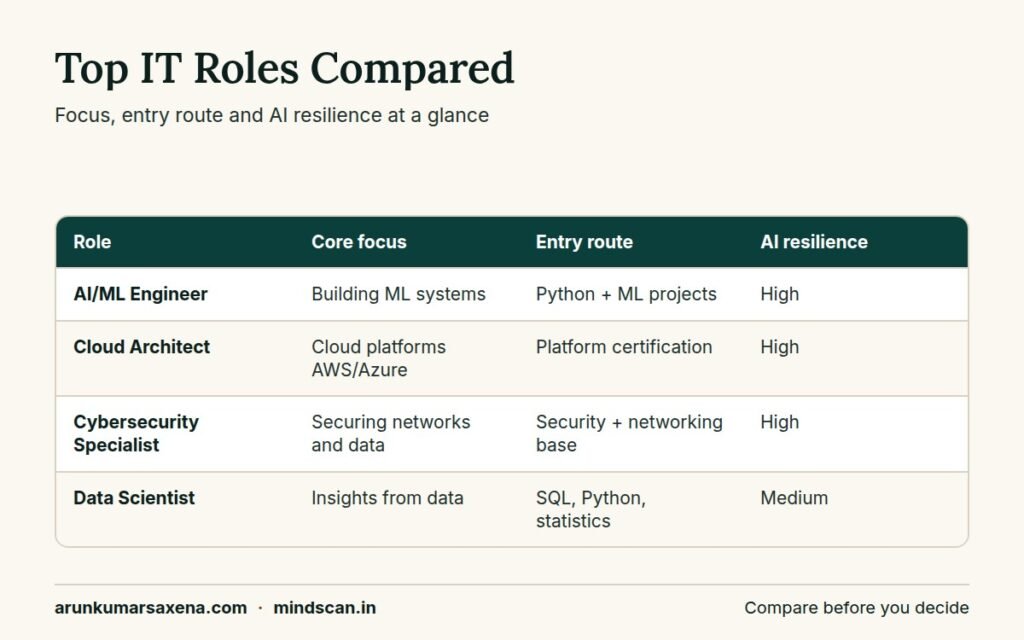
The table below compares five roles that consistently rank among the high-paying IT jobs in India. Salary ranges are approximate and drawn from online sources. The AI resilience column is my honest assessment based on how much of the daily work involves judgement, accountability, and adversarial thinking that automation cannot replicate.
| Role | Focus | Typical Salary Range (LPA) | Entry Route | AI Resilience |
|---|---|---|---|---|
| AI/ML Architect | Designing and deploying machine learning systems | ₹20 to 40+ | Strong coding and math, ML portfolio, cloud certs | Very high (builds the AI) |
| Cloud Architect | Cloud infrastructure, migration, and cost optimisation | ₹18 to 35+ | Cloud platform certs, systems engineering background | High (design and accountability) |
| Cybersecurity Specialist | Threat detection, incident response, compliance | ₹15 to 30+ | Security certs, networking knowledge, CTF experience | Very high (adversarial thinking) |
| Data Scientist | Analytics, modelling, and business insight generation | ₹12 to 30+ | Statistics or CS degree, strong project portfolio | Moderate (routine analysis is automatable) |
| Product/Technology Leader | Strategy, team leadership, and product decisions | ₹30 to 80+ | 10+ years of experience, MBA or equivalent, track record | Very high (owns decisions) |

What does an AI/ML architect actually do, and is it a high-paying IT job in India?
An AI/ML architect designs the systems that allow machines to learn from data and make decisions. This is not about using ChatGPT. It is about building and deploying models at scale, selecting algorithms, managing data pipelines, and ensuring the system works reliably in production. It is one of the highest-paying IT jobs in India because the skill gap is enormous and the business impact is direct.
Picture a Class 12 student who loved math puzzles and taught herself Python during the summer break. Five years later, she is designing a recommendation engine for a major e-commerce platform. That path is real, but it demands depth. A surface-level online certificate will not get you an interview. You need a strong portfolio of projects, contributions to open-source repositories, and ideally a cloud certification from AWS, Azure, or GCP.
The MINDSCAN AI Career Clarity Report, priced at ₹1,499, can help you check early whether your aptitude aligns with the abstract reasoning and logical thinking this role demands before you invest years in it. The report with a counselling session costs ₹2,999. You can book through my online career counselling in India with Arun Kumar Saxena page.
Mistakes to avoid when targeting AI/ML roles
Many candidates chase the salary headline and ignore the foundation. They enrol in expensive bootcamps without first testing their comfort with statistics and linear algebra. They build no portfolio beyond tutorial projects. A hiring manager at a product company can spot this in five minutes. Start with a free self-check. Try the RIASEC career personality quiz on my website. If your investigative and realistic scores are high, you may have a natural tilt toward this kind of work.
What does a cloud architect do, and why is it among the high-paying IT jobs in India?
A cloud architect designs, deploys, and manages an organisation’s cloud computing strategy. This includes choosing the right services, ensuring security, controlling costs, and planning migration from on-premise systems. Every bank, every hospital, every retail chain is moving to the cloud or optimising its cloud spend. That demand makes cloud architecture one of the most stable high-paying IT jobs in India.
The entry path is clearer than for AI/ML. Platform certifications carry real weight here. An experienced systems administrator or network engineer can transition by earning the AWS Solutions Architect, Microsoft Azure Administrator, or Google Cloud Professional Cloud Architect certification and then building a few migration or cost-optimisation projects. The work is highly AI-resilient because it involves architecture decisions, vendor accountability, and security trade-offs that no automation can own.
What does a cybersecurity specialist do, and can it be a high-paying IT job in India?
A cybersecurity specialist protects an organisation’s systems, networks, and data from attacks. The work ranges from monitoring for intrusions and running penetration tests to designing security policies and leading incident response when a breach happens. It is one of the high-paying IT jobs in India that will only grow in demand as digital regulation tightens and attacks become more sophisticated.
This role suits someone who thinks like an adversary. If you enjoy puzzles, capture-the-flag competitions, and understanding how systems break, cybersecurity may be your strongest fit. Certifications like CompTIA Security+, CEH, and CISSP open doors. The work is extremely AI-resilient. Automation can scan logs, but it cannot take accountability for a breach or think creatively about an attacker’s next move. Check the National Career Service portal for current role information. Cross-check your aptitude with the MINDSCAN AI Career Clarity Report before committing to a certification path.
How much can you actually earn in IT in India at each experience level?
As per online sources and with an honest qualifier, typical IT salaries in India run approximately ₹3 to 8 LPA at fresher level, ₹8 to 20 LPA at mid-level, and ₹20 to 40+ LPA at senior specialist or architect level, with tech leadership at product companies scaling beyond that. These are the realistic bands for high-paying IT jobs in India, not the outlier headlines.
Company type changes these ranges significantly. Product companies and global capability centres (GCCs) pay at the higher end. Service companies and small startups pay at the lower end. Location and remote policy now influence pay less than skill rarity. A cloud architect in a tier-2 city working remotely for a product company can earn close to a Bengaluru-based peer. Always benchmark against live listings on job portals, not blog headlines. The Skill India Digital Hub for government-recognised skilling courses is a useful place to find affordable, credible upskilling options that employers recognise.

How do you switch into a high-paying IT job in India? A step-by-step plan
For a working professional, a focused switch into one of the high-paying IT jobs in India takes approximately 6 to 12 months. Anyone promising a faster path is selling a dream. The plan below is the one I recommend in my sessions. It works because it builds evidence, not just certificates.
- Fit test first. Before you spend a rupee on a course, check whether your aptitude matches the role. Take a free psychometric quiz like the RIASEC career personality quiz or invest in the MINDSCAN AI Career Clarity Report. A mismatch caught early saves months of frustration.
- Skill-building with projects. Pick one specialisation (cloud, security, AI/ML, or data). Complete a structured certification and build two to three real projects. A project means something you can show on GitHub or a portfolio site, not a tutorial clone. This phase takes approximately 3 to 6 months.
- Build a portfolio. Document your projects clearly. Write about the problem, your approach, and the result. A well-documented portfolio matters more than a long list of certificates.
- Targeted applications. Apply to roles that match your new portfolio, not every IT job. Customise your resume for each application. Highlight projects over degrees.
- Network with intent. Connect with people already in the role on LinkedIn. Ask about their day-to-day work, not for a job referral. The insight you gain will sharpen your interview answers.
Which high-paying IT jobs in India will survive AI disruption?
AI is reshaping the IT job market faster than any previous technology shift. Routine coding, basic testing, and L1 support roles are already under pressure. The high-paying IT jobs in India that will survive and grow are the ones that require depth, judgement, and accountability. AI/ML engineering builds the AI. Cybersecurity secures the systems. Cloud architecture owns the infrastructure decisions. Product and technology leadership owns the strategy and the team. These four categories are your safest long-term bets.
I have seen this pattern before. When cloud computing arrived, administrators who stayed in on-premise server rooms faced stagnation. Those who learned cloud architecture moved into the best-paying roles. AI is the same wave, only faster. The window to position yourself is open now. Do not wait for a layoff to force your hand. My book 3 Steps to Knowing Yourself explains why self-knowledge must come before any career move, especially when the ground is shifting.
Roles that face the highest AI pressure
Manual testing, basic front-end development, data entry, and L1 IT support are the roles most exposed to automation. If you are in one of these roles, a move toward the resilient categories above is urgent. The switch is possible.
Frequently asked questions about high-paying it jobs in india
Which job has the highest salary in India?
In the IT sector, senior product or technology leadership roles at large product companies and GCCs command the highest salaries, often exceeding ₹80 LPA and reaching approximately ₹1 crore or more at the VP and CTO levels. Among hands-on technical roles, AI/ML architect and cloud architect are the top-paying high-paying IT jobs in India, with senior packages broadly in the ₹20 to 40+ LPA range as per online sources.
Which IT job gets 20 lakh per month in India?
Almost none in salaried employment. ₹20 lakh per month (₹2.4 crore a year) is founder, top-executive or extreme-outlier territory, not a typical high-paying IT job in India. Treat such headlines as clickbait and plan against verified LPA ranges instead.
Can freshers get high-paying IT jobs in India?
Freshers rarely start at the highest salaries, but AI/ML, data and cloud roles at product companies and GCCs pay well above the average fresher package. Strong project portfolios and internship experience make the difference. A generic resume with only a degree will not get you into the high-paying IT jobs in India.
Is cybersecurity a good high-paying IT career in India?
Yes. Senior cybersecurity roles commonly command ₹15 to 30+ LPA as per online sources. Demand keeps rising with digital regulation, and the work is highly AI-resilient because it involves accountability and adversarial thinking that automation cannot replicate. It is one of the safest high-paying IT jobs in India to target.
Which 3 jobs will survive AI in the IT sector?
AI/ML engineering (building AI), cybersecurity (securing systems), and cloud architecture (owning infrastructure decisions) are the three best-placed categories. Automation pressures routine, repeatable coding and support work first, so these are the high-paying IT jobs in India worth targeting now.
How long does it take to move into a high-paying IT role?
For a working professional, a realistic focused switch takes approximately 6 to 12 months. Spend approximately 3 to 6 months on skill-building with projects, then approximately 3 to 6 months on targeted applications and networking. Anyone promising a faster path into a high-paying IT job in India is selling something.
Is a career in IT still worth it in 2026 given layoffs?
Yes, but selectively. Layoffs have hit generic, replaceable roles hardest. Specialists in AI, cloud and security remain in demand. The lesson is to specialise and keep re-skilling, not to avoid IT. The high-paying IT jobs in India that survive are the ones that require depth, not surface-level familiarity.
Every list of high-paying IT jobs in India tells you what pays. Few tell you whether you will survive long enough in that role to earn it, or whether the role itself will survive AI. The MINDSCAN AI Career Clarity Report gives you the self-knowledge that no salary list can. It maps your aptitude to 20+ career groups and tells you which IT specialisation actually fits, so you invest your upskilling months in the right direction.
Book your online career counselling in India with Arun Kumar Saxena or try the MINDSCAN AI Career Clarity Report today. The window in the best-paying IT roles is open now. Do not wait for a layoff or an AI disruption to force your hand.