
Audiologist Course in India: Eligibility, Duration and Career Path
By Arun Kumar Saxena, Certified Advanced Career Coach · Updated November 2026
Quick answer: An audiologist course in India means a degree in Audiology and Speech-Language Pathology, usually the 4-year BASLP after Class 12 Science with Physics, Chemistry and Biology or Maths, including a clinical internship. Shorter one-year audiometry diplomas and the 2-year MASLP exist too. Check your genuine fit with a psychometric assessment before you pay any fees.
An audiologist course in India is a healthcare qualification that teaches you to test hearing, fit hearing aids and support speech and language problems, and this page helps a Class 12 student and their parents decide whether that path is worth four years and the fees. It covers eligibility, duration, course types, salary reality and the honest way to check fit.
With 22 years of experience and 20,000+ students and professionals guided, I have seen families choose a clinical course because a relative wears a white coat, then discover in year two that the daily work does not suit them. This page gives you the facts and a way to test yourself before you commit.
Table of Contents
What is an audiologist course and who should take it?
An audiologist course trains you to diagnose and manage hearing, balance and related communication disorders. The main qualification is BASLP, the Bachelor in Audiology and Speech-Language Pathology, a four-year degree with a full clinical internship year. It suits students who enjoy biology, patient contact and careful problem-solving, and who want a healthcare career without the NEET route.
BASLP combines two streams in one degree. Audiology deals with hearing assessment, hearing aids and implants. Speech-language pathology deals with speech, language and swallowing difficulties, often in children. That combination is why the degree is written as Audiology and Speech-Language Pathology, not audiology alone.
This is clinical work, not lab work. You will spend hours with a nervous parent of a toddler who is not speaking yet, or with an elderly patient who has stopped hearing the television. If that kind of contact drains you, a different healthcare course will serve you better.
Who genuinely fits this course
- Students who liked Biology and were comfortable with diagrams and diagnosis
- People who can stay patient through slow progress in speech therapy
- Students who want hospital or clinic work without an MBBS
- Anyone willing to learn equipment, software and hearing-aid technology
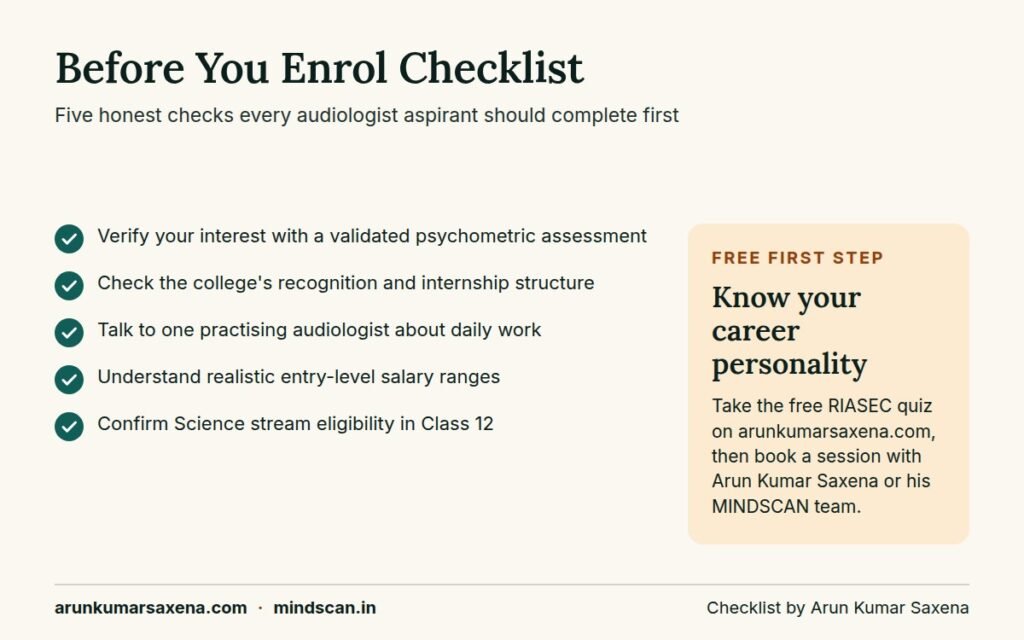
Before you commit, check your interests scientifically. A free RIASEC career personality quiz takes under ten minutes and tells you whether clinical healthcare actually matches your personality type.
What is the BASLP audiologist course duration and eligibility?
The BASLP audiologist course duration is four years: three years of classroom and practical study plus one year of supervised clinical internship. Eligibility is Class 12 Science with Physics, Chemistry and Biology or Mathematics, usually with a minimum aggregate that each college sets. Some universities add an entrance test or interview, so admission rules differ by state and institute.
The internship year is not a formality. That is where you rotate through hospital audiology units, speech therapy departments and hearing-aid fitting centres. Students who use this year well leave with a clear specialisation and real patient hours on their record.
Eligibility looks simple on paper and trips people up in practice. A student who took Biology but not Maths may find some institutes closed, and a student with Maths but no Biology may find others closed. Read each college’s official admission page rather than a coaching blog.
What to verify before applying
- Whether the college accepts PCB, PCM or both
- The minimum aggregate percentage it demands
- Whether admission is merit-based or through an entrance test
- Which hospitals the internship is attached to
- Recognition status of the programme
If you are still mapping your options, my guide to career options after 12th Science PCB shows how audiology sits alongside other healthcare paths. For a full picture of how I work, see my profile page on Arun Kumar Saxena.
Which audiologist course types exist in India?
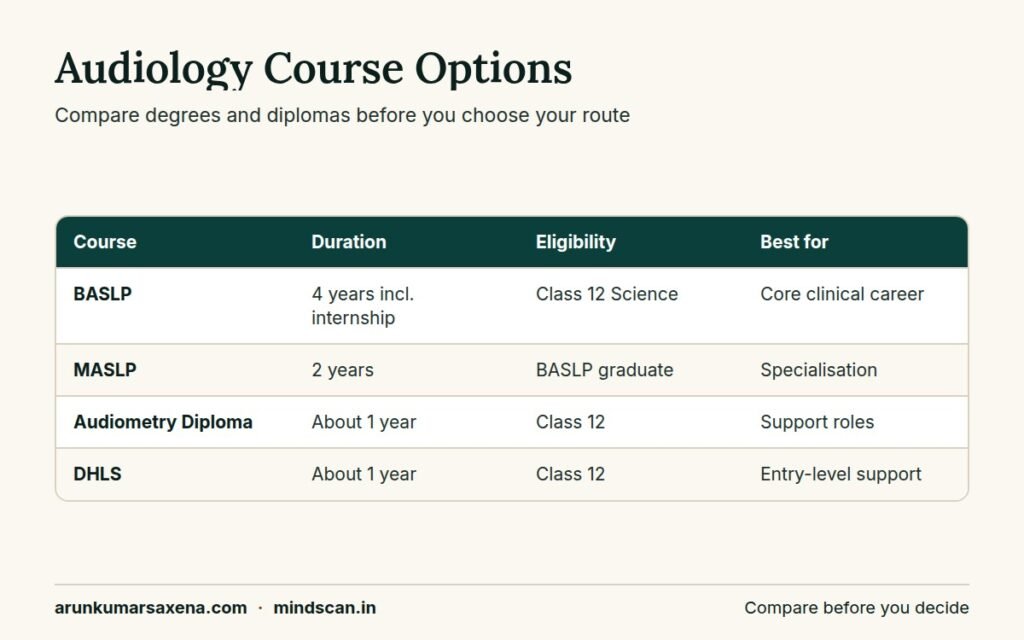
India offers four main audiologist course types: the four-year BASLP degree, the two-year MASLP or MSc Audiology after graduation, roughly one-year diplomas such as the Diploma in Audiometry Technician or DHLS for support roles, and doctoral research for teaching and senior clinical posts. BASLP remains the core professional degree for full clinical practice.
| Course | Duration | Eligibility | Best for |
|---|---|---|---|
| BASLP | 4 years (including internship) | Class 12 Science (PCB or PCM) | Core clinical career |
| MASLP or MSc Audiology | 2 years | BASLP graduate | Specialisation and research |
| Diploma in Audiometry Technician | About 1 year | Class 12, as per institute | Technical support roles |
| DHLS | About 1 year | Class 12, as per institute | Entry-level hearing and speech support |
| PhD in Audiology | 3+ years, varies | Master’s degree | Teaching and senior research |
The choice between these routes decides your ceiling, not just your start date. A diploma gets you into a clinic faster; a degree gets you into independent clinical decisions and eventually your own practice.
Is there any 1 year diploma audiologist course?
Yes. Shorter programmes such as the Diploma in Audiometry Technician and the Diploma in Hearing Language and Speech run for about a year and prepare you for support work like basic hearing tests and hearing-aid fitting under supervision. They get you earning sooner, but full clinical independence needs a BASLP degree.
Be clear about the difference in role. A diploma holder assists with testing and device handling. A degree-holding audiologist interprets results, plans rehabilitation and takes clinical responsibility. Hospitals pay and promote accordingly.
Many diploma holders bridge to a degree later through lateral or fresh admission, depending on the university. If you are young and unsure, the degree is usually the safer first bet because it keeps both doors open.
How do you become an audiologist in India step by step?
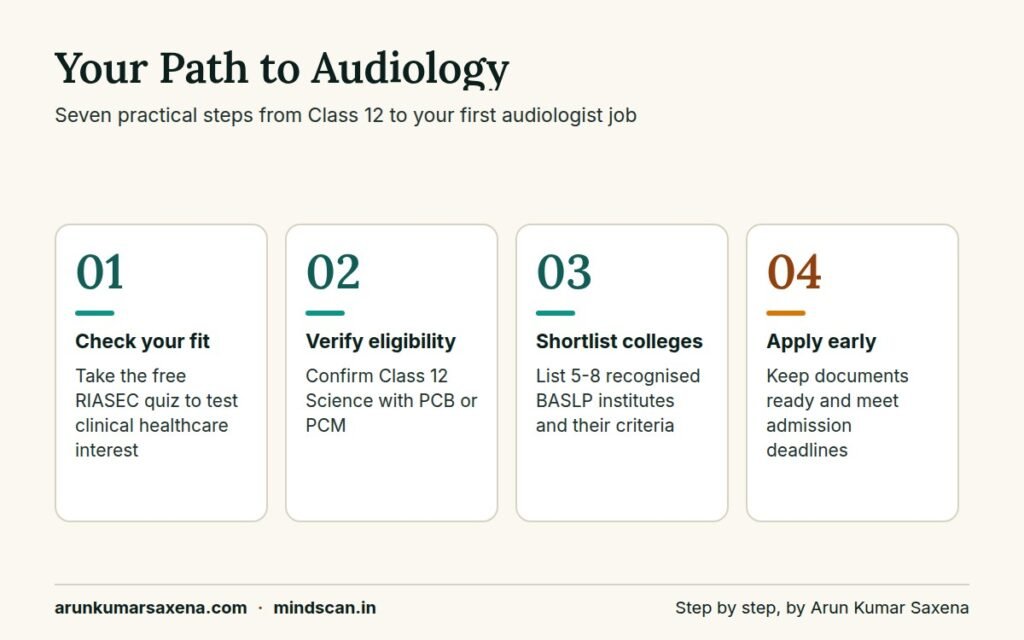
The practical path is: finish Class 12 Science, take a scientific career-fit assessment, shortlist recognised BASLP colleges, secure admission, complete three years of study plus one year of internship, then register and begin practice. A MASLP can follow later for specialisation.
- Confirm you have or will take Science with PCB or PCM in Class 12.
- Take the free RIASEC career personality quiz to check whether clinical healthcare genuinely matches your interests.
- Complete a psychometric assessment and discuss the audiologist path with a career counsellor before paying any fees.
- Shortlist five to eight recognised BASLP colleges and note their exact eligibility, entrance exams and internship structure.
- Talk to one practising audiologist about a typical working day and honest salary expectations.
- Apply as soon as admission windows open, with documents ready.
- Decide early whether you will pursue MASLP or move towards private practice after the internship year.
For students comparing several non-NEET routes at once, my list of careers after 12th Science without NEET or JEE gives a wider view before you narrow down.
What is the salary of an audiologist in India?
Entry-level audiologist salary in India is commonly reported by major career portals at roughly Rs 3 to 5 lakh per year, rising with experience, specialisation and private practice. Hospital and clinic roles dominate first jobs. Earnings grow meaningfully for those who later run their own hearing-care clinic, but treat every figure as an estimate, not a promise.
The growth curve matters more than the starting number. A fresh graduate in a hospital audiology department earns modestly. An audiologist with implant experience, paediatric skills or a steady hearing-aid client base earns considerably more. Private practice rewards reputation built over years.
Diploma technicians earn less than degree-holding audiologists, and the gap widens with time. This is one reason I ask families to look at the long-term picture, not the first payslip.
Which is better, audiology or speech pathology?
Audiology has strong and growing scope in India because of rising noise exposure, an ageing population and better newborn hearing screening. Speech pathology offers broader caseloads across children, stammering and autism support. Audiology is more technology and device driven, with hearing aids, implants and diagnostics at its centre. The combined BASLP keeps both doors open.
Headphone use, traffic noise and industrial sound have made hearing conservation a real need, not a slogan. Hospitals, schools and industry all recruit for it. Speech pathology demand is strong in schools, child development centres and rehabilitation setups.
My advice is simple. Do not specialise at eighteen. Take the combined degree, use the internship to see both sides, and choose your master’s with real experience behind you.
Which is better, speech pathology or audiology?
Neither is universally better; they serve different patient groups and suit different working styles. Audiology leans towards technology, diagnostics and device fitting, often with older patients. Speech pathology leans towards therapy, child development and communication rehabilitation. The BASLP degree deliberately covers both, so you can test your preference during the internship year rather than guessing now.
Is BASLP better than BPT for a healthcare career without NEET?
Neither is universally better; they fit different people. BASLP leads to hearing and speech clinics with quieter, equipment-based work and less saturation than physiotherapy. BPT has larger caseloads, more colleges and a more crowded market. Choose on personality and work style, not generic scope claims.
Picture two students. One dislikes physical handling of patients and enjoys testing, devices and counselling. The other wants movement-based therapy and is comfortable with hands-on rehabilitation. The first will likely thrive in BASLP, the second in BPT.
Both allow private practice after registration. Both need you to check the college’s recognition and internship quality. Neither should be chosen because a friend took it.
BASLP vs BPT: a quick comparison
- Work style: BASLP is quieter, equipment-based and counselling-heavy. BPT is hands-on, movement-based and physically active.
- Market saturation: BASLP has fewer graduates and lower competition, as per online sources. BPT has more colleges and a more crowded job market.
- Physical handling: BASLP involves minimal physical handling of patients. BPT requires daily physical contact and rehabilitation exercises.
How do you check if an audiologist course suits you before applying?
Before applying, verify three things: genuine interest in clinical patient work, aptitude for biology and diagnostic reasoning, and realistic salary expectations. My book, 3 Steps to Knowing Yourself, argues that self-knowledge must come before any career choice. A psychometric assessment tests this objectively instead of leaving it to assumption or family pressure.
“Analyse your child’s aptitude scientifically and check the scores critically before taking any decision.” (Arun Kumar Saxena)
I have watched this play out many times. A student admires a relative’s profession, enrols in the matching course, and then struggles because the daily work never suited them. The same logic applies before choosing an audiologist course: verify fit with data, not admiration for someone else’s life.
What most guides miss: the three-question fit test
Most ranking pages tell you the syllabus and the college list. Almost none tells you how to test yourself before you commit. Use this simple test.
Question one: can you sit with a frustrated parent for forty minutes without losing patience? Question two: do you enjoy figuring out why something is not working, from a machine to a child’s speech? Question three: are you comfortable that your income will grow slowly for the first few years and faster only after you build a reputation or a clinic?
Two honest yes answers out of three is a workable signal. One or none means you should explore other healthcare routes before paying admission fees. This test is not a substitute for a proper assessment, but it filters out the most common mistake I see: choosing a clinical course for the title, not the daily work.
Where MINDSCAN fits in
The MINDSCAN report maps the student to 20+ career groups. It gives a family a shared language for the decision instead of an argument at the dinner table. I review every report with my team before it reaches you.
You can also check official routes and scheme information on the National Career Service portal of the Government of India and skill programmes on the Skill India Digital Hub.
Frequently asked questions about audiologist course
Can I do an audiologist course online?
No full audiologist course can be completed purely online, because clinical contact hours and supervised internships are mandatory. Some theory modules and short certificate programmes exist online, but BASLP, MASLP and the diplomas all require in-person clinical training. Treat any claim of a fully online BASLP with suspicion and verify recognition before paying.
Is NEET required for an audiologist course?
Generally no. Most BASLP admissions use Class 12 Science marks or institute-level entrance tests rather than NEET. A few universities run their own exams, so read the specific college’s admission notification carefully. This is why audiology is a genuine healthcare option for students who do not want the NEET route.
What subjects are studied in a BASLP audiologist course?
BASLP covers anatomy and physiology of hearing, acoustics, hearing assessment through audiometry, hearing aids and implant technology, speech-language pathology, paediatric and geriatric audiology, and research methods. The final year is a supervised clinical internship in hospitals and clinics, where you apply all of it with real patients.
What is the audiologist course fees in India?
As per online sources, private BASLP programmes can cost approximately Rs 1 to 3 lakh per year, while government and national institutes are significantly cheaper. Fees vary widely by institution type. Treat these as estimates only and confirm exact fees, hostel charges and internship costs on each college’s official page. If you are unsure about the investment, book an online career counselling session to weigh the course against your budget and long-term goals.
Can a commerce or arts student take an audiologist course?
Not for BASLP. The standard eligibility requires Class 12 Science with Physics, Chemistry and Biology or Mathematics. A student from another stream who wants audiology would need to requalify through Science first. If the interest is genuine, an honest counselling session can map the fastest realistic route for your situation.
What jobs can I get after an audiologist course?
Graduates work as audiologists in hospitals and hearing clinics, hearing-aid specialists, speech and hearing therapists in schools and rehabilitation centres, industrial hearing-conservation consultants, or lecturers after postgraduation. Many eventually open their own hearing-care clinic, which usually offers the best long-term earning potential.
Which are the best institutes for an audiologist course in India?
National institutes such as AYJNISHD and regional speech and hearing institutes, plus university-affiliated colleges listed on national education portals, are the main options. Evaluate recognition status, clinical exposure, internship hospitals and placement records rather than marketing claims, and shortlist using official sources only. For a wider view of healthcare paths, see my guide to career options after 12th Science PCB.
हिंदी में जवाब: 12वीं के बाद ऑडियोलॉजिस्ट कोर्स: पूरी जानकारी
12 वीं के बाद सबसे अच्छा कोर्स कौन सा है?
कोई एक कोर्स सबके लिए सबसे अच्छा नहीं होता। यह आपकी रुचि, योग्यता और करियर लक्ष्य पर निर्भर करता है। Science में BASLP, B.Sc. Nursing, BPT और Biotechnology जैसे विकल्प हैं। अरुण कुमार सक्सेना का सुझाव है कि पहले साइकोमेट्रिक असेसमेंट से अपनी रुचि जाँचें, फिर कोर्स चुनें।
Science में सबसे अच्छी नौकरी कौन सी है?
Science में अच्छी नौकरी का मतलब है वह काम जो आपकी रुचि से मेल खाए। हेल्थकेयर में ऑडियोलॉजिस्ट, फिजियोथेरेपिस्ट और नर्सिंग जैसे विकल्प स्थिर हैं, जबकि इंजीनियरिंग और डेटा क्षेत्र में वेतन तेजी से बढ़ सकता है। सही चुनाव के लिए पहले अपनी क्षमता समझें।
कौन सी पढ़ाई ज्यादा सैलरी देती है?
सैलरी कोर्स से ज्यादा आपकी स्किल, शहर और अनुभव पर निर्भर करती है। इंजीनियरिंग और मैनेजमेंट में शुरुआती वेतन ऊँचा हो सकता है, जबकि हेल्थकेयर में शुरुआत धीमी पर वृद्धि स्थिर होती है। लगभग आँकड़े बदलते रहते हैं, इसलिए दस साल की संभावना देखें।
If your child is weighing an audiologist course against other healthcare options, do not decide from a brochure or a relative’s advice. Book an online career counselling session and we will look at aptitude, salary reality and the right course route together, across India.
You can also start with the MINDSCAN AI Career Clarity Report at ₹1,499, or take it with a counselling session at ₹2,999, and bring the report to the discussion.