
Is PCMB Hard in Class 11? 11th Class Science Subject List: PCM, PCB and How to Choose
By Arun Kumar Saxena, Certified Advanced Career Coach · Updated November 2026
Last updated: November 2026. Board-wise curriculum details on this page were cross-checked against the Ministry of Education, Government of India curriculum documents (accessed November 2026).
Quick answer: Is PCMB hard in Class 11? PCMB is the heaviest combination in the 11th class science subject list, carrying both Mathematics and Biology, and it is manageable only for students who perform well in both. The 11th class science subject list includes 5 to 6 subjects: Physics, Chemistry, and either Mathematics (PCM) or Biology (PCB), or both (PCMB), plus a compulsory language (usually English) and one elective such as Computer Science, Physical Education, Economics or Psychology. Arun Kumar Saxena advises choosing PCM or PCB based on verified aptitude, not peer pressure or coaching-institute hype.
Direct answer: Is PCMB hard in Class 11? Yes, it is the heaviest science combination, read the full answer near the top of the guide below, or check the complete 11th class science subject list first.
The 11th class science subject list looks simple on paper, but the choice between PCM, PCB and PCMB shapes the next six to eight years of a student’s life. This page gives parents and Class 10 pass-outs the full subject list, a clear comparison of every combination, and a step-by-step plan to pick the right one without guesswork.
With 22 years of experience and 20,000+ students and professionals guided, I have seen too many families lock a science combination based on a neighbour’s opinion, a coaching institute’s batch timing, or the fear of closing a door. The subject list is the easy part. The decision is what costs time and money if it goes wrong. Here is everything you need to know about the 11th class science subject list and how to use it wisely.
Table of Contents
What subjects are in the 11th class science subject list?
Physics, Chemistry, one of Mathematics or Biology, and a compulsory language form the core 11th class science subject list in CBSE, ICSE and most state boards. Schools then offer one or two electives from a board-approved pool, bringing the typical total to five or six subjects.
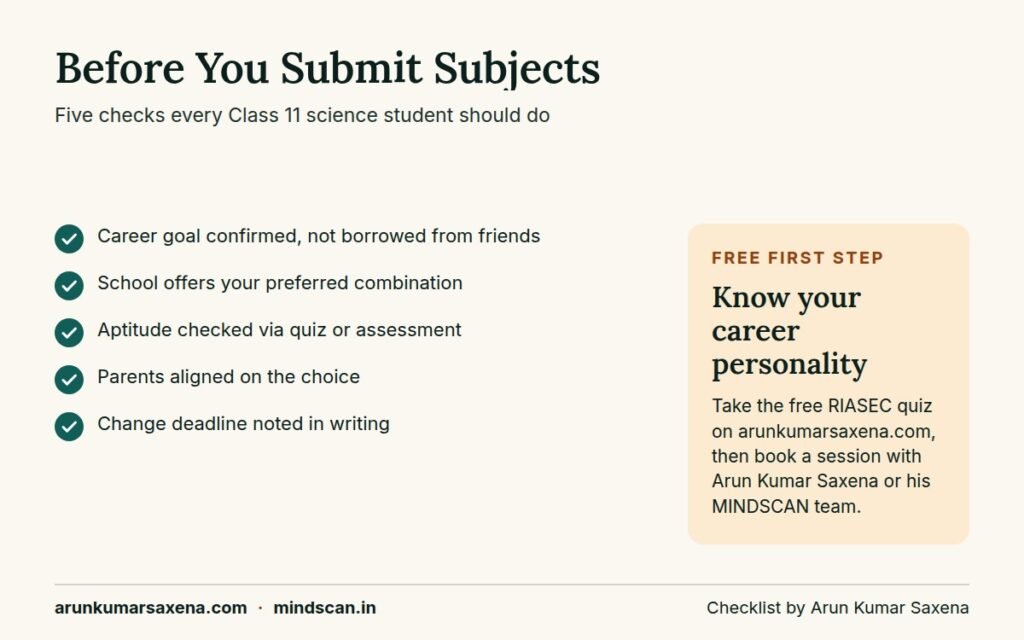
Physics and Chemistry are compulsory in every science combination. PCM adds Mathematics; PCB adds Biology; PCMB takes both. English or another language is a compulsory paper across CBSE, ICSE and state boards. Electives vary school by school, so confirm your school’s actual list before admission. A student who assumes Computer Science will be available and discovers it is not often scrambles at the last minute. Get the school’s subject combination sheet early.
For the complete breakdown of every subject, see the full subject list for the science stream. If you are weighing the biology side of science, this after intermediate bipc courses list shows where PCB can take you after Class 12. If you are considering an arts elective instead, this guide to arts subjects lists the options available. If you have not yet decided on the stream itself, this overview of science fields after 10th explains the choices before you reach the subject list.
What are pure science subjects in Class 11?
Pure science subjects in Class 11 mean Physics, Chemistry, Biology and Mathematics taught as core theoretical disciplines without applied or vocational electives. In common usage, the term refers to the PCB or PCM combination, keeping the student eligible for medical, engineering or pure-science degree routes.
Physics covers mechanics, thermodynamics, optics and electricity. Chemistry spans physical, organic and inorganic branches. Biology includes cell structure, plant and animal morphology, and human physiology. Mathematics covers algebra, calculus, coordinate geometry and statistics. A student taking pure science with PCB and no additional applied subject is squarely on a medical or life-science track. A PCM student with no Computer Science or Economics elective is on a classical engineering or mathematics track.
Many parents ask whether pure science is better than adding an elective. The answer depends on the career goal. A student aiming for a pure physics degree at a central university gains nothing from dropping Mathematics for an unrelated elective. A student targeting an IT career gains a lot from adding Computer Science to PCM. The 11th class science subject list must serve the goal, not a label.
PCM vs PCB vs PCMB: which 11th class science subject combination is right for you?
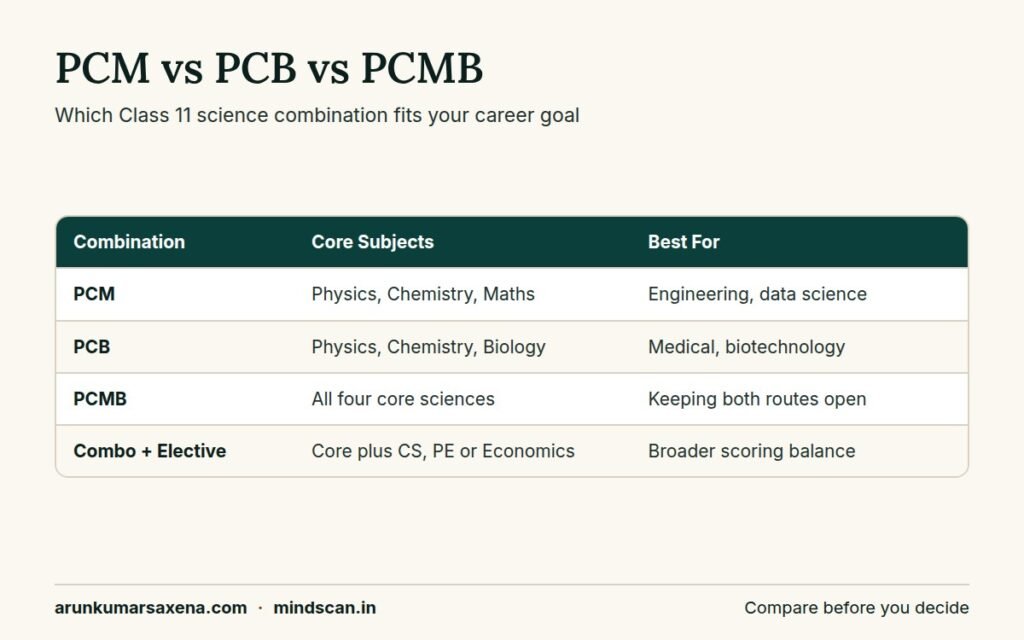
PCM suits students aiming for engineering, architecture, data science or defence; PCB suits medical, nursing, biotechnology and life-science routes; PCMB keeps both doors open but roughly doubles the workload. Choose by aptitude evidence, not by keeping options open out of fear.
PCMB is only advisable if the student genuinely enjoys both Maths and Biology and performs well in both. In my sessions, I ask one question: do you want NEET, JEE, or are you still unsure? An honest answer narrows the choice instantly. An aptitude or RIASEC assessment settles this faster than guesswork. The table below lays out the differences clearly.
| Combination | Core Subjects | Best Suited For | Workload |
|---|---|---|---|
| PCM | Physics, Chemistry, Maths | Engineering, architecture, data science, defence | Moderate to high |
| PCB | Physics, Chemistry, Biology | Medical, biotechnology, life sciences, allied health | Moderate to high |
| PCMB | Physics, Chemistry, Maths, Biology | Students keeping both medical and engineering open | Highest |
| PCM/PCB + Elective | Core combo plus Computer Science, PE, Economics or Psychology | Broadens options and scoring balance | Depends on elective chosen |
For a deeper comparison of the two main routes, read engineering vs medical after 12th.
How many subjects are compulsory in Class 11 science?
Four subjects are compulsory in the 11th class science subject list: Physics, Chemistry, one of Mathematics or Biology, and a language. Most boards mandate a 5th subject and allow an optional 6th, so the typical total is 5 subjects, with PCMB students taking 6.
Boards mandate at least 5 subjects; a 6th is usually optional. Exact compulsory lists differ by board, so check your school’s subject combination sheet before admission. The board-wise curriculum documents published by the Ministry of Education, Government of India are worth checking.
Is PCMB hard in Class 11?
PCMB is the hardest combination in the 11th class science subject list because students study both Mathematics and Biology alongside Physics and Chemistry, roughly doubling the workload. It is manageable for students who genuinely enjoy and score well in both, not for those keeping options open out of fear. For a full side-by-side breakdown, see the PCM vs PCB vs PCMB comparison above, and take the free RIASEC career personality quiz before deciding. The Ministry of Education, Government of India publishes the official board curricula if you want to see the syllabus load yourself. Before committing to PCMB, a psychometric assessment from MINDSCAN Career Guidance by Arun Kumar Saxena verifies whether your aptitude actually supports both Maths and Biology.
Is Class 11 science difficult? Honest answer from a career coach
Class 11 science feels harder than Class 10 because the syllabus depth jumps sharply, especially in Physics and Maths, and many students face it without a study strategy. With consistent revision and realistic expectations, it is manageable. Is Class 11 harder than Class 12? Yes in shock value, but Class 12 adds board pressure.
The jump from Class 10 to 11 is the real difficulty, not the subjects themselves. Picture a student who scored 92 percent in Class 10 and enters PCM. In the first month, she sees her Physics problem-solving speed is half of what the topper in her new class manages. She panics, assumes she picked the wrong stream, and wants to switch. That panic is the difficulty, not the subject. Students who build a Term 1 strategy in the first month cope far better.
A 74 percent in Class 11 is below typical topper benchmarks but says nothing fixed about Class 12 potential. Many students with a modest score in Class 11 have crossed 94 percent in Class 12 boards after fixing their study system, as per online sources. The 11th class science subject list does not change; the approach to studying it must.
Which optional subject should you pick with science in Class 11?
The best optional depends on the career goal: Computer Science for engineering and IT routes, Physical Education for a lighter scoring paper, Economics for commerce-linked ambitions, Psychology for human-behaviour careers. Choose one you can score in without it eating time from PCM or PCB.
Computer Science or Informatics Practices pairs naturally with PCM. Psychology is rising in popularity due to growing psychology careers. Avoid picking an elective just because friends picked it. Picture a PCM student who took Economics as an elective, discovered a genuine interest, and later pursued actuarial science, a high-paying field most Class 11 students never hear about. The elective can open a door, but only if it matches a real interest.
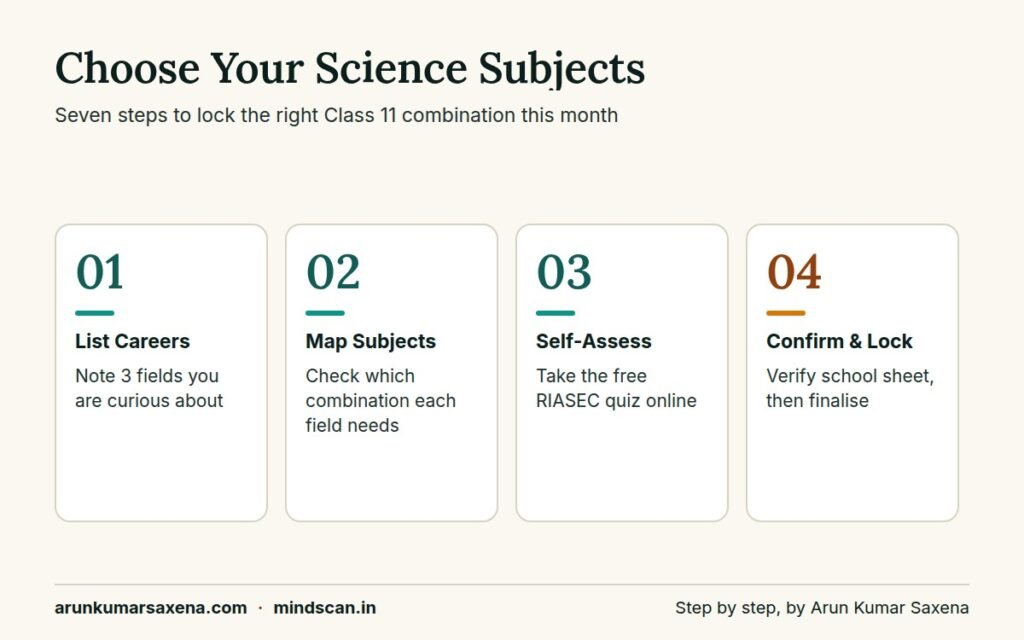
How should you actually choose your 11th class science subjects? A step-by-step plan
List your career goals, check which combination each goal demands, verify your school’s combinations, take an aptitude or personality assessment, discuss honestly with parents, and confirm the final subject sheet before the school deadline. Decisions made on data beat decisions made on panic.
Start from the career, work backwards to the combination. Use a free RIASEC quiz as a first self-check. Never let a coaching institute’s batch timing decide your subjects. Here is the full sequence.
- Write down 3 career fields you are genuinely curious about.
- Check which Class 11 combination each field officially requires.
- Get your school’s subject combination sheet and shortlist what they actually offer.
- Take the free RIASEC career personality quiz as a first self-check.
- Discuss the shortlist with parents, goals first, logistics second.
- Book one online career counselling session if you are still split between PCM and PCB.
- Lock your subjects before the school deadline and build a Term 1 study plan.
You can also explore career paths on the National Career Service portal by the Government of India.
What most guides miss: self-knowledge must come before any subject choice
Most listicles give you the 11th class science subject list and stop there. They treat the decision as a menu: pick PCM for engineering, PCB for medical, done. The real mistake is not picking the wrong combination. It is picking any combination before the student knows what she is good at and what she genuinely wants to do.
My book “3 Steps to Knowing Yourself” is built on one principle: self-knowledge must come before any stream or subject choice. A Class 10 student who has never asked herself whether she enjoys solving abstract problems or working with living systems is not ready to choose between PCM and PCB. The 11th class science subject list is a tool. The user must be calibrated first. That is why MINDSCAN’s AI Career Clarity Report maps the student to 20+ career groups, helping families verify the science combination before admission.
“Analyse your child’s aptitude scientifically and check the scores critically before taking any decision.” (Arun Kumar Saxena)
What careers does each science combination open after Class 12?
PCMB is a Class 11 science combination that includes Physics, Chemistry, Mathematics and Biology together. The table below maps each combination to the career routes it opens.
| Combination | Career Routes After Class 12 |
|---|---|
| PCM | Engineering (B.Tech), Architecture, Data Science, Defence (NDA) |
| PCB | Medicine (MBBS via NEET), Nursing, Biotechnology, Audiology |
| PCMB | Engineering or Medicine (both exams open), Pure Sciences, Research, Allied Health |
| PCM/PCB + Elective | Actuarial Science (Economics), Psychology careers, IT roles (Computer Science) |
PCM leads to engineering, architecture, aviation, data science and defence. PCB leads to medicine, dentistry, nursing, biotechnology, audiology and allied health. Both open pure-science degrees, research and teaching. Career options after 12th science extend well beyond NEET and JEE.
Many PCB careers exist without NEET: clinical research, nutrition, forensic science, environmental science, and more. PCM students also qualify for commerce-linked roles like actuarial studies. Emerging fields reward skills, not just stream. For a detailed list of PCB paths, see career options after 12th science PCB. The 11th class science subject list opens all these doors. The key is knowing which door you want to walk through before you pick the key.
Frequently asked questions about 11th class science subject
Is 74% good in Class 11?
74 percent is below the typical topper benchmark in Class 11 science but is not a verdict on ability. Class 11 marks matter less than the trend: identify weak chapters now, build a revision system, and Class 12 performance can improve sharply with focused effort. Many students cross 90 percent in Class 12 after a modest Class 11 score.
How many subjects are in PCMB Class 11? (Can I take both Maths and Biology?)
Yes, most boards and many schools allow PCMB with 6 subjects. It keeps both medical and engineering doors open, but doubles the study load. Take it only if you genuinely perform well in both Maths and Biology, not out of fear of closing options. An honest self-check of your marks and interest in both subjects tells you if PCMB is wise.
What subjects are offered in the CBSE 11th science section?
The CBSE 11th science section offers Physics and Chemistry as compulsory subjects, plus Mathematics or Biology (or both), a compulsory language such as English, and one or more electives like Computer Science, Physical Education, Economics or Psychology. The exact 11th class science subject list depends on what your school offers, so confirm the combination sheet before admission. The official CBSE curriculum page lists the prescribed Class 11 science subjects and electives.
Which board is best for Class 11 science, CBSE or state board?
CBSE aligns closely with NEET and JEE syllabi, making it convenient for competitive exams; state boards like Maharashtra HSC follow their own structure. The better choice depends on your exam targets, school quality and language of instruction, not the board name alone. Check the syllabus overlap with your target entrance exam before deciding.
Can I change subjects in Class 11 after admission?
Most schools allow a subject change within the first few weeks to a couple of months, subject to seat availability and board rules. Decide quickly: the longer you wait, the more syllabus you miss in the new subject, so verify change deadlines at admission time. Do not assume you can switch from PCB to PCM in October. Board-specific change rules are published on the official CBSE website, and state boards publish equivalents on their own portals.
What is the 6th subject in Class 11 science?
The 6th subject is usually optional and chosen from Computer Science, Informatics Practices, Physical Education, Economics, Psychology, Environmental Studies, Fine Arts or an additional language. Many students pick Physical Education or Computer Science for scoring balance with the core 11th class science subject list, but the best pick always ties back to the career goal. The CBSE secondary curriculum document names the approved 6th-subject options.
When should career counselling start for choosing Class 11 subjects?
Ideally from Class 8 onwards, so there is time to explore interests before stream selection. But even in the admission window after Class 10 results, one structured session with psychometric assessment can prevent an expensive wrong combination. The 11th class science subject list demands a decision; counselling makes sure it is the right one.
How many hours of study does PCMB need in Class 11?
PCMB needs approximately two to three focused hours of self-study each day beyond school hours. It doubles the syllabus load with both Maths and Biology, so consistency matters more than total hours. A steady daily routine beats weekend cramming, and an aptitude check helps confirm you can sustain the pace.
हिंदी में जवाब: 11वीं कक्षा के विज्ञान विषय: PCM, PCB और सही विकल्प कैसे चुनें
10वीं के बाद 11वीं में कौन-कौन से विषय होते हैं?
11वीं कक्षा के विज्ञान विषयों में भौतिकी, रसायन विज्ञान, और गणित (PCM) या जीवविज्ञान (PCB), या दोनों (PCMB), साथ ही एक अनिवार्य भाषा (आमतौर पर अंग्रेज़ी) और एक वैकल्पिक विषय जैसे कंप्यूटर विज्ञान, शारीरिक शिक्षा, अर्थशास्त्र या मनोविज्ञान शामिल होते हैं। स्कूल के अनुसार कुल लगभग 5 या 6 विषय होते हैं।
विज्ञान में सबसे अच्छी नौकरी कौन सी है?
विज्ञान में सबसे अच्छी नौकरी उस छात्र की रुचि और योग्यता पर निर्भर करती है, किसी एक सूची पर नहीं। PCM से इंजीनियरिंग, डेटा साइंस और रक्षा क्षेत्र में अच्छे अवसर हैं; PCB से चिकित्सा, जैव प्रौद्योगिकी और संबद्ध स्वास्थ्य क्षेत्रों में। अरुण कुमार सक्सेना सलाह देते हैं कि नौकरी का चुनाव पहले अपनी योग्यता की वैज्ञानिक जाँच के आधार पर करें, न कि कोचिंग संस्थानों के प्रभाव में।
The 11th class science subject list is the same for everyone. The right combination is not. If your child is standing at the PCM vs PCB crossroads and the decision still feels like a guess, one structured session can replace months of confusion with a clear, data-backed answer. Book online career counselling in India with Arun Kumar Saxena and get the MINDSCAN AI Career Clarity Report (₹1,499) or the report with a counselling session (₹2,999) at mindscan.in/psychometric-assessment. The subjects will wait. A wrong combination will cost. Get the clarity first.
Learn more about Arun Kumar Saxena and the MINDSCAN approach to career decisions built on self-knowledge, not hype.