
How to Become a Forensic Scientist After 12th in India
By Arun Kumar Saxena, Certified Advanced Career Coach · Updated November 2026
Quick answer: To learn how to become a forensic scientist after 12th, complete Class 12 with Physics, Chemistry and Biology or Maths, clear an entrance exam like NFAT, AIFSET or CUET, and earn a B.Sc. in Forensic Science. An M.Sc. is needed for senior roles. Verify your fit with a psychometric test before committing.
A forensic scientist is a specialist who analyses physical evidence from crime scenes and presents findings in court. Are you searching for a clear, step-by-step path on how to become a forensic scientist after 12th? You are in the right place. This page answers every real question a Class 12 student or parent asks, from the exact stream and entrance exams to salary, difficulty and whether AI will take the jobs. I have cut through the generic course lists to give you data-verified guidance and honest reality-checks.
With 22 years of experience and 20,000+ students and professionals guided, I have seen too many students pick forensic science from TV crime dramas, only to struggle later. My name is Arun Kumar Saxena, and I am a Certified Advanced Career Coach and the founder of MINDSCAN Career Guidance. My aim here is simple: give you the facts, the framework to check your own fit, and a clear decision path so you can move forward with confidence on how to become a forensic scientist after 12th.
Table of Contents
How to become a forensic scientist after 12th step by step?
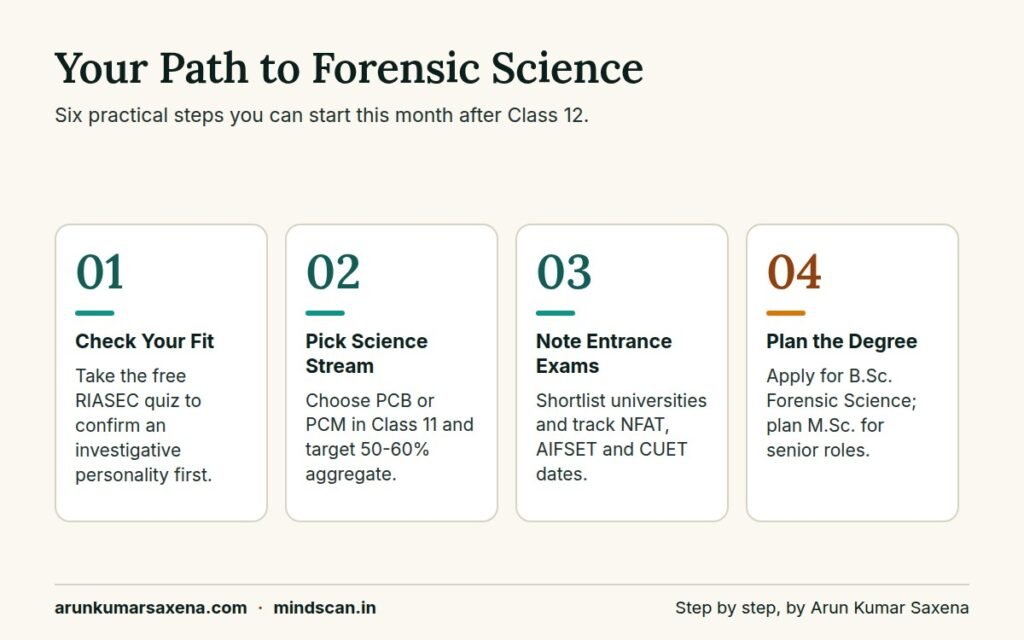
The direct path on how to become a forensic scientist after 12th begins with the science stream and moves through an entrance exam, a B.Sc. degree, and then an M.Sc. for senior roles. Follow the seven steps below to build your roadmap without confusion.
- In Class 11-12, take the science stream with PCB or PCM and aim for approximately 50-60% aggregate.
- Take the free RIASEC career personality quiz this week to confirm an investigative, detail-oriented fit.
- Shortlist approximately 5-7 universities offering B.Sc. Forensic Science and note their entrance exams: NFAT, AIFSET or CUET.
- Check application windows and entrance dates now; do not wait for results before preparing.
- Prepare for the entrance exam with past patterns in science fundamentals and general aptitude.
- Apply, and in parallel research M.Sc. specialisations (toxicology, DNA analysis, digital forensics) for later.
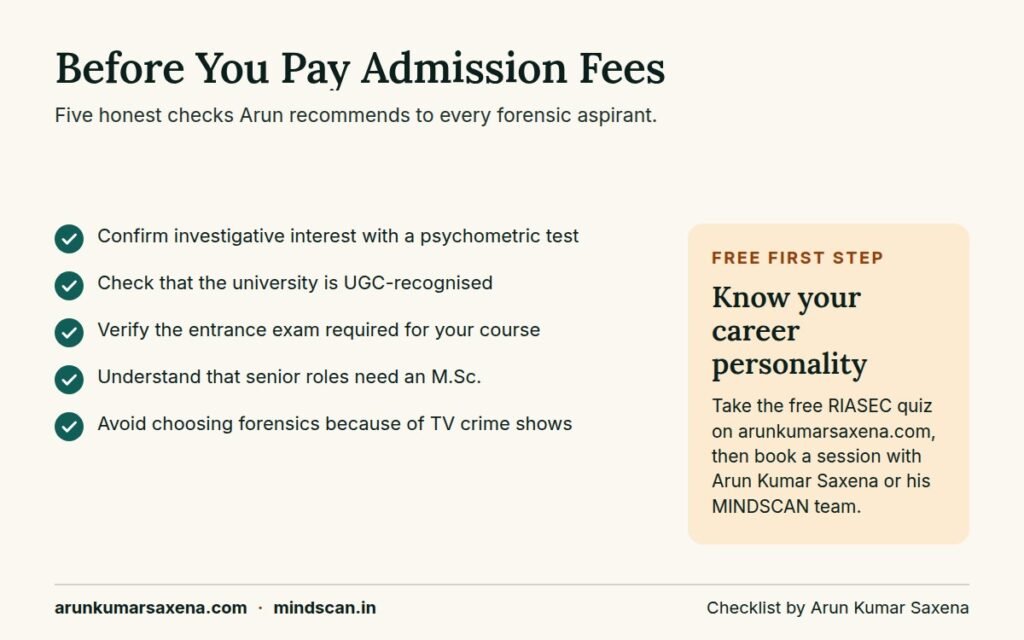
- If still unsure about fit after the quiz, book a psychometric assessment with counselling before paying admission fees.
Most universities ask for Physics, Chemistry and Biology or Mathematics in Class 12. The exact aggregate requirement varies, but approximately 50-60% is a safe target as per online sources. Entrance exams you must track are NFAT (for NFSU), AIFSET and CUET. A 3-year B.Sc. qualifies you for junior lab assistant roles. Senior scientific officer posts in government labs almost always need an M.Sc. Internships at forensic science laboratories during your degree make a real difference to your first job prospects. Start looking for internship opportunities by your second year.
Picture a Class 12 student who has just received board results and is now scrambling to understand entrance exam dates. Many families wait for results before they even begin researching how to become a forensic scientist after 12th. That delay costs them preparation time and often a seat at a preferred institution. Start your shortlisting and application tracking in the middle of Class 12 itself.
The entrance exam picture for forensic science is not as crowded as NEET or JEE, but NFSU seats through NFAT are competitive. Treat the entrance exam with the seriousness it deserves, and do not assume merit-based admission is a guaranteed fallback.
Entrance exams for forensic science after 12th at a glance
| Exam | Conducting Body | What It Tests |
|---|---|---|
| NFAT | National Forensic Sciences University | Science fundamentals and general aptitude |
| AIFSET | Varies by participating institute | Physics, Chemistry, Biology/Maths and logical reasoning |
| CUET | National Testing Agency | Domain-specific science subjects and general test |
Which course is best for forensic science after 12th?
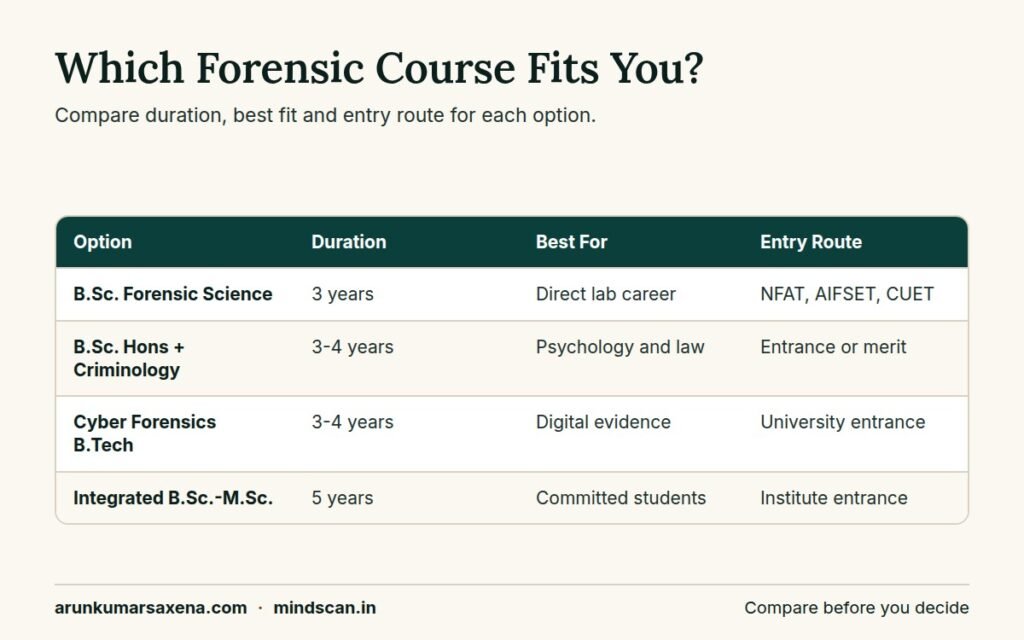
A B.Sc. in Forensic Science is the most direct and popular course to become a forensic scientist after 12th. Alternatives include a B.Sc. Hons in Forensic Science and Criminology, a B.Sc. or B.Tech in Cyber Forensics, and a 5-year integrated B.Sc.-M.Sc. programme. Your best choice depends on your specialisation interest, not on college marketing.
A B.Sc. in Forensic Science covers toxicology, DNA profiling, ballistics and crime scene investigation. If digital evidence and cybercrime pull you more strongly, a cyber forensics degree is the sharper fit. An integrated B.Sc.-M.Sc. saves a year and suits students who are certain about forensics early. Choose by the daily work you want to do, not by the course title that sounds most impressive. Many students ask me which course is best for forensic science after 12th, and my answer always starts with a question: what kind of evidence do you want to handle every day?
What are the fees for a B.Sc. in forensic science in India?
Fees for a B.Sc. in Forensic Science vary widely. Government universities charge a lower annual fee, while private institutions charge a higher fee, as per online sources. The total course cost can differ by several lakh rupees between a state university and a private college. Check individual university pages for exact figures before shortlisting. If the cost of a full degree worries you, some students also explore short-term technical options first and compare iti courses name to build practical skills alongside their plans.
What most guides miss: verify your interest in lab work before enrolling
Many students pick forensic science after 12th because crime dramas make it look fast and glamorous. In my sessions, I see a pattern: students who enjoy the idea of solving crimes but dislike routine lab documentation often struggle deeply by the second semester. Real forensic work is methodical and repetitive. One sample may need hours of preparation and careful notes that a lawyer will scrutinise in court.
Before you pay admission fees, test your genuine comfort with detail-oriented lab work. The MINDSCAN report maps a student to 20+ career groups, letting you compare forensic science against neighbouring science careers on data, not drama. This honest comparison prevents expensive mid-degree switches. A common mistake is assuming that interest in crime stories equals interest in forensic lab work. They are different things, and a psychometric assessment separates the two clearly. Ask yourself these questions honestly:
- You enjoy routine lab documentation and writing detailed notes.
- You are comfortable with repetitive precision work for hours.
- You can write reports a lawyer will scrutinise in court.
- You value accuracy over speed in every task.
- You are patient when a single sample needs multiple tests.
| Option | Duration | Best For | Entry Route |
|---|---|---|---|
| B.Sc. Forensic Science | 3 years | Most direct lab career route | NFAT, AIFSET, CUET or merit |
| B.Sc. Hons Forensic Science and Criminology | 3-4 years | Forensics plus psychology and law | NFAT, AIFSET, CUET or merit |
| B.Sc./B.Tech Cyber Forensics | 3-4 years | Digital evidence and cybercrime | University entrance or merit |
| Integrated B.Sc.-M.Sc. (NFSU-type) | 5 years | Students certain of forensics early | Institute entrance such as NFAT |
Does forensic science need NEET?
No, you do not need NEET to become a forensic scientist after 12th. Admission to forensic science courses is through university entrance exams like NFAT, AIFSET or CUET, or through merit-based selection on Class 12 marks. The confusion is common because forensic science sits beside medicine in many student searches.
Only the forensic pathology or forensic medicine route requires an MBBS first, and therefore NEET. Forensic scientist lab roles, the path most students follow, do not need any medical entrance exam. If you are aiming for lab-based forensic work, your focus should be on the science entrance exams listed above, not on NEET preparation. Every year I meet students who have spent months preparing for NEET only to discover that their real interest lies in forensic science, a field that does not require that exam at all.
How can I join CBI or CID forensic after 12th?
You cannot join the CBI or CID as a forensic expert directly after 12th. First complete your forensic science degree, then enter through government recruitment routes such as SSC or state-level forensic science laboratory vacancies. For officer-level investigation roles, the path is typically through UPSC Civil Services or SSC CGL.
Forensic experts usually join investigation agencies after gaining experience in a Forensic Science Laboratory. Agencies hire experienced specialists for case support. If your goal is CBI forensic work, plan for a B.Sc., then an M.Sc., then a few years of lab experience before targeting recruitment notifications. Check the National Career Service portal for government forensic lab vacancies for current openings and career pathways.
Is forensic science hard to study?
Forensic science is moderately demanding. It needs strong fundamentals in chemistry and biology, attention to detail, and comfort with lab work and report writing. It is not harder than other science degrees, but it demands precision because conclusions carry legal weight.
Subjects include chemistry, biology, law basics and lab techniques. Work quality is scrutinised in courts, so accuracy is non-negotiable. Students who dislike routine lab documentation often struggle, even if they enjoy the science itself. If you are someone who rushes through practical files, forensic science will challenge that habit directly. The question of how to become a forensic scientist after 12th is not just about clearing exams; it is about whether you can sustain the daily discipline of meticulous lab work for years.
What is the salary of a forensic scientist in India?
Fresher forensic scientists earn a modest starting pay, typically around ₹3-5 lakh per year approximately, as per online estimates. Government lab and senior officer roles pay more. Salaries rise sharply with an M.Sc., a specialisation, and experience.
Junior lab assistant roles sit at the lower end of the range.
M.Sc. specialisations like DNA analysis and digital forensics command better pay.
Government posts offer stability and structured pay scales, while private labs may offer faster growth for specialists.
Every salary figure you see online is an estimate; actual pay depends on the employer, city and your qualification level. The National Career Service portal lists official pay-scale information for government forensic science positions.
Forensic scientist salary by level in India
| Level | Typical Qualification | Approximate Annual Salary (INR) |
|---|---|---|
| Junior Lab Assistant / Fresher | B.Sc. Forensic Science | ₹3-5 lakh |
| Forensic Specialist | M.Sc. with specialisation | ₹6-10 lakh |
| Senior Scientific Officer | M.Sc. plus experience | ₹12 lakh and above |
B.Sc. Forensic Science vs B.Sc.-M.Sc. integrated: which should you choose?
The 3-year B.Sc. keeps options open and costs less. The 5-year integrated B.Sc.-M.Sc. suits students already committed to forensics as a long-term career. Choose by certainty of interest and financial readiness.
A standalone B.Sc. alone limits senior lab roles; an M.Sc. is heavily preferred for career growth. Only forensic-specialised institutions like NFSU offer integrated programmes. If you are still exploring career options after 12th science PCB, the 3-year B.Sc. gives you more flexibility. If you have already researched deeply and know forensics is your path, the integrated route saves a year and gives you a head start on specialisation.
The decision on how to become a forensic scientist after 12th often narrows down to this one choice, and it is worth a long conversation with a career coach if you feel stuck.
Will AI replace forensic science careers?
AI will not replace forensic science careers. AI speeds up pattern analysis and digital evidence processing, but court testimony, crime scene judgment and chain-of-custody responsibility stay human. Forensic science is comparatively AI-resistant, though digital skills will boost employability.
Courts require expert witnesses with accountability. AI assists with image and pattern matching, not final conclusions. Cyber forensics demand is growing alongside AI adoption, so building digital investigation skills makes you more valuable, not less. The human judgment in a forensic report is what a court cross-examines; a machine cannot take that stand. When students ask me how to become a forensic scientist after 12th in an AI-driven world, I tell them that the field needs people who can interpret AI outputs and defend findings in court, not people who fear the technology.
| Task | Human or AI |
|---|---|
| Crime scene judgment | Human |
| Pattern matching | AI assists |
| Court testimony | Human |
| Chain-of-custody | Human |
How do you know forensic science is the right career for you?
Forensic science is the right career for you if you enjoy detail-oriented lab work, have patience for repetitive documentation, and care deeply about accuracy under legal scrutiny. Check your interests scientifically, not emotionally. Many students pick forensics from TV crime dramas, not real interest.
My approach uses a psychometric assessment to reveal whether investigative and detail-oriented traits dominate. Self-knowledge before course choice prevents expensive mid-degree switches.
“Analyse your child’s aptitude scientifically and check the scores critically before taking any decision.” (Arun Kumar Saxena)
Start with the free RIASEC career personality quiz as your zero-cost first step this month. If the result conflicts with your plan, book a session for deeper clarity. My book ‘3 Steps to Knowing Yourself’ teaches that self-knowledge must come before any career choice. Apply that message here: verify your interest in lab work and legal accuracy before enrolling. For a broader view of how to choose the right career after 12th, read my detailed guide.
If you are exploring careers after 12th science without NEET or JEE, forensic science is one strong option among many. Understanding how to become a forensic scientist after 12th is only half the task; confirming that it matches your natural strengths is the other half. Learn more about my approach on the profile page of Arun Kumar Saxena.
Frequently asked questions about how to become a forensic scientist after 12th
Can I do forensic science after 12th without maths?
Yes. PCB students are accepted by most forensic science programmes. Maths is only essential for cyber forensics and some B.Tech routes. Always check each university’s subject requirement before applying, because a few institutions may still ask for Mathematics as a compulsory subject.
What is the NFAT exam for forensic science?
NFAT is the National Forensic Admission Test for NFSU undergraduate programmes. It tests science fundamentals and general aptitude. Students should prepare from their Class 12 science content. NFSU is a premier institution, so competition is high; start preparation early.
Can commerce or arts students become forensic scientists?
Directly after 12th, no. Forensic science B.Sc. programmes require the science stream. A rare indirect route exists later through law-adjacent or cybercrime roles, but the standard path to become a forensic scientist after 12th demands PCB or PCM in Class 12.
What skills does a forensic scientist need beyond a degree?
Attention to detail, report writing, patience, courtroom communication, ethical integrity and comfort with chain-of-custody procedures. Documentation quality decides case outcomes. If your report has a gap, a lawyer will find it. Precision is the skill that separates good forensic scientists from average ones.
Is a certificate course in forensic science after 12th worth it?
A short certificate can build early familiarity, but it cannot replace a B.Sc. for jobs. Treat it as a taster. Use a psychometric quiz first to confirm interest before spending on certificates. The real qualification employers look for is a full degree.
Should I take a drop year to prepare for forensic science entrance exams?
Rarely necessary. Merit-based and multiple exam routes (NFAT, AIFSET, CUET) mean most students secure a seat in the admission year itself. A drop only makes sense if you are targeting one specific elite institution and your score gap is narrow and closing.
How long does it take to become a forensic scientist after 12th?
It takes approximately 3 years to earn a B.Sc. in Forensic Science, which qualifies you for junior lab roles. For senior scientific officer positions, you need an M.Sc., adding another 2 years. A 5-year integrated B.Sc.-M.Sc. programme offers the fastest route to senior-level eligibility.
हिंदी में जवाब: 12वीं के बाद फोरेंसिक साइंटिस्ट कैसे बनें: आपके सवालों के जवाब
12 वीं के बाद सबसे अच्छा कोर्स कौन सा है?
12वीं के बाद सबसे अच्छा कोर्स वह है जो आपकी रुचि और योग्यता से मेल खाता हो। फोरेंसिक साइंस में B.Sc. एक सीधा रास्ता है, लेकिन अरुण कुमार सक्सेना और MINDSCAN करियर गाइडेंस सलाह देते हैं कि कोई भी कोर्स चुनने से पहले साइकोमेट्रिक टेस्ट से अपनी फिट जांच लें। इससे महंगी गलतियों से बचा जा सकता है। अगला कदम: मुफ्त RIASEC करियर क्विज़ से अपनी रुचि की जांच करें।
Science में सबसे अच्छी नौकरी कौन सी है?
साइंस में सबसे अच्छी नौकरी वह है जो आपको संतुष्टि और विकास दे। फोरेंसिक साइंटिस्ट की नौकरी स्थिरता और सम्मान देती है, खासकर सरकारी प्रयोगशालाओं में। शुरुआती वेतन लगभग 3-5 लाख रुपये सालाना होता है, जो M.Sc. और अनुभव के साथ बढ़ता है। अगला कदम: ऑनलाइन करियर काउंसलिंग के लिए अभी बुक करें।
कौन सी पढ़ाई ज्यादा सैलरी देती है?
फोरेंसिक साइंस में M.Sc. और डिजिटल फोरेंसिक जैसी स्पेशलाइजेशन ज्यादा सैलरी देती हैं। सीनियर साइंटिफिक ऑफिसर के पदों पर वेतन अच्छा होता है। अरुण कुमार सक्सेना बताते हैं कि सही स्पेशलाइजेशन चुनने के लिए पहले अपनी रुचि की वैज्ञानिक जांच जरूरी है। अगला कदम: MINDSCAN साइकोमेट्रिक असेसमेंट से अपनी सही स्पेशलाइजेशन पहचानें।
You now have the complete roadmap on how to become a forensic scientist after 12th, from the exact stream and entrance exams to the honest reality of lab work and salaries. The next step is to check your personal fit before you commit years and fees to a degree. Start with the free RIASEC quiz, and if you need deeper clarity, my MINDSCAN team and I are here to help with a psychometric assessment and a one-on-one counselling session.
Book your online career counselling in India session today. You can also get the MINDSCAN AI Career Clarity Report at ₹1,499, or the report with a counselling session at ₹2,999, directly on the MINDSCAN psychometric assessment page. Your career decision deserves data, not drama. Let us find your clearest path together.