
Science Fields After 10th: Every Option Explained Honestly
By Arun Kumar Saxena, Certified Advanced Career Coach · Updated November 2026
Quick answer: The main science fields after 10th are PCM, PCB, and PCMB, plus electives like Computer Science or Psychology. PCM leads to engineering and technology, PCB to medicine and life sciences, and PCMB keeps both doors open. I advise choosing the field your aptitude and verified interests point to, not the one coaching institutes push hardest.
The decision about science fields after 10th is the first career fork that actually counts. You are choosing not just four Class 11 subjects but the next six to ten years of your life: the entrance exams you will sit for, the degree you will chase, and the professional identity you will build.
This page lays out every science field after 10th, the careers each one feeds, and a practical way to decide which one fits you. It is written for Class 10 students, worried parents, and anyone tired of coaching-centre sales pitches that start with “the best field” and never mention the student.
With 22 years of experience and 20,000+ students and professionals guided, I have sat across the table from thousands of families at exactly this crossroads. The pattern is always the same: the child is confused, the parents are anxious, and the relatives have plenty of free advice. By the time you finish reading, you will know the real differences between PCM, PCB and PCMB, which careers each group unlocks, and how to make a decision that does not need a U-turn two years later.
Table of Contents
What are the science fields after 10th (PCM, PCB, PCMB and beyond)?
Physics and Chemistry are compulsory, and the third subject defines the group: Mathematics creates PCM, Biology creates PCB, and taking both creates PCMB. English is mandatory, and most schools require one additional elective. The elective shapes your skill base and career options, so treat it as a fourth subject decision, not an afterthought.
Electives vary by board and school, and they matter more than families realise. A student who picks Computer Science alongside PCM builds a different skill base from one who picks Economics or Psychology. Check the elective list with your target school before locking any combination.
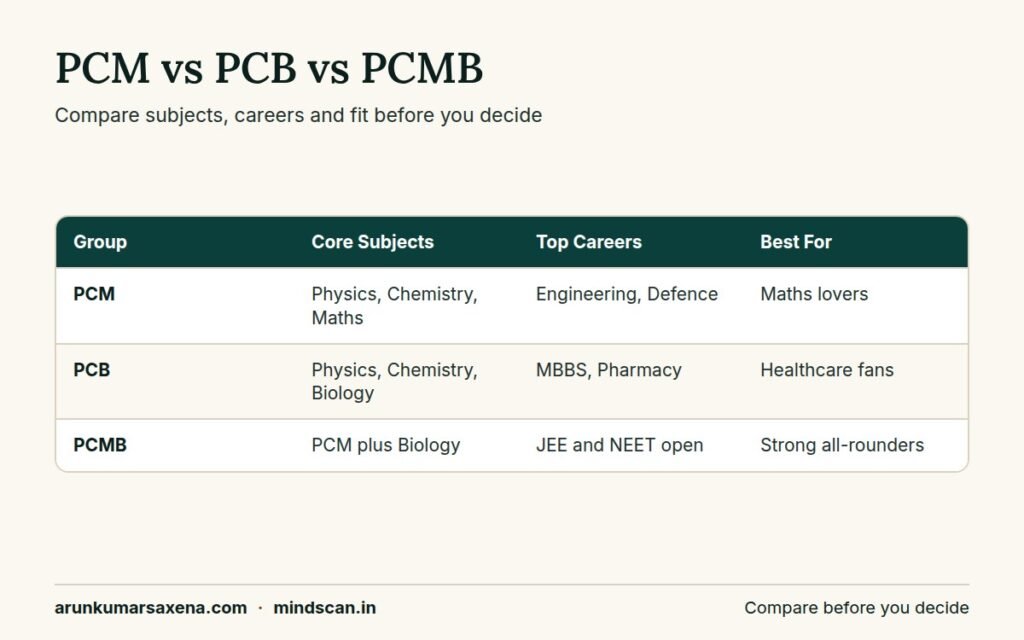
- PCM (Non-Medical): Physics, Chemistry, Mathematics plus an elective. This group suits engineering, architecture, defence, data science and pure sciences.
- PCB (Medical): Physics, Chemistry, Biology plus an elective. This group suits medicine, pharmacy, nursing, agriculture and life sciences.
- PCMB (Both): Physics, Chemistry, Mathematics and Biology. This group keeps both NEET and JEE routes open but carries the heaviest workload of all science fields after 10th.
- Elective subjects: Common choices include Computer Science, Informatics Practices, Psychology, Economics, Biotechnology, Physical Education and Home Science.
Across India, CBSE, ICSE and most state boards offer these combinations, though the exact elective menu differs. The 11th class science subject list with PCM and PCB combinations breaks down board-wise options in detail. For an official overview, the National Career Service portal by the Ministry of Labour and Employment lists career pathways linked to each science group.
Which field is best in science after 10th for me?
The best science field after 10th is the one that matches your interests, your aptitude and the career family you actually want, verified by an assessment before you commit two years to it. There is no universal best. Start from the career, work backwards to the stream, and test your assumption with data.
Picture a Class 10 student who loves tinkering with gadgets and solving Maths puzzles. PCM is a natural fit. Now picture a student who is fascinated by how the human body works and spends hours watching surgery videos. PCB is the obvious direction. The problem arises when a student has no strong pull towards either and the family defaults to “science because it keeps options open.” That is not a decision. It is a postponement that often backfires.
Ask yourself: what do you want your typical Tuesday morning to look like ten years from now? A student who describes a hospital ward needs PCB. A student who describes a design lab or a coding terminal needs PCM. A student who cannot describe anything specific needs an assessment, not a stream choice.
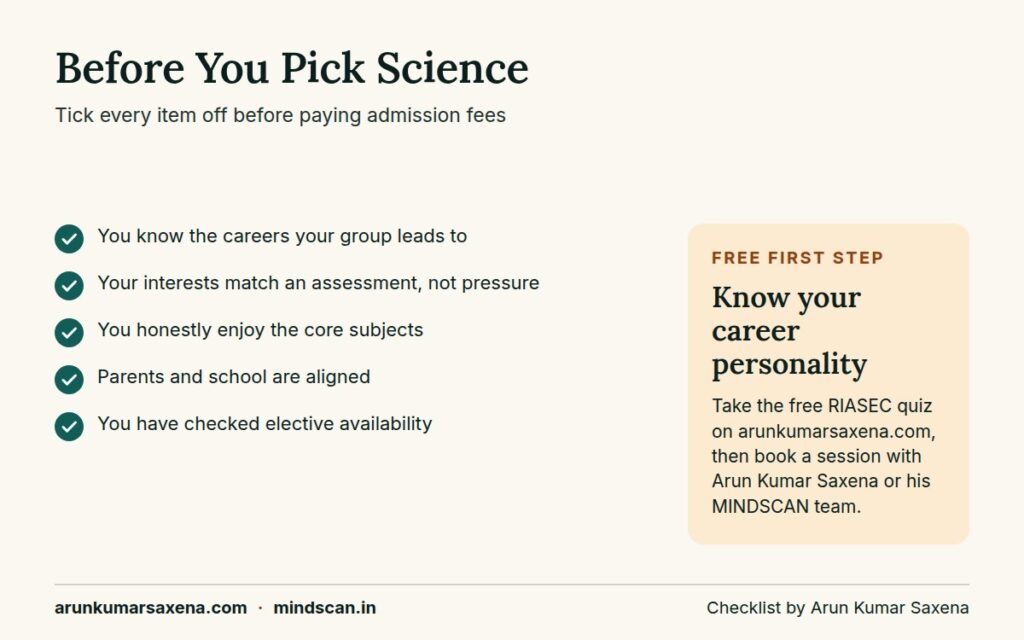
Here is a simple self-check before you proceed. Ask yourself three questions. One: when you struggle with a subject, do you still want to understand it, or do you want to escape it? Two: if nobody were watching, which career would you Google at 2 a.m.? Three: are you choosing this field because you want the career at the end of it, or because a relative, neighbour or topper chose it? The third question alone has redirected more students than any aptitude test I have administered.
What most guides miss: the career-first, stream-second sequence
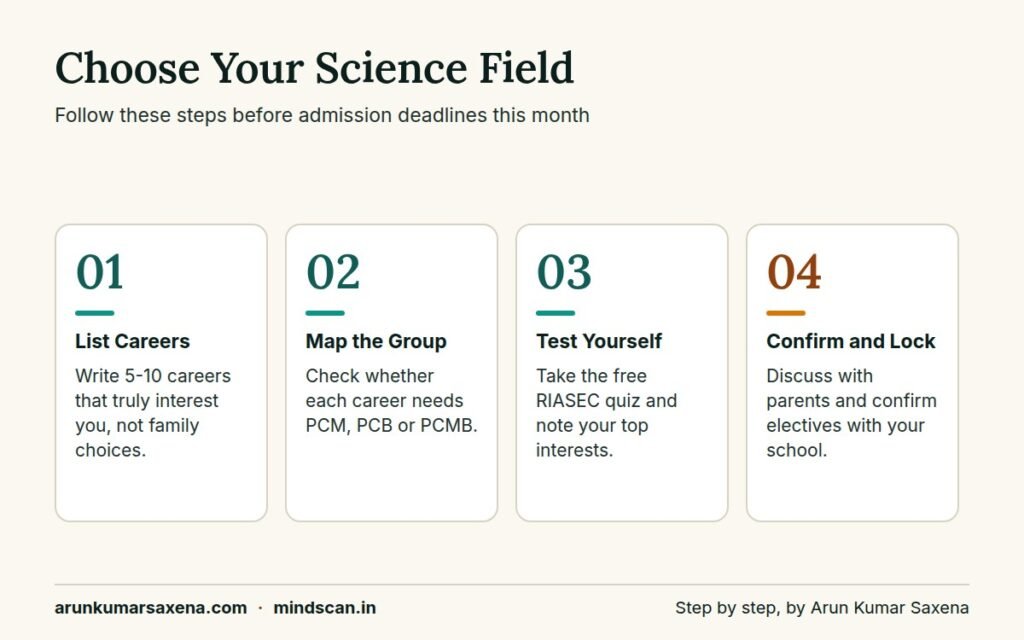
Most websites list subjects and careers, but they skip the sequence. The right order is career first, stream second. Write down five to ten careers that genuinely interest you. Not your parents’ list, not your tuition teacher’s list, yours. Then check which science group each career actually requires. You will find that many careers you assumed needed PCM actually accept PCB with Mathematics as an elective, and some careers you thought were pure PCB have data-science offshoots that need strong Maths. This simple exercise clears more confusion than hours of Googling “best field in science after 10th with high salary.”
Once you have that career shortlist, test it. The free RIASEC career personality quiz takes about ten minutes and shows which interest themes drive you. If your career list says surgeon but your RIASEC profile says artistic and enterprising with low investigative, pause and dig deeper. That gap is trying to tell you something.
My book ‘3 Steps to Knowing Yourself’ argues that self-knowledge must come before any stream or career choice. Most families do it backwards and pay for it with two wasted years.
What careers does the PCM (non-medical) field lead to?
PCM opens engineering, architecture, defence, data science, pure sciences and aviation careers. The best-known route is engineering through JEE, but it is far from the only one. BSc in Physics, Mathematics, Statistics or Data Science leads to research and analytics. NDA offers a prestigious non-engineering path. Architecture needs NATA, not JEE.
The career spread is wider than most Class 10 students realise. Beyond the BTech corridor, PCM students build careers in quantitative finance, actuarial science, geoinformatics, meteorology, merchant navy and commercial pilot training. The common thread is comfort with mathematical reasoning. If you enjoy breaking down a problem into logical steps, the PCM career family has room for you.
- Engineering (BTech/BE): Computer Science, Mechanical, Civil, Electrical, Aerospace, Chemical and AI/ML branches through JEE Main and Advanced, plus state-level and private university entrance exams.
- Architecture (BArch): Requires Mathematics in Class 12 plus the NATA exam. A five-year degree blending design, structures and urban planning.
- Defence (NDA, 10+2 Tech Entry): PCM students can appear for the NDA written exam and SSB interview for Army, Navy and Air Force officer roles.
- Pure Sciences (BSc): Physics, Chemistry, Mathematics, Statistics and Data Science honours degrees from central and state universities, feeding into research, academia and analytics roles.
- Computer Applications (BCA): A three-year degree for students who want a software career without the engineering route. Some universities admit students without Mathematics, but strong Maths helps.
- Aviation (Commercial Pilot, Aircraft Maintenance): Requires Physics and Mathematics in Class 12. Pilot training is costly and regulated by DGCA, but the career demand is real.
Many PCM careers do not need a JEE rank at all. If the engineering entrance rat race feels suffocating, look at BSc Data Science, BCA, NDA or the merchant navy. The Vikaspedia’s official career options after 10th guide lists several of these less-hyped PCM pathways with government-recognised course details.
What careers does the PCB (medical) field lead to?
PCB leads to MBBS, BDS, BAMS, BHMS, BPharm, BSc Nursing, physiotherapy, biotechnology, forensic science, veterinary science and dozens of allied health careers. The doctor dream dominates every PCB discussion, but the reality is that only a fraction of NEET aspirants secure an MBBS seat each year. The rest need solid Plan B options, and PCB provides many.
Allied health is the most underrated PCB career cluster in Indian households. Roles in audiology, speech therapy, occupational therapy, medical lab technology, radiology and nutrition are stable, respected and in steady demand. They do not require a top NEET rank, and they lead to jobs in hospitals, diagnostic chains, rehabilitation centres and public health programmes.
In many homes, a PCB student with two NEET attempts and a large score gap faces a family still saying “one more drop.” The gap is not narrowing. The student is exhausted. The parents are financing another year of coaching with EMI. At this point, the question is not “how to crack NEET” but “which PCB career fits this student’s actual aptitude.”
“Look at the gap between the marks obtained and the marks needed to get a seat. If the gap is big and not narrowing, I suggest switching to other fields.” (Arun Kumar Saxena)
“One NEET aspirant who could not make it in her last two attempts reached out to me in a gloomy state. Her parents were equally worried and sad. When I examined her last two scores, I found the gap to fill was huge. There was a big gap between expectation and reality. I conducted a psychometric assessment for her, and it confirmed my apprehension: she wasn’t the right fit for medicine.
When I grilled her a little about where her inspiration for medicine came from, I found that she admired her aunt, who is a doctor, and therefore wanted to become one too. After two rounds of consultation, she herself realised that clearing NEET was demanding much more than she could offer. Today she is happily doing a B.Sc. in Biotechnology, with career clarity and a roadmap.” (Arun Kumar Saxena)
This pattern repeats across hundreds of PCB families every year. The aspiration is borrowed, not owned. The assessment reveals the mismatch, and the student finally exhales. For a full list of what PCB can lead to beyond the stethoscope, see the career options after 12th science PCB page.
- Medicine (MBBS, BDS, BAMS, BHMS): Through NEET-UG. MBBS and BDS are the most competitive. AYUSH courses (BAMS, BHMS, BUMS) have lower cut-offs but require genuine interest in the system.
- Pharmacy (BPharm, DPharm): A four-year degree and two-year diploma respectively. Careers in pharmaceutical companies, hospital pharmacies, regulatory affairs and clinical research.
- Nursing (BSc Nursing, GNM): High demand in India and abroad. BSc Nursing is a four-year degree; General Nursing and Midwifery is a three-year diploma.
- Allied Health (Physiotherapy, Audiology, Medical Lab Technology, Radiology, Nutrition): Bachelor’s degrees of three to four years. Steady demand, lower entry barriers than MBBS, and clear career progression.
- Biotechnology and Forensic Science: Three-year BSc programmes. Lab-based careers in research, quality control, crime investigation and pharmaceuticals. No NEET score needed for most colleges.
- Veterinary Science (BVSc & AH): A separate entrance path through NEET-UG or state-level veterinary exams. Treating animals, livestock management and public health roles.
PCM vs PCB vs PCMB: which science group should you choose?
PCM fits Maths-comfortable students targeting engineering or technology careers. PCB fits biology-driven students targeting healthcare or life sciences. PCMB keeps both entrance exams open but doubles the study load. Choose PCMB only if you are genuinely strong in both Maths and Biology and can handle the heaviest academic schedule among all science fields after 10th.
Families often treat PCMB as an insurance policy: “If NEET does not work, JEE is still there.” The logic sounds appealing at the dinner table but breaks down in the classroom. A PCMB student attends Maths and Biology classes while PCM and PCB students get free periods or lighter electives. The syllabus volume is not double; it is closer to approximately 2.5 times when you factor in practicals, projects and entrance-exam preparation for both tracks.
Before you choose, run this honesty check. Look at your last two years of Maths and Science marks. If your Maths average is below approximately 60% and you are choosing PCMB “just in case,” you are setting yourself up for two years of catch-up that rarely ends well. PCMB works for the student who scores above approximately 80% in both Maths and Biology and genuinely enjoys both. For everyone else, it is a gamble.
| Option | Core Subjects | Top Careers | Best For |
|---|---|---|---|
| PCM (Non-Medical) | Physics, Chemistry, Maths | Engineering, Architecture, Defence, Data Science | Students strong in Maths and technology |
| PCB (Medical) | Physics, Chemistry, Biology | MBBS, Pharmacy, Nursing, Biotechnology | Students drawn to healthcare and life sciences |
| PCMB (Both) | Physics, Chemistry, Maths, Biology | Keeps JEE and NEET both open | Strong all-rounders ready for the heaviest load |
The table above gives you the snapshot. Now add the human layer. A PCM student with a passion for robotics will thrive. A PCB student who faints at the sight of blood needs a rethink. A PCMB student who averages approximately 55% in Maths and approximately 60% in Biology is carrying a load that the marksheet already warns against. The group you choose must match the student you are, not the student your family hopes you will become.
Is science the best stream after 10th, or should I look at commerce or arts?
Science is the best stream after 10th only if your target careers genuinely need it. For careers in law, management, design, humanities, finance or entrepreneurship, commerce or arts may serve you better and with far less stress. Stream prestige is not a career strategy.
The Indian middle-class default is “science first, everything else is a consolation prize.” This mindset fills PCM and PCB classrooms with students who have no interest in the subjects and no intention of pursuing science careers. They endure two years of tuition, low marks and parental disappointment, then switch to B.Com, BA or BBA after Class 12. The same destination was available with less damage through commerce or arts in Class 11.
Every stream has high-paying careers. A commerce student with a CA or CFA qualification out-earns many engineers. An arts student who builds a career in UX design, public policy or content strategy can match any tech salary. The stream does not cap your income. Your skill, network and clarity cap your income. Choosing science “to keep options open” is the single most common reason students struggle through Class 11 and 12 with no motivation. Options stay open only when you have the energy to walk through them.
If you are genuinely torn between science and commerce, take the free RIASEC quiz first. If your interest themes are enterprising and conventional with low investigative, commerce is probably a stronger fit than science. That is not a downgrade. It is a direction correction before you waste two years.
Can I take science after 10th if I am weak in Maths or my marks are average?
Yes, but choose honestly. PCB needs minimal Maths beyond Class 11. Average board marks matter less than genuine interest and willingness to work. However, entering PCM while disliking Maths is a common and costly mistake I see every counselling season. Weak Maths plus PCM is the single most frequent misfit I correct in my sessions.
Average marks in Class 10 do not disqualify you from science. Board exams test memory and presentation more than aptitude. A student with approximately 72% in Class 10 who loves Biology and asks curious questions in class is a stronger PCB candidate than a 92% student who memorised everything and celebrated the marks. Schools set their own science admission cut-offs, usually between approximately 60% and 75%, and many accept students in the 70-80% range. Check your target school’s policy, but do not let one percentage decide your self-assessment.
The real test is not the marksheet. It is this: when you sit with a Maths problem or a Biology diagram, does time pass without your noticing? Do you look for harder problems, or do you look for excuses to close the book? If the subject pulls you in, weak marks are fixable. If the subject repels you, no coaching centre can fix the mismatch.
- PCB minimises Maths dependency: After Class 11, the Maths requirement in PCB drops sharply. Allied health, nursing and biotechnology careers need almost no advanced Maths.
- Weak Maths plus PCM is a red flag: Engineering and architecture degrees are built on mathematical reasoning. Struggling through Class 12 Maths only to face another four years of it is a recipe for burnout.
- An aptitude assessment separates weak marks from wrong fit: A psychometric test shows whether low Maths scores reflect a teaching gap or an aptitude gap. The MINDSCAN report maps each student to 20+ career groups and flags mismatches before they become regrets.
- Polytechnic is a valid bypass: Students who want technical training without the Class 11-12 academic load can explore polytechnic diplomas. See what a polytechnic course after 10th involves for the full picture.
How do I decide my science field in 7 practical steps this month?
List your careers of interest, check which group each needs, take a psychometric or RIASEC assessment, discuss honestly with parents, and confirm the subject combination with your school before admission deadlines. One month is enough if you follow the sequence in order and do the self-assessment before the family discussion, not after.
Most families do this backwards. The parents announce the stream at a family gathering. The child nods. The admission form is filled. Then, two months into Class 11, the child says “I hate this.” The sequence below prevents that conversation.
- Write down five to ten careers that genuinely interest you. Not your relatives’ choices, not the careers your colony aunty approves of. Yours. If you cannot list five, start browsing career videos and reading one-page career summaries until something sparks.
- Check which science group (PCM, PCB or PCMB) each career on your list actually requires. Cross out careers that need a group you are unwilling to take. Your list will shrink, and that is the point.
- Take the free RIASEC career personality quiz and note your top interest themes. If your career list and your RIASEC profile point in opposite directions, that tension needs attention before you commit to a group.
- Discuss the shortlist with your parents honestly. Show them the careers, the required groups, and your RIASEC results. Talk about the workload of each group, not just the prestige.
- Take a full psychometric assessment if interests and aptitude still conflict. The MINDSCAN AI Career Clarity Report maps you to 20+ career groups and gives you a data-backed starting point for the family conversation.
- Confirm the exact subject combination and elective availability with your target school. Some schools offer Computer Science only with PCM; others offer Psychology only with PCB. Do not assume.
- Lock your choice and start Class 11 preparation for the relevant entrance exam early. The student who starts JEE or NEET prep in April has an approximately six-month lead over the one who starts in October.
This sequence works because it puts evidence before opinion. By the time you reach the family discussion, you are not saying “I think I want PCM.” You are saying “Here are five careers I am interested in, here is the group they need, here is my RIASEC profile that supports this direction, and here is the workload I am signing up for.” That conversation goes differently from “Take PCM, it has scope.”
Frequently asked questions about science fields after 10th
What are the subjects in science after 10th?
Physics, Chemistry and either Mathematics (PCM), Biology (PCB) or both (PCMB), plus English and usually one elective such as Computer Science, Psychology, Economics or Biotechnology. Exact electives vary by board and school, so confirm availability before admission. These subjects define all science fields after 10th across CBSE, ICSE and state boards.
Can I switch from PCB to PCM or back after Class 11?
Most boards and schools restrict subject changes after Class 11 admission, and switching mid-year is disruptive and rarely permitted. Decide carefully before admission. If you are genuinely stuck after a few months, consult your school and a career counsellor immediately rather than struggling through two years of a group you dislike.
Is PCMB a good choice after 10th?
PCMB keeps both JEE and NEET routes open, which helps genuinely undecided strong students. But it carries the heaviest workload of all science fields after 10th. Choose it only if you are confident in both Maths and Biology, not as insurance against a decision you are avoiding. For most students, picking one group fully is better than doing both halfway.
Which science field has the highest salary after 10th?
Long-term salaries depend on the career you build, not the group you pick in Class 11. Engineering, medicine, data science and research can all pay well. As per online sources, technology and specialist medical careers often top salary charts, but passion and aptitude predict success better than any salary table. Chase the fit, and the money follows.
Do I need 90% in Class 10 to take science?
No fixed percentage is universal. Schools set their own cut-offs, and many accept science students with 70 to 80 percent. Sustained interest and work ethic matter more than one board score. Be honest about whether weak marks reflect a temporary dip or a real mismatch with the science fields after 10th you are targeting.
Can I do polytechnic or diploma courses after 10th instead of Class 11 science?
Yes. Polytechnic diplomas in engineering, nursing and allied fields let students start technical training straight after Class 10. They suit hands-on learners who want earlier job readiness. The Class 11 and 12 route still keeps the widest degree options open, so weigh your learning style against long-term flexibility before deciding.
Which field is best after 10th in science?
The best field is the one that matches your verified aptitude and genuine interests, not the one with the most hype. PCM fits students drawn to technology and problem-solving. PCB fits those fascinated by living systems and healthcare. Take a psychometric assessment before deciding. A data-backed choice now prevents a painful U-turn two years later.
हिंदी में जवाब: 10वीं के बाद साइंस फील्ड: हर विकल्प की ईमानदार जानकारी
10वीं के बाद 11वीं में कौन-कौन से सब्जेक्ट होते हैं?
11वीं साइंस में फिजिक्स, केमिस्ट्री और या तो मैथ्स (PCM), बायोलॉजी (PCB) या दोनों (PCMB) होते हैं। इसके साथ इंग्लिश अनिवार्य है और एक इलेक्टिव सब्जेक्ट जैसे कंप्यूटर साइंस, साइकोलॉजी या इकोनॉमिक्स चुनना होता है। हर स्कूल के इलेक्टिव अलग हो सकते हैं, इसलिए एडमिशन से पहले स्कूल से पुष्टि कर लें।
Science में सबसे अच्छी नौकरी कौन सी है?
साइंस में सबसे अच्छी नौकरी वह है जो आपकी रुचि और योग्यता से मेल खाती है। इंजीनियरिंग, मेडिसिन, डेटा साइंस और रिसर्च सभी में ऊंची सैलरी वाली नौकरियां हैं। अरुण कुमार सक्सेना और MINDSCAN Career Guidance का अनुभव है कि जो छात्र अपनी असली रुचि के अनुसार करियर चुनते हैं, वे लंबे समय में ज्यादा सफल और संतुष्ट रहते हैं।
कौन सी पढ़ाई ज्यादा सैलरी देती है?
सैलरी पढ़ाई के ग्रुप पर नहीं, बल्कि आपके करियर और स्किल पर निर्भर करती है। PCM से इंजीनियरिंग और डेटा साइंस में, PCB से मेडिसिन और बायोटेक्नोलॉजी में अच्छी कमाई हो सकती है। ऑनलाइन स्रोतों के अनुसार, टेक्नोलॉजी और स्पेशलिस्ट मेडिकल करियर में लगभग सबसे अधिक सैलरी देखी जाती है, लेकिन सफलता के लिए रुचि और मेहनत ज्यादा मायने रखती है।
10वीं के बाद कौन सी परीक्षा देनी चाहिए?
10वीं के बाद कोई तुरंत परीक्षा नहीं देनी है। 11वीं और 12वीं की पढ़ाई के बाद, PCM छात्रों के लिए JEE (इंजीनियरिंग), NDA (डिफेंस) और NATA (आर्किटेक्चर) मुख्य परीक्षाएं हैं। PCB छात्रों के लिए NEET (मेडिकल) सबसे बड़ी परीक्षा है। 10वीं के फौरन बाद पॉलिटेक्निक डिप्लोमा के लिए अलग-अलग राज्यों की प्रवेश परीक्षाएं भी होती हैं।
The science fields after 10th look like a multiple-choice question with three options, but the real answer is not on any admission form. It is in your interests, your aptitude, and the career you are willing to work for over the next decade. A wrong pick costs two years of struggle. A right pick gives you a head start that no coaching centre can manufacture.
If you are still unsure between PCM and PCB, or if your family’s choice and your gut feeling are at war, get a data-backed answer before you fill the form. The MINDSCAN AI Career Clarity Report (₹1,499) maps you to 20+ career groups and gives you a neutral, assessment-verified starting point. Or book an online career counselling session with Arun Kumar Saxena (₹2,999 with the report included) and let us work through your shortlist together.
Before you book, try the free RIASEC career personality quiz to see which interest themes drive you. The decision is yours, but you do not have to make it alone.