
Which Stream is Required for Architecture After 10th?
By Arun Kumar Saxena, Certified Advanced Career Coach · Updated October 2026
Quick answer: The exact stream required for architecture after 10th is Science with Physics, Chemistry and Mathematics (PCM). Mathematics in 10+2 is a non-negotiable rule set by the Council of Architecture for B.Arch admission in India; PCB without Maths does not qualify. Before locking PCM, verify your drawing, spatial and mathematical aptitude scientifically, and always check the current CoA norms.
The question of which stream is required for architecture after 10th has a clear textbook answer, but the real decision runs deeper. This page is for Class 10 students and their parents who are weighing the PCM commitment against a genuine interest in buildings and design. It gives you the honest subject rules, the diploma-vs-degree trade-off, and an aptitude-first framework that most college blogs skip.
With 22 years of experience and 20,000+ students and professionals guided, I have seen too many students pick PCM for architecture because a cousin did, only to switch streams in Class 12 or drop out of B.Arch later. The subject requirement is simple; knowing whether the career fits you is the part that saves years and lakhs in fees. Let us walk through both, step by step. Last updated: October 2026
Table of Contents
Which stream is required for architecture after 10th in India?
The stream required for architecture after 10th is the Science stream, and you must lock Physics, Chemistry and Mathematics as your core subjects in Class 11 and 12. The Council of Architecture mandates Mathematics as a compulsory 10+2 subject for admission to any recognised Bachelor of Architecture programme.
Stream choice alone is not enough. NATA and JEE Main Paper 2 test drawing aptitude and mathematical reasoning at a level that board marks do not capture. A student with 90% in Class 10 Maths may still find architectural geometry and spatial visualisation challenging. This is why I urge families to check aptitude before they check the subject box.
“Analyse your child’s aptitude scientifically and check the scores critically before taking any decision.” (Arun Kumar Saxena)
PCM is the standard qualifying combination for which stream is required for architecture after 10th
Every B.Arch college approved by the Council of Architecture lists Physics, Chemistry and Mathematics as the required 10+2 subjects. No recognised institution can override this. If you are certain about architecture, PCM is the only stream that keeps every college door open and answers which stream is required for architecture after 10th definitively.
Mathematics is the non-negotiable subject
Mathematics is the gatekeeper. Even if a student scores well in Physics and Chemistry, missing Mathematics in 10+2 disqualifies them from the standard B.Arch route. Some students try to add Mathematics through NIOS or a private candidate route after 12th; that path exists but adds a year and administrative complexity that is easy to avoid by choosing correctly now.
PCB students cannot take the traditional B.Arch route
A student with Physics, Chemistry and Biology in 11th and 12th cannot apply for B.Arch through NATA or JEE Main Paper 2, because the Mathematics requirement is not met. In many homes, a Class 12 PCB student discovers a passion for architecture after seeing a stunning building or a senior’s project. The fix is harder at that stage, which is why deciding which stream is required for architecture after 10th belongs right after Class 10 results.
Can I do architecture without JEE after 10th or 12th?
Yes, you can become an architect without JEE. NATA, the National Aptitude Test in Architecture, is the primary entrance exam for B.Arch seats across most Indian colleges. JEE Main Paper 2 is an alternative accepted by NITs and several other institutions. Students can qualify with either exam, and many prepare for both to widen their college options.
Diploma routes after 10th exist too. A 3-year diploma in architectural assistantship or architectural engineering lets you enter drafting and site-assistance roles early. But a diploma alone does not make you a licensed architect. For that title, a B.Arch degree and Council of Architecture registration are still required. The diploma is a job entry point, not a shortcut to the full profession.
NATA tests drawing and mathematical aptitude
NATA evaluates two things that school exams barely touch: freehand drawing skill and the ability to visualise three-dimensional forms. The mathematics section tests application-level reasoning, not formula memorisation. Students who start NATA-style practice in Class 11 build these skills gradually; those who wait until after boards often find the aptitude gap too wide to close in months.
JEE Main Paper 2 is the other accepted exam
JEE Main Paper 2 includes mathematics, aptitude and drawing sections. It is the gateway to architecture seats at NITs, SPAs and a handful of other centrally funded institutions. The competition is steeper, but the seat quality makes it worth considering for students who are strong in mathematics and want a government-college tag.
Diploma after 10th is possible but limits you to assistant roles
A diploma in architecture after 10th can lead to jobs as a CAD drafter, site supervisor or architectural assistant. These are valued roles, but they are not architect roles. If your long-term goal is to design buildings and sign off on plans, you will eventually need the degree. The diploma path works best when you see it as a stepping stone, not the destination.
Is a diploma in architecture after 10th a good idea or a big mistake?
A diploma in architecture after 10th is a good idea for students who want early employment in drafting or site work and are clear that a full B.Arch may come later. It becomes a big mistake when chosen only to escape PCM, because the same mathematical thinking shows up in diploma coursework and on-site structural calculations.
Picture a Class 10 student who enjoys making models and sketching house plans but freezes at algebra. A diploma in architectural assistantship lets that student enter the building industry within three years, earn while learning, and later bridge into a B.Arch through lateral entry where available. The same student pushed into PCM may struggle, lose confidence and drop the architecture dream entirely. The path must match the person. For a detailed list of courses, you can check Career360’s list of architecture courses after 10th.
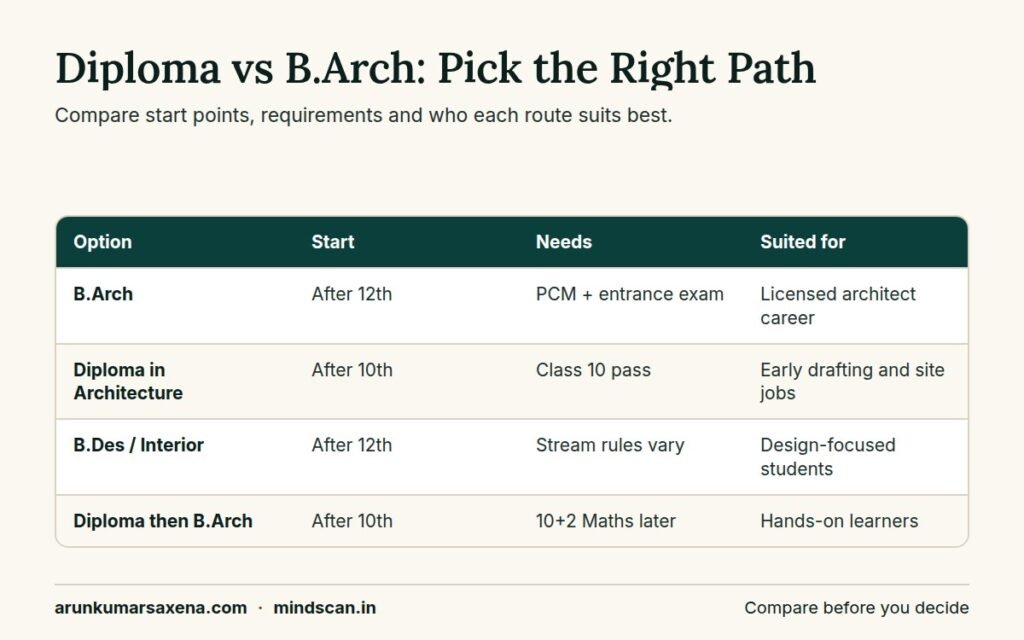
| Option | When you start | What it needs | Best suited for |
|---|---|---|---|
| B.Arch (5-year degree) | After 12th with PCM | PCM with Mathematics plus NATA or JEE Main Paper 2 | Students set on a licensed architect career and willing to invest seven-plus years |
| Diploma in Architecture | After 10th | Class 10 pass | Students who want early job entry in drafting, CAD or site assistance |
| B.Des or Interior Design | After 12th | Stream rules vary; many accept any stream | Design-interested students without PCM who want a creative built-environment career |
| Diploma then B.Arch | After 10th, degree later | Diploma plus meeting the 10+2 Mathematics requirement later | Hands-on learners who want both early work exposure and a long-term architect licence |
The table above lays out the four routes honestly. Notice that three of the four paths still require Mathematics at some stage. Avoiding it now only postpones the reckoning. If you are unsure which column fits you, a free RIASEC career personality quiz can give you a first directional check in approximately ten minutes.
Can PCB students become architects in India?
PCB students cannot become architects in India through the standard B.Arch route because the Council of Architecture requires Mathematics in 10+2. A PCB student who wants to design spaces can enter adjacent fields like interior design, furniture design or a Bachelor of Design programme where stream rules are more flexible.
The window to fix this is narrow. Right after Class 10, a student can still choose PCM or PCMB and keep the B.Arch door open. After Class 11 subject registration closes, adding Mathematics becomes a bureaucratic and academic headache. Picture a PCB student in Class 12 who realises their architecture interest after a school trip to a heritage site. They then have to spend an extra year obtaining a Mathematics qualification through open schooling. It is doable, but it is avoidable.
Mathematics in 10+2 is the gatekeeper subject
No Mathematics, no B.Arch licence. That is the rule, and no college can bend it. If you are even 40% sure about architecture, keep Mathematics in your subject set. Dropping it closes a door that is expensive to reopen.
Interior design and B.Des are alternate doors for non-Maths students
Interior design, exhibition design, set design and B.Des programmes in spatial design accept students from any stream in many colleges. These careers let you shape spaces, work with clients and earn well without the structural-engineering component of architecture. For a PCB student who loves design, this is a smarter pivot than forcing a B.Arch.
Switching or adding Mathematics is easiest right after 10th
The subject selection form you fill in April or May of Class 10 is the lowest-friction moment to secure your architecture eligibility. Once that form is submitted, changing streams or adding Mathematics involves school approvals, board permissions and, often, a gap year. Act now, not after the regret sets in.
How do I know if architecture actually suits me after 10th?
Liking drawing is not the same as being suited to architecture. Architecture demands spatial reasoning, the ability to hold 3D forms in your head and rotate them, patience for long project cycles and comfort with applied mathematics. A student who tops school art class may still find structural design frustrating if their numerical aptitude is low.
Arun Kumar Saxena’s book “3 Steps to Knowing Yourself” teaches that career decisions built on self-knowledge last; those built on peer pressure or a relative’s example usually unravel. In many homes, a Class 10 student picks PCM for architecture because an older cousin is doing it, without ever checking if their own brain works that way. The same aptitude-first logic saves years and lakhs in fees.
Spatial and numerical aptitude matter more than school art grades
NATA and architecture coursework test whether you can think in three dimensions and apply geometry to real structures. These abilities can be measured. The MINDSCAN report maps a student to 20+ career groups, so you can see whether architecture appears among your strong matches before you commit two years of PCM and five years of B.Arch to it.
Self-knowledge before stream choice prevents costly switches
Switching from PCM to Commerce or Humanities in Class 12 costs a year. Switching from B.Arch to another degree in the second year costs two years and several lakhs in fees. A scientific aptitude check done in Class 10 costs a fraction of that and is completed quickly. The maths is simple.
Free RIASEC quiz is a first check; a full assessment gives deeper mapping
Start with the free RIASEC career personality quiz this week. It takes approximately ten minutes and shows whether your interest pattern leans toward realistic, investigative and artistic domains, the three dimensions most relevant to architecture. If the pattern is unclear, a full psychometric assessment like the MINDSCAN AI Career Clarity Report gives you a detailed map across 20+ career groups, so you can see where your strengths fit.

What are the steps to become an architect after 10th in India?
The full roadmap from Class 10 to licensed architect takes roughly seven years. It starts with a subject choice and ends with Council of Architecture registration. Each step builds on the one before it, and skipping ahead, such as starting entrance prep only after boards, creates a scramble that hurts both board marks and entrance scores.
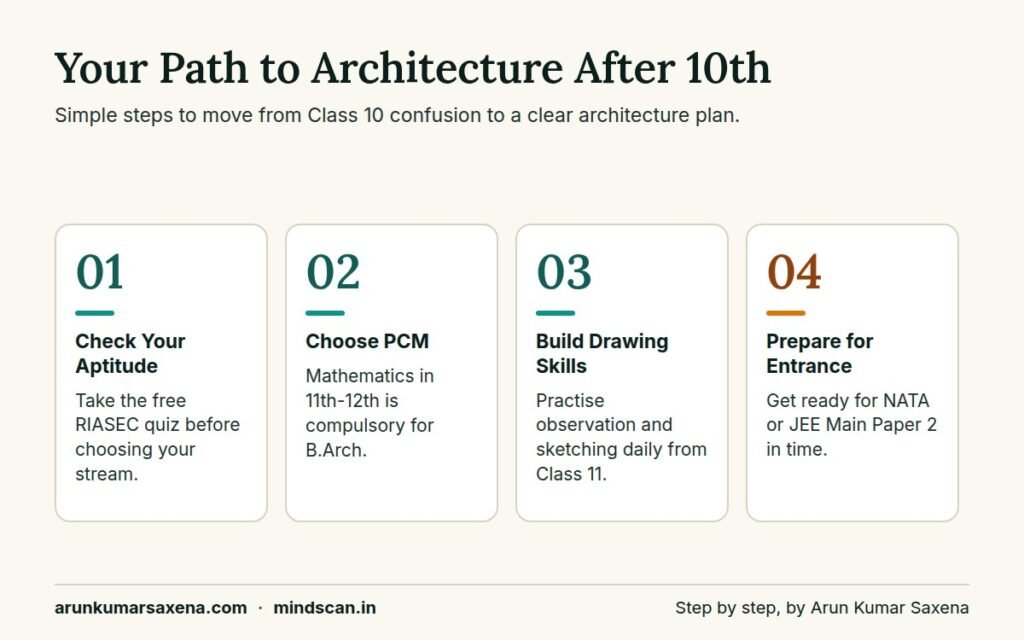
- Check your aptitude honestly. Take the free RIASEC career personality quiz this week and note whether spatial and realistic interests dominate. If the result is unclear, book a psychometric assessment before locking your stream.
- Discuss PCM with your school before Class 11 subject selection closes. Mathematics is the compulsory subject. Confirm that your school offers PCM and that you meet any internal cutoffs for the Science stream.
- Start basic NATA-style drawing and observation practice. Twenty to thirty minutes of daily freehand sketching, perspective drawing and object visualisation is enough at this stage. The goal is habit, not perfection.
- Shortlist three to five architecture colleges. Note whether each accepts NATA, JEE Main Paper 2 or both. This shapes your entrance exam strategy for Class 12. Use the National Career Service portal by the Government of India to cross-check recognised institutions and verify eligibility on the official Council of Architecture or NTA website.
- Visit or talk to one practising architect or senior B.Arch student. Ask about the honest day-to-day reality: studio hours, project revisions, site visits and the gap between college projects and professional work. No brochure will tell you this.
- If unsure after these checks, book a psychometric assessment before locking your stream. The MINDSCAN AI Career Clarity Report maps you to 20+ career groups and shows whether architecture is a strong match or a weak one. A weak match does not mean you cannot do it; it means the road will be harder and the satisfaction lower.
- Set a Class 11 target plan covering boards plus light entrance preparation from day one. Do not wait until Class 12 to open a NATA book. The students who score well in both boards and entrance exams are the ones who spread the load over two years.
For a related roadmap, read my guide on which stream after 10th for fashion designing and see how the aptitude-first approach applies across creative fields. If you are also weighing leadership careers, see my guide on which stream is best for ceo after 10th. The principle is the same: know yourself, then pick the stream.
Is architecture very hard compared to other careers?
Architecture is demanding, but the real question is whether the daily work fits your natural thinking style. A 5-year degree with studio work, long project hours and repeated design revisions is the norm, not the exception. Students with genuine spatial aptitude and a tolerance for iterative work often enjoy the grind, while those who chose it under pressure often struggle and drop out.
Studio culture in B.Arch programmes involves late nights, jury presentations where your work is critiqued in detail, and a workload that does not fit a 9-to-5 rhythm. Mathematics and physics appear in practical forms: calculating load distributions, understanding material stresses, working with building codes. This is applied thinking, not theoretical problem-solving. A student who hated Physics in school may find it far more interesting when tied to a real building.
Studio culture involves long project hours
Architecture studios run on project deadlines that compress time. Students learn to iterate, accept feedback and rework designs multiple times. This process builds resilience in those who are wired for it and burnout in those who are not. The difference is rarely visible in Class 10 marks; it shows up in how a student responds to open-ended problems with no single correct answer.
Mathematics and physics are used practically, not theoretically
You will not be solving abstract calculus problems. You will be calculating whether a beam of a certain material can span a given distance, or how wind loads affect a façade. The maths is real, and it is central to the work. Students who enjoy building things and understanding how they stand up tend to engage with this naturally.
Misfit, not difficulty, causes most dropouts
In my sessions, I see B.Arch dropouts who were good students. Their problem was not intelligence or effort; it was a mismatch between what they expected architecture to be and what it actually demanded. A psychometric check in Class 10 would have flagged that mismatch early and saved them two or three years. If you are also weighing other professional paths, my article on the best stream for law after 10th applies the same fit-before-subject logic to another popular career.
Will architects be in demand in 2030 and beyond?
Demand for architects will continue with urbanisation, infrastructure growth and the push for sustainable design. But the nature of junior-level work is shifting. Design software, parametric modelling and AI-assisted drafting are changing what an entry-level architect does. Pure drafting roles are the most exposed; design thinking, client communication and regulatory knowledge remain human strengths.
Infrastructure projects, smart-city initiatives and green-building mandates are creating new specialisations. Architects who understand energy modelling, vernacular materials or computational design will have an edge. The profession is not shrinking; it is splitting. Routine technical work is being automated, while high-judgement design work is growing. A student entering architecture now should aim for the judgement side of that split.
Infrastructure and urban growth sustain demand
India is urbanising faster than most countries. New housing, commercial complexes, metro stations and public buildings need licensed architects to design and sign off on plans. This baseline demand is not going away. The question is not whether architects will be needed, but which architects will be needed.
Sustainability and computational design are growth areas
Green rating systems, energy codes and climate-responsive design are moving from optional to mandatory. Architects who can model building performance and integrate sustainable systems will be in demand. Students who enter the field now have five to seven years to build these skills before they graduate.
AI affects routine drafting more than licensed design work
AI tools can generate floor plans, optimise layouts and produce renderings faster than a junior drafter. But they cannot take legal responsibility for a building’s safety, negotiate with a client or handle municipal approval processes. The licensed architect’s role, the one that requires the B.Arch and Council of Architecture registration, is protected in ways that pure drafting roles are not.
If you want personalised guidance on whether architecture is the right fit for you, online career counselling with Arun Kumar Saxena gives you a science-backed, honest assessment before you commit your next seven years. You can verify my credentials and approach on my detailed profile page.
Frequently asked questions about which stream is required for architecture after 10th
Is Commerce with Maths okay for architecture?
Commerce with Mathematics builds logical thinking but does not meet the 10+2 PCM requirement that the Council of Architecture mandates for B.Arch admission. Such students should target B.Plan, design or related paths, or explore whether their board allows adding Physics and Chemistry as additional subjects. Check specific college rules before ruling yourself out, but expect that most B.Arch doors will remain closed without PCM.
Do I need to be good at drawing to become an architect?
Basic drawing ability helps for NATA and studio work, but it can be trained. Spatial reasoning and structural understanding matter far more than artistic talent. Students with average sketching skills can excel in architecture when their 3D visualisation and mathematical thinking are strong. The drawing is a communication tool; the thinking behind it is the real skill.
What percentage is needed in Class 12 for B.Arch?
Most B.Arch colleges expect a pass with Mathematics in 10+2, and many list an aggregate benchmark around 50% in the qualifying examination as per online sources. Exact cutoffs vary by college, category and entrance exam score. Always verify the current eligibility criteria on the specific college website or the Council of Architecture portal before applying.
How long does it take to become an architect after 10th?
Roughly seven years: two years of Class 11 and 12 with PCM, followed by the 5-year B.Arch degree, plus a few months for Council of Architecture registration. Entrance exam preparation runs in parallel during Classes 11 and 12, so the timeline is not sequential. A diploma-then-degree path may stretch longer but includes earning years in between.
Can I switch to architecture after 12th without PCM?
The standard B.Arch route requires Mathematics in 10+2, so a student without it cannot apply through NATA or JEE Main Paper 2. Alternatives include pursuing a diploma in architectural assistantship, exploring B.Des or interior design programmes, or checking whether your board or open schooling allows you to add Mathematics as an additional subject after 12th. Each option adds time, so choose carefully.
What is the difference between NATA and JEE Main Paper 2?
Both exams qualify students for B.Arch seats. NATA is the architecture-specific aptitude test conducted by the Council of Architecture and is accepted by most private and state colleges. JEE Main Paper 2 is conducted by the NTA and is the gateway to architecture seats at NITs, SPAs and other centrally funded institutions. Students often prepare for both to maximise college options, as the drawing and aptitude sections overlap significantly. For official eligibility details, check the Council of Architecture or NTA website.
What is the salary of a B.Arch architect in India?
As per online sources, a fresh B.Arch graduate in India can expect a starting salary of approximately ₹3 lakh to ₹5 lakh per year. With five to ten years of experience and a strong portfolio, this can grow to approximately ₹8 lakh to ₹15 lakh per year. Senior architects, partners in firms, or those running their own practice earn significantly more, but income depends heavily on specialisation, city and project scale.
हिंदी में जवाब: 10वीं के बाद आर्किटेक्चर के लिए कौन सी स्ट्रीम चाहिए?
10वीं के बाद 11वीं में कौन-कौन से सब्जेक्ट होते हैं?
10वीं के बाद 11वीं में साइंस स्ट्रीम में फिजिक्स, केमिस्ट्री और मैथ्स (PCM) या बायोलॉजी (PCB) का विकल्प होता है। आर्किटेक्चर के लिए PCM अनिवार्य है क्योंकि काउंसिल ऑफ आर्किटेक्चर 12वीं में मैथ्स को ज़रूरी मानती है। कॉमर्स और आर्ट्स में भी विषयों के अलग-अलग समूह होते हैं, लेकिन B.Arch का रास्ता केवल PCM से खुलता है।
10वीं के बाद कौन सी परीक्षा देनी चाहिए?
10वीं के बाद सीधे कोई आर्किटेक्चर प्रवेश परीक्षा नहीं होती। 11वीं और 12वीं PCM के साथ पूरी करने के बाद NATA या JEE Main Paper 2 देनी होती है। NATA मुख्य आर्किटेक्चर एप्टीट्यूड टेस्ट है, जबकि JEE Main Paper 2 से NIT और SPA जैसे संस्थानों में दाखिला मिलता है। दोनों की तैयारी 11वीं से शुरू करना सही रहता है।
12 वीं के बाद सबसे अच्छा कोर्स कौन सा है?
12वीं PCM के बाद B.Arch सबसे सीधा और लाइसेंस्ड आर्किटेक्ट बनने का रास्ता है। यह लगभग 5 साल का डिग्री कोर्स है जिसके बाद काउंसिल ऑफ आर्किटेक्चर में रजिस्ट्रेशन कराना होता है। जिन छात्रों की रुचि डिज़ाइन में है लेकिन मैथ्स नहीं है, उनके लिए B.Des या इंटीरियर डिज़ाइन बेहतर विकल्प हो सकते हैं। कोर्स से पहले अपनी एप्टीट्यूड की जाँच ज़रूर करें।
Science में सबसे अच्छी नौकरी कौन सी है?
साइंस में सबसे अच्छी नौकरी वह है जो आपकी रुचि, योग्यता और व्यक्तित्व से मेल खाती हो। आर्किटेक्चर, इंजीनियरिंग, मेडिसिन, डेटा साइंस और बायोटेक्नोलॉजी सभी में अच्छे अवसर हैं, लेकिन हर क्षेत्र की अपनी माँगें हैं। केवल सैलरी या ट्रेंड देखकर फैसला लेने के बजाय साइकोमेट्रिक असेसमेंट से अपनी सही दिशा पहचानें।
Choosing which stream is required for architecture after 10th is the first of many decisions on a seven-year path. The subject rule is clear: Science with PCM and Mathematics. The harder question, the one that determines whether those seven years feel like a grind or a calling, is whether architecture actually fits you. A scientific aptitude check done now is a small investment compared to the cost of a wrong stream choice.
If you want a data-verified answer instead of guesswork, start with the MINDSCAN AI Career Clarity Report at ₹1,499, or the report with a counselling session at ₹2,999. It maps you to 20+ career groups so you can see where your strengths fit. When you are ready to talk through the results, book an online career counselling session and we will build a roadmap that matches your strengths, not someone else’s story.