
Indian Entrance Exams: The Complete 2026 Guide for Students
By Arun Kumar Saxena, Certified Advanced Career Coach · Updated November 2026
Quick answer: Indian entrance exams are national, state and university-level tests such as JEE, NEET, CUET, CLAT, CAT and NDA that gate admission to engineering, medical, law, management, design and defence courses. The right exam depends on your stream and career fit, not on which exam is most popular.
Indian entrance exams decide which college, course and career a student can enter, yet most students pick an exam before they pick a career. This page helps Class 10, 11 and 12 students and their parents understand the major exams, compare their levels, and choose the right ones after checking real aptitude. With 22 years of experience and 20,000+ students and professionals guided, I have seen that the costliest mistake is not a failed attempt but a wrong exam chosen under pressure.
Whether you are targeting engineering, medical, law, design, defence or central universities, this guide gives you a fit-first decision framework for Indian entrance exams. It covers JEE, NEET, CUET, CLAT, NATA, NID DAT, UCEED, NDA and state CETs, plus what to do if you keep failing one exam. You can also book online career counselling in India with Arun Kumar Saxena for a personalised roadmap.
Table of Contents
What are the major Indian entrance exams after 12th?
After 12th, the major Indian entrance exams are JEE Main for engineering, NEET UG for medical, CUET UG for central universities, CLAT for law, NATA for architecture, NID DAT and UCEED for design, and NDA for defence. Each maps to a specific stream and career family, so students should shortlist by goal first.
Many students start with a list of Indian entrance exams and then look for a career that fits the list. That is backwards. A better approach is to name the career family first, then identify the two or three exams that open its doors. This prevents the common situation of a student preparing for JEE for two years only to discover an interest in design or law.
- Engineering: JEE Main, JEE Advanced, BITSAT, state CETs like MHT CET and WBJEE, and university tests like VITEEE and SRMJEE.
- Medical: NEET UG is the single national exam for MBBS, BDS, AYUSH and allied courses.
- Law, design and defence: CLAT, NID DAT/UCEED and NDA cover these career families.
- Central universities: largely admit through CUET UG across science, arts and commerce.
Why stream-wise clarity matters more than a long exam list
Competitor pages list every Indian entrance exam but rarely tell a student which list applies to them. A PCM student does not need the full CLAT syllabus, and a humanities student does not need NEET physics. Stream-wise clarity saves months of scattered preparation and helps parents stop comparing children at the dinner table.
If you are still deciding between streams, read this guide on engineering vs medical after 12th before locking your exam calendar.
Which is the best engineering entrance exam in India?
JEE Main is the most widely accepted engineering entrance exam, opening doors to NITs, IIITs and qualifying for JEE Advanced for IITs. But ‘best’ depends on your target: BITSAT fits BITS campuses, state CETs fit home-state colleges, and private tests like VITEEE fit specific universities.
Calling one exam the best is a marketing habit. The honest answer is that the best exam is the one that leads to the institute and branch you can realistically enter and afford. JEE Main matters for nationally funded institutes. State CETs often offer lower competition for good in-state seats. University tests give you a clear single-institute target.
- JEE Main is the gateway exam; JEE Advanced is only for IIT aspirants who qualify.
- BITSAT, VITEEE, SRMJEE and MET are university-specific options.
- State exams such as MHT CET, WBJEE and COMEDK offer strong in-state engineering seats.
- BTech admission is possible without JEE through state CETs, private university tests and some merit-based routes.
What are the top 5 government exams after 12th?
After 12th, the top government exams are NDA for defence, SSC CHSL for clerical posts, banking exams for eligible positions, state police and clerical exams, and railway recruitment tests. Degree-level government jobs need graduation first, so many students pair a degree with entrance exam preparation.
For a wider look at exams for government jobs after 12th, the defence and civil routes are covered separately.
Which is the entrance exam for MBBS in India?
NEET UG is the single national entrance exam for MBBS, BDS, AYUSH and allied medical courses in India. There is no separate state or private MBBS exam; every medical aspirant must clear NEET UG, which the National Testing Agency conducts.
Because NEET UG is the only medical doorway among Indian entrance exams, it carries enormous pressure. Families treat it as a prestige exam rather than a fit exam. That pressure produces droppers who repeat the exam without ever checking whether medicine suits them.
- NEET UG covers MBBS, BDS, BAMS, BHMS and allied medical admissions.
- Families often wait for the exam date announcement before starting serious preparation, which is a costly mistake.
- Aptitude should be verified before committing to repeated NEET attempts.
“Most families wait for the date to be announced before they press the accelerator, and that is a huge mistake. When you know you have to appear for NEET, there is no point waiting for the date announcement to shift into top gear. Every day counts, and lakhs of students are preparing. In this scenario, it is not every day but every minute, planned strategically, that gives you an edge over others.” (Arun Kumar Saxena)
What most guides miss: the NEET decision is an aptitude decision before it is a marks decision
Most pages explain the NEET syllabus and cut-offs but never ask whether the student should be attempting NEET at all. In my sessions, I repeatedly see NEET aspirants who chose medicine because a relative is a doctor or because the family wanted a doctor in the house. They spend two or three years chasing a seat while their actual strengths sit unused in another field.
Before you commit to repeated attempts, verify two things: your genuine interest in patient care and daily clinical work, and your aptitude for biology, chemistry and physics under timed pressure. If both are weak, no number of attempts will fix the mismatch. A psychometric assessment or a structured counselling session settles this with data instead of family pressure.
Can I get BTech admission without JEE?
Yes. BTech without JEE is possible through state CETs like MHT CET and WBJEE, private university exams like BITSAT, VITEEE and SRMJEE, and merit-based admission at some institutes. JEE is not legally mandatory for an engineering degree; it matters mainly for NITs, IIITs and IITs.
This is one of the most searched questions from Indian entrance exams, and the answer surprises many parents. An engineering degree from a recognised university does not require a JEE rank. JEE is a selection tool for a specific set of institutes, not a legal licence to study engineering.
- State CETs serve students targeting engineering colleges within their own state.
- Private university tests open BTech seats independent of JEE scores.
- Diploma-to-degree lateral entry routes exist for polytechnic students.
If you are exploring engineering entrance exams apart from JEE Main, check the application windows for BITSAT, VITEEE, SRMJEE and your state CET. Many open approximately between November and March, and missing one window can cost a full year.
Which Indian entrance exam should I choose for my career?
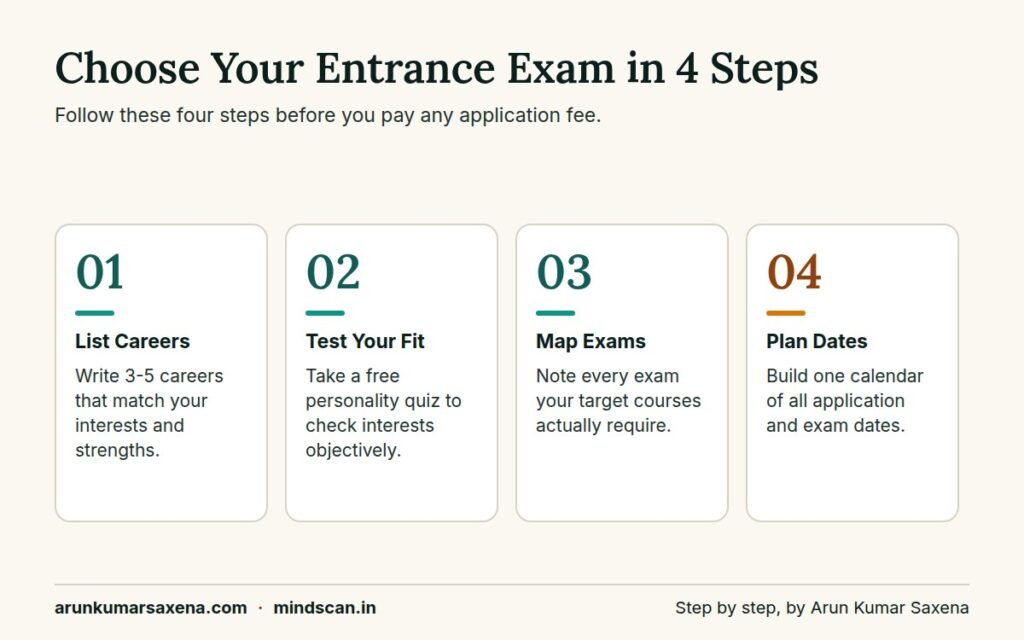
Choose the exam after choosing the career, not before. List the careers that genuinely fit your aptitude and interests, check which courses lead there, and only then shortlist the Indian entrance exams those courses require. A free RIASEC personality quiz or a psychometric assessment can settle the fit question objectively.
Most students do the reverse. They hear that JEE or NEET is prestigious, start preparing, and only later ask what career the exam leads to. That is like buying a train ticket before deciding the destination.
- Career choice first, exam second; the exam is only a doorway.
- Self-knowledge comes before any career choice, as Arun Kumar Saxena’s book ‘3 Steps to Knowing Yourself’ explains.
- A mismatch discovered after two failed attempts costs years; testing fit early costs hours.
Use the free RIASEC career personality quiz to check your interests before committing to any exam. For a deeper, step-by-step process, see how to choose the right career after 12th.
A simple three-question test before you pick any exam
Before you shortlist any Indian entrance exam, answer three questions honestly. One: Would I still want the destination career if the exam did not exist? Two: Do my strongest subjects match the subjects this exam tests? Three: Can I picture the daily routine of the career, not just the college admission day? If any answer is no, pause and re-check the fit. This test takes approximately ten minutes and can save two wasted years.
How do national, state and university-level entrance exams differ?
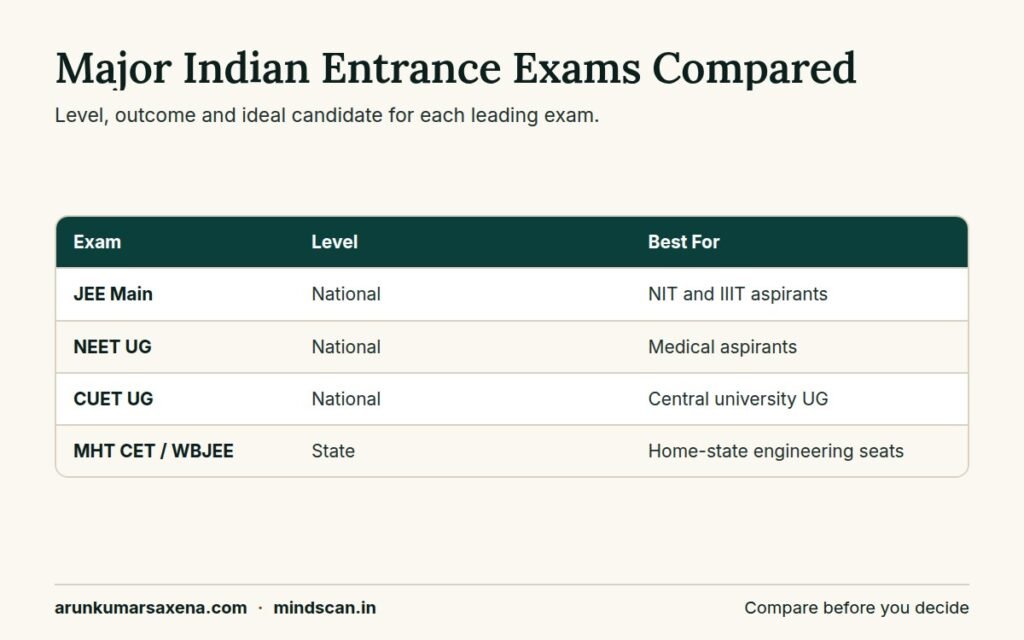
National exams (JEE, NEET, CUET, CLAT) are accepted across India and conducted centrally. State exams (MHT CET, WBJEE) mainly serve colleges within one state and often favour state residents. University-level exams (BITSAT, VITEEE) admit students only to that university’s campuses.
Understanding this difference changes your strategy for Indian entrance exams. A student who wants a good college in Maharashtra may find MHT CET more practical than JEE Main. A student fixed on BITS Pilani needs BITSAT and nothing else. A student who wants maximum institute choice across India targets national exams.
- National exams offer the widest choice of institutes.
- State CETs can be a lower-competition route to good state colleges.
- University exams mean one application controls one institution’s seats.
| Exam | Level | Leads To | Best For |
|---|---|---|---|
| JEE Main | National | BTech, BArch | NIT, IIIT and IIT aspirants |
| NEET UG | National | MBBS, BDS, AYUSH | Medical aspirants |
| CUET UG | National | Central university UG courses | Science, arts and commerce students |
| CLAT | National | BA LLB at NLUs | Law aspirants |
| MHT CET / WBJEE | State | State engineering seats | Students targeting home-state colleges |
JEE Main, NEET UG, CUET UG and CLAT are the four national-level Indian entrance exams covering engineering, medical, central university and law admissions respectively; MHT CET and WBJEE are state-level and BITSAT and VITEEE are university-level.
When should I start preparing for entrance exams in India?
Ideally from Class 11, because syllabus overlap with boards makes early preparation efficient. For highly competitive exams like NEET and JEE, most successful candidates treat Class 11 as the real starting line. Waiting for official notifications before starting is the most common and most damaging mistake.
Starting early does not mean joining a coaching institute in Class 8. It means knowing your target Indian entrance exam early so every study hour counts twice, once for boards and once for the entrance. Students who decide late often study the same topics twice without depth.
- Start career counselling from Class 8 onwards so stream and exam choices are informed.
- Knowing your target exam early lets every study hour count twice, for boards and the entrance.
- List three to five careers that genuinely interest you and match your strengths.
- Take a free career personality quiz to check your interests objectively against those careers.
- Identify the courses and colleges that lead to your top careers.
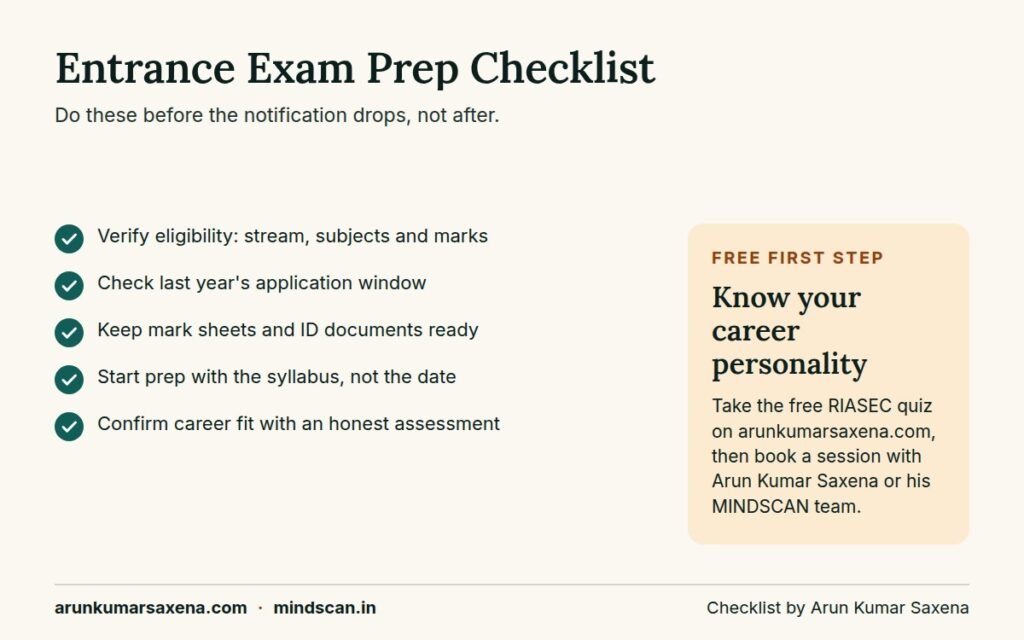
- Note every entrance exam those colleges require, with last year’s application window.
- Check eligibility for each exam (stream, subjects, minimum marks) against your record.
- Make a single calendar of application dates and exam dates so nothing is missed.
- Start preparation now, not when the notification drops; every planned minute counts.
What if I keep failing my entrance exam after multiple attempts?
Judge the gap between your marks and the marks needed for a seat. If scores improve each attempt and the gap is narrowing, another attempt is reasonable. If the gap is big and not closing, switching fields is the honest move; one failed exam route never ends a career.
Repeating an Indian entrance exam is not a character flaw, but repeating without analysing the gap is a planning failure. Two attempts with flat or widening gaps is a clear switch signal. The goal is a career, not a particular exam.
- A psychometric assessment can confirm whether the field itself was a mismatch.
- A MINDSCAN report maps the student to 20+ career groups, revealing alternatives beyond the single exam.
“One NEET aspirant who could not make it in her last two attempts reached out to me in a gloomy state. Her parents were equally worried and sad. When I examined her last two scores, I found the gap to fill was huge. There was a big gap between expectation and reality. I conducted a psychometric assessment for her, and it confirmed my apprehension: she wasn’t the right fit for medicine.
When I grilled her a little about where her inspiration for medicine came from, I found that she admired her aunt, who is a doctor, and therefore wanted to become one too. After two rounds of consultation, she herself realised that clearing NEET was demanding much more than she could offer. Today she is happily doing a B.Sc. in Biotechnology, with career clarity and a roadmap.” (Arun Kumar Saxena)
For a detailed profile of the coach behind this approach, visit Arun Kumar Saxena. You can also verify official exam notifications on the Ministry of Education, Government of India, the National Testing Agency for JEE Main and NEET UG notifications, and explore career options on the National Career Service portal.
Frequently asked questions about indian entrance exams
Which are the toughest entrance exams in India and the world?
As per online sources, the toughest Indian exams are generally considered UPSC Civil Services, JEE Advanced and NEET UG, due to vast syllabi and extreme competition. As per online sources, JEE Advanced and NEET UG frequently appear in global ‘toughest exams’ lists alongside UPSC Civil Services. Difficulty is relative: an exam is only hard for those pursuing it without aptitude or preparation strategy.
How many entrance exams can I take after 12th?
There is no cap; students can appear for multiple Indian entrance exams in the same year, as long as dates do not clash and they meet eligibility. Most counsellors advise a focused shortlist of two to four exams, because scattered preparation usually weakens all of them.
Is CUET compulsory for admission to central universities?
CUET UG is the standard route into central and participating universities for undergraduate courses across streams. Some private and state institutions still use their own exams or merit lists, so students should confirm requirements for each target university.
Which government exams can I take after 12th?
After 12th, students can target NDA for defence, SSC and banking exams for eligible posts, state police and clerical exams, and railway recruitment tests. Degree-level government jobs need graduation first, so many students pair a degree with entrance exam preparation.
Do entrance exam scores matter after graduation?
Yes; postgraduate and career entrances include GATE for M.Tech and PSU recruitment, CAT, XAT, NMAT and MAT for MBA, IIT JAM for M.Sc., CLAT for LLM and CUET PG. Planning your degree with the next entrance in mind keeps postgraduate options open.
How do I know if an exam-based career actually suits me?
Check three things honestly: your aptitude for the subjects tested, your genuine interest in the destination career, and whether the daily reality of that career appeals to you. A psychometric assessment or a structured career counselling session verifies this with data instead of family pressure or peer trends.
What documents and eligibility rules should I check before applying?
Before applying, verify age limits, qualifying stream and subjects, minimum board marks, category-based relaxations, and document requirements such as mark sheets and ID. Reading the official notification for each Indian entrance exam prevents wasted fees and disqualification at the counselling stage.
हिंदी में जवाब: भारतीय प्रवेश परीक्षाएं: छात्रों के लिए पूरी गाइड
10वीं के बाद कौन सी परीक्षा देनी चाहिए?
10वीं के बाद सीधे कोई बड़ी प्रवेश परीक्षा नहीं होती, लेकिन स्ट्रीम का चुनाव सबसे महत्वपूर्ण है। विज्ञान, वाणिज्य या कला में से जो विषय आपकी रुचि और योग्यता से मेल खाते हों, वही चुनें। अरुण कुमार सक्सेना कहते हैं कि कक्षा 8 से ही करियर परामर्श शुरू करना चाहिए ताकि 11वीं और 12वीं में सही परीक्षा की तैयारी हो सके।
12 वीं के बाद सबसे अच्छा कोर्स कौन सा है?
12वीं के बाद सबसे अच्छा कोर्स वही है जो आपकी योग्यता, रुचि और भविष्य के लक्ष्य से मेल खाता हो। इंजीनियरिंग के लिए JEE Main, मेडिकल के लिए NEET UG, कानून के लिए CLAT और केंद्रीय विश्वविद्यालयों के लिए CUET UG मुख्य परीक्षाएं हैं। अरुण कुमार सक्सेना सलाह देते हैं कि पहले करियर चुनें, फिर परीक्षा।
Indian entrance exams are only doorways. The career behind the door is what you will live for decades. Do not choose a doorway because it looks prestigious from outside. Choose it because it opens into a room where your strengths and interests can actually work. If you are unsure which doorway is yours, book online career counselling in India and get a personalised, data-verified roadmap.
Start with the MINDSCAN AI Career Clarity Report at ₹1,499, or add a counselling session for ₹2,999. The report maps you to 20+ career groups, so you stop guessing and start preparing for the right exam with confidence.